A woman in her sixties once stared at me for eleven straight stops. Not glaring, not angry — just watching, the way you’d watch weather. I hadn’t done anything wrong that I could tell. I wasn’t on the phone, wasn’t eating, wasn’t spread across two seats with a backpack taking up a third. Eventually I realized what it was: I’d sat down in a nearly empty subway car, chosen a seat at random, and it happened to be one seat away from the pink priority section. Close enough that she was quietly deciding whether I understood the invisible fence around it. I did, actually. But apparently not well enough to sit a safe two-seat buffer away, which — I would later learn — is its own unwritten sub-rule that nobody puts on a sign.
Nobody hands you a rulebook for Korean subway etiquette. There’s no laminated card, no orientation video for foreign residents, no HR module titled “Subway Behavior 101.” You absorb it by getting quietly, mortifyingly wrong in public, usually more than once, until the pattern clicks. I’ve been riding Seoul’s subway system for years now, and I still occasionally discover a rule I didn’t know existed — usually because I just broke it.
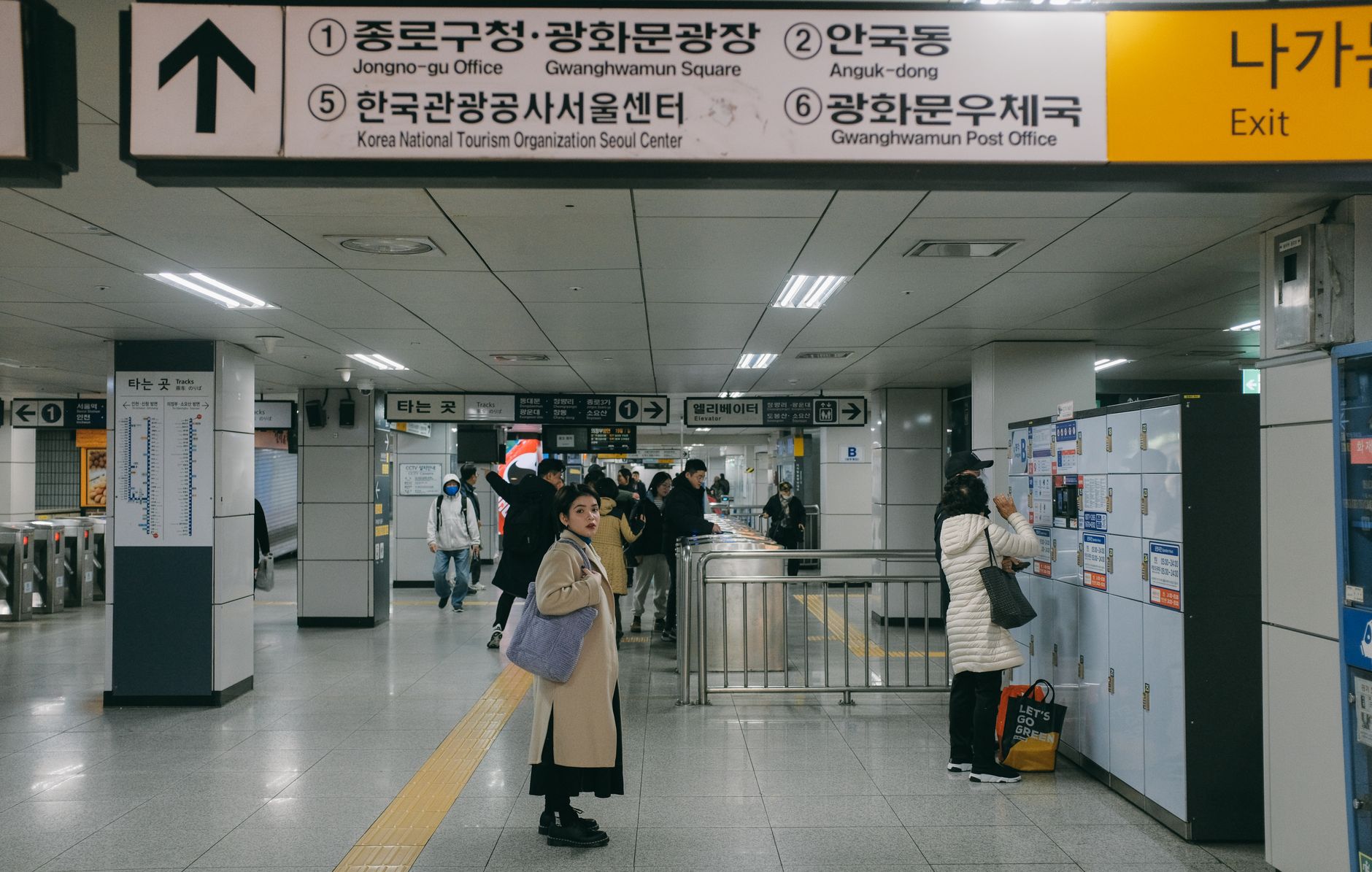
The Pink Seats Are Not Actually About You
You’d think the pink seats — the pregnancy priority seats, distinct from the general priority seating near the doors — would be simple: pregnant women sit there, everyone else doesn’t. And functionally, that’s correct. But the deeper rule, the one that took me embarrassingly long to absorb, is that Koreans generally won’t sit there even when the car is empty at midnight and the seat is objectively just a seat. I used to think this was performative. Surprisingly, it isn’t, or at least not entirely. A friend explained it to me this way: the point isn’t that you personally will get caught misusing it. The point is that leaving it empty is the whole mechanism. If everyone treats the seat as occupied-by-default, then a pregnant woman who isn’t visibly showing yet — first trimester, say, when nothing looks different but everything feels different — never has to have the awkward conversation of asking someone to move. The seat does the asking for her, silently, all day, every day. Once I understood that the empty seat is doing work, not sitting idle, I stopped seeing it as an odd taboo and started seeing it as a pretty elegant piece of social engineering.
While the pink seats run on that strict, almost invisible logic, the general priority seats near the train doors operate on a slightly looser wavelength — usually a different color scheme, sometimes yellow or orange depending on the line, with more real-world flexibility built in. Elderly riders, people with disabilities, pregnant passengers, and anyone visibly injured take precedence, and younger riders will often stand near those seats without ever sitting down, treating the whole four-seat cluster as reserved airspace even on a packed rush-hour train at Gangnam station. To my surprise, this holds up even when standing is genuinely uncomfortable — I’ve watched people choose to stand through a 40-minute commute rather than take an open priority seat, on a train so full that the physics of not falling over required real effort.
Silence Isn’t Awkward. Silence Is the Room’s Whole Personality.
Back home, silence on public transit usually reads as tension — like something’s wrong, or everyone’s avoiding eye contact after an argument. Here, silence is just the default operating mode, and it took me a while to stop reading it as coldness. A subway car in Seoul, even one packed shoulder to shoulder during evening rush hour out of Sindorim or Jamsil, can be startlingly quiet. Not silent-silent — there’s the mechanical hum, the announcement chimes, someone’s earbuds leaking a K-pop bassline two seats over — but conversational volume drops to something close to a library register. Groups of friends will lean in and murmur rather than project. It’s not enforced by any conductor. It’s enforced by the mild, collective discomfort everyone feels when one person breaks it.
You’d assume this makes the subway feel sterile or tense, and for the first few months, it kind of did, to me. I’m not a naturally quiet person. But the strange part is how quickly the norm reprograms you. Now when I visit another country and hear a subway car full of people laughing loudly, playing music through a phone speaker, or having a full-volume argument about weekend plans, it’s the loud version that feels foreign to my ear, not the quiet one. That reversal genuinely surprised me the first time I noticed it happening.
The Phone Call Nobody Wants to Hear
Texting, scrolling, watching a show with headphones in — all completely normal, nobody blinks. Taking an actual voice call, though, is where the temperature in the car visibly drops. You’ll see people glance up, not with hostility exactly, more like the collective flinch you’d give a car alarm. Most Koreans, if their phone rings on the subway, will either let it go to voicemail, answer just to whisper “call you back,” or duck toward the space between cars — that narrow, bumpy accordion connector most people ignore, where the floor plates shift under your feet and the rail noise is loud enough to swallow half a sentence — to actually talk. I didn’t understand why that connector space even existed functionally until I saw a middle-aged man stand there for two full stops, one hand braced on the wall to keep his balance, half-shouting into his phone about, from what I could piece together, a delayed shipment. It’s a terrible place to have a conversation. That’s precisely why it works as one — the discomfort is the point, a built-in incentive to keep it short.
I’ll admit I broke this rule constantly during my first year, mostly out of habit rather than defiance. Back home, taking a call on the train was unremarkable. Here, it read as either clueless-foreigner or mildly self-important, and probably both. Nobody ever said anything to me directly — that’s not really how it works — but I could feel the seat next to me stay empty a beat longer than usual, or catch someone’s eyes flick toward me and away. That nonverbal feedback loop turned out to be more effective at correcting my behavior than any scolding would have been.
Eating on the Subway: The Tuna Gimbap Line
Here’s where a lot of newcomers trip up, because eating in public is genuinely common in Korea — street food stalls, convenience store tables, people finishing a triangle kimbap on a park bench. So it’s a reasonable assumption that eating on the subway would be fine too. It is not, and the reaction to it is sharper than almost anything else on this list. A gimbap roll, a bag of chips, even something as low-smell as a granola bar tends to draw disapproving looks, and full meals are essentially unthinkable. The reasoning, once you ask around, comes down to enclosed shared space and smell — a crowded, air-conditioned or heated subway car traps food odor in a way an open street stall never does, and thirty strangers stuck breathing someone else’s tuna gimbap for four stops is apparently the line nobody wants to cross. Drinks are where the exception actually lives, and it’s a fairly specific exception: a takeout coffee in one of the ubiquitous plastic-lidded cups, or a sealed bottle of water, draws no reaction at all, precisely because it has no smell and no risk of spilling into someone’s coat. Anything that involves unwrapping, chewing, or an actual smell profile does not get the same pass.
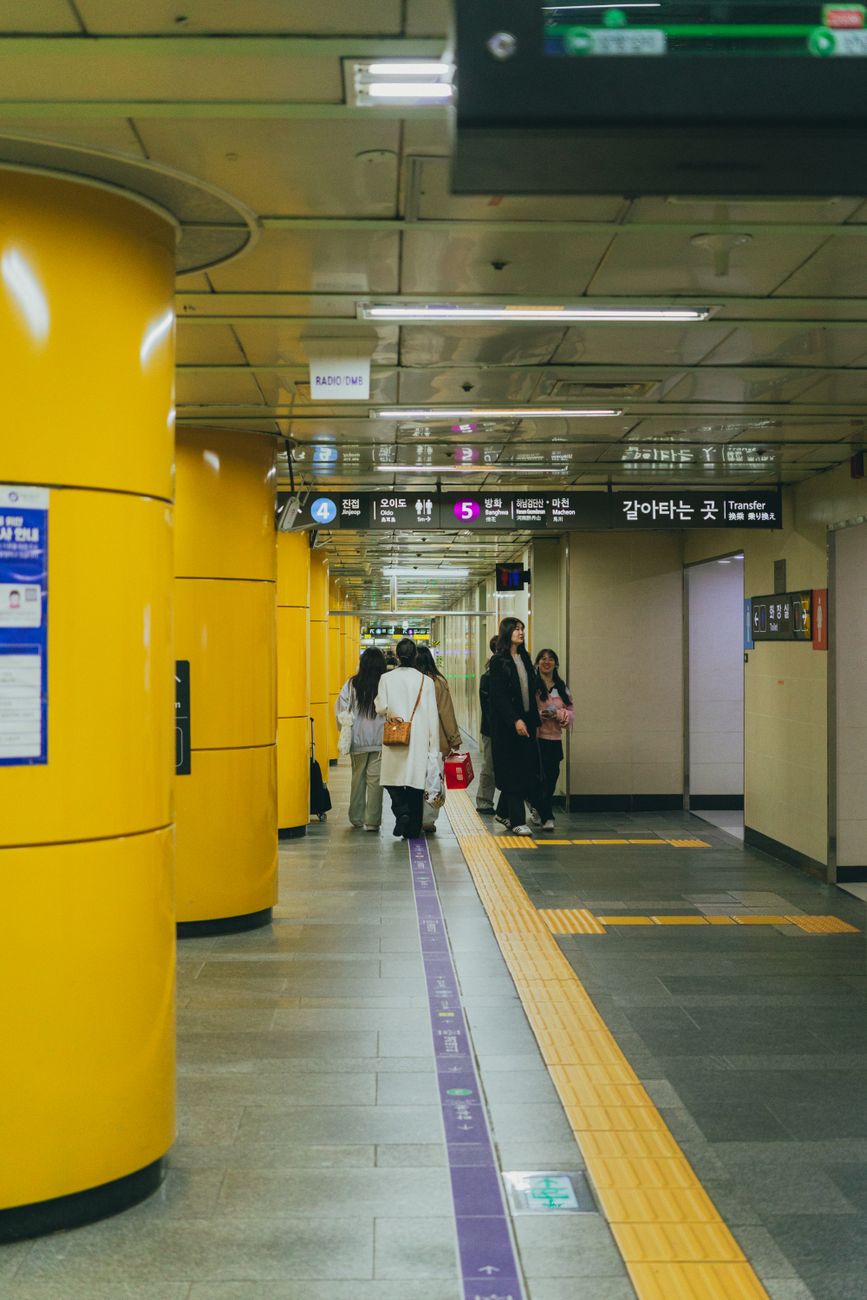
Line-Up Culture: The Floor Markings Are Not a Suggestion
Most Seoul subway platforms have painted arrows or footprint markings showing exactly where to stand and which direction to move once the doors open — step to the side, let people off first, then board. You’d think, with the sheer volume of daily riders, that this system would collapse into chaos the moment the platform gets crowded. Turns out, it mostly doesn’t, and that’s honestly one of the more impressive pieces of collective choreography I’ve watched in daily life here. At a transfer-heavy station like Express Bus Terminal or Gyodae, where three lines cross and rush hour turns the platform into a genuine crowd, people still largely queue to the sides of the doors rather than mob the center. Still, it’s not flawless — tourists unfamiliar with the markings, or a distracted local staring at their phone, will occasionally stand dead center and get gently, wordlessly nudged aside by the flow of the crowd itself, no words exchanged, just body language doing the correcting.
Rush Hour: The Etiquette Doesn’t Disappear, It Compresses
Between roughly 7:30 and 9 on a weekday morning, especially on lines running through major job centers, the normal rules don’t get suspended so much as squeezed into a smaller space. Personal space, already a flexible concept, basically stops existing — Seoul’s Line 2 and Line 9 routinely run well past their rated passenger capacity during the morning peak, packed to a density where you can lift both feet off the floor for a second and not actually go anywhere, held upright by the crowd itself. You’d expect that kind of crush to produce constant friction — shoving, complaints, at minimum a lot of muttered irritation. Surprisingly, it mostly doesn’t. There’s an unspoken understanding that everyone is equally trapped in the same standing-room sardine tin, so getting visibly upset about incidental contact reads as overreacting rather than justified. People angle their bodies sideways to make marginally more room, hold their bags against their chest instead of on their back, and generally do a dozen small adaptations that reduce friction without a word being spoken. I’ve been pressed so tightly against strangers on the Line 2 loop near Sindorim that conversation would’ve been physically awkward even if the silence rule didn’t already apply. Nobody seemed bothered. It was just Tuesday.
Transfer Stations: Following the Color, Not the Crowd
Transfer stations are where a lot of visitors, and honestly some longer-term residents too, quietly panic. Places like Sindorim, Dongdaemun History & Culture Park, or Gyodae stack multiple lines with overlapping color codes, sometimes requiring a walk of several minutes and multiple staircases just to reach the connecting platform. The instinct is to follow the crowd, assuming everyone around you is headed the same way. That instinct is wrong more often than you’d expect, because a crowd at a transfer station is usually a merge of several different destinations, not one. The more reliable method — and this took me embarrassingly long to adopt — is to trust the color-coded signage and line numbers overhead rather than the herd, and to build in a couple of extra minutes at any station with three or more connecting lines. It’s a small planning habit, similar in spirit to the timing adjustments I mentioned in an earlier post about navigating Seoul’s less obvious neighborhoods, where knowing the unglamorous logistics mattered more than knowing the landmarks.
Frequently Asked Questions
If you’re still working out how these unwritten rules actually play out in real situations, here are a few scenarios that come up constantly for foreign residents and visitors alike.
What happens if a foreigner accidentally sits in a pink priority seat? In practice, almost nothing dramatic. Nobody is likely to confront you directly. You might notice sideways glances, or an older passenger hovering nearby without asking you to move, which is itself the social cue to get up. The safest habit is simply treating those seats as off-limits by default, the same way locals do, rather than waiting for a clear signal that it’s not okay.
Is it really that big a deal to eat a small snack, like a granola bar, on a short two-stop ride? Short answer: it’s a smaller deal than a full meal, but it’s still noticed. On a nearly empty late-night train, you’ll likely get away with it without comment. On a packed morning commute into a station like City Hall, unwrapping anything with a smell tends to draw visible discomfort from the people standing closest to you, even if nobody says a word.
I got a phone call during rush hour and couldn’t avoid answering — was I supposed to just ignore it? Not necessarily. The norm isn’t “never answer,” it’s “don’t hold a conversation.” Answering briefly to say you’ll call back, or stepping toward the door connector for anything longer, covers most situations without drawing much attention.
The Quiet Logic Underneath It All
None of these rules are written down anywhere official, which is exactly what makes them disorienting at first and, eventually, kind of remarkable. They’re enforced entirely through shared expectation and mild social discomfort, and somehow that turns out to be a more effective enforcement mechanism than any announcement system could be. I still get things wrong occasionally — I doubt that ever fully stops for a foreign resident, no matter how many years pile up. But there’s something worth noticing in a system that runs this smoothly on nothing but collective agreement and the quiet fear of standing out. You don’t have to love every rule to respect how well the whole thing functions once you actually understand what each one is protecting.
Leave a Reply