The first time I heard the siren, I grabbed my laptop, my passport, and one shoe before I even registered what was happening. It was 2 p.m. on the 15th of the month, and outside my window in Mapo-gu, absolutely nobody else was panicking. A man kept sweeping his storefront. Two ajummas kept talking about radishes. I stood there with one shoe on, feeling like the only person who hadn’t gotten the memo, which, as it turned out, was exactly the point. That was my introduction to Korea’s civil defense drill, and it is still one of six things that rearranged how I think about this country, even years into calling it home.
1. Civil defense drills that nobody treats as an emergency
You’d expect a national siren test to cause at least a little commotion — a few confused tourists, some honking, maybe a dog losing its mind. Instead, what I got was near silence. The Minbang app on my phone buzzed with a notice, the loudspeakers outside did their thing for about fifteen minutes, and life underneath it just kept going, like the drill was weather rather than an emergency. I asked my coworker Ji-eun about it over lunch near Hongik University, half expecting her to explain some deep cultural stoicism. She just shrugged and said, “We’ve done it since we were kids, it’s like a fire alarm at school, nobody really reacts.” I’ll admit that answer undersold how impressive the system actually is — apartment complexes here run their own evacuation drills too, and mine, an 18-story building near Sinchon, had a full stairwell walk-down in April with building staff at every landing checking names off a clipboard. Nobody complained about the inconvenience. They just filed down twelve flights like it was a mildly annoying errand. It wasn’t until later, reading up on it, that I connected the dots — a lot of this drill infrastructure, and the seriousness with which schools and workplaces now run their own safety trainings, tightened considerably after the Sewol ferry disaster in 2014. That context reframed the whole thing for me. The calm isn’t indifference. It’s what a society looks like after deciding, collectively, that this stuff has to actually work rather than just exist on paper.
2. Hair salons on every corner, and somehow all of them survive
You might assume that in any city, salons cluster the way coffee shops do, one every couple of blocks, tasteful spacing. Walk down a single stretch of Yeonnam-dong, though, between the park and the rail-line walking trail, and you’ll pass seven — I counted, more than once, mostly out of disbelief — within about 200 meters. Not barbershops repurposed with a sign; full salons, multiple chairs, hair models smiling from posters in the window, prices for a men’s cut hovering around 20,000 to 25,000 won. My first thought was that half of them had to be fronts for something else, because the math didn’t seem to work. It does work, somehow. Koreans get haircuts more often than I ever did back home — every four to six weeks seems standard rather than aspirational — and there’s a level of finish, the blow-dry, the styling gel application, the little consultation about your face shape, that turns a basic cut into something closer to a service industry than a chore. I still haven’t fully adjusted to being asked, unprompted, whether I want my eyebrows trimmed too.
3. The UV index treated like an actual weather forecast
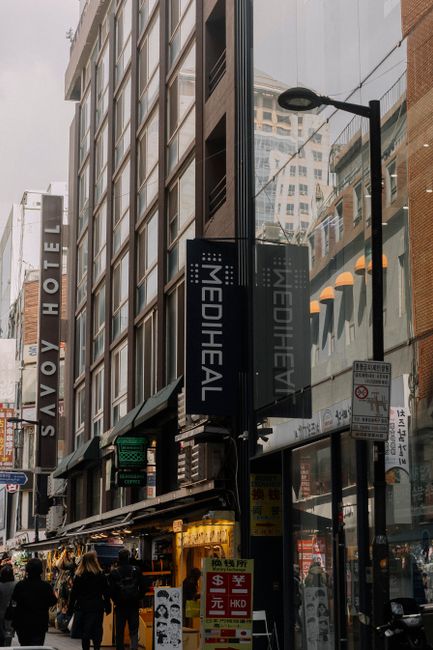
I figured checking a UV index was something dermatologists did, not something regular people built into their morning routine the way you’d check for rain. Then I noticed my landlord’s wife checking the 자외선지수 (UV index) on the weather app before deciding whether to bike to the market, the same casual glance you’d give a rain forecast. Middle-aged men carry black umbrellas in July, not because it’s raining but because the sun index hit “very high,” and nobody so much as glances twice. At Hangang Park on a bright Saturday in late May, I watched an entire family reapply sunscreen mid-picnic, kids included, with the practiced rhythm of people brushing their teeth. Even I’ve started doing it, somewhat embarrassingly, and I used to be the guy who considered sunscreen an occasional summer afterthought. There’s a whole retail aisle logic behind it too — SPF is printed on makeup, on hand cream, on lip balm, on things I never would have thought to check back home. Part of it, I’ve come to think, traces back further than convenience: pale, even skin has been an aesthetic ideal here for generations, long before K-beauty turned “whitening” and SPF-layered skincare into a global export. So it’s not vanity exactly, or not only vanity. It reads more like basic hygiene that everyone quietly agreed on decades ago and just never bothered to announce.
4. The dual-speed rhythm of 빨리빨리, on and off
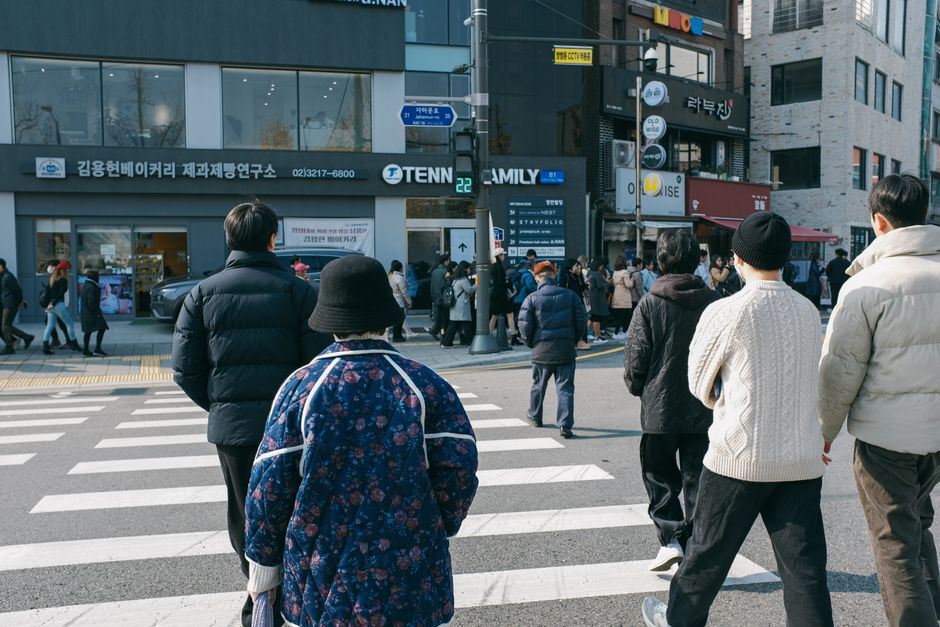
You’d think a country famous for hospitality and patience with elders would be uniformly unhurried in daily interactions, but that assumption falls apart the second you step into an elevator. People mash the door-close button like it’s a video game, sometimes before the last passenger has even cleared the threshold, and if you hesitate, someone will lean past you to do it for you. It’s not rudeness — it genuinely doesn’t register as rude to anyone involved — it’s closer to reflex. Crosswalks have the same energy: the countdown timer hits single digits and the entire crowd picks up its pace in unison, like a school of fish reacting to the same signal. I noticed it most clearly outside Gangnam Station around 8:40 on a Tuesday morning, watching maybe forty people break into a light jog the second the number hit six. And yet flip the setting slightly and that urgency just evaporates. Nobody rushes you out of a restaurant here, even when there’s a line at the door. A shared meal runs as long as the conversation does. I’ve watched a grandmother near my building chat with a stranger on a park bench for a good twenty minutes, in no hurry at all. At first that contrast looked like a contradiction to me. Now it feels more like Korea runs on two separate clocks depending on context, and everyone around me just knows, instinctively, which one applies without ever needing it explained.
5. Buildings that quietly skip the 4th floor
I noticed this one purely by accident, jabbing the elevator panel in my building and finding the sequence go 1, 2, 3, F, 5. My first assumption was a broken button. It wasn’t. The number 4 sounds like the Sino-Korean word for death, 死, and enough buildings quietly skip it — replacing it with F for “four” in English, or just leaving it off entirely — that I now notice when a building doesn’t do it, rather than when it does. Older apartment blocks around my neighborhood do the same thing with unit numbers ending in 4, and a friend who works in real estate in Ilsan told me landlords sometimes list a 4th-floor unit slightly cheaper because some tenants still request a different floor outright. What surprised me wasn’t the superstition itself — plenty of countries skip a 13th floor — but how unremarked-upon it is here. Nobody brings it up unprompted. It’s baked into the architecture the way a building code would be, not treated as folklore you’d explain to a foreigner unless he specifically asked, which, admittedly, I did, more than once, at more than one dinner table.
6. Bakery lines that run on rules nobody wrote down
Popular bakeries here have no ticket machine, no rope, no app to hold your place — and yet I have never once seen the line actually break down. At a bakery near Yeonhui-dong that gets a small crowd most Saturday mornings, everyone picks up a tray and a pair of tongs at the door and just… knows where the line starts, weaving single-file past the pastry case as if the floor itself were marked. Try to guess wrong and drift toward the register out of order, and you will get a look — not hostile, just a flat, immediate look that tells you everything. I got that look exactly once, back in my first month, reaching for a coffee bun a half-step ahead of an elderly woman who had clearly been standing there the whole time. I apologized, she nodded once, and that was the entire exchange. No confrontation, no words really necessary, just an unwritten rule enforced with total consistency by people who’ve never discussed it with each other.

What none of this adds up to
None of these are the “big” culture shock stories you’d expect someone to lead with — no chopsticks confusion, no karaoke mishap. They’re smaller than that, almost administrative, and that’s exactly why they stuck with me. A siren nobody panics over. A block with more salons than it seems to need. A UV number people check like the weather. An elevator that turns everyone into a sprinter for eight seconds and then lets them go back to being unhurried. A floor that quietly doesn’t exist. A bakery line with rules nobody wrote down. Individually they’re minor. Taken together, though, I’ve started to think of them less as quirks and more as the quiet machinery that lets a genuinely dense, fast-moving society avoid grinding against itself all day — dozens of small, mostly invisible agreements everyone honors without ever discussing them out loud, because discussing them was never really the point. They just work, which might be the most Korean thing about all six of them.
FAQ
Q1. Is the monthly siren drill something I need to actually do anything during, as a visitor or new resident?
A. For a short-term visitor, no — you can generally ignore it and continue what you’re doing, since it’s a nationwide civil defense test rather than an actual emergency signal. If you’re a resident and it happens to coincide with a building-specific fire drill (posted in advance in the elevator or lobby noticeboard), it’s worth following building staff instructions just so you know your building’s evacuation route, but the siren itself, on the 15th at 2 p.m., is routine and expected.
Q2. Why do some apartment buildings skip the 4th floor and others don’t seem to care at all?
A. It comes down to age and management style rather than any official rule. Older buildings and ones managed by more traditional developers are far more likely to relabel or skip 4, while newer high-rises, especially ones built or renovated with international buyers or tenants in mind, sometimes keep it as-is. There’s no law requiring either approach, which is part of why it can look inconsistent from building to building even on the same street.
Q3. If I accidentally jump a bakery queue like you did, what’s the actual expected recovery move?
A. A quick, sincere “죄송합니다” (I’m sorry) and stepping back is genuinely enough — nobody expects a foreigner to know an unwritten system on day one, and the flat look I mentioned earlier isn’t anger, more just mild surprise. What matters more is not repeating it once you notice how the tray-and-tongs flow works; regulars will absolutely notice if you keep cutting in, even unintentionally.
Leave a Reply