I went to Namdaemun the way most first-time visitors do — during the day, weaving through wholesale stalls stacked with kitchenware and dried anchovies, figuring that was the market. Bulk buyers, grandmothers restocking side-dish ingredients, that whole daytime economy. It took a Seoul-based friend mentioning, almost as an aside, that the place has a second life starting around dusk before I understood I’d only seen half of it.
You’d think a wholesale market built around bulk textiles and imported goods would go quiet once the metal shutters start rattling down, and for an hour or so around 7 or 8pm, it genuinely does look that way — storefronts dark, delivery carts stacked and abandoned for the night. But somewhere in that window, usually once the sky has gone from orange to that flat Seoul grey-blue, a different crowd starts filtering in through the same gates the wholesale buyers used that morning. The food alleys light up first, one griddle at a time, until entire lanes that were dead ten minutes earlier are suddenly thick with steam and noise.
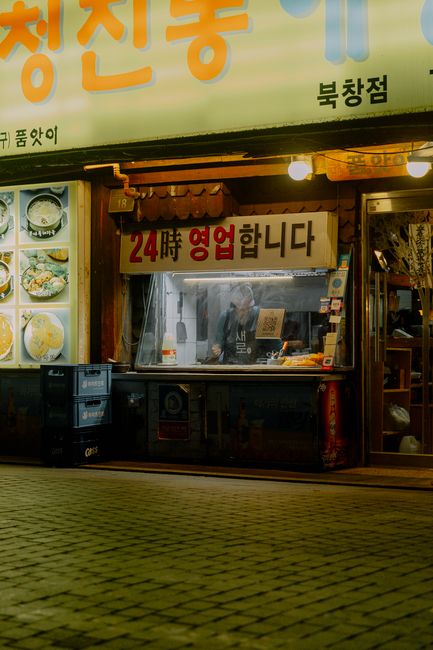
The Shift From Daytime Wholesale to Nighttime Food Alley
What’s strange about Namdaemun, compared to somewhere like Gwangjang Market, is that it doesn’t have one clean identity. By day it functions like a working commercial district — dishware wholesalers, fabric shops, camera gear, ginseng, kids’ clothing sold by the dozen, all part of what’s usually described as Korea’s oldest and largest traditional market, dating back to the 1400s. Come back after dark, though, and the emphasis quietly shifts toward the alleys built around cooked food rather than goods you’d carry home in bulk. It’s less that the market physically transforms and more that an entirely different cast of stalls takes the stage once the first one clears off.
Namdaemun is divided into these named alleys, which sounds almost too tidy to be real until you’re standing in one, disoriented, following a smell rather than a map. There’s Galchi Jorim Alley, tucked into the northern section not far southeast of Gate 2, where a run of small restaurants all serve some version of the same dish — braised hairtail, or beltfish, simmered down in a red pepper broth until it’s fall-apart tender. There’s also Kalguksu Alley, sometimes just called the noodle alley, where hand-cut wheat noodles get ladled into broth alongside dumplings behind entrances so narrow and plastic-sheeted you’d walk right past without knowing to look. Kalguksu Alley actually runs more on a daytime schedule — open roughly 5am to 9pm, busiest at lunch — so it functions less as a nighttime destination and more as a landmark for getting your bearings before the after-dark food-stall crowd fully takes over.
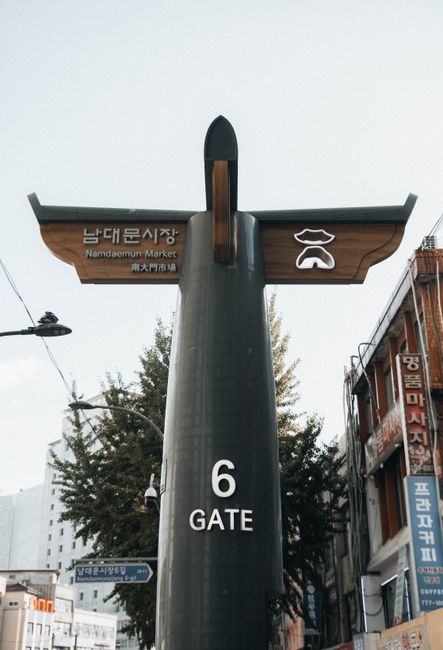
What the Air Smells Like Before You See Anything
Smell gets you before sight does, especially near the entrance around Hoehyeon Station. There’s a layered mix of hot oil, scorched brown sugar, and the faint brine of seafood that seems to hang in the alley air rather than drift off, less like one clean scent and more like walking through several kitchens running at once — which, functionally, you are.
Hotteok is usually the first thing people notice, partly because vendors tend to work right at the edge of foot traffic, flattening the dough with a metal press that hisses against the hot griddle. A stall owner might call out something like “hotteok deuseyo” — come get your hotteok — as much to the alley in general as to any one customer. The filling, a mix of brown sugar, cinnamon, and crushed peanuts, turns molten the instant the pancake gets pressed flat, so the first bite is genuinely dangerous if you’re impatient; I’ve burned my tongue on hotteok more times than I’d like to admit and I still don’t slow down. A single hotteok tends to run around 1,500 won, sometimes a little more when a savory, vegetable-stuffed version is on offer alongside the sweet kind, which some stalls do. That price is low enough that trying two or three different vendors back to back, just to compare, barely registers as a decision.
The sound is its own layer on top of all this, and it’s worth pausing on, because it’s not just background noise — it’s what tells you where to walk next. Metal tongs click against woks. Galchi jorim pots roll at a low, steady boil, lids rattling slightly with the steam pressure underneath. Plastic stools scrape against gritty concrete every time someone squeezes onto a bench that already looked full, and somewhere close by a vendor is quoting a price in quick, clipped Korean to someone who clearly wasn’t expecting an answer that fast. None of it is loud in an aggressive way. It’s closer to ambient noise that happens to be edible, and it’s usually what pulls you deeper into the alley rather than any sign.
From Grazing to Sitting Down: Galchi Jorim
Eventually the standing-and-snacking phase gives way to wanting an actual seat, and that’s where Galchi Jorim Alley earns its reputation. If there’s one dish that feels distinctly tied to this particular market, this is it. The alley itself is a short row of small, plainly decorated restaurants that all essentially serve the same core dish with slight variations — some lean spicier, some pile on more radish, a few add a steamed egg custard on the side almost as a palate reset between bites. The fish is silvery, blade-thin hairtail, braised until the flesh practically falls off the bone in the gravy. It arrives with rice, a handful of banchan, and usually more red broth than seems reasonable, which is honestly the best part, since spooning that broth over rice at the end of the meal often beats the fish itself.
Pricing varies more than you’d expect between stalls that look nearly identical from the outside — I’ve seen it listed as low as 7,000 won per person at some no-frills spots, and closer to 14,000 won at places that include grilled fish and a steamed egg alongside the rice and side dishes. Nobody seems bothered comparing prices out loud, either; groups will stand at the mouth of the alley debating which storefront to duck into, sometimes deciding based on nothing more than which one currently has an open seat.
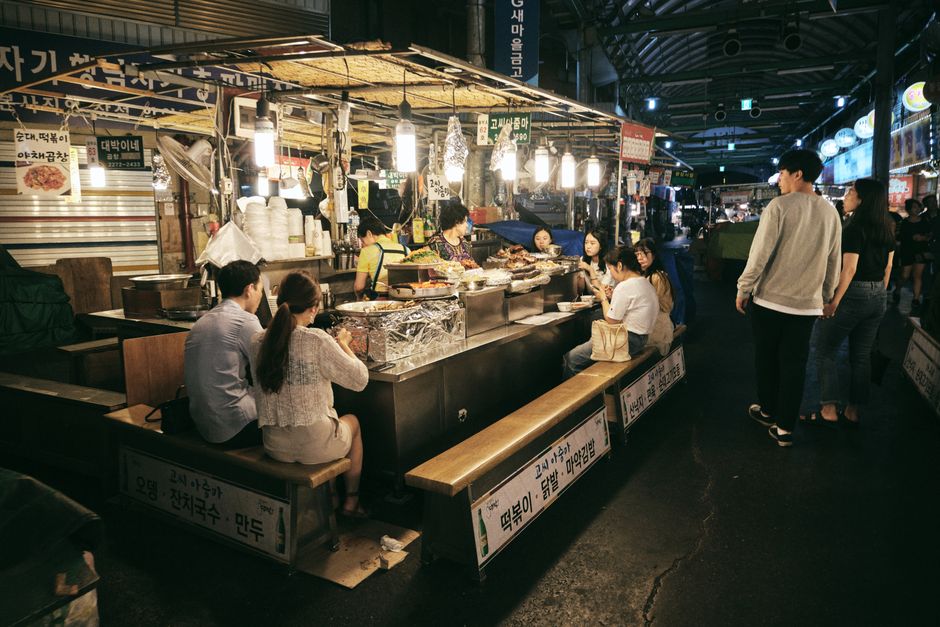
Who’s Actually There
The crowd at night is a real mix, and that mix is a big part of what makes the whole scene work. Tourists are there, some clutching phones with translated menu photos pulled up, trying to figure out if what they’re pointing at is spicy. But there are also off-duty market workers grabbing a quick, cheap dinner before heading home, taxi drivers on a break parked just outside the alley mouth, and coworkers who’ve clearly wandered over from a nearby office for something that isn’t a sit-down restaurant meal. During business hours everyone at Namdaemun has a defined role — buyer or seller — but at night that line dissolves into just people eating standing up, shoulder to shoulder, under strings of bare bulbs.
Above all of it, a lot of the daytime signage stays lit even though the shops themselves are shuttered — a faded lightbox for a wholesale button supplier, say, casting a cool blue-white glow directly over a steaming pot of red galchi jorim broth two doors down. It’s not designed, exactly, but it ends up looking almost intentional, like someone went for maximalist contrast on purpose: commerce advertising itself in a language that has nothing to do with what’s actually being sold underneath it.
Traditional Markets Competing With Convenience Stores and Delivery Apps
It’s worth being honest about the pressure a place like this is under. Convenience stores in Korea are absurdly good — heated food counters, decent instant noodles, coffee machines, all open 24 hours — and delivery apps mean almost anything can show up at your door in under half an hour. Against that backdrop, a market that requires you to physically walk somewhere, squeeze onto a plastic stool, and eat in the open air has to be offering something those alternatives genuinely can’t replicate, or it won’t survive the comparison for long.
And yet, that same mix of people I just described — office workers, taxi drivers, locals doing an evening errand — might be exactly what’s keeping it afloat. Namdaemun’s night alleys don’t feel like they’re clinging on out of nostalgia. If anything, the food-stall side of the market has leaned harder into what convenience stores structurally can’t offer: cooked-to-order food with a bit of theater to it, eaten in a setting with actual atmosphere instead of fluorescent lighting and a microwave. Younger visitors especially seem to treat it as something worth documenting rather than a chore — you’ll spot people filming a hotteok press mid-flip for a few seconds of video before finally eating the thing. Whether that’s enough to sustain a centuries-old market indefinitely is a bigger structural question than one visit can answer, and I don’t want to pretend otherwise. But on the nights I’ve walked through, it didn’t feel like a market winding down. It felt busy, a little chaotic, and unmistakably in use.
Practical Notes for Going Yourself
Getting there is straightforward: Hoehyeon Station on Line 4, Exit 5, puts you close to several food alleys, including the entrance near the well-known vegetable hotteok stall by the IBK bank building. You can also walk down from Sungnyemun Gate along Namdaemun-ro and cut into the market from there. As for timing, the night-market energy tends to build from around 9 or 10pm onward, once the wholesale sections have mostly closed for the evening — and worth flagging, the market is generally closed on Sundays, so a Sunday-night visit will mostly disappoint you. Cash matters here more than you might expect walking around a country this digitally cashless; plenty of the smaller stalls either prefer it or don’t take cards at all, and while a few will scan a KakaoPay QR code taped to the counter, it’s safer to assume you’ll need actual won on hand rather than find out mid-order that you don’t.
Budget-wise, this is not an expensive night out by any measure. A hotteok or two, a bowl of something warm, maybe a skewer from a stall on the way back to the station — you can eat well for somewhere in the 10,000 to 20,000 won range per person, less if you’re mostly grazing. It’s the kind of place where a loose plan is really all you need: follow whichever smell seems most convincing, and you’ll end up full without having made a single reservation.
Frequently Asked Questions
Is Namdaemun Market open at night? The wholesale shops run daytime hours and mostly close by early evening, but the food alleys pick up from around 9 or 10pm and stay lively later into the night — except Sundays, when the market is generally closed.
What’s the one dish worth planning a visit around? Galchi jorim, if you only try one thing — the braised hairtail alley is specific to Namdaemun in a way hotteok and kalguksu, both found elsewhere in Seoul, aren’t.
Do I need cash? Yes, mostly. Some stalls accept KakaoPay, but plenty are cash-only, so carry small won bills rather than counting on cards.
Leave a Reply