The Lunch That Almost Didn’t Happen
A few years ago, walking into a samgyeopsal joint by myself around 7 p.m. on a Friday would have earned me a look from the ajumma at the counter — not hostile, just puzzled, like I’d shown up to a wedding without a date. These days, nobody blinks. I can slide onto a stool at a ramyeon bar in Hongdae, order through a touchscreen without saying a word to another human being, and eat my noodles in peace while couples argue quietly two seats over. Something shifted, and it happened faster than most outsiders realize.
That something has a name: honbap. It’s a mashup of “honja” (alone) and “bap” (rice, or more loosely, a meal), and if you’d typed it into a search bar in, say, 2011, you’d have gotten mostly blank stares. The word barely existed. Now it’s stitched into ordinary conversation the way “brunch” is in English — nobody remembers a time before it, even though that time was recent.
Why Eating Alone Used to Feel Loaded
To understand why honbap became a whole cultural conversation instead of just a personal preference, you have to know what it was pushing against. Korean dining has historically been built around the group — dishes served family-style, shared side dishes (banchan) refilled for the table, portions sized for at least two people, and a social rhythm where eating together after work or class was less an option than an expectation. Sitting alone at a restaurant wasn’t illegal or even explicitly frowned upon; it just read as a small signal that something was off. Maybe you had no friends. Maybe you’d been dumped. Maybe you were the type who couldn’t function in a group, and in a culture that leaned hard on nunchi — reading the room, matching everyone else’s pace — eating solo made you the one variable nobody could read.
I’ll admit I underestimated how real that stigma was until I watched a Korean coworker, back around 2014, visibly steel herself before eating lunch alone at her desk instead of walking down to a restaurant by herself. She wasn’t ashamed of the food. She was avoiding the optics of a table for one. That’s a strange thing to explain to someone from a country where solo lunches are just Tuesday.
What Actually Changed the Math
Several things converged, and none of them were about food snobbery or some sudden embrace of introversion. Household structure changed first and hardest: by the early 2020s, roughly a third of households in Seoul were single-person households, a number that would have seemed implausible a generation earlier. That’s not a niche demographic anymore — that’s a market. Restaurants, being businesses and not moral institutions, noticed.
Around the same period — people who track this stuff point to somewhere near 2017 as the inflection — “honjok,” the alone tribe, went from a slightly mocking label to something closer to a lifestyle brand. Variety shows started featuring people who lived alone and seemed fine, even enviable. Convenience stores expanded their single-serving meal sections. And crucially, kiosks arrived. Once you can order and pay without speaking to a cashier or a server, a huge chunk of the social friction around eating alone just evaporates — nobody has to make small talk, nobody has to explain that yes, it’s just you, table for one.
Even so, I don’t think technology alone explains it. Kiosks made solo dining logistically easier, but the cultural permission had to come first, or people would have just avoided those restaurants altogether. The two reinforced each other.
The Restaurants Built Around You, Singular
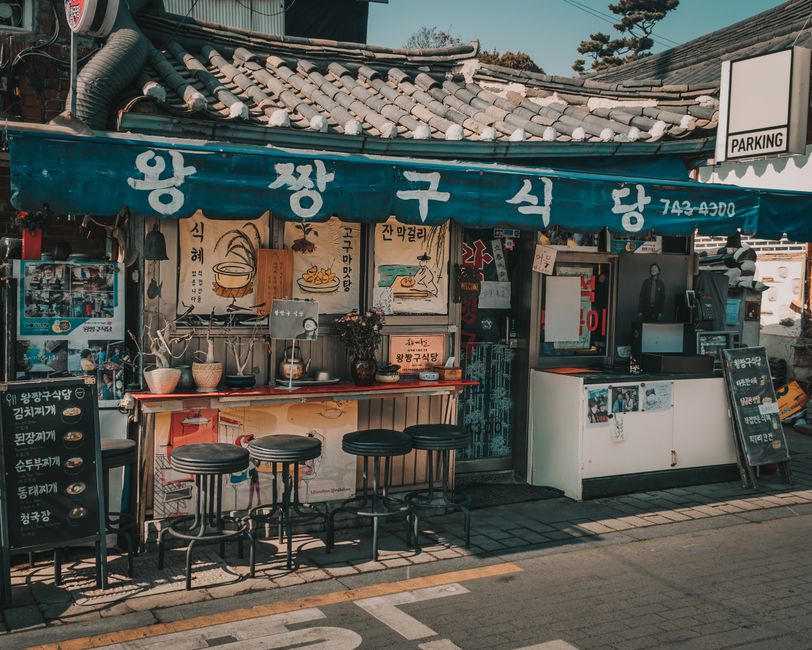
The clearest proof that honbap stopped being a fringe behavior is that entire restaurant formats now exist because of it. Ramyeon and donkatsu chains with long bar-style counters facing a wall or an open kitchen are everywhere now, and that layout isn’t accidental — it’s a deliberate signal that a single diner isn’t an inconvenience to be seated awkwardly at a four-top, but the default customer the space was designed for. Some hot pot and jjigae spots now do single-portion stone pots, which sounds obvious until you remember that traditionally a lot of stews were built to be ladled out to multiple bowls from one shared pot.
The category I find genuinely clever, though, is one-person barbecue. Grilled meat was the textbook example of a dish that punished solo diners — more on that in a second — so a wave of restaurants (Gogitbar being probably the most recognized name in the space) built individual grill stations, one per seat, so you get your own little tabletop burner and your own portion instead of negotiating shared grill real estate with strangers. It’s a strange kind of innovation: solving a social problem with a hardware solution.
Honsul — drinking alone, the sibling trend to honbap — has followed a similar arc. Standing bars and small wine bars with counter seating have multiplied, and nobody assumes the person alone with a glass of makgeolli is having a crisis. If anything, in some neighborhoods it reads as mildly stylish, the kind of thing you’d see in a lifestyle magazine spread rather than something to be embarrassed about.

What Still Doesn’t Quite Work Solo
I don’t want to oversell how far this has come, because there are real limits, and pretending otherwise would be dishonest. Classic samgyeopsal — the pork belly barbecue that’s arguably Korea’s most iconic communal dish — is still awkward to eat alone in a lot of ordinary restaurants, the ones without the one-person setups I just mentioned. The reasons are structural, not just social: many places sell it in units of two servings minimum, the grill is genuinely more fun and more efficient with someone else managing the tongs while you drink, and the whole ritual — wrapping the meat in lettuce, passing bowls, refilling each other’s soju glasses — is built for at least a pair. You can absolutely order it alone at plenty of places now, but you’re often paying for two servings whether you eat them or not, which turns “eating alone” into “eating alone, expensively.”
Group-portion dishes are the other holdout. Things like certain jjimdak, budae jjigae, or seafood boils are priced and portioned assuming multiple mouths, and a solo diner ordering one is either going to have a lot of leftovers or is going to get a polite but firm “this is for two people minimum” from the server. It’s not personal — it’s just the economics of a dish built around a shared pot. Turns out cultural change moves faster than menu engineering; restaurants can rearrange seating in a season, but redesigning a dish’s entire cost structure around single portions is a bigger lift.
Company dinners — hoesik — sit outside honbap’s reach entirely, but that’s a different animal with its own hierarchy and expectations, not really a solo-dining question at all.
The Generational Split Is Real, and It’s Not Just About Age
Ask a Korean in their 20s about eating alone and you’ll often get something close to indifference — it’s just how Tuesday lunch works sometimes, no bigger a decision than picking a Netflix show. Ask someone in their 50s or 60s and you’re more likely to hear an acknowledgment that things have changed, paired with a lingering sense that eating alone, especially at a nicer restaurant or for a special occasion, still feels a little sad, or at least worth commenting on. That’s not universal — plenty of older Koreans have embraced honbap as simply efficient, and plenty of younger ones still find certain solo situations (a table for one at a wedding-hall-style buffet, for instance) genuinely uncomfortable.
What I’ve noticed, having lived through roughly a decade of this shift, is that the generational gap isn’t really about whether eating alone is acceptable anymore — pretty much everyone agrees it is — it’s about which situations still carry weight. For someone who came of age professionally in the 1990s, the workplace lunch group was practically a duty; skipping it to eat alone could read as a small social statement even if none was intended. For someone who graduated during or after the pandemic, remote work and delivery apps had already normalized eating by yourself well before honbap became a cultural buzzword, so the whole debate can feel a bit like adults discovering something teenagers already knew.
There’s also a quieter class dimension worth naming honestly: honbap as a trendy, empowered lifestyle choice is a different experience than honbap as an unavoidable reality for someone working long hours with no one to eat with. The same act — a bowl of noodles, alone, at a counter — can be read as liberation or as loneliness depending entirely on context, and I think part of why the topic still generates so much commentary in Korea is that both readings are true at once, for different people, sometimes for the same person on different days.

So, Is It Actually Rude?
No — and honestly, it hasn’t been “rude” in any formal sense for a while now. What lingers isn’t rudeness but residue: a faint cultural memory of a time when solo dining meant something about your social standing, even though the infrastructure, the businesses, and most of the people around you have already moved past that. If you’re visiting or living in Korea and hesitant to eat alone, the honest answer is that almost nowhere will treat you badly for it, and a growing number of places are specifically built for exactly that. The exceptions are narrow and mostly about menu logistics, not judgment — a samgyeopsal spot that needs two orders minimum isn’t shaming you, it’s just running a kitchen designed around a different assumption.
What surprised me most, watching this unfold over years rather than reading about it after the fact, is how quickly the infrastructure caught up to the sentiment once the sentiment tipped. Culture is usually slower than that. Here, it took roughly a decade to go from “table for one” being a quiet confession to being a menu category.
FAQ
Is it weird to eat samgyeopsal alone in Korea?
It’s increasingly normal, but check the restaurant first. Ordinary neighborhood BBQ spots often have a two-serving minimum simply because of how the dish and grill are set up, while one-person BBQ chains (Gogitbar and similar) are built specifically for solo grilling, single portion and all — no minimum, no awkwardness.
Will servers judge me for eating alone at a nice restaurant?
Almost certainly not for judgment in the sense of disapproval, though at higher-end or banquet-style places (think wedding-hall buffets or set-course restaurants built around groups) you may just get a slightly puzzled clarifying question about your reservation, since the format itself assumes company rather than the diner being unwelcome.
What’s the easiest way to eat alone without feeling self-conscious?
Look for counter or bar seating facing the kitchen or a wall — ramyeon shops, donkatsu counters, and casual Japanese-style spots usually have this by design — and use the kiosk if there is one. Ordering without a verbal exchange removes most of the friction people worry about, and it’s honestly how a large share of solo diners in Korea already do it.
Leave a Reply