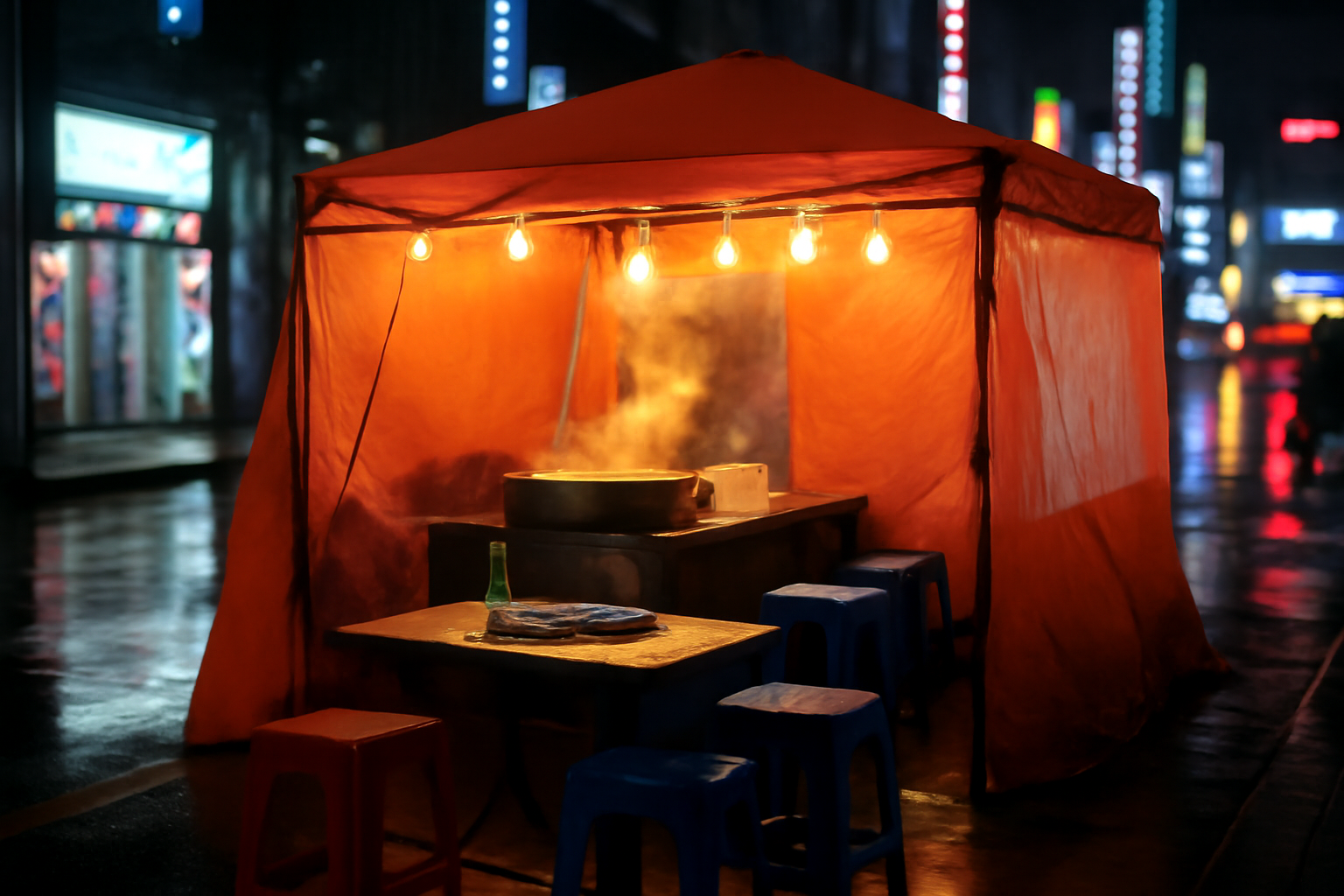
The first time I sat down at a pojangmacha, it was raining just enough to make the plastic tarp overhead sound like static. I remember the orange glow before I remember anything else — that particular shade of orange-red plastic sheeting lit from inside by a bare bulb, the kind of light that makes everyone’s face look a little warmer than it actually is. My father-in-law had waved me toward a stool with the confidence of a man who’d done this a thousand times, ordered without opening a menu, and within about ninety seconds there was a paper cup of hot broth in front of me and a stick of odeng balanced across the rim. I hadn’t asked for it. I didn’t need to.
That’s more or less how I fell into pojangmacha culture — not through a guidebook, but through being physically pulled onto a plastic stool on a wet street near a subway exit, somewhere between a convenience store and a shuttered flower shop. Years later, it’s still one of the things about living in Korea that I have a hard time explaining to people back home, because on paper it sounds like nothing. A tent. Plastic stools. Fish cake in broth. But the actual experience of it is something else.
What’s Actually on the Table
If you’ve never sat at one, the menu at a pojangmacha reads like a greatest-hits list of Korean bar food, and there’s a reason for that — this is anju territory, food built specifically to go with drinking, not food that happens to be served near alcohol.
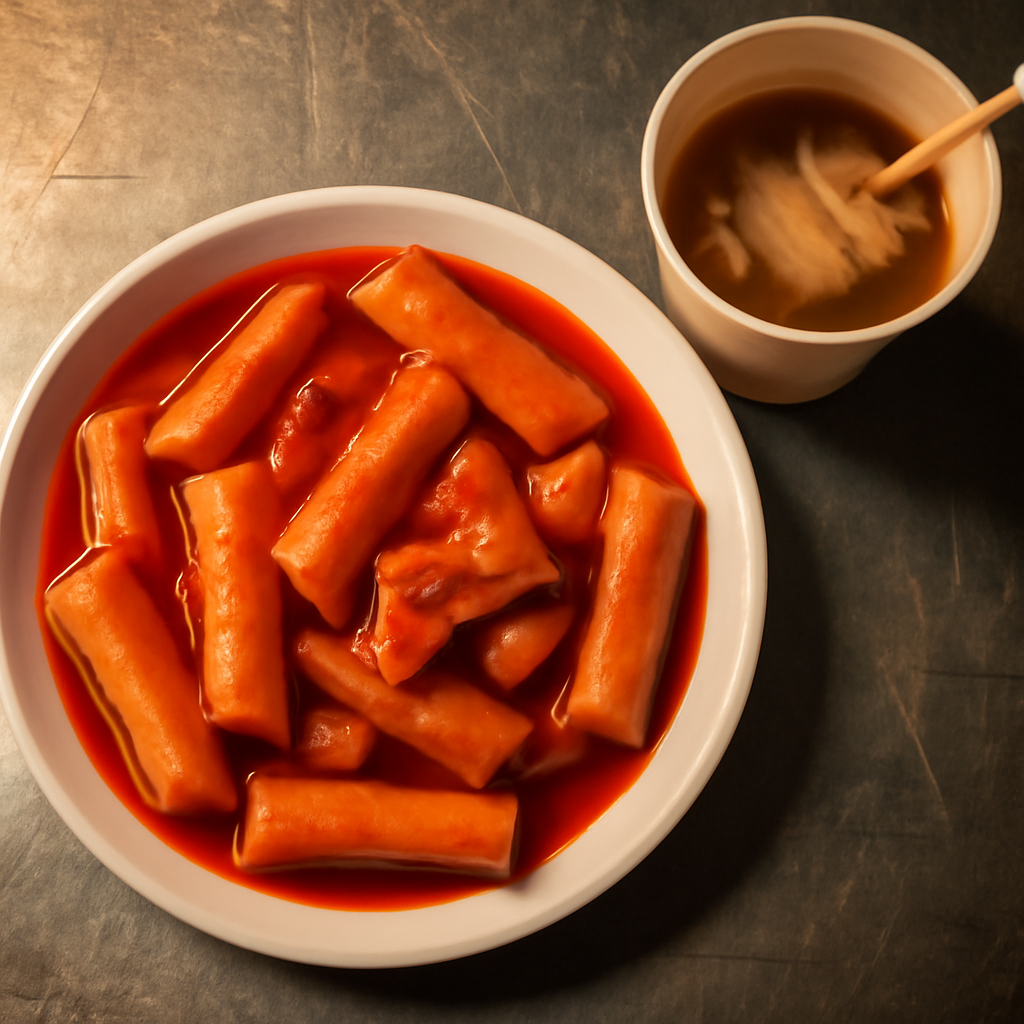
Odeng (also called eomuk depending on the region and who’s talking) is the entry point for almost everyone. Fish cake skewers sit in a vat of anchovy-and-radish broth that’s been simmering all night, and you’re handed a little paper cup to drink the broth from between bites — nobody explains this to you, you just watch the person next to you do it and copy them. Tteokbokki is the other anchor, cylinders of rice cake stewed down in gochujang sauce until it’s thick and a little sweet underneath the heat, usually crowded into the same pot as triangles of fried fish cake and boiled eggs. Then there’s sundae, blood sausage stuffed with glass noodles, sliced and served with a dish of salt or a spicy dip depending on the stall — it’s one of those foods I’ve watched split a table of foreigners right down the middle, half reaching for seconds, half politely declining and reaching for the tteokbokki instead. Grilled skewers round it out — chicken skin, pork belly, sometimes squid — cooked right there on a small grill a foot from your elbow, so you get the smoke along with the smell of soy and sesame oil.
And soju, obviously. Green bottles land on the table almost as fast as the food does, along with small stainless steel cups that somebody — usually the most senior person at the table, or whoever’s closest to the bottle — fills for everyone else before filling their own.
The Part That’s Not About the Food
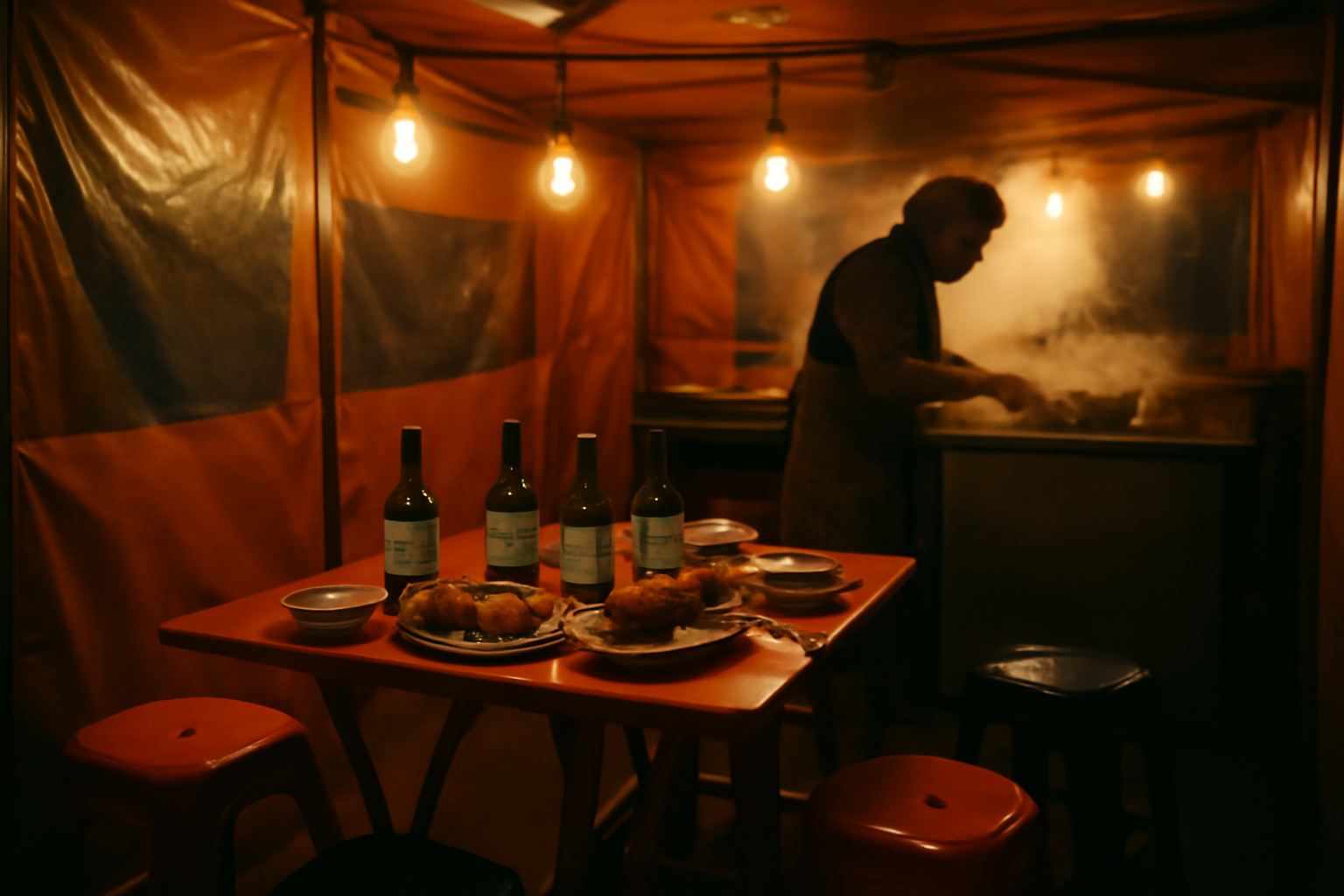
What actually keeps me coming back isn’t any single dish, it’s the physical setup. Pojangmacha tables are small and the stools are close together, so you end up practically shoulder to shoulder with strangers at the next table over, especially at the popular ones where every seat is full by nine. There’s an intimacy to it that a regular restaurant doesn’t have — the tent traps the steam and the smoke and the noise all together, so even a stall with fifteen people crammed in feels loud and close in a way that somehow reads as cozy instead of chaotic.
I’ve heard pojangmacha described as something like an informal therapist’s office for the neighborhood, and after enough nights there I understand why. It’s where I’ve watched coworkers loosen the top button after a rough day, where I’ve listened to two guys my age going back and forth about their kids’ school schedules with the specific bluntness that only comes after the second bottle. Nobody’s performing for anybody. The lighting is bad, the stools wobble, and that’s precisely the point — it’s a low-pressure space that isn’t trying to impress you.
There’s also an unspoken order to how a table works. Someone pours for someone else, you turn slightly away from an elder when you drink out of respect, and if a stranger’s stool bumps into your table while they’re squeezing past, an apology or a small nod is exchanged and everyone moves on. Nobody’s checking a phone at a pojangmacha the way they might at a cafe. It’s one of the few places I’ve noticed where the whole point is just sitting there, talking, eating slowly, and not being anywhere else.
Where the Tents Came From
I didn’t know any of this history the first few years I lived here — I just liked the food and the atmosphere — but it turns out pojangmacha have a pretty specific backstory. They started appearing in and around Seoul’s Cheonggyecheon area in the early 1950s, when the city was full of refugees and people displaced after Japanese colonial rule ended, all trying to make a living with almost no capital. A cart, a tarp, and a burner was about all it took to get started, and “pojangmacha” literally translates to something like “covered wagon” — po-jang meaning covering or wrapping, ma-cha meaning cart.
By the 1970s, as Korea’s economy was accelerating and the palli-palli (“hurry up, hurry up”) pace of work life took hold, the tents multiplied around office districts and transit hubs, because they filled an obvious gap — cheap food and a place to decompress for people getting off work late and needing something before the last train or bus. That’s basically still the function they serve, just with fewer of them left standing.
Why You See Fewer of Them Now
This is the part that actually makes me a little sad to write. In the neighborhoods I’ve lived in over the years, I’ve watched pojangmacha clusters that used to run the length of a block shrink down to two or three tents, or disappear entirely. Areas like Jongno 3-ga and Euljiro in Seoul are still known for having some of the densest concentrations left, but even there the footprint has shrunk noticeably over the last decade or so.
Part of it is straightforward urban redevelopment — old low-rise neighborhoods get rezoned, alleys get widened or built over, and a tent that’s occupied the same curb for twenty years doesn’t have a lease to point to when the block changes. Part of it is licensing and sanitation crackdowns, since informal tents have always occupied a legal gray area that’s gotten less tolerated as cities modernize. And part of it, I think, is generational — younger Koreans I’ve talked to are just as likely to suggest a hof or a themed bar for a night out, places with menus, receipts, and card machines, instead of a tent where the tab gets tallied by memory.
I get the logic on all sides. But there’s something about a pojangmacha that a hof with fluorescent lighting and a laminated menu just can’t replicate, and every time one closes near where I live, it feels like a small, specific kind of neighborhood memory disappearing with it — not dramatic, just quiet.
If You’re Going for the First Time
My best advice is to not overthink it. Pick a tent that already has people in it — a crowded pojangmacha is a good sign, an empty one on a busy street is usually empty for a reason. Order one shared dish to start (tteokbokki or odeng are the safest, broadest-appeal choices), see who’s next to you, and let the night move slowly. Nobody’s going to rush you off a stool, and nobody expects you to know the menu cold on your first visit — I certainly didn’t.
If you’re navigating Korean eating and drinking customs for the first time in general, I’ve written before about the etiquette around eating alone in Korea and honbap culture, which covers some of the same ground on social expectations around food and drink here — a lot of it applies just as much at a pojangmacha table as it does anywhere else.
Frequently Asked Questions
Is it safe to eat at a pojangmacha?
Generally yes. The food is cooked fresh and often right in front of you, which actually makes it easier to judge cleanliness than at a lot of sit-down restaurants — you can see the broth simmering, the grill smoking, the vendor handling the food. Use common sense the way you would with any street food anywhere: pick a stall that looks busy and well-kept, and if something looks like it’s been sitting out too long, skip it.
Do you need cash, or can you pay by card?
Cash is still safer to assume, especially at the smaller, older tents that have been run by the same person for years. Some of the larger, more established pojangmacha near stations or busy nightlife areas now take cards or mobile payment, but I’ve been caught out more than once assuming a card machine would be sitting there when it wasn’t. Bring cash, and treat a card reader as a nice surprise rather than a given.
Do I need to speak Korean to order?
Not really. Most pojangmacha menus are short enough that pointing works fine, and dishes like tteokbokki, odeng, and sundae are common enough that you can usually just say the name and gesture at how many. I got by for a long time just pointing at what the table next to me was eating and holding up fingers for the quantity, and nobody ever seemed bothered by it.
Leave a Reply