
My son came home from his Korean kindergarten with a name tag sewn onto his gym bag, and for a second I didn’t recognize it. The teacher had written it the way the school always does — family name first, given name second, no comma, no flip. I’d filled out the enrollment paperwork myself weeks earlier, and still needed a beat to place it. Strange as it sounds, you can understand Korean name order perfectly in theory and still feel your Western brain stutter the first few times you see it in the wild.
I’m Yijidaddy, an American dad raising a family in Korea, and this is one of those small, everyday puzzles that trips up almost every foreigner here at some point. It looks simple on paper — and yet it gets less simple the moment you’re holding someone’s business card, trying to figure out which half of the name to actually call them by.
The basic structure: family name comes first
In Korea, the surname is written and spoken before the given name. Always. There’s no ambiguity the way there sometimes is in, say, Hungarian contexts where usage varies by setting. You might expect some wiggle room somewhere in there, but there isn’t: a Korean name is built as family name, then given name — typically one syllable for the surname and one or two for the given name, so the full name usually runs two or three syllables total.
Take a name like Kim Min-jun. Kim is the family name, Min-jun the given name. In English-language media you’ll sometimes see this flipped to “Min-jun Kim” to match Western reading habits, but that’s a translation convention, not how the name actually works in Korean. Even so, on his Korean ID card, at his workplace, on his mailbox, it’s Kim first.
How it looks on paper
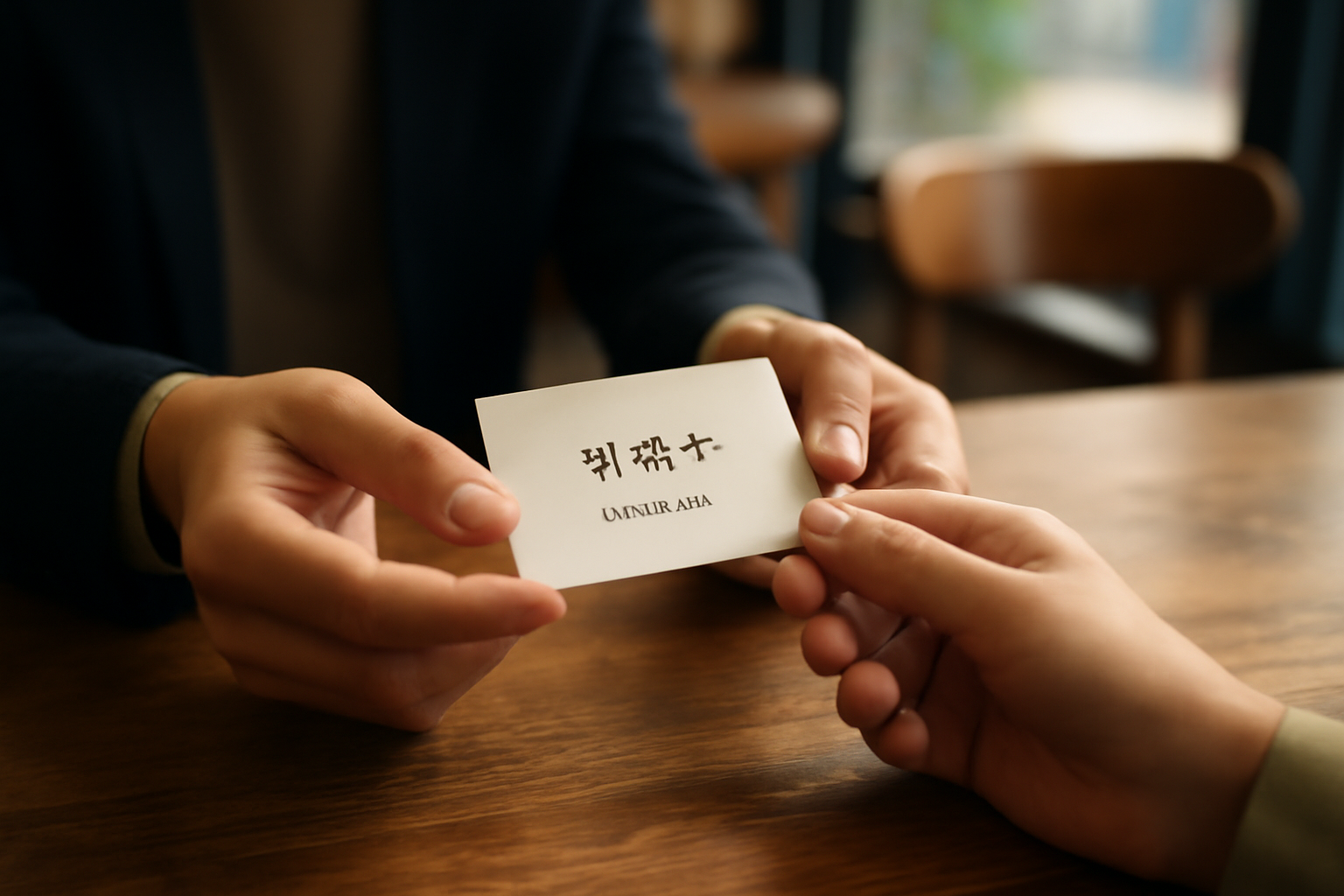
On a Korean resident registration card — the local equivalent of a national ID — the name field reads surname-first with no punctuation separating the two parts; it’s just one continuous string of syllables. Business cards follow the same logic. When a Korean colleague hands you a card, the top line is almost never split into “first name / last name” the way Western cards are — it’s the full name, family name leading, usually followed by a job title, and increasingly an English line underneath that keeps the same order instead of flipping it.
The surnames you’ll see constantly
You’d think a population this size would spread across hundreds of common surnames. It doesn’t. One reason the family-name-first structure stands out so much in Korea is how few surnames there actually are, relative to the population. Kim, Lee, and Park together account for roughly 45 percent of the country’s family names, and Kim alone covers around one in five Koreans. Add in Choi, Jung, Kang, Cho, Yoon, Jang, and Lim, and you’ve got maybe ten surnames covering a huge share of the population.
That concentration is partly historical — during the late Joseon dynasty, non-aristocratic families increasingly adopted surnames, many gravitating toward established, high-status clan names. The result is a country where surnames alone carry almost no distinguishing information; it’s the given name and the clan or regional lineage (bon-gwan) behind the surname that actually differentiate people. Oddly, two Kims might not be related at all, or they might belong to entirely different Kim clans going back centuries. Practically, this means any Korean classroom or office is full of people who share a surname but are complete strangers.
Where Westerners get tripped up
Mistake one: assuming the last word is the surname
Coming from English, the instinct is to treat whatever comes last as the family name — that’s how it works with “John Smith.” You’d assume the same logic carries over to Korean names. It doesn’t. Applied to a name like Park Ji-sung, that instinct produces “Mr. Sung,” which is wrong on two counts: Park is the surname, and Ji-sung isn’t split into two separate calling names anyway.
Mistake two: calling someone by their given name too early
This one isn’t really about word order — it’s about what the order signals. Korean given names are generally reserved for close friends, family, or a senior addressing someone junior. In most everyday and professional interactions, Koreans use surname plus title rather than a bare given name. A foreigner who learns that “Min-jun” is Mr. Kim’s given name and starts using it right away, thinking it’s the friendly move, can come across as oddly familiar. I made a version of this mistake early on — using a new acquaintance’s given name because it felt warmer — and got a slightly startled look before someone quietly set me straight.
Mistake three: flipping Western names into Korean order unnecessarily
Some foreigners, trying to be culturally sensitive, reverse their own Western name on Korean business cards to mimic the local order. You might think that’s the considerate move — most etiquette guidance actually recommends against it. Koreans doing business internationally are generally aware that Western names run given-name-first, and flipping your own name can create more confusion than it resolves — nobody’s sure anymore which part is your surname. Keeping your name in its normal order, and adding a Korean-script line if you want to be thorough, tends to land better.
How this plays out day to day, as a foreign parent
Living here, the surname-first structure stops being an abstract fact and turns into muscle memory fast. School documents, hospital check-in screens, delivery labels — they all default to the Korean order, and you adjust without noticing you’ve adjusted. Still, where it stays genuinely interesting is at the intersection of two naming systems, which is exactly where international families in Korea live.
When you’re naming a child with one Korean parent and one non-Korean parent, the ordering question gets real fast. Some families give the child a Korean given name that follows the Korean parent’s surname for official documents here, while using a separate Western-order name for the other side of the family or an international birth registration. Others keep one unified name and just accept that it reads differently depending on which country’s form you’re holding. I’ve watched friends weigh exactly this — how a name functions on a Korean ID versus a US passport versus everyday conversation — since something that works cleanly in one system doesn’t always carry over without friction.
None of it amounts to a crisis. It’s more a recurring small negotiation between two grammars of identity, and every mixed family I know here has worked out its own version of an answer.

Why the order exists at all
The family-name-first convention reflects a historical emphasis on lineage and household over the individual — identified first by the family or clan, and only then by the specific person within it. You might expect that emphasis to still visibly shape daily life. It doesn’t, not really — the naming convention has simply outlasted the social structure that produced it, the way naming customs tend to everywhere. Nobody in Seoul is consciously thinking about Joseon-era clan hierarchies when introducing themselves as Lee Somebody. It’s just how names work here, the same unconscious way “Smith” trailing “John” is just how names work in Ohio.
FAQ
Is the family name always first in Korea, with no exceptions?
In native Korean-language contexts — official documents, workplaces, everyday introductions — yes, the surname consistently comes first. It only flips when a name is deliberately rendered for an English-speaking audience, such as some international news bylines, and even then, plenty of Korean public figures keep their name surname-first in English too.
How do I know which part of a Korean name is the surname?
If the name is two or three syllables long and you don’t already know the person, the safest assumption is that the first syllable is the surname — especially if it’s one of the common ones like Kim, Lee, Park, Choi, or Jung. When in doubt, it’s completely normal to just ask; Koreans are used to explaining this to foreigners and won’t think less of you for checking.
Should I address a Korean colleague by their given name?
Generally not, unless they’ve specifically invited you to. Surname plus an appropriate title, or a workplace role term, is the safer default in professional settings. Given-name usage tends to open up naturally as a relationship grows closer or more informal, and it’s usually the Korean person who signals when that shift is welcome.
Names are one of those small doors into how a culture thinks about identity, and Korea’s surname-first order is a good example of a minor formatting detail that carries real social weight. Get the order right, and you’re not just avoiding an awkward moment — you’re showing you noticed something that matters here. That’s usually enough to earn a small, appreciative nod, even from someone who’s heard a foreigner get it wrong a hundred times before.
Leave a Reply