The first time I understood what Chuseok actually meant, it wasn’t from a textbook or a Korean class handout. It was standing in an empty subway car on Line 2, somewhere around what should have been the evening crush at Gangnam station, on a Tuesday afternoon. Normally that stretch of Line 2 is the kind of packed where you’re pressed against a stranger’s backpack and both of you are pretending it’s fine. That day, I had an entire six-seat bench to myself.
Nothing was wrong. Twenty-some million people had simply left the city at once, all heading toward the same general direction: home. That’s Chuseok in a single image, honestly, before you’ve learned a single word of the vocabulary around it. Before you learn about ancestral rites or rice cakes, you learn that this holiday can empty out an entire capital city almost overnight.
If you’re a foreigner living in Korea, working with Korean colleagues, married into a Korean family, or just Chuseok-curious because your favorite K-drama keeps mentioning it, this is the explainer I wish someone had handed me years ago. Not a listicle of “fun facts,” but the actual shape of the holiday — what it’s for, what happens inside a Korean home during it, and what you should know if you’re the foreigner who gets invited.
What Chuseok Actually Is
Chuseok (추석) is often translated as “Korean Thanksgiving,” and that comparison isn’t wrong, but it undersells things a bit. Thanksgiving in the U.S. is largely one big meal and a parade. Chuseok is a multi-day cultural event built around three overlapping purposes: giving thanks for the harvest, honoring ancestors through formal rites, and — the part outsiders tend to underestimate — resetting the family hierarchy for another year.
That last piece is worth sitting with. Grandparents get visited in order of seniority. Younger cousins who haven’t seen each other since Seollal end up quietly comparing notes on jobs, relationships, and who’s bought an apartment yet, usually while pretending it’s casual small talk. Seating at the big dinner table, who pours drinks for whom, who gets served first — none of it is random. It’s a whole year’s worth of family standing, briefly made visible over shared food.
The name itself breaks down to “autumn” (秋, chu) and “evening” (夕, seok), a reference to the full harvest moon that lights up the holiday. It’s also called Hangawi (한가위), an older native Korean word meaning roughly “the great middle of autumn.” Both names point to the same root idea: this is a lunar calendar holiday, tied to the 15th day of the 8th lunar month — historically the point in the farming year when farmers, who tracked planting and harvest cycles by the moon rather than a fixed solar calendar, knew the year’s rice crop was finally in.
Because it’s lunar, the date jumps around on our regular Gregorian calendar every year. In 2026, it lands on September 25, a Friday, with the official holiday period running from September 24 through 26. Since September 27 falls on a Sunday, plenty of workplaces treat it as a four-day stretch through the 27th with a substitute holiday added on. It’s worth double-checking your own calendar if you’re planning travel, because the exact bridge days can shift depending on the year and the employer.
The roots of all this go back over two millennia, to a time when a good harvest wasn’t just nice to have — it was the difference between a comfortable winter and a genuinely hard one. That history is probably why the holiday still carries an undertone of gratitude that feels almost solemn compared to something like New Year’s Eve. It’s less “let’s party” and more “let’s not take this for granted.”

Charye: The Ancestral Rite at the Center of It All
Ask a Korean friend what Chuseok “is,” and a lot of them will mention food and traffic before they mention charye (차례). But charye is the actual center of gravity for the whole holiday. It’s a memorial rite performed for deceased ancestors, usually a few generations back, held either at home in front of an ancestral tablet or, in some families, combined with a visit to the grave site (성묘, seongmyo) to tidy it and pay respects directly.
The choreography of the table is strictly prescribed. A low table is set with a specific arrangement of food — fruit on one side, meat and fish on another, rice and soup, and of course songpyeon — following placement rules that vary slightly by region and even by individual family lineage. Family members bow in a set order, usually eldest first, in a formal deep bow called jeol. There’s no priest and no religious institution involved for most families; it’s closer to a structured family ceremony than a religious service, even though it clearly has spiritual roots in Confucian ancestor worship.
What surprised me the first time I watched one up close wasn’t the ritual itself. It was the division of labor leading up to it. Traditionally, the women of the family — daughters-in-law especially — handle days of food preparation, while the formal bowing portion is often dominated by the men. Younger generations in Korea are actively pushing back on that imbalance, and plenty of families have quietly modernized the whole arrangement, splitting cooking duties or scaling the rite down to something simpler. If you’re a guest, the honest move is to notice who’s doing what, offer to help wherever you’re allowed to, and not assume the dynamic in one household reflects every household.
Songpyeon: Small Rice Cakes With an Outsized Job
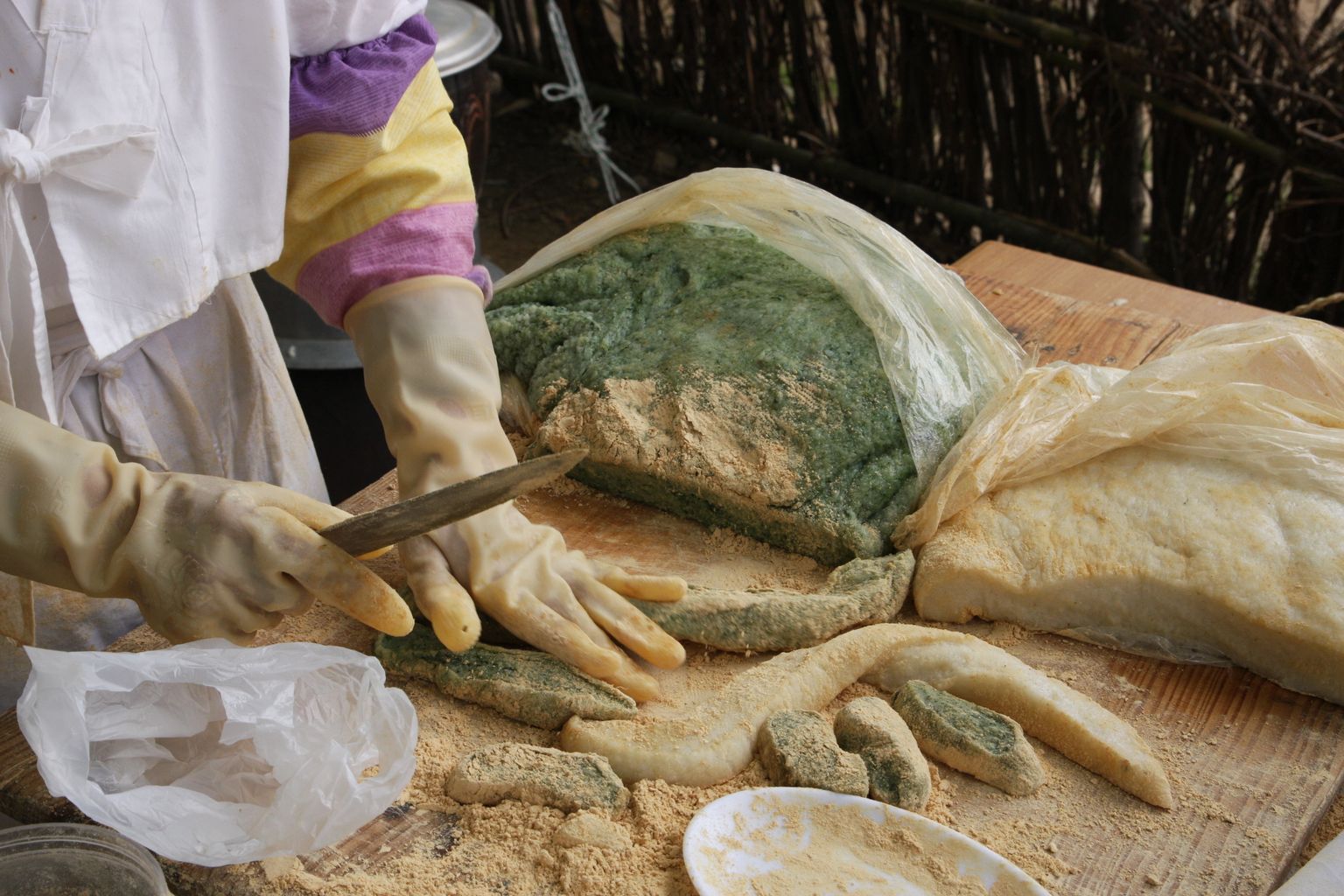
Songpyeon (송편) are half-moon-shaped rice cakes made from short-grain rice dough, filled with something sweet — sesame seeds and sugar, chestnut paste, sweetened mung bean, or red bean — then steamed over a bed of pine needles. That’s actually where the name comes from, “song” referencing pine. The needles aren’t just decorative; they give the rice cakes a faint, specific fragrance, and steaming this way is one of those small technique details a Korean grandmother will correct you on if you try to skip it.
Why half-moon shaped, given that the holiday itself revolves around the full harvest moon? There’s a popular explanation rooted in an old Korean saying that a crescent moon holds more promise than a full one, because a full moon can only wane afterward. The half-moon shape is meant to symbolize a future that’s still filling out, still becoming something. It’s a nice piece of folk logic once you sit with it for a second.
There’s also a long-running bit of folklore that a young unmarried woman who shapes especially pretty songpyeon will end up with a good-looking spouse, or a beautiful daughter someday. Nobody today treats it as an actual dating strategy — it’s the kind of half-joking thing an aunt says to tease a niece over the mixing bowl. But it tells you something real about how songpyeon-making functions socially: it’s less about the finished rice cake and more about the hours a family spends sitting around a table together, hands covered in rice flour, actually talking. If you get invited to help make songpyeon, say yes. Nobody expects your shapes to look professional, and it’s one of the more genuinely fun parts of the whole holiday.
Gwihyanggil: The Great Migration Home
Here’s something worth planning around: Chuseok triggers a nationwide traffic event. Koreans call the journey home for the holiday gwihyanggil (귀향길), literally “the road of returning to one’s hometown,” and it’s not a small-scale phenomenon. A large share of the country’s population — commonly cited figures run somewhere around a third to over half of all Koreans, depending on the year — travels during the holiday window, mostly converging on the same handful of highways at the same handful of hours.
The practical result: a drive from Seoul to a city like Busan, which normally takes about four to five hours, can stretch to twelve hours or more during peak departure times. Train tickets for the high-speed KTX lines toward popular hometown destinations sell out within minutes of going on sale weeks in advance. I’ve watched Korean coworkers set alarms for the exact second reservations open, the same way people camp out for concert tickets.
If you’re planning to travel anywhere in Korea during the Chuseok window, either book absurdly early or accept that you might lose a day to traffic. Seoul itself, meanwhile, goes strangely quiet, which — if you’re staying in the city rather than traveling — is honestly one of the more pleasant times to explore usually-packed neighborhoods like Hongdae or Myeongdong without the crowds.
And while a chunk of the country is sitting in traffic, another chunk is doing battle in a very different arena: the gift aisle of the local department store.
The Gift-Giving Economy of Chuseok
This part of the holiday looks, at a glance, almost more corporate than familial. Chuseok is one of two major gift-giving seasons in Korea (the other is Seollal, Lunar New Year), and department stores, supermarkets, and companies all build entire marketing calendars around it. Walk into any large grocery store in the weeks before Chuseok and you’ll find towering, elaborately packaged gift sets: boxed sets of Korean pears and apples, Korean beef, toiletries, even health supplement sets for elderly relatives.
Then there’s the Spam. Premium Spam and canned tuna gift sets are a genuinely popular Chuseok present, which sounds bizarre to a lot of Western visitors until you know the backstory. Canned meat entered Korea through U.S. military bases after the Korean War, at a time when meat of any kind was scarce and expensive for most households. It became associated with prosperity and access — a taste of American abundance during a hard postwar stretch — and that association never fully faded, even as Korea became one of the wealthiest countries in the world. Gifting a nicely boxed set of Spam today isn’t about the meat itself; it’s a small callback to what used to count as luxury.
Companies routinely give Chuseok bonuses or gift sets to employees, and it’s common for people to send gift boxes to bosses, landlords, or business partners they want to maintain goodwill with. It’s less about the monetary value and more about the gesture of being remembered. If you work at a Korean company, don’t be surprised if a gift box shows up on your desk in the days before the holiday. Reciprocating in some small way, even just a thoughtful note or a modest gift to a close colleague, is generally appreciated.
You’ve Been Invited to a Korean Family’s Chuseok — Now What?
This is genuinely one of the more meaningful invitations you can receive as a foreigner in Korea. It usually means the family considers you close, not just polite company. A few things worth knowing going in:
Bring something, but keep it modest. Fruit, a nice box of cookies, or a small gift set from a department store food hall is the standard move — nothing extravagant, nothing that risks embarrassing anyone by seeming to one-up the household. Cash isn’t typically expected from a guest the way it might be at a wedding.
Dress a notch more conservative than you think you need to. You don’t need a hanbok — most Korean families don’t wear one for the day-to-day parts of Chuseok anymore, saving it for photos or temple visits — but modest, presentable clothing shows you understand the day has some formality to it.
If charye is happening, watch first, and treat it as a rite, not a photo op. It’s fine to ask quietly beforehand whether it’s okay to observe, and ask before taking any pictures at all. Most families are happy to explain what’s happening if you show genuine curiosity, but showing up with a camera phone already raised reads the wrong way.
Offer to help in the kitchen, and expect to be gently refused at first. This is a very Korean social dance — the host insists you relax, you insist on helping, and eventually you’re handed a low-stakes task like shaping songpyeon or setting the table. Keep offering. It’s genuinely appreciated even when it’s initially waved off.
Prepare for pointed personal questions, and have a soft deflection ready. Questions about your job, your salary bracket, your marriage plans, or your weight can come up more directly than Western small talk norms allow, especially from older relatives. It’s less about being nosy and more about how status and care get expressed in a hierarchical family structure. If an auntie asks why you haven’t bought an apartment yet, a light “I’m still working on it, but I’m hopeful!” paired with a smile and a quick topic change usually lands fine — deflecting with humor rather than a flat “that’s personal” tends to keep the mood warm.
A Few Quick Answers Before You Go
Is Chuseok the same as Lunar New Year (Seollal)? No, though outsiders often confuse them since both are lunar-calendar family holidays with ancestral rites. Seollal happens in late January or February and centers on the new year, tteokguk (rice cake soup), and sebae bowing for New Year’s money. Chuseok happens in autumn and centers on the harvest, songpyeon, and the fuller charye ceremony.
Are businesses and restaurants closed during Chuseok? Many small businesses, traditional markets, and family-run restaurants close, especially in neighborhoods where owners travel to their hometowns. Larger chains, convenience stores, and most spots in central Seoul tend to stay open, though hours can be reduced. Worth checking ahead if you’re relying on a specific place.
What should I say to someone during Chuseok, as a greeting? “Chuseok jal bonaeseyo” (추석 잘 보내세요) — roughly “have a good Chuseok” — works well and is genuinely appreciated coming from a foreigner, even with imperfect pronunciation. It signals that you actually know what the holiday is, which goes a long way.
Chuseok took me a few years to actually understand rather than just observe, and I’d guess that’s true for a lot of expats, even ones who’ve lived here a decade. It’s a holiday that rewards curiosity over distance — the more questions you ask a Korean host, the more the whole thing opens up, from the folklore behind the rice cakes to the quiet choreography of who bows first. If a Korean family ever invites you into that world, it’s worth showing up for.
Leave a Reply