The first time I watched a table of Korean coworkers order drinks, I noticed something strange: nobody ever filled their own glass. Bottles moved constantly, hands reached across the table, but everyone waited — sometimes for a beat too long, glass sitting empty in front of them — until someone else picked up the soju and poured. I remember thinking it looked almost like a small, silent choreography that everyone but me already knew the steps to. Years into life here, I still find Korean drinking culture to be one of the clearest windows into how this society thinks about hierarchy, care, and belonging. It is not just about alcohol. It is about who you are to the person sitting across from you.
If you are new to Korea, or just planning a trip, the etiquette around soju, beer, and makgeolli can feel like a minefield of unspoken rules. Do you really have to use two hands? Is it actually offensive to pour your own drink? Can you say no without causing a scene? Below is what I’ve picked up — not as an anthropologist, but as a foreign dad who has sat through enough company dinners, in-law gatherings, and neighborhood barbecues to have absorbed the basics, sometimes the hard way.
Rule One: You Never Pour Your Own Glass
This is the rule that trips up almost every newcomer, because it runs against instinct. In most Western drinking settings, self-service is normal — you finish your beer, you pour another, nobody blinks. In Korea, filling your own glass is read as a small social failure. It signals that you are not paying attention to the people around you, or worse, that you don’t care to be.
The unspoken system works like this: you watch the glasses near you, and when someone’s runs low, you pick up the bottle and top them off. In return, they will watch yours. It is a kind of mutual surveillance dressed up as courtesy — everyone is quietly responsible for everyone else’s cup. At a lively dinner table, this can mean your glass gets refilled before it’s even half empty, which is its own kind of lesson in pacing yourself.
What surprised me most is how automatic this becomes once you’re used to it. After enough dinners, I catch myself instinctively reaching for a bottle the moment I notice an empty glass nearby, even at gatherings that have nothing to do with work. It stops feeling like a rule and starts feeling like manners.
The Two-Handed Pour: Reading the Room With Your Hands
Once you understand that pouring is a social act rather than a convenience, the two-handed gesture makes a lot more sense. When you pour for someone older than you, or someone more senior in a professional or family sense, the expectation is that you hold the bottle with your right hand while your left hand supports your right wrist or forearm. It is a small physical bow built into the motion of pouring a drink.
The same logic applies in reverse. When an elder pours for you, you are expected to hold your glass with both hands, or at minimum steady it with your left hand while your right hand holds the cup. Receiving with one careless hand, like you might grab a coffee mug, can come across as brusque even if no one says anything about it.
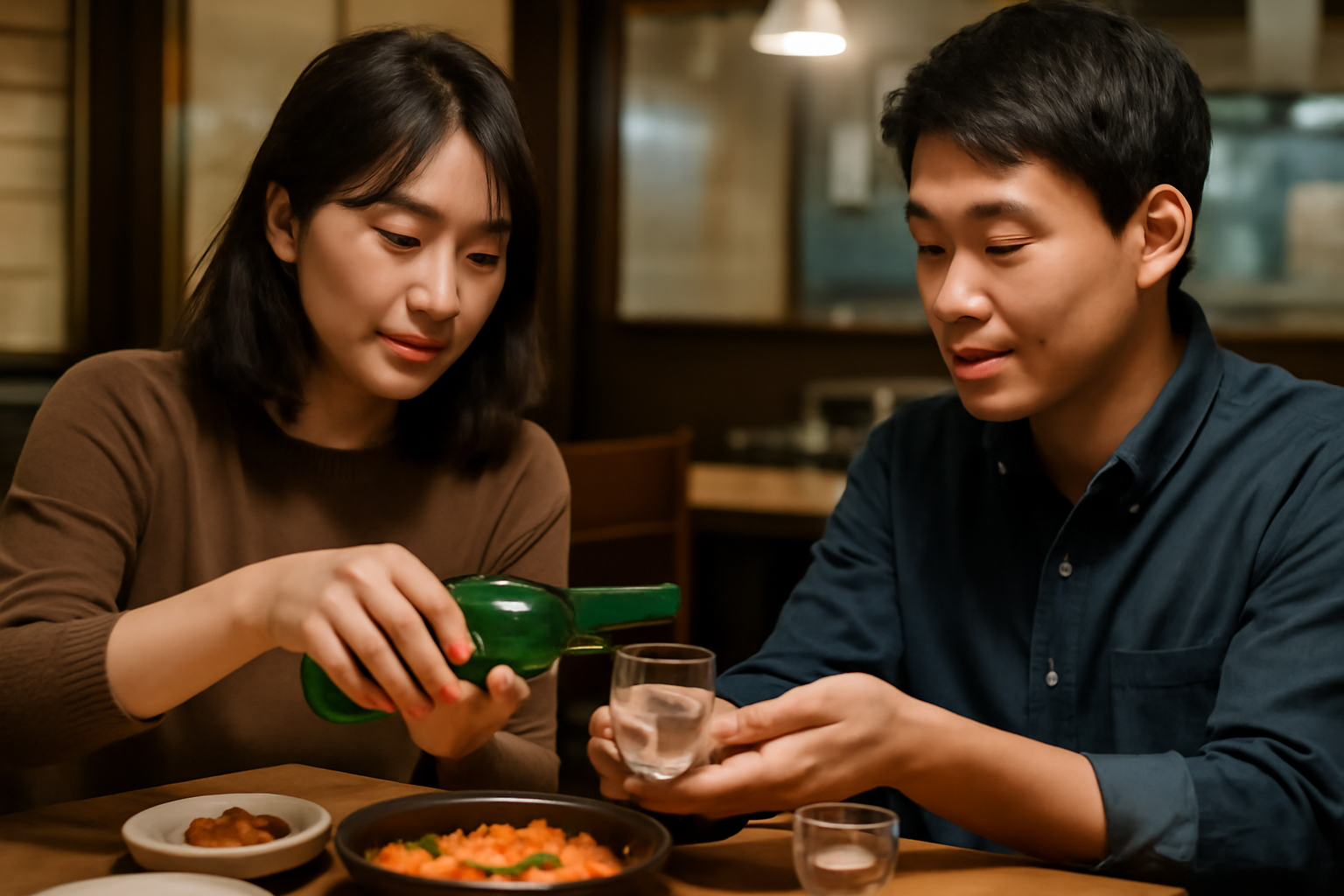
None of this is written down anywhere you’ll find as a tourist. Nobody hands you a manual at the airport. You learn it by watching, by the faint wince on someone’s face when a young colleague pours one-handed for a boss, or by a gentle correction from a mother-in-law who says nothing critical but quietly repositions your hands the next time around. It’s subtle instruction, and it works.
Age and seniority in Korea aren’t abstract concepts confined to job titles — they show up physically, in how a bottle is held. That’s part of what makes this custom interesting to me as an outsider. It turns a hierarchy that could otherwise stay invisible into something you can actually see happening at the table.
Turning Away: The Etiquette of Drinking With Elders
This is the custom that tends to surprise people the most, because it looks almost theatrical the first time you see it. When drinking directly with someone significantly older — a parent-in-law, a boss, a senior relative — the polite move is to turn your head and body away from them slightly before taking the drink, often covering the glass with your free hand as you do.
The origins trace back to Confucian ideas about respect and modesty: it was considered inappropriate to let an elder watch you drink directly, since the act of drinking involves an open mouth and, in the case of a full shot, some amount of unglamorous swallowing. Turning away softens that moment, keeps things decorous, and visually acknowledges the age gap in the room.
In practice today, the gesture has loosened somewhat with younger, more casual company, but it has not disappeared. I still see it reliably at family gatherings and formal work dinners, and I’ve come to appreciate it as one of those customs that looks strange from the outside and makes complete sense once you understand the values underneath it. It’s not about hiding the drink. It’s about not making a spectacle of yourself in front of someone you owe deference to.
Wonsyaht: The Pressure and the Escape Hatch
No conversation about Korean drinking culture is complete without wonsyaht (원샷) — a Konglish rendering of “one shot,” meaning to down your drink in a single go. It usually erupts after a toast, especially an enthusiastic one, or as a mock penalty in a drinking game. Someone raises a glass, calls out “wonsyaht!”, and the table drains their cups in unison, often followed by the exaggerated upside-down glass to prove it’s empty.
It can feel like peer pressure with a smile on it, and for a long time it functioned as an actual test of loyalty and stamina at company dinners, where drinking heavily with your boss was treated as a bonding ritual and sometimes an unofficial job requirement. That culture is real, and it’s part of why South Korea has one of the more alcohol-heavy corporate social scenes in the world.
But — and this matters — you are not obligated to one-shot every drink, and increasingly, nobody expects you to. Sipping is fine. Nursing a single glass through an entire dinner is fine. The custom persists as a fun, expressive gesture more than an enforced rule, particularly outside of the more traditional, hard-drinking corners of corporate culture. If someone calls “wonsyaht” and you’d rather sip, a small smile and a slower drink rarely draws real criticism anymore.
Is It Actually Rude to Refuse a Drink?
This used to be one of the trickier questions for foreigners, and honestly for younger Koreans too. There was a time when refusing alcohol at a group dinner, especially a work one, could be read as standoffish or even disrespectful to the person offering. Some of that pressure still exists in more traditional or older-generation settings.
But attitudes have shifted noticeably. Health consciousness, changing workplace norms, and a broader cultural move away from mandatory group drinking have made it far more acceptable to decline. The simplest, most universally understood way to do it is a small physical gesture: place your hand lightly over the top of your glass when someone moves to pour, paired with a polite “gwaenchanayo” (괜찮아요 — “I’m okay” or “it’s fine”). Nobody pushes further after that, in my experience.
If you want to stay warm and engaged without drinking, there’s an easy workaround that Koreans themselves use constantly: keep pouring for everyone else. Being the person who tops off the table’s glasses, who keeps an eye on who needs a refill, lets you participate fully in the social ritual without touching a drop yourself. Attentiveness, not alcohol, is really the currency at these tables.
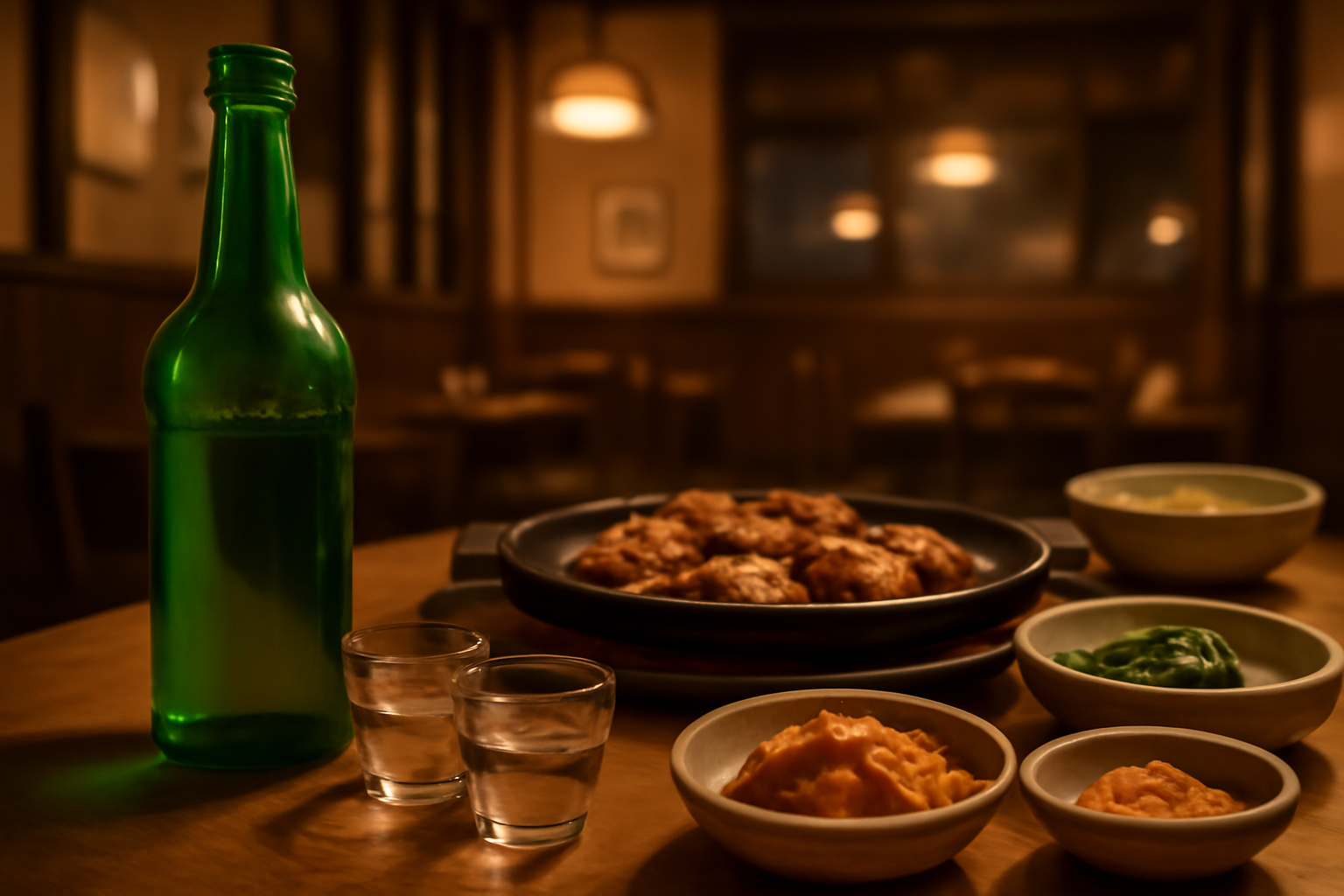
Honsul: Drinking Alone Without the Stigma
For decades, drinking in Korea was fundamentally a group activity — an extension of team-building, family bonding, or celebration, rarely a solitary act. Sitting alone at a bar with a glass of soju used to invite curious or pitying looks, the kind reserved for someone assumed to be nursing heartbreak or loneliness.
That has changed substantially. Honsul (혼술) — literally “alone-alcohol,” or drinking solo — has become its own accepted lifestyle choice, part of a broader honjok (혼족, “alone tribe”) movement that also includes honbap (eating alone) and honyeo (traveling alone). Convenience stores now sell smaller drink formats and easy solo-friendly snack pairings specifically aimed at this market. Bars with single-seat counters, once rare, have become common enough in cities like Seoul that they barely register as unusual anymore.
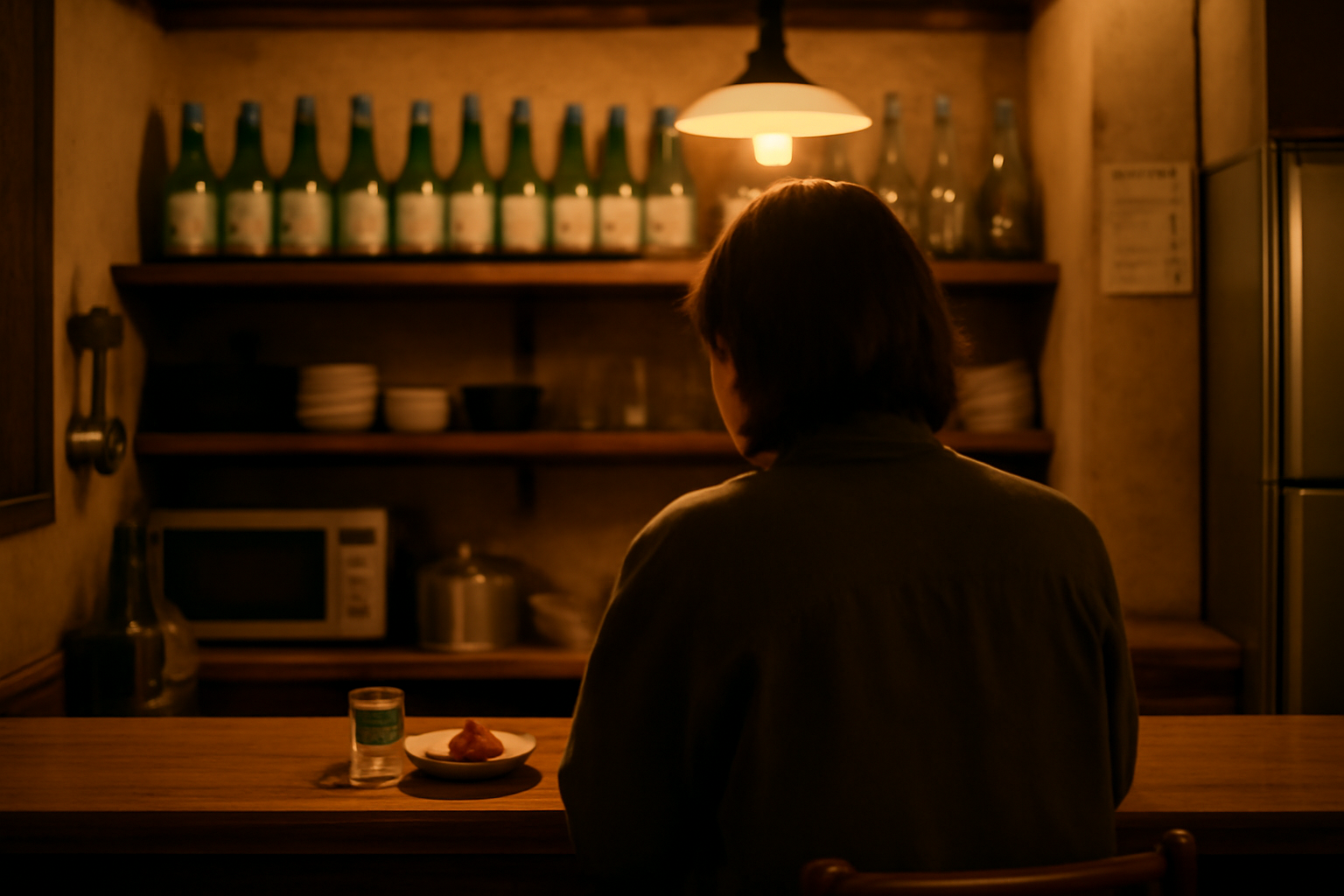
I find the honsul shift genuinely interesting to watch unfold, because it says something bigger about Korean society than just drinking habits. A culture historically organized around the group — family units, school cohorts, company teams — is quietly making room for people who want a quiet glass on their own terms, no explanation required. It doesn’t mean the group-drinking culture is disappearing. Company dinners and boisterous group tables are still everywhere. But the space for solitude has widened, and nobody assumes something is wrong with you for choosing it anymore.
Putting It Together at the Table
None of these customs exist in isolation — they layer on top of each other at a real dinner table. You watch glasses and refill them before they empty. You use two hands when age or rank calls for it. You turn slightly away when drinking with someone senior. You call or answer a wonsyaht if the mood strikes, or you don’t, and either is fine. You decline politely with a hand over your glass if you’re not drinking, and you stay useful by pouring for others instead. And if you’d rather sit at a quiet counter with a single glass and your own thoughts, that’s a completely normal way to spend an evening too.
What strikes me most, having watched this from the outside for years now, is how much emotional information gets packed into these small physical gestures — the angle of a wrist, the tilt of a head, the choice to top off someone’s glass before your own. It’s a language you pick up slowly, mistake by mistake, correction by gentle correction, until one day you realize you’re doing it without thinking. That, more than anything, is when a place starts to feel less foreign.
Frequently Asked Questions
My Korean coworker’s boss is at the table. Should I pour for the boss with two hands even though I barely know him?
Yes. The two-handed pour is tied to seniority and age, not familiarity. If you’re pouring for someone clearly senior — a boss, an elder relative, a teacher — use your right hand on the bottle with your left hand supporting your wrist or forearm, regardless of how well you know them. It reads as basic respect, and getting it right on a first meeting tends to leave a good impression precisely because so few foreigners know to do it.
I don’t drink at all for health reasons. Will people be offended if I never touch my glass?
Generally, no — this is one of the areas where Korean etiquette has genuinely relaxed. A polite “I don’t drink” or a hand over your glass when the bottle comes around is well understood today, especially with younger Koreans and in most professional settings. If you want to soften it further, mention a simple reason (health, medication, or just personal preference) and offer to pour for others instead. That keeps you socially engaged even while sitting the actual drinking out.
Is it weird to go to a Korean restaurant or pojangmacha alone and order soju just for myself?
Not anymore. Honsul culture has made solo drinking a normal, even trendy, choice, particularly in cities. You’ll increasingly find bars with single-seat counters designed exactly for this. Older, more traditional establishments in smaller towns may still see it as unusual, but in general it no longer carries the stigma it once did — nobody will assume something is wrong if you’re enjoying a quiet drink by yourself.
Leave a Reply