
My father-in-law poured my first shot of soju at a barbecue place in Ilsan back in 2016, and I did everything wrong. I grabbed the glass with one hand, drank facing him head-on, and then — the real crime — reached for the bottle to pour myself a second round before anyone offered. Nobody yelled at me. My wife just put her hand over mine, gently moved the bottle back to the table, and said, “Not like that.” That one dinner taught me more about Korean social hierarchy than any book could have, and ten years later I still catch myself running the checklist in my head before the first glass ever touches the table.
Korean drinking culture isn’t really about alcohol. It’s a language. Who pours for whom, who turns away, who orders the second round — every gesture is a small transaction of respect, and once you can read it, you can read a lot about how a Korean workplace or family actually functions. I’ve written before about two narrower slices of this — whether it’s rude to say no to a drink and why you never pour your own glass — but this time I want to zoom out and lay out the whole system, the way I had to learn it in real time, glass by glass.
The Two-Handed Rule Isn’t Optional
Here’s the rule that trips up almost every foreigner in their first week: when you pour for someone older or more senior than you, you hold the bottle with your right hand and rest your left hand somewhere on your right forearm — near the wrist, near the elbow, doesn’t matter exactly where, as long as the left hand is visibly supporting the pour. Receiving works the same way in reverse. When someone senior pours for you, you hold your glass with both hands, or at minimum keep your glass hand supported by the other. I’ve seen my father-in-law wince, actually wince, when a younger relative poured with one hand like they were serving tap water at a diner.
What surprised me is how much this scales with the gap in status, not just age. Pouring for my wife, who’s a few years younger than me, I don’t think twice about using one hand. Pouring for her father, both hands, every time, no exceptions, even after a decade of him telling me I don’t have to be so formal. And pouring for my own boss back when I worked a contract job in Gangnam — I used two hands so deliberately that a coworker once joked I looked like I was defusing a bomb. Korean etiquette isn’t designed for physical comfort; it’s designed to signal, instantly and wordlessly, that you know exactly where you stand relative to the person across the table.
Turning Away: 고개 돌리고 마시기
The custom that still feels the strangest to explain to friends back home is 고개 돌리고 마시기 — literally “turning your head and drinking.” When you’re drinking in front of someone senior, particularly an elder, you angle your body slightly away from them, turn your head to the side, and often cover the glass or your mouth with your free hand as you drink. I asked my mother-in-law about it once over dinner in Bucheon, and she said something that stuck with me: “You don’t show your face while drinking in front of your elders. It’s like turning away to sneeze.” The comparison isn’t perfect, but it captures the spirit — it’s not shame about drinking itself, it’s about not putting your unguarded face on display in front of someone you owe deference to.
I’ll admit the first few times I did it, it felt almost performative, like I was in a period drama. But I’ve come to see it differently. At a work dinner in 2019 with my wife’s old team, I watched a 24-year-old new hire turn fully sideways in her chair to drink in front of the department head, who was maybe 55. Nobody commented on it. It was just the water everyone swims in. And honestly, once you do it enough times, it stops feeling theatrical and starts feeling like just… manners. The same way you’d angle away to cough.
Why Nobody Pours Their Own Glass
I’ve covered this one in depth elsewhere, but it deserves a mention here because it’s structurally central to everything else. In Korea, you don’t pour your own drink — someone else fills your glass, and you keep an eye on theirs in return. The rule forces constant, low-level attention to the people around you: you can’t zone out at a Korean dinner table, because part of your job is watching every glass within reach and topping it off before it runs dry, especially if you’re the youngest person there. At my first hoesik, my wife’s colleague — the most junior guy on the team, maybe two years into the company — spent half the night doing almost nothing but refilling glasses. He barely ate.
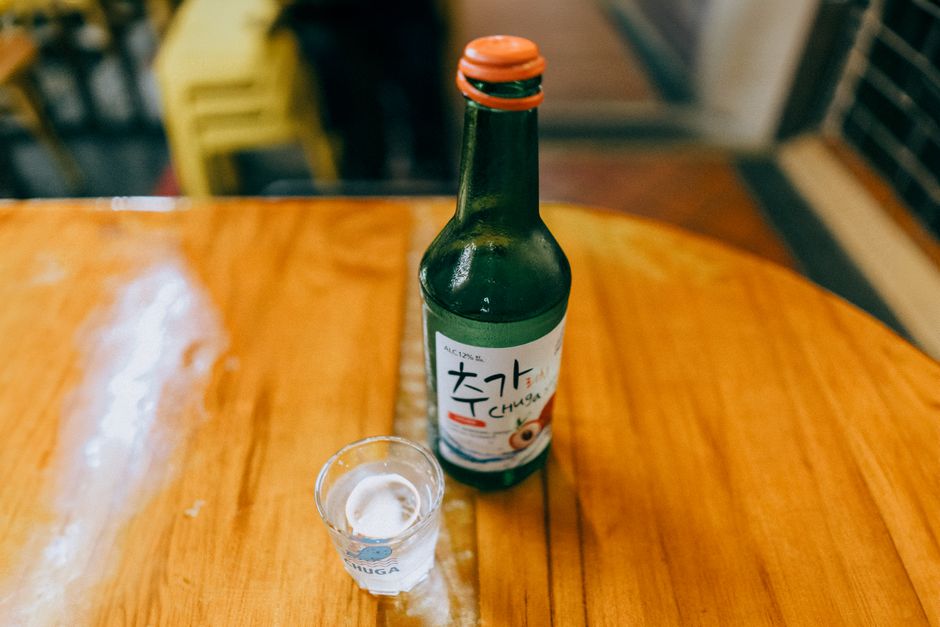
That’s the unspoken job description of being the maknae, the youngest, at a Korean table, and it’s less punishing than it sounds. My brother-in-law told me once that his own maknae years — running drinks, refilling side dishes nobody asked him to refill, laughing at every joke the department head made even the third time around — are what he actually looks back on fondly now that he’s the senior guy at the table. It’s a shared hazing that everyone in the room has already survived, which is part of why nobody feels sorry for the current maknae; they just remember being him. And when a junior finally gets promoted and someone newer takes over the pouring, there’s usually a small, half-joking ceremony to it — someone announces “이제 너는 아니야” (you’re off the hook now), and the outgoing maknae gets handed a full glass instead of pouring one for once.
회식: The Company Dinner That Isn’t Optional (Or Wasn’t)
회식 (hoesik) technically just means “staff dining,” but functionally it’s closer to a mandatory team-building exercise that happens to involve soju. A department head announces a hoesik, usually with a day or two of notice, sometimes with none at all, and the team goes out — Korean barbecue first, then often a “2차” (second round) at a different bar, and occasionally a “3차” that ends at a noraebang around 1 a.m. I remember my brother-in-law, who worked at a mid-sized construction firm in Incheon, describing a stretch in 2018 where his team had hoesik three nights in a row during a project crunch, and turning down even one of them was treated as a mild character flaw.
That’s changing, and I think it’s worth being honest about the direction it’s changing in rather than just describing the old version like it’s still universal. A Korea Times survey found that 56 percent of Koreans aged 19 to 29 said in 2024 that they either don’t drink at all or drink no more than once a month — the highest that number has been since the survey started in 2005. A lot of that shift traces back to the pandemic years, when hoesik simply stopped happening for a while, and plenty of younger employees discovered they didn’t miss it. I’ve noticed it myself in the last couple of years — coworkers who used to grumble and go now just say “저는 빠질게요” (I’ll sit this one out) and nobody blinks. The hierarchy that used to make hoesik feel compulsory hasn’t disappeared, but it’s noticeably looser than it was even five years ago.
You can actually see it in the neighborhoods. Walk through Hongdae or Gangnam on a Thursday night in 2026 and you’ll still find plenty of loud, soju-heavy tables, but you’ll also see far more of what didn’t really exist when I first moved here — barbecue places doing brisk business at 8 p.m. with tables ordering zero alcohol at all, and a noticeable rise in “무한리필” (all-you-can-eat) meat spots that market themselves on the food, not the drinking. A friend who manages a restaurant near Gangnam Station told me their alcohol sales as a share of total revenue have dropped year over year since 2021, even as the tables stay full. Companies have adjusted too — a lot of hoesik now start earlier, wrap up after one round, or get rebranded entirely as “런치식” (lunch hoesik), which is exactly what it sounds like: the same team bonding, minus the soju and the 1 a.m. finish.
Even so, when a traditional hoesik does happen — especially the kind meant to kick off a big project or celebrate a contract win — the old rituals still show up in full force, poktanju included.
Soju Bombs and the Ritual of Mixing
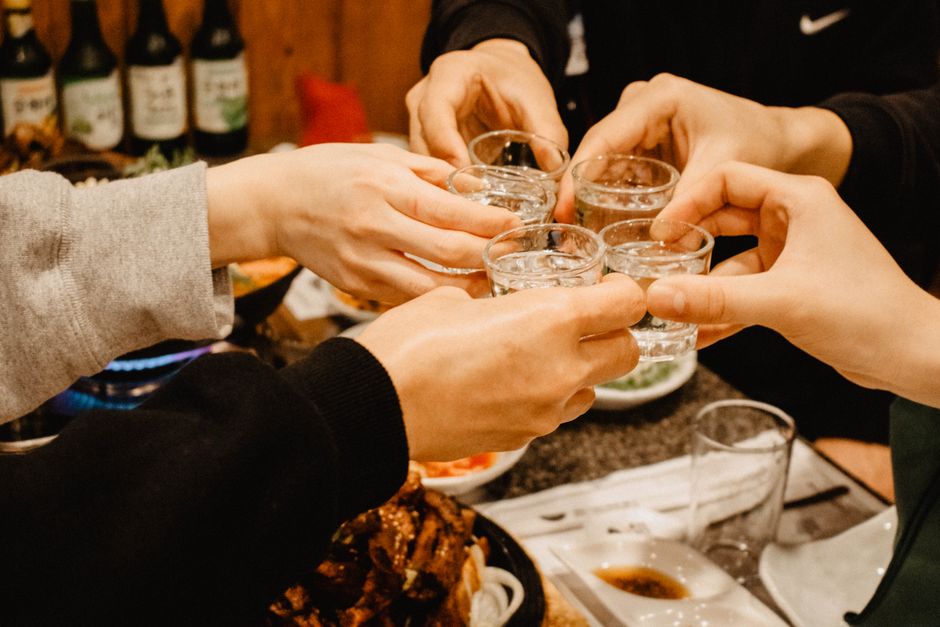
Poktanju (폭탄주), the “bomb drink,” is soju dropped into beer — the gentler modern version is called somaek, a portmanteau of soju and maekju (beer). The tradition traces back to the 1970s, when it became something of a workplace ritual, and there’s real showmanship to how it’s made. I’ve seen a senior colleague spin a spoon balanced on top of a shot glass of soju inside a beer glass until it drops in on its own, and I’ve seen people line up a row of glasses and knock them like dominoes so the soju cascades down the row into beer below. The person mixing is usually someone senior or someone who’s simply good at it, and there’s a small performance element to the whole thing — people clap, someone records it on their phone, it becomes the highlight of the night’s photos.
I want to be careful here, because it’s easy for an outsider to describe soju bombs and make it sound like the goal is speed-drinking. It isn’t, or shouldn’t be. The ritual is about the shared moment — the countdown, the clink, everyone drinking together on cue — not about who can down the most glasses. The healthiest hoesik culture I’ve been part of treats poktanju as a once-per-night novelty, not a repeating event, and honestly the times I’ve seen it get out of hand are exactly the times people remember the night badly the next morning. If you’re at a table where the bombs keep coming and nobody’s checking in on how you’re doing, that’s not tradition, that’s just bad hosting, and it’s fine to say so with your feet if you need to.
When “No” Is Fine, and When It Actually Lands Badly
This is the part people get most anxious about, so let me be concrete. Saying no to a single round, or nursing one drink through a whole dinner, is almost never a problem anymore — I do it constantly, especially since I started running in the mornings and stopped wanting to nurse a hangover through a 6 a.m. jog along the Anyangcheon. The way you say no matters more than the no itself. If someone pours for you and you don’t want to drink, you don’t leave the glass sitting there ignored — you touch it to your lips, or take a small token sip, or simply say “저 오늘 컨디션이 안 좋아서요” (I’m not feeling great today) while gesturing that your glass is still fine. What actually reads as rude is refusing a poured drink outright without any acknowledgment, or worse, refusing to let someone pour for you at all — that one can genuinely sting, because it can read as refusing the relationship, not just the alcohol.
There’s also a level above the individual glass: refusing to attend a hoesik altogether used to be the harder no, though as I mentioned, that’s softened a lot. My own read, after years of this, is that Korean drinking culture has gotten a lot more tolerant of “I don’t drink” as a blanket policy and much less tolerant of “I don’t drink with you specifically,” which still reads as a pointed social snub. Say no to the substance all you want. Don’t make it look like you’re rejecting the person pouring.

Where the Rules Loosen: Drinking With Close Friends
Almost everything above assumes a hierarchy is in the room — an elder, a boss, someone senior enough that the formality matters. Take that away and the whole system relaxes fast. With my closest Korean friends, guys I’ve known since my early years here, we pour one-handed, we don’t turn away, and somebody’s already refilling their own glass before the bottle’s even made it around the table once. The two-handed pour and the head turn aren’t really about the physical act of drinking — they’re about signaling rank, and among genuine peers there’s no rank to signal, so the gestures fall away almost automatically, not as a rule you consciously break.
What’s interesting is watching the switch happen in real time. I’ve sat at tables where a boss leaves after the first round and says “이제 편하게 마셔” (drink comfortably now), and the whole table visibly loosens — people slouch, pour for themselves, laugh louder. It’s not disrespect; it’s understanding exactly which mode you’re supposed to be in and calibrating to the room correctly when the mode changes. That instinct — knowing which version of the rules applies to this exact table, tonight — is really what the whole etiquette system is training you to build.
I think about that first dinner in Ilsan a lot, actually. Ten years on, I don’t fumble the two-handed pour anymore, and turning my head to drink in front of my mother-in-law isn’t a performance — it’s just what my body does now, the same way I don’t think about buckling a seatbelt. What changed wasn’t that I memorized a list of rules. It’s that I finally understood what the rules were for: reading a room full of relationships and responding to it correctly, glass by glass. My father-in-law still brings up that first night sometimes, usually after a few rounds, and usually to remind me how far I’ve come — which, I’ve learned, is its own kind of compliment in this culture. A few practical questions people ask me most often, before we wrap up:
FAQ
Do I really have to turn away every single time I drink in front of an elder, even at a casual family dinner? In practice, yes, if the elder is present and it’s a drinking context — a Chuseok family dinner, a grandmother’s birthday meal. I still do it with my mother-in-law even after ten years, purely out of habit at this point. But at a mixed table where everyone present is roughly your peer and the “elder” is more like an older cousin than a parent figure, people tend to relax it. Read the room; when in doubt, turn slightly.
What if I genuinely can’t drink for health reasons — will people push back? In my experience, no, not if you say it plainly and early. “저는 술을 못 마셔요” (I can’t drink alcohol) said once at the start of a meal is generally respected, and Korean drinking culture has gotten noticeably more accommodating of this over the past several years as the younger generation’s own drinking rates have dropped. What doesn’t land well is agreeing to a round and then leaving the glass full and untouched without saying anything — that reads as awkward rather than the clear boundary it’s meant to be.
Is it rude to ask for a soju bomb to be made weaker, or to skip it? Not at all, and I do this constantly now. You can ask for a lighter mix, or simply let the glass sit through that particular round and join back in on the next one. Nobody at a decent table is tracking your exact intake glass by glass — they’re tracking whether you’re engaged and having a good time, which you can absolutely do at your own pace.
Leave a Reply