There’s a particular kind of silence that falls over a Korean table when you say the wrong ending on a sentence. Not the whole sentence — just the ending. One syllable, really. I still remember the first time it happened to me, sitting across from my father-in-law at a family dinner not long after I’d moved to Korea, feeling proud of how much Korean I’d picked up in a few months. I dropped a casual “-eo” ending onto something I meant to say politely, and for about two seconds nobody moved. My wife’s eyes went wide. Her father just blinked at me, then laughed it off, but I could feel the temperature of the room change and come back, like a thermostat resetting. That two-second silence taught me more about Korean than any textbook chapter had.

If you’ve spent any real time in Korea, you’ve probably had your own version of that moment. Maybe you called a stranger “you” the wrong way, or answered your boss with the ending you use with your roommate, or — like me — got too comfortable too fast with someone who technically outranked you by age or position. The thing underneath all of these moments has a name: the jondaetmal and banmal system, and once you understand how it actually works, a huge amount of what feels confusing or arbitrary about Korean social life starts to make sense.
What jondaetmal and banmal actually are
Jondaetmal (존댓말) is polite, formal Korean. It’s the language of sentence endings like “-yo” and “-seumnida,” and it’s the version of Korean you’ll hear on the news, in customer service, in classrooms, and in pretty much every interaction where the speakers aren’t close or aren’t equals. Banmal (반말), which literally translates to something like “half speech,” is the stripped-down, casual version — shorter endings, more direct phrasing, the Korean you’d use with a childhood friend or a younger sibling.
It’s tempting for English speakers to think of this as roughly equivalent to the difference between “Would you like to sit down?” and “Sit down,” but that undersells it. In English, formality is mostly a matter of word choice and tone. In Korean, formality is baked into the grammar itself — the verb endings change, certain nouns and even some verbs swap out entirely for more elevated versions, and the whole architecture of the sentence shifts depending on who you’re speaking to and how you’re positioned relative to them. It’s less like choosing a formal outfit and more like the outfit determining which language you’re allowed to speak at all.
This is why jondaetmal and banmal aren’t really a matter of politeness in the Western sense of “being nice.” They’re a structural feature of the language that encodes a relationship every time you open your mouth. You can’t really speak Korean without implicitly answering the question: who is this person to me?
When each one shows up
Jondaetmal is the default. If you’re speaking to a stranger, a store clerk, a coworker you’ve just met, someone noticeably older than you, or basically anyone in a professional or public context, jondaetmal is what you reach for. It’s the safe setting. Korean children are taught from a young age to speak jondaetmal to adults, teachers, and anyone outside their close circle, and that habit doesn’t go away in adulthood — it just gets redirected toward new categories of people: managers, in-laws, senior coworkers, the older regular at the neighborhood café who somehow knows everyone’s business.
Banmal, on the other hand, is reserved territory. It shows up between close friends who are the same age, among siblings, from parents to children, and from an older person to someone clearly younger once a relationship has been established. But — and this is the part that trips up a lot of foreigners — banmal is not the “casual, relaxed, no big deal” mode that its English description makes it sound like. Using it with the wrong person, or too early, can land as genuinely disrespectful, even if you didn’t mean it that way at all.
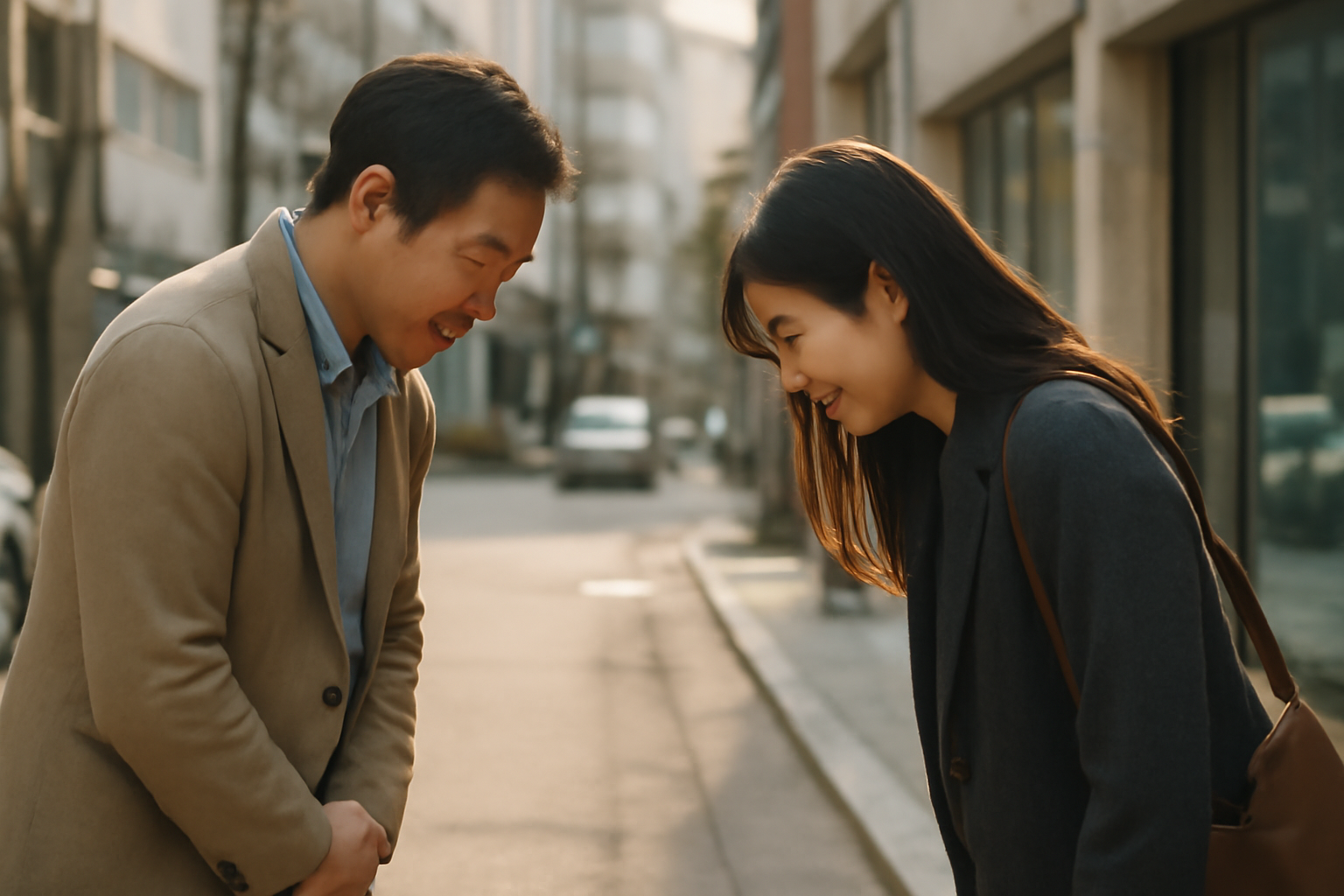
The age factor, and why Koreans ask “how old are you” so fast
One of the first things a lot of visitors notice is how quickly Koreans ask each other’s age when they meet. It can feel invasive if you’re not used to it, almost rude by the standards of some other cultures. But once you understand the honorific system, the question makes total sense — it’s not idle curiosity, it’s logistics. Age (along with seniority in school or work) is one of the main variables that determines who uses jondaetmal to whom, and whether banmal is even on the table. Without that piece of information, two Korean speakers genuinely don’t know how to grammatically address each other. Asking someone’s age isn’t nosiness; it’s the fastest way to figure out how to speak to them correctly.
Once the age gap is established, the social script mostly writes itself. The older person may eventually switch to banmal with the younger one, especially as they get closer, while the younger person typically keeps some version of jondaetmal going, sometimes for years, sometimes forever, depending on the relationship. Even a one-year age difference can matter in Korea in a way that feels foreign to people from more age-flattened cultures. It’s not that the younger person is considered lesser — it’s that the language has a built-in way of marking who came first, and Korean social custom generally expects that to be acknowledged.
The “permission to banmal” moment
If there’s one part of this system that foreigners find both charming and stressful, it’s the moment when two people who’ve been speaking jondaetmal to each other decide to switch to banmal. It’s rarely announced outright in a formal way, but it is usually negotiated somehow — a slightly awkward “should we just speak comfortably with each other?” or a half-joking “we’re close enough now, right?” It’s a genuine milestone in a friendship, almost like a verbal handshake that says: we’re equals now, or at least equal enough that the ladder between us doesn’t need to be climbed every sentence.
What makes it stressful for foreigners is that you can’t always tell when that moment is supposed to happen, and getting it wrong in either direction carries a cost. Switch to banmal before it’s offered, and you risk looking presumptuous or even disrespectful, especially with someone older. Stay locked in jondaetmal long after a friendship has clearly become close, and you risk something subtler — a kind of emotional distance that Korean friends sometimes notice and comment on, the sense that you’re keeping them at arm’s length even though you don’t feel that way at all.

The mistake I kept making
My mistake, for what it’s worth, wasn’t really about disrespect — it was about miscalibrating closeness. Once I got comfortable with a Korean friend or family member, I wanted the language to reflect that comfort immediately, the way it would in English, where warmth and informality tend to move together. I’d slide into banmal endings a beat too early because emotionally I already felt close to the person, even if the relationship hadn’t formally caught up to that yet. In Korean, feeling close and having earned the linguistic right to informality are two separate things, and I kept conflating them.
The opposite mistake is just as common among long-term foreign residents, maybe more so. Plenty of people get so anxious about accidentally offending someone that they stay in jondaetmal forever, even with friends who’ve been quietly waiting for the switch for months. I’ve heard Korean friends describe this as almost lonelier than the reverse mistake — being endlessly “honored” by someone who never lets the wall down enough to just be normal with you.
The honest fix, as far as I’ve found one, is to pay attention rather than to guess. Notice how the other person is speaking to you. Notice small openings — a joke about dropping the formality, a friend who starts using banmal with you first and is quietly checking whether you’ll follow. And when in doubt, it’s almost always safer to stay polite a little longer than to jump the gun. Korean culture is generally forgiving of foreigners who are too formal; it’s less forgiving, especially with older people, of foreigners who are too casual too soon.
Why this connects to something bigger than grammar
It would be easy to file all of this under “language quirk” and move on, but jondaetmal and banmal are really a window into how Korean social structure works more broadly. Age hierarchy, seniority at work, the deep cultural weight placed on knowing your position relative to the people around you — all of it shows up first, and most concretely, in how people talk to each other. Learn to read the honorific system and you’re not just learning grammar, you’re learning to read the room in a very Korean way: who’s senior here, who’s being deferred to, where the invisible lines are.
That’s part of why getting it “wrong” as a foreigner is usually met with more grace than you’d expect. Koreans generally know the system is hard, even for Koreans navigating it with each other for the first time. What tends to land well isn’t perfection — it’s effort, and a willingness to adjust once someone gently corrects you. That two-second silence at my father-in-law’s table wasn’t the end of anything. If anything, it was the beginning of actually learning how to talk to him.
Frequently Asked Questions
What happens if I accidentally use banmal with someone older or a stranger?
Most of the time, nothing catastrophic. Koreans tend to extend a lot of patience to foreigners who are clearly still learning, and an honest mistake read as a mistake rather than an insult. That said, with someone notably older, or in a formal setting like a workplace, it can land badly enough that you’ll notice a cooling in tone. The fix is simple and expected: apologize briefly, switch back to jondaetmal, and move on. Nobody expects you to have this mastered on day one.
Can I ever just ask someone whether it’s okay to use banmal?
Yes, and honestly, this is one of the more foreigner-friendly moves available. Directly asking something like “is it okay if we speak comfortably?” is a completely normal way to initiate the switch, and Korean speakers often find it endearing rather than awkward when a foreigner asks outright instead of guessing. It sidesteps a lot of the ambiguity that trips up even Korean speakers sometimes.
Do Koreans use banmal with people younger than them automatically?
Not automatically, no — it depends heavily on the relationship and context. An older coworker might stay in jondaetmal with a much younger colleague out of professional courtesy, while an older friend might drop into banmal with a younger friend fairly quickly once they’re close. Age gives someone the option to initiate banmal; it doesn’t obligate them to.
Is it rude for a foreigner to just speak jondaetmal to everyone, all the time, to be safe?
Not rude at all — it’s actually the recommended default if you’re unsure. The only downside is social rather than etiquette-based: close friends may eventually feel a little distanced if you never loosen up, since banmal often carries real emotional warmth in a friendship. But nobody will fault you for playing it safe, especially early on.
Leave a Reply