A Korean coworker once asked me, with real confusion in her voice, why the guidebook photo of Myeongdong on my desk looked nothing like the Myeongdong she remembered from college — hers had fewer suitcases and more actual Seoulites buying school supplies. Guidebook photos flatten a place into whatever sells; the actual neighborhood keeps living underneath it, mostly unbothered. I’m not going to tell you Myeongdong is bad. It’s fine. It’s cosmetics shops and street food carts and a cathedral, and if it’s your first day in Seoul, go, get your bearings, eat the tornado potato. But if you’ve already done that, or if you’re here long enough that you want to see where the city actually exhales, there’s a second Seoul sitting just outside the main tourist grid, and almost none of it requires you to walk more than fifteen minutes from a subway exit.
I want to be upfront about something before I get into specific neighborhoods: none of these places are secret in the sense that Koreans don’t know about them. That would be a strange claim to make about a city of nearly ten million people. What they mostly lack is a critical mass of foreign tourists, and that changes the atmosphere more than you’d expect — menus stay in Korean only, prices stay at local rates, and nobody’s rearranging a table for a photo before the food gets cold. That’s the bar I’m using for “hidden” here, and by that measure, these five hold up.
Buam-dong: the hill Gyeongbokgung guards but never advertises
Buam-dong sits just north of Gyeongbokgung Palace, on the other side of the Jahamun Tunnel, tucked against the base of Bukaksan mountain. There’s no subway station inside the neighborhood itself, which is probably the single biggest reason it stays quiet — you take Line 3 to Gyeongbokgung Station, go out exit 3, and catch green bus 1020 or 7022 up the hill. That extra step filters out a surprising number of people who’d otherwise show up. I find that a little funny, honestly, because the bus ride itself is only about ten minutes.
Once you’re up there, the neighborhood reveals itself slowly: small galleries the size of a one-car garage, a British-run bakery with flour dusted permanently into the window frames and a case of scones that sell out before two in the afternoon, ceramics studios where the person behind the counter is often also the person who made everything on the shelf. Sanmotoonge, the mountainside cafe with two outdoor decks looking toward Inwangsan and a stretch of the old fortress wall, became famous years ago as a filming location for a Korean drama, and it does get busy on weekends now — so don’t expect total solitude there. But it’s still worth the climb, if only for the view, and the surrounding blocks are where things get genuinely quiet again. The Whanki Museum, dedicated to the abstract painter Kim Whanki, sits nearby and rarely has a line. A lot of the smaller shops close on Mondays, so a Tuesday or Wednesday morning visit — arriving around eleven, before lunch crowds show up — tends to give you the neighborhood at its calmest.
Seongbuk-dong: where the wall is actually old and the crowds actually aren’t
Come back down off Buam-dong’s hill, loop around the other side of Bukaksan, and you land in a neighborhood with a similar altitude and a completely different texture. If Bukchon Hanok Village is what most visitors picture when they hear “traditional Seoul neighborhood,” Seongbuk-dong is what that picture looked like before it became a picture. It sits in the foothills below Bugaksan, reachable by Line 4 to Hansung University Station, exit 5 or 6, and then a walk or short local bus ride up into the hills. The neighborhood has long housed diplomats, artists, and old-money Seoul families, and that history shows up in the architecture — hanok sitting next to modernist houses next to actual embassy compounds, all sharing the same narrow, sloped streets.
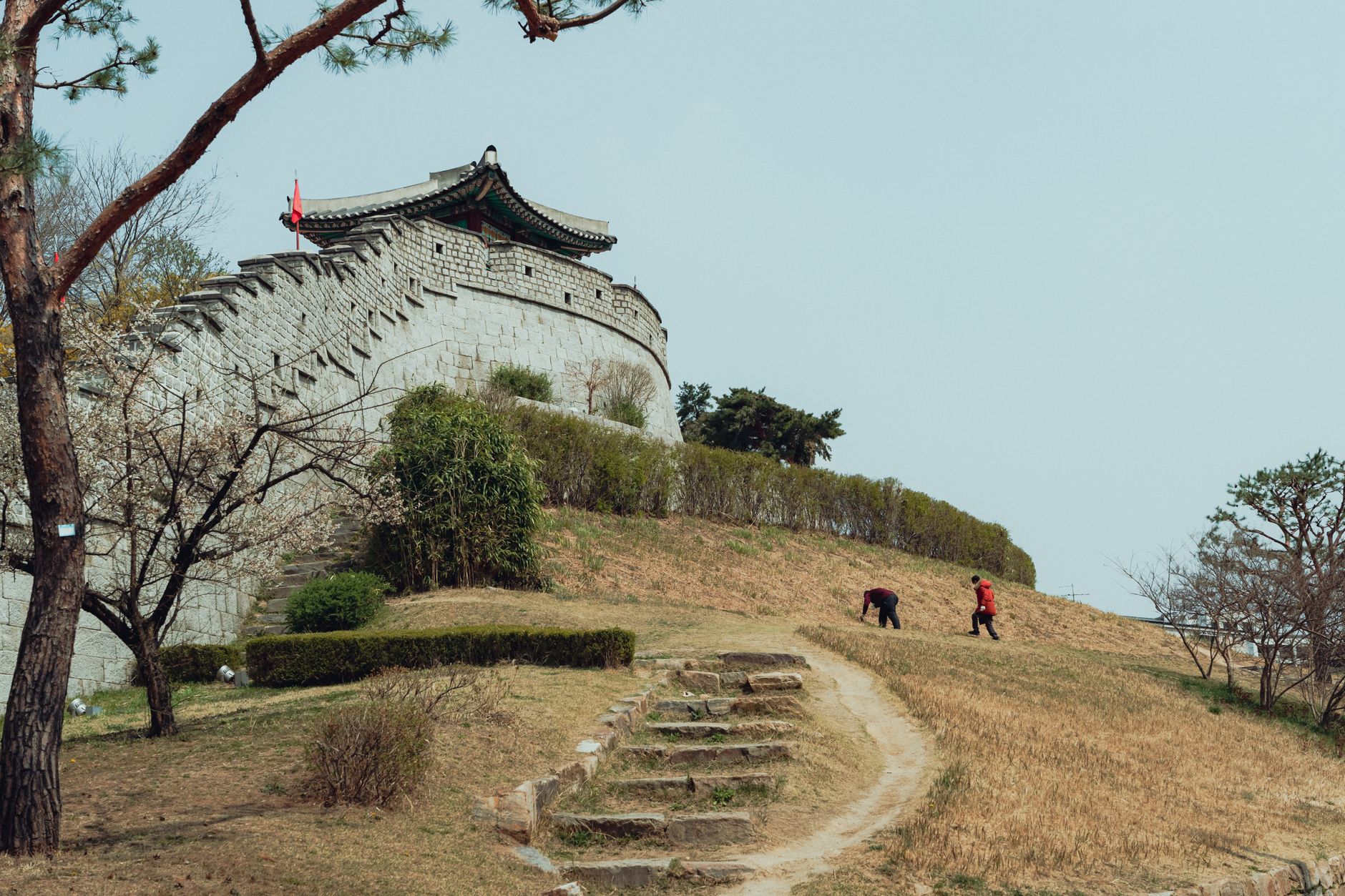
What makes Seongbuk-dong worth the trip, to me, is that the Seoul Fortress Wall running along its edge isn’t a reconstruction built for photos — it’s the genuine 600-year-old Hanyangdoseong wall, and you can walk a real stretch of it here without a ticket or a timed entry slot. The Gansong Art Museum, one of the country’s most important private collections of Korean art, is tucked into the neighborhood’s heart, along with Hyegok House, the former home of the art historian Choi Sunu, preserved almost exactly as he left it. Admittedly, this isn’t a neighborhood built for a quick one-hour stop. It rewards slow walking uphill past crooked utility poles tangled in decades of wiring, past a stray cat asleep on a sun-warmed tile roof, past a gate that someone’s grandmother is quietly sweeping in front of — and I’ve found that unhurried pace is exactly what makes the place stick in memory afterward, longer than a lot of the “must-see” stops do.
Haebangchon: Itaewon’s steeper, scrappier cousin
Haebangchon — HBC to basically everyone who lives there — clings to the slope of Namsan in Yongsan-gu, wedged between Itaewon and Noksapyeong Station on Line 6. The name translates to “Liberation Village,” and the history behind it is heavier than the current vibe suggests: it started as a settlement for refugees after the Korean War, both from the north and from other parts of the peninsula, and that layered, patched-together origin never fully went away. You can still feel it in the built environment — old market stalls sitting next to a Mexican taqueria, the smell of slow-roasted carnitas drifting straight over a folding table where an ajumma is selling dried anchovies and sesame leaves, a decades-old Korean grocer two doors down from a vintage clothing shop with hand-lettered English signage. Nobody seems bothered by the mismatch. If anything, it’s the mismatch that makes the walk interesting.
Getting there from Noksapyeong exit 2 means a genuine uphill walk of fifteen to twenty minutes along Sinheung-ro, and I won’t pretend that’s a small ask on a humid August afternoon — take a cab or a short bus hop if you’re not in the mood to sweat through your shirt before lunch. What you’re rewarded with, though, is a neighborhood that somehow avoids feeling like an extension of Itaewon’s nightlife strip even though it’s a ten-minute walk away. It’s quieter, more residential, full of small rooftop cafes that turn into some of the best sunset viewpoints in the city once N Seoul Tower starts lighting up over the ridge. HBC also still functions as one of the more genuinely international pockets of the city, in a way that predates the current wave of “global Seoul” branding — it was multicultural back when that wasn’t a marketing angle, and longtime residents will tell you that without much prompting.
Yeonhui-dong: the neighborhood so quiet even Seoul half-forgets it exists
You notice how quiet Yeonhui-dong is before you notice anything else about it — no delivery scooters idling at a red light, no line outside a dessert cafe, just the occasional creak of a gate and someone’s dog barking twice and then giving up. There’s no subway station inside the neighborhood itself, which tells you most of what you need to know about how it functions — you get there via Hongik University Station or Hongje Station on Line 3 and then walk or bus in the rest of the way, and most people simply don’t bother, because there’s no single landmark pulling them there. That’s arguably the whole appeal. It’s a residential neighborhood of villas and two-story houses rather than the high-rise apartment blocks that dominate most of the city, known locally for architect-designed homes tucked behind hedges and low walls, the kind of quiet wealth that doesn’t announce itself.
It’s also, somewhat unexpectedly for a neighborhood this residential, one of the country’s genuine literary strongholds. Seoul Art Space Yeonhui, the capital’s first writer-in-residence program, is based here, hosting novelists and poets in a converted compound that used to belong to a city history commission. I didn’t expect a program like that to sit in the middle of ordinary houses and quiet cafes rather than some cultural district downtown, but that’s exactly where it is, and the neighborhood’s whole personality — unhurried, a little literary, resistant to being a destination — makes more sense once you know it’s there. For green space, Yeonhui Forest Rest Area sits at the foot of Ansan mountain, nearest to Hongje Station. Go on a weekday morning and it’s quiet enough to hear wind moving through the pines instead of a thousand camera shutters, which is more than you can say for most of Seoul’s better-known cherry blossom spots in April.
Sindang-dong: where tteokbokki actually comes from
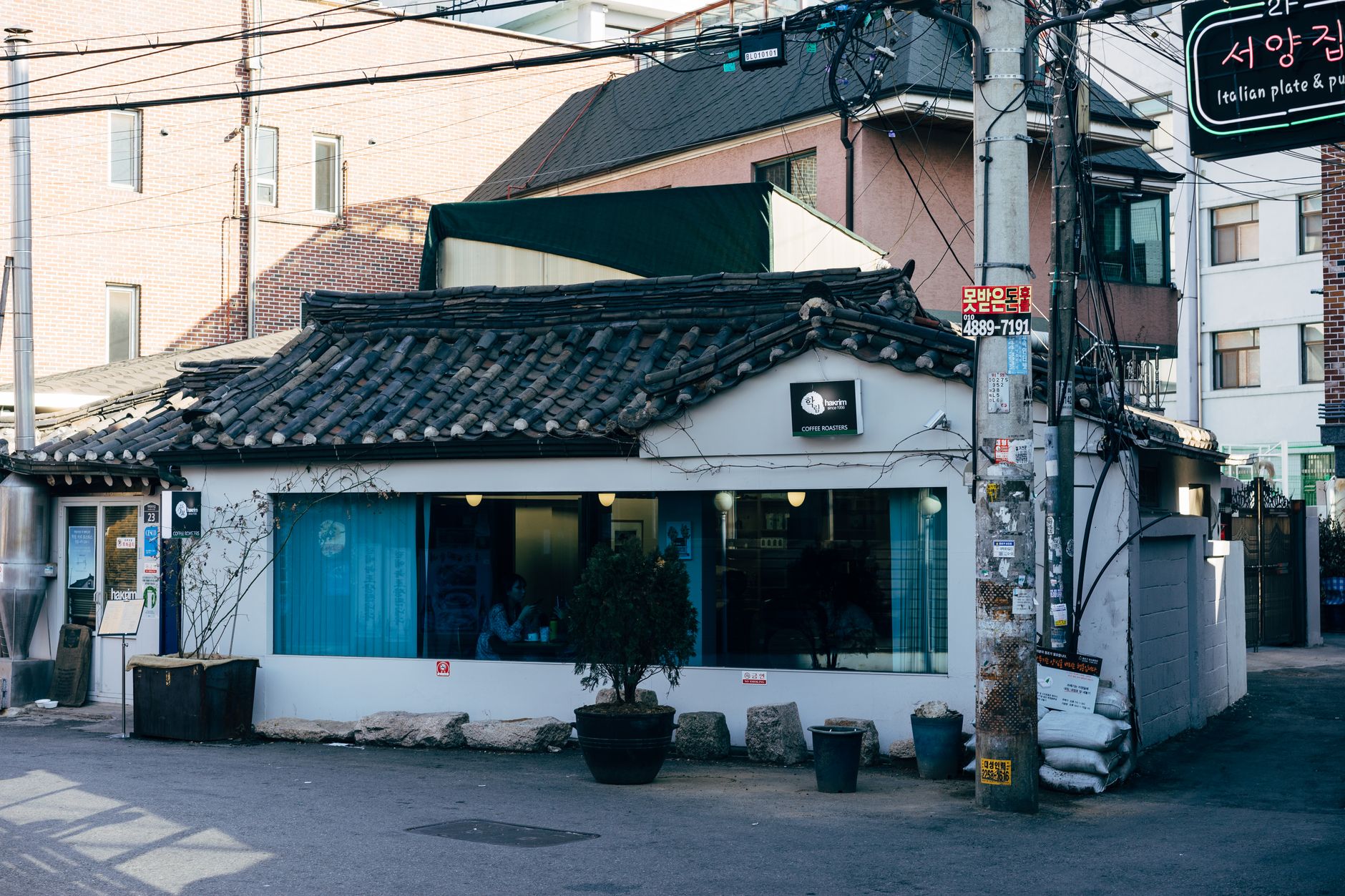
Sindang-dong is the one entry on this list that’s arguably famous in its own right, at least among people who take Korean food seriously — but it’s famous for the right reasons, not the Instagram-bait ones. It sits at Sindang Station, where Line 2 and Line 6 cross, and exit 8 leads you into what’s officially called Sindang-dong Tteokbokki Town, a dedicated alley of restaurants specializing in the spicy rice-cake dish. The story goes back to 1953, when a woman named Ma Bok-rim started frying rice cakes in chili sauce near here, and by the late 1970s and into the 80s the alley had grown into its own scene, complete with in-house DJs at some restaurants spinning trot and pop ballads while customers scribbled song requests on scraps of paper and passed them up to the booth between bites. Older Seoulites still bring it up unprompted, usually with a slightly embarrassed grin, the way you’d talk about a haircut you loved at seventeen — it wasn’t fine dining, it was a whole social ritual built around a bowl of spicy rice cakes, and for a certain generation that DJ booth was basically their version of a first date.
What surprised me the first time I actually explored past the main tteokbokki strip is that Sindang-dong has quietly grown a second identity. Take a left just outside exit 12 and you land on a stretch of cafes and bars built into old warehouses and former rice shops — the kind of adaptive reuse that Seongsu-dong gets all the credit for, happening here with almost none of the attention. It’s the sort of contrast that sums up a lot of these neighborhoods: a decades-old food alley that still runs on muscle memory and regulars, two exits away from a newly built cafe scene that most tourists have never heard of. Go for the tteokbokki, honestly, since it’s the reason the neighborhood exists at all — but don’t leave without wandering past exit 12 first.
A few honest notes on actually getting to these places
None of this is hard, exactly, but it does take a little more effort than hopping off at Myeongdong Station and following the crowd out the exit — and that small bit of friction is, ironically, most of why these places still feel like they belong to the people who live there. A couple of things I’ve learned the hard way, since none of this is obvious the first time you try it. First, Naver Map or Kakao Map will serve you far better than Google Maps here — Google’s Korea data is famously incomplete for anything smaller than a major landmark, and neither Buam-dong nor Yeonhui-dong will route cleanly without a Korean map app. Second, weekday visits genuinely change the experience; several of these neighborhoods flip from mostly-local to mostly-visitor depending on whether it’s a Tuesday or a Saturday, and the difference is bigger than you’d guess. Third, a lot of the smaller cafes and galleries in hillside neighborhoods like Buam-dong and Seongbuk-dong close on Mondays, so plan around that rather than around it.
Quick questions before you go
I only have one afternoon free — which of these should I actually pick? If you want walkable history without a bus transfer, go with Seongbuk-dong; Hansung University Station drops you close enough that you can be on the fortress wall within twenty minutes. If you’d rather eat your way through the afternoon, Sindang-dong is the more efficient choice, since the food alley and the newer cafe street sit almost back to back near the same station.
Do I need to speak Korean to get around these neighborhoods? Not really, though it helps more here than it does in Myeongdong. None of these five have much English signage, and smaller restaurants often don’t have posted English menus, so having a translation app ready — or just pointing at what the table next to you is eating — goes a long way. The subway and bus systems themselves are fully bilingual, so the transit part is easy regardless.
Is it worth visiting Buam-dong or Seongbuk-dong if it’s raining? Honestly, it can still be worth it — the hanok rooflines and stone walls in Seongbuk-dong look genuinely striking in overcast light, and Buam-dong’s cafes are cozier with rain against the window than under a hot summer sun. Just wear proper shoes, since both neighborhoods involve real uphill walking and Seoul’s older stone streets get slick fast.
Leave a Reply