Three weeks into my first job in Seoul, a coworker handed me his business card with both hands, gave a small bow, and said his name was “Kim Minjun.” I shook his hand, looked him dead in the eye, and said, “Nice to meet you, Mr. Minjun.” He didn’t correct me. Nobody did, actually, for almost a month — until a Korean friend finally pulled me aside at a work dinner and said, gently but with the kind of wince you give a friend who has spinach in their teeth, “It’s Mr. Kim. Minjun is his first name.” I had been calling a man by his given name, minus any honorific, in front of his own boss, for four weeks straight.
That single mix-up is, I’d guess, the most common naming error foreigners make in Korea. It sounds like a small thing. It isn’t, really — or rather, it’s small in the sense that nobody’s going to yell at you over it, but it quietly signals that you haven’t quite figured out how names work here, and Koreans notice. So let’s actually sort this out, properly, the way I wish someone had sat me down and explained it back in 2016.
Family name first, always
Korean names follow the East Asian convention: surname first, given name second. Kim Minjun means the family name is Kim and the given name is Minjun — not the other way around, and not interchangeable depending on context, the way some Western first-and-middle names can be shuffled. This is the reverse of English order, where “John Smith” puts the personal name first and the family name last. You’d think this would be an easy switch to internalize, and honestly, after a while it is. But in the first few months, your brain keeps defaulting to the pattern it learned as a toddler, and you end up parsing “Kim Minjun” as if “Kim” were a first name, because in your own language, name order has always worked that way.
Here’s a number that surprised me when I first heard it: three surnames — Kim, Lee, and Park — cover roughly 45% of the entire South Korean population. Statistics Korea’s most recent large-scale census breakdown put Kim alone at over 21% of the country, Lee at around 14%, and Park at just under 8%. Fewer than 300 surnames exist in Korea total, compared to the tens of thousands used in the United States. So when you meet three Kims in one meeting, that’s not a coincidence or a running joke — it’s just math. Given names, meanwhile, carry almost all of the individual distinctiveness. That’s precisely why Koreans lean so heavily on titles and honorifics instead of first names when addressing each other, which we’ll get to.
How the given name itself is built
Most Korean given names are two syllables, though one-syllable given names exist too — think Yuna, Jihoon, or a shorter name like Ho or Jin. In the traditional structure, one of those two syllables is a “generation name” (돌림자, dollimja), shared by siblings or cousins of the same generation within an extended family, and the other syllable is unique to that individual. It’s a custom with roots going back centuries, tied to Confucian family record-keeping, and it still shows up constantly, even if fewer families follow it strictly than fifty or sixty years ago.
A commonly cited example: the singer Lee Hyori has sisters named Lee Yuri and Lee Jinkyung, and if you know Korean naming customs you can spot the shared syllable pattern at a glance. You might think this sounds like a minor genealogical detail that only matters to historians, but oddly enough, it comes up in daily life more than you’d expect — Koreans will sometimes ask a new acquaintance whether their siblings share a syllable with them, purely as a bit of small talk, the way you might ask an American whether they’re named after a grandparent. Still, this isn’t universal anymore. Plenty of younger parents now pick given names purely for sound or meaning, skipping the generation-name system altogether, especially in Seoul.
The mix-ups foreigners actually make
The Minjun story above is the classic one, but it’s far from the only trap. Here are the ones I’ve watched happen — to myself and to nearly every other expat I know — over close to a decade here.
Calling someone by their given name alone. In English, first-name-only is friendly and default. In Korean workplaces, it can read as oddly familiar, even blunt, unless you’re close friends or the person is younger than you and has explicitly said it’s fine. Strange as it sounds to someone raised on casual American office culture, using a coworker’s bare given name on day one can land as mildly disrespectful, not warm.
Treating the surname as the “casual” part. Some foreigners, once they realize Kim is the family name, overcorrect and start calling everyone by surname alone — “Hey, Kim!” — assuming it functions like an English last-name nickname among friends. It doesn’t, generally. Surname alone, with no title attached, can sound abrupt or even a little rude in most everyday contexts.
Assuming the name order flips on English documents. This one trips up even long-term residents. Officially, Korea’s government style guide keeps surname-first order even when a name is romanized — for example, “Kim Minjun,” not “Minjun Kim.” But in practice? It’s genuinely inconsistent. Passports, English business cards, and social media bios sometimes flip the order to match Western expectations, and sometimes don’t, depending on the person, the company, or which decade the document was made. You basically have to ask, or wait for context, rather than guess.
Business cards: a small ritual with real rules
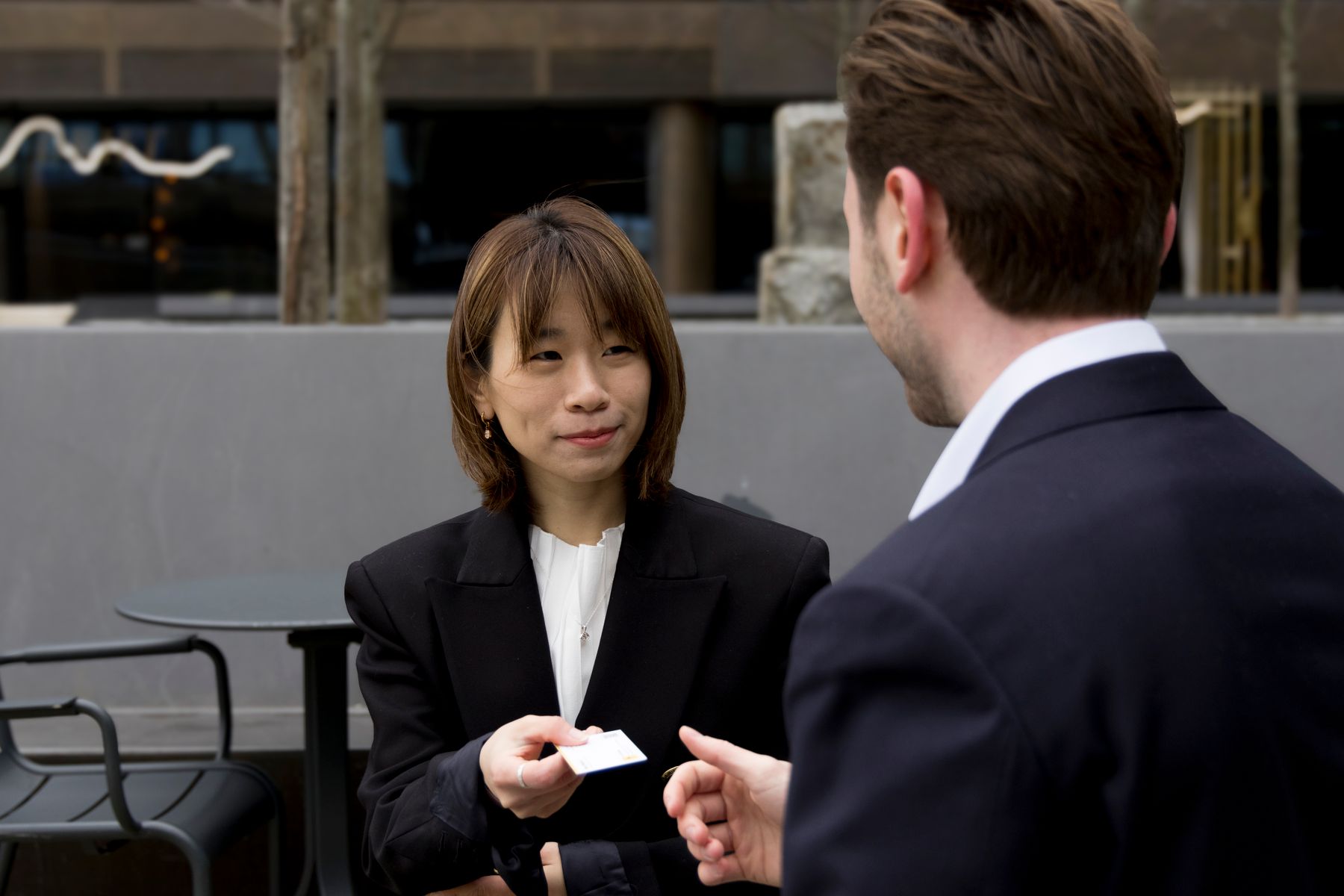
If there’s one object that condenses all of Korean naming etiquette into a single physical item, it’s the business card, or 명함 (myeongham). You receive one with both hands. You don’t shove it straight into your back pocket while the other person is still standing there — that one’s a genuine faux pas, and I learned it the hard way at a conference in Gangnam back in 2018, card crumpled in my jeans within about four seconds of receiving it, while the woman across from me watched with an expression I can only describe as polite horror.
The card itself tells you almost everything you need to address someone correctly: full name in the surname-first order, and — critically — their job title. This matters more than it might in, say, an American office, because Korean address terms are built around title plus honorific suffix far more often than around given names. You might think checking someone’s job title feels a bit formal for a casual chat, but in Korea it’s actually the opposite of formal-for-formality’s-sake — it’s the quickest, most respectful way to know how to talk to someone you just met.
Honorifics: why titles do the heavy lifting
This is the part that finally made everything click for me. In Korean, you rarely address someone directly by their bare given name unless you’re close in age and status, or they’re your child, or they’ve told you it’s okay. Instead, you use surname plus title plus 님 (nim), an honorific suffix roughly equivalent to “esteemed” or a very respectful “Mr./Ms.” — so a manager named Kim becomes “Kim Gwajang-nim” (Manager Kim), a teacher becomes “seonsaeng-nim,” a doctor becomes “uisa-nim.” Given name alone, with no honorific, is reserved for close friends, younger family, or people distinctly below you in age and hierarchy.
So when I called my coworker “Mr. Minjun” that first month, I’d actually managed two mistakes stacked on top of each other: wrong part of the name, and an English honorific grafted onto it in a way that doesn’t really exist in Korean structure at all. Surprisingly, nobody seemed to think less of me for it — most Koreans extend a lot of patience to foreigners still learning this stuff. Still, once I understood the system, conversations felt noticeably smoother. People visibly relaxed when I got their title right, the way you might relax when a stranger in your home country pronounces your name correctly on the first try.

A quick way to keep it straight
Here’s the mental shortcut I give newer expats now. First, assume the first word of a Korean name is the surname unless you have clear evidence otherwise. Second, don’t use given name alone in a professional or first-meeting context — lean on title-plus-nim, or just “Mr./Ms. [Surname]” in English conversation, until someone explicitly invites more casual address. Third, read the business card. It usually tells you exactly what you need. None of this requires fluent Korean. It just requires paying attention to structure rather than assuming your home country’s rules travel with you.
It’s a small adjustment, in the end, but it’s one of those cultural details that quietly separates someone who’s visiting Korea from someone who’s actually settled in and started paying attention.
FAQ
My Korean coworker introduced herself as “Sarah” — is that her real name, and how does it fit with the surname-first rule?
Plenty of Koreans who work with foreigners or study abroad adopt an English name for convenience — it’s extremely common in offices with international clients, English academies, and universities. “Sarah” usually isn’t a legal name; it’s a chosen nickname that sits alongside her actual Korean name, which still follows surname-first order on any official document. You can address her as “Sarah” comfortably in English conversation — that’s exactly why she offered it. Just don’t assume it replaces her real name if you ever see her business card or official paperwork, where the Korean surname-first name will still appear.
I’m meeting a Korean business contact for the first time next week. Should I say their given name, surname, or full name when greeting them?
Safest bet: full name plus an appropriate title, or surname plus “Mr./Ms.” in English — for example, “It’s great to meet you, Mr. Park,” rather than “Hi, Jihoon.” If you already know their job title from an email signature or business card, using surname plus that title in Korean (if you speak any) reads as genuinely respectful. Given name alone, especially on a first meeting, tends to feel too casual for a Korean professional context, even if the same move would be perfectly normal in an American or European office.
Why do some Koreans list their name as “Minjun Kim” on LinkedIn instead of “Kim Minjun”?
Because there’s no single enforced rule for how Korean names get romanized on international platforms, and plenty of people flip the order themselves to make things easier for Western colleagues and recruiters who might otherwise misread the surname. It’s a practical accommodation, not a sign that the traditional surname-first order has changed domestically — inside Korea, on Korean documents and everyday introductions, surname still comes first. When in doubt on a platform like LinkedIn, check for a job title or company page for context, or just ask which part is the family name.
Leave a Reply