The first time I really understood Korea’s shoes-off rule, I wasn’t the one being corrected — I was watching someone else get corrected, and feeling my own stomach drop in secondhand embarrassment. A guy about my age, clearly just off the plane, walked into a friend’s studio apartment in his sneakers, made it about four steps onto the floor, and stopped when he noticed everyone else was standing at the door in socks. Nobody yelled. Nobody even really said anything. But the silence did more work than words would have, and he was back at the entryway peeling off his shoes within about three seconds. I remember thinking: okay, this is clearly not a suggestion.
If you’re new to Korea, or just Korea-curious from abroad, you’ve probably heard the shorthand version already — “Koreans take their shoes off inside.” True, but it undersells what’s actually going on. This isn’t just about protecting hardwood floors. It’s a rule with real infrastructure behind it, real history, and real consequences if you get it wrong. Once you understand why, the whole logic of a Korean home — where the furniture is, where you sit, even how apartments are laid out — starts to make a lot more sense.
It Starts With the Floor Itself
Most explanations skip a detail that actually matters: in a lot of the world, floors are just floors, something you cross to get from the door to the couch. In Korea, historically, the floor was the furniture. That distinction matters more than it sounds like it should, and it’s the reason this whole custom exists in the first place.
The reason goes back to ondol (온돌), Korea’s traditional underfloor heating system — the name literally translates to “warm stone.” Long before radiators or electric heaters, Korean homes were built with a network of flues underneath the floor. A wood fire at one end of the house sent hot smoke and air winding through channels under a layer of heated stones, warming the entire floor slab from below. If you’ve ever seen radiant floor heating marketed as a luxury upgrade in a Western remodel — the kind installed under bathroom tile so your feet don’t hit cold ceramic in winter — that’s roughly the same physics ondol runs on, except it wasn’t a premium feature reserved for a few rooms. It was the default heating method for essentially every home in the country, rich or poor, for centuries. It’s also old — the basic concept dates back at least to the early centuries CE, with some scholars tracing rudimentary versions even further. In 2018, Korea’s Cultural Heritage Administration went so far as to designate ondol culture as a piece of National Intangible Heritage — not just the technique of building the heating system, but the whole way of living it produced.
And that’s really the key phrase: the way of living it produced. Because the floor was warm, people sat directly on it instead of on chairs. Because they were already sitting on it, they ate their meals there too, gathered around low tables barely a foot off the ground. And because they ate and lived on it all day, sleeping on it — on a folded mat called a yo rather than a raised bed — wasn’t a stretch at all. The floor wasn’t a walkway. It was where life happened. Suddenly, tracking outdoor dirt onto the exact surface you’d be sitting, eating, and sleeping on stops being a minor faux pas and starts looking like an obviously bad idea.
Getting from that wood-fired original to today’s apartments took a fairly bumpy road — wood-fire ondol proved impractical and even dangerous once Korea started stacking families into concrete high-rises during the rapid urbanization of the 1960s and 70s, so builders reengineered the same idea using hot water circulated through pipes embedded in the concrete slab instead of smoke through stone flues. The heating source changed twice over; the habit it created never did. Even in a high-rise apartment with a sectional sofa and a dining table, you’ll usually find the ondol thermostat mounted right next to the light switch, and on a cold February night, plenty of Koreans still end up sitting on that warm floor rather than the couch a few feet away, because forty years of central heating never quite talked people out of a few thousand years of floor living.
The Hyeongwan: A Small Space Doing a Lot of Work
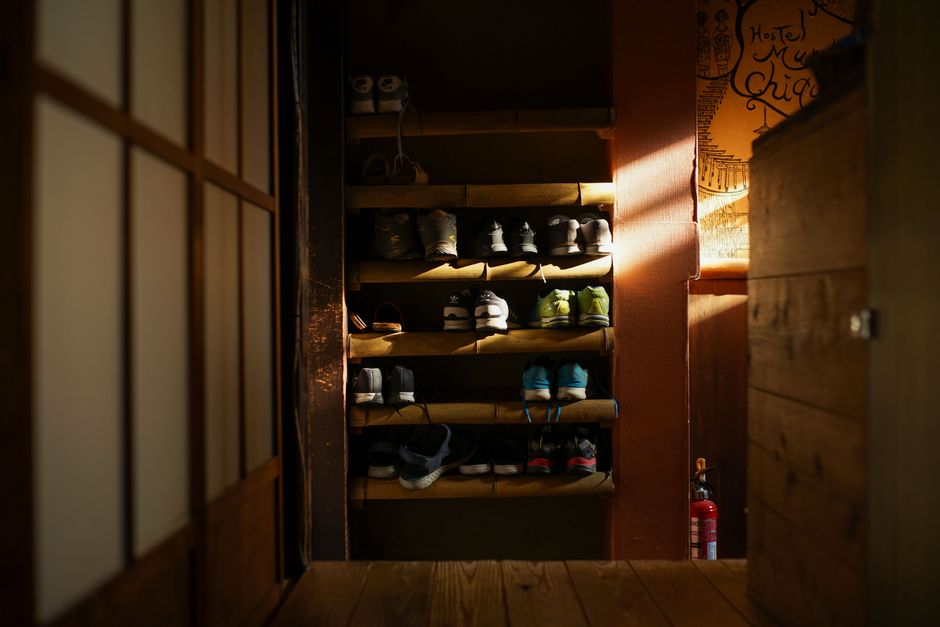
Walk into pretty much any Korean home — whether it’s a decades-old house or a brand-new officetel — and you’ll notice the entryway, called the hyeongwan (현관), sits noticeably lower than the rest of the floor, usually by something like 10 to 20 centimeters. That step isn’t decorative and it isn’t an accident of construction. It’s a physical, built-in boundary line between “outside” and “inside,” and it exists specifically so shoes have somewhere to stay.
I’ll admit I underestimated the hyeongwan for a while. It looks like just a landing pad for shoes, maybe with a tall built-in cabinet along the wall — called a sinbaljang (신발장), literally “shoe cabinet,” and nearly every Korean home has one, often floor-to-ceiling and sized for a family’s entire footwear rotation. But functionally, the hyeongwan is doing something closer to what an airlock does on a spaceship: it’s the transition chamber where you shed the outside world before you’re allowed into the clean one. You step down into it in shoes, step up out of it without them, and the two spaces — objectively just a few inches apart — are treated as categorically different territories.
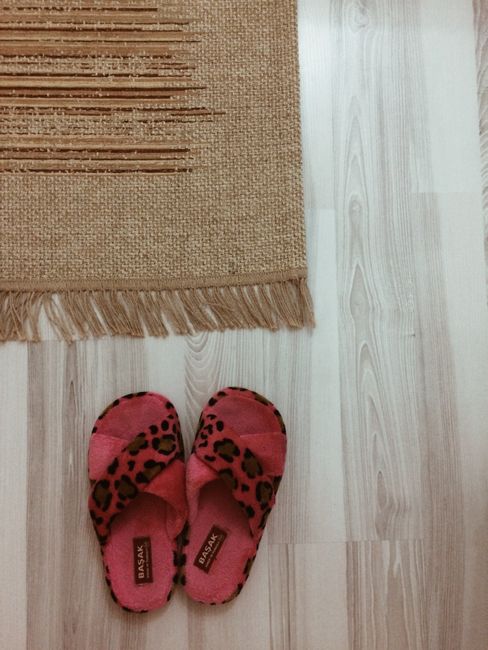
This is also, practically speaking, where you’ll find slippers waiting if you’re a guest. Sil-nae-hwa (실내화), or “indoor shoes,” are the soft house slippers many Korean families keep by the door for visitors. Not every household bothers — plenty of people are perfectly happy having guests pad around in socks or bare feet — but if slippers are sitting there lined up and pointed toward you, that’s your host’s way of saying “please, use these,” and it’s polite to actually use them rather than politely declining.
So What Happens If You Forget?
Nobody’s going to shout at you. But you will absolutely know you messed up, usually within about two seconds of doing it.
In my experience, the correction is almost always nonverbal, and honestly that’s what makes it sting a little more than a direct comment would. You’ll get a glance down at your feet, maybe a small wince, maybe someone quietly sliding a pair of slippers toward you without a word. At a friend’s grandmother’s house, I’ve seen it get slightly more animated — a sharp, urgent gesture at the floor, sometimes with a “no, no, no” thrown in, delivered with the kind of energy usually reserved for someone about to step on broken glass. It’s not hostility. If anything, it comes from the same place as flinching when someone’s about to spill a drink on your carpet — an instinctive, slightly panicked reaction to a mistake, not a moral judgment against you as a person.
Where this trips people up most isn’t actually private homes — most travelers get briefed on that one before they even land. It’s the gray-zone spaces: certain traditional restaurants with raised floor seating, some guesthouses and hanok stays, temple accommodations, even the occasional clinic waiting room or fitting room. Jjimjilbang — the Korean bathhouse-and-sauna complexes that are practically a national pastime — take it even further, with a locker system right at the entrance built specifically to swap your street shoes for a pair of sandals before you ever reach the changing room; skipping that step isn’t really an option, since the front desk staff will simply redirect you back to the lockers. The tell in most other spaces is almost always that step at the entrance and a shoe rack sitting right there, sometimes with little plastic bags for you to carry your shoes if the layout requires walking back through in socks later. If you see a raised floor and a pile of shoes at the base of it, that’s your cue, even if nobody’s posted a sign explaining it.
And to be fair, this isn’t some ancient custom frozen in amber — Korea’s own norms shift depending on context. A shoes-optional Western-style café with hardwood floors and barstool seating won’t blink if you keep your sneakers on. It’s specifically floor-seating and floor-adjacent spaces — homes, traditional restaurants, temples, some yoga studios and hair salons — where the rule kicks back in hard. Reading the floor level, more than reading any sign, is usually the most reliable guide.
More Than Hygiene — Though That’s Real Too
It would be easy to file all of this under “hygiene,” and sure, that’s part of it — shoes track in street dust, mud, and whatever else you stepped in on the subway platform, and nobody wants that ground into the same floor a toddler is about to crawl across. But I think the hygiene explanation, while accurate, actually undersells how deep this goes.
There’s a boundary-drawing function here that goes beyond germs. The outside world in Korean daily life — the crowded subway, the office, the street — is public territory, full of obligations and other people’s expectations. The home, by contrast, is private, relaxed, unshod ground, almost literally. Taking your shoes off is a small physical ritual that marks the switch from one mode to the other, the same way changing out of work clothes does for a lot of people elsewhere. You’re not just protecting the floor. You’re stepping across a line between two very differently governed spaces, and your body knows it before your brain catches up.
That’s also, I’d argue, why the custom survived the shift to Western-style apartment living so intact. You’d expect sofas and dining tables to have eroded the shoes-off rule along with the floor-sitting lifestyle that originally produced it. Instead, it just kept going, detached from its original hygiene-and-warmth logic and reattached to something more social: this is a threshold, and crossing it means something — which is exactly why the practical advice below matters more than a simple etiquette tip would.
What I’d Tell Anyone Visiting
So here’s the practical version of everything above: default to taking your shoes off the second you see a raised floor level or a shoe rack, and don’t wait for someone to tell you. Wear socks without holes in them, ideally — learn from other people’s mistakes here, not your own. If slippers are laid out for you, use them. And if you do slip up, don’t overcorrect into a five-minute apology; a quick, slightly sheepish “sorry” and immediately fixing it lands much better than turning it into a whole production.
But the checklist is really just the surface version. What the shoes-off rule is actually telling you is how space itself works here. The floor isn’t an afterthought in a Korean home — it’s arguably the most important surface in the house, warmer and more central than the sofa most Western homes build a living room around. Once that clicks, a lot of other things about Korean domestic life — the low tables, the floor cushions, why apartment listings advertise their ondol system like it’s a selling point — stop looking random and start looking like one coherent system, built around a single warm floor and the very reasonable decision to keep the street off of it.
FAQ
Do all Koreans still use traditional wood-fired ondol?
No — modern apartments use hot water circulated through pipes under the floor, controlled by a thermostat, rather than an actual wood fire. But it’s still called ondol, and it still keeps the shoes-off logic alive because the floor stays the main living surface either way.
Is it rude to ask if I should take my shoes off?
Not at all — if you’re ever unsure, just ask. Most Koreans will actually appreciate that you’re being thoughtful about it rather than assuming, and it takes the guesswork out of borderline spaces like some cafés or clinics.
What if I have a foot condition or just really don’t want to take my shoes off?
Say so honestly rather than trying to sneak by — most hosts will offer a workaround, like clean disposable shoe covers, rather than force the issue. It’s a much better look than getting caught trying to skip the rule.
Leave a Reply