I once sat through a Korean wedding that started at 11:40 a.m. and, by 12:15, the bride and groom had already changed clothes twice, thrown chestnuts at each other, and the guests were lining up at a buffet with trays of galbi-tang, sushi rolls, and japchae. Coming from a culture where weddings swallow an entire Saturday — ceremony, cocktail hour, dinner, dancing until midnight — I remember standing there thinking I’d missed something. I hadn’t. That is the wedding. In Korea, the whole main event is often over before most Western guests would have finished their first glass of champagne, and then there’s a second, much older ceremony happening behind a curtain that almost no one outside the family ever sees.
If you’ve been invited to a Korean wedding, or you’re just curious why your Korean coworkers keep talking about “chukhagum” and disappearing for an hour on a Saturday, this is the rundown I wish someone had given me before my first one.
The Modern Ceremony: Fast, Western-Style, and Over Almost Before It Starts
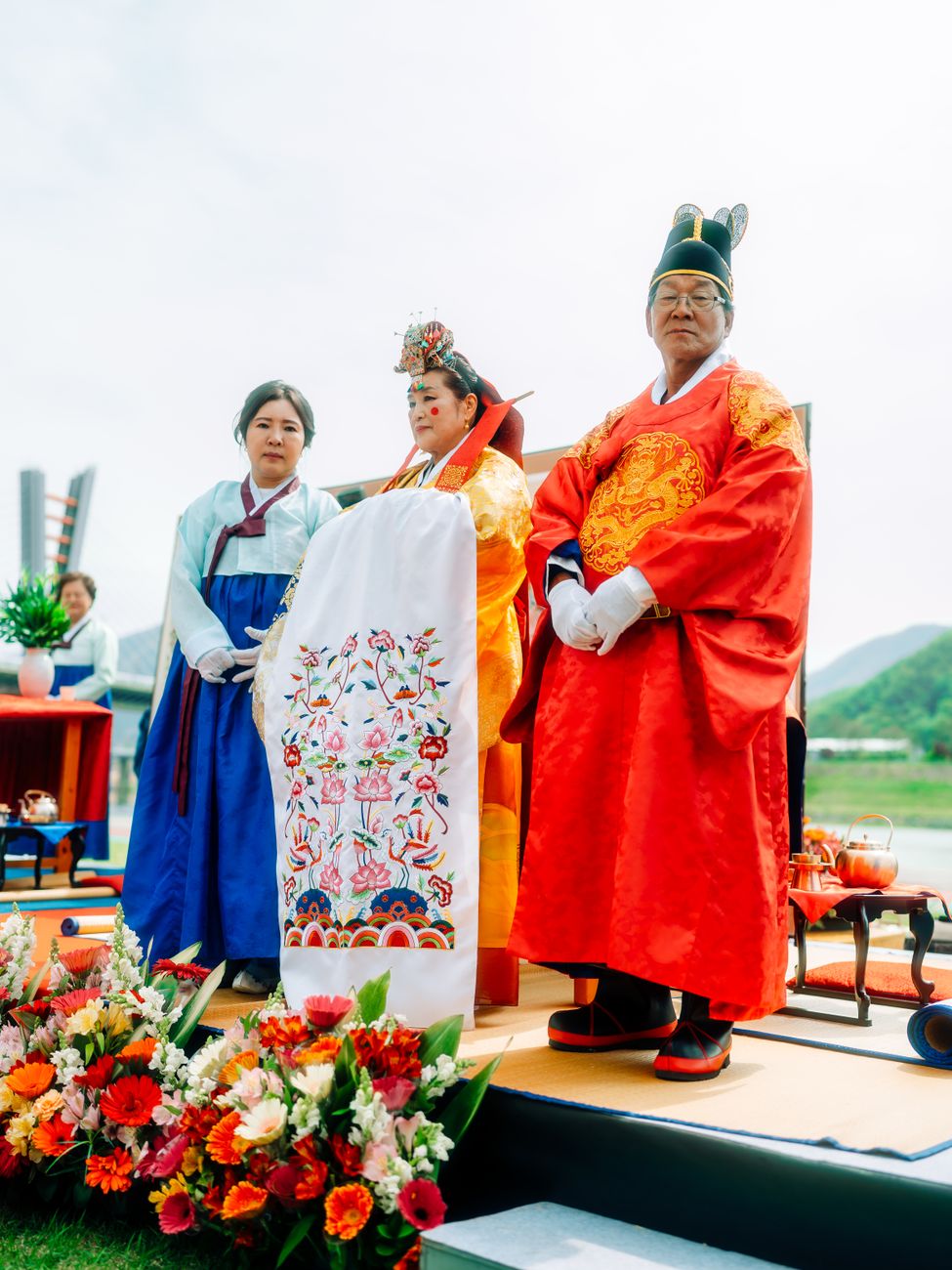
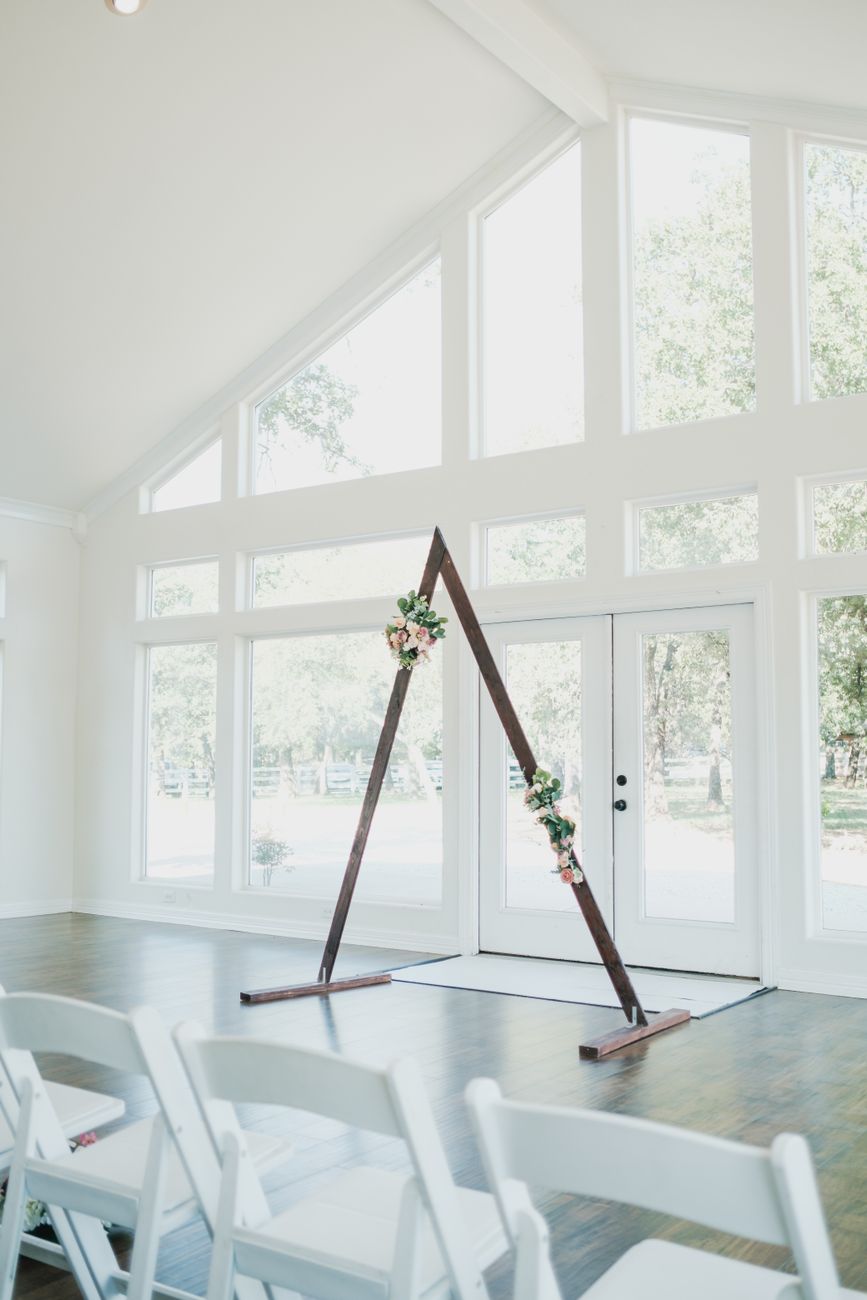
Most Korean weddings today happen at a “yebeom” — a dedicated wedding hall, sometimes inside a hotel, sometimes a standalone building that runs six or seven weddings back to back on a Saturday. Walk into the lobby of one of these places on a weekend afternoon and it’s genuinely chaotic in a specific, almost choreographed way: elevators packed with men in near-identical dark suits, floral wreaths with ribbon banners lined up along the hallway announcing whose wedding is in which room, and ushers directing traffic like they’re working a subway platform at rush hour. These halls are businesses running on a schedule, which is why the ceremony itself clocks in at around 20 to 30 minutes. There’s a wedding director with a headset moving things along, an officiant (often a mentor, former professor, or family friend rather than clergy), the walk down the aisle, an exchange of vows, a video montage of the couple’s childhood photos, and a song — sometimes sung live by a friend, sometimes lip-synced, always a little emotional. Then it’s done, and everyone applauds and files out so the next couple’s guests can start filing in.
I found the speed genuinely jarring the first time. You’d expect a life event to get more runway than a dentist appointment, but the pacing makes more sense once you understand the venue economics: a popular hall in Seoul can host a wedding almost every hour on a Saturday, and couples often book a slot the way you’d book a restaurant reservation. The ceremony is really the formal, photographable part — the actual “we are now married” moment for family records and social media — while the deeper emotional and ritual weight gets saved for later, in a room most guests never enter.
Guests, for their part, aren’t necessarily expected to watch the whole thing anyway. It’s completely normal to arrive just in time to hand over an envelope, snap a photo or two from the back, and head straight to the buffet before the couple has even finished their vows. That would read as rude at a Western wedding. Here, it’s just how the math of a 300-guest hall wedding works — and the buffet itself is worth arriving hungry for, since Korean wedding-hall catering tends to go big: hot soup stations, sashimi, bulgogi, tteokbokki, a whole table of sliced fruit and pastries, sometimes even soft-serve ice cream and a draft beer tap in the corner.
Chukhagum: Why Everyone Is Handing Over Cash in a White Envelope
Before you even reach the ceremony hall, you’ll pass a reception desk where relatives of the couple are checking names against a guest list and collecting envelopes. This is chukhagum (축의금) — congratulatory cash — and it is the backbone of how Korean weddings actually get paid for. Instead of gift registries, the near-universal custom is a crisp cash gift in a plain white envelope with your name written on the back, vertically, in your own handwriting. It’s common enough to see a small line at the convenience store ATM right outside the wedding hall on a Saturday morning, guests withdrawing exact bills before they walk in, because handing over a wrinkled or borrowed note is considered a little careless. You sign a guestbook with whatever pen is chained to the desk, hand off the envelope, and get a small meal ticket in return.
The amount is not random. As of 2026, 50,000 won (roughly $35–40) functions as the bare minimum for a distant acquaintance, while 100,000 won has become the standard for anyone you’d genuinely call a friend or close colleague — closer relationships or higher social obligation can easily push that number up. Students and younger guests sometimes give 30,000 won and it’s not considered stingy. On paper, chukhagum sounds brutally transactional. In practice, it’s an intensely social ledger — Koreans keep informal mental notes of who gave what at whose wedding, because the same amount is often expected to circulate back when the tables turn, sometimes years later at that same guest’s own wedding or their child’s first birthday party.
There’s a practical reason chukhagum matters so much: it directly funds the buffet. Wedding halls typically charge per meal ticket, so the cash guests bring in roughly offsets what the couple pays to feed everyone. It’s less “generous gift” in the Western sense and more a mutual-aid system that’s been running for generations, dressed up as a gift.
A Few Things That Still Catch Foreign Guests Off Guard
Before we get to the older ceremony happening backstage, a few practical notes for anyone actually attending one of these. Dress code confusion is real: guests are expected to dress formally, but two rules trip people up constantly. First, never wear white — that’s reserved for the bride, full stop. Second, a full black formal gown can actually read as trying to upstage the bride, since overly elaborate guest outfits are generally frowned on; smart-casual dark clothing is the safer lane. The buffet-before-ceremony-ends thing catches people off guard too — I’ve seen visiting friends nearly refuse to eat until the couple finished their vows, not realizing that’s simply not how the room operates. And the meal ticket system trips up anyone expecting a seated, plated dinner: you hand that small ticket to buffet staff, find your own table among strangers from both families, and eat standing in line if it’s a busy Saturday.
Pyebaek: The Ceremony That Happens After the Party Already Started
Here’s the part almost no foreign guest ever sees, because it happens in a small side room while everyone else is eating. The moment the last photo is taken with the main-hall backdrop, the couple all but sprints to a dressing room — tuxedo and gown coming off, hanbok going on, in what I’m told can be under ten minutes flat with an assistant helping from both sides. Pyebaek (폐백) is the traditional ceremony where the bride formally bows to and is welcomed by the groom’s family, a custom with roots going back to the Goryeo dynasty, when it was originally performed days after the actual wedding, at the groom’s home.
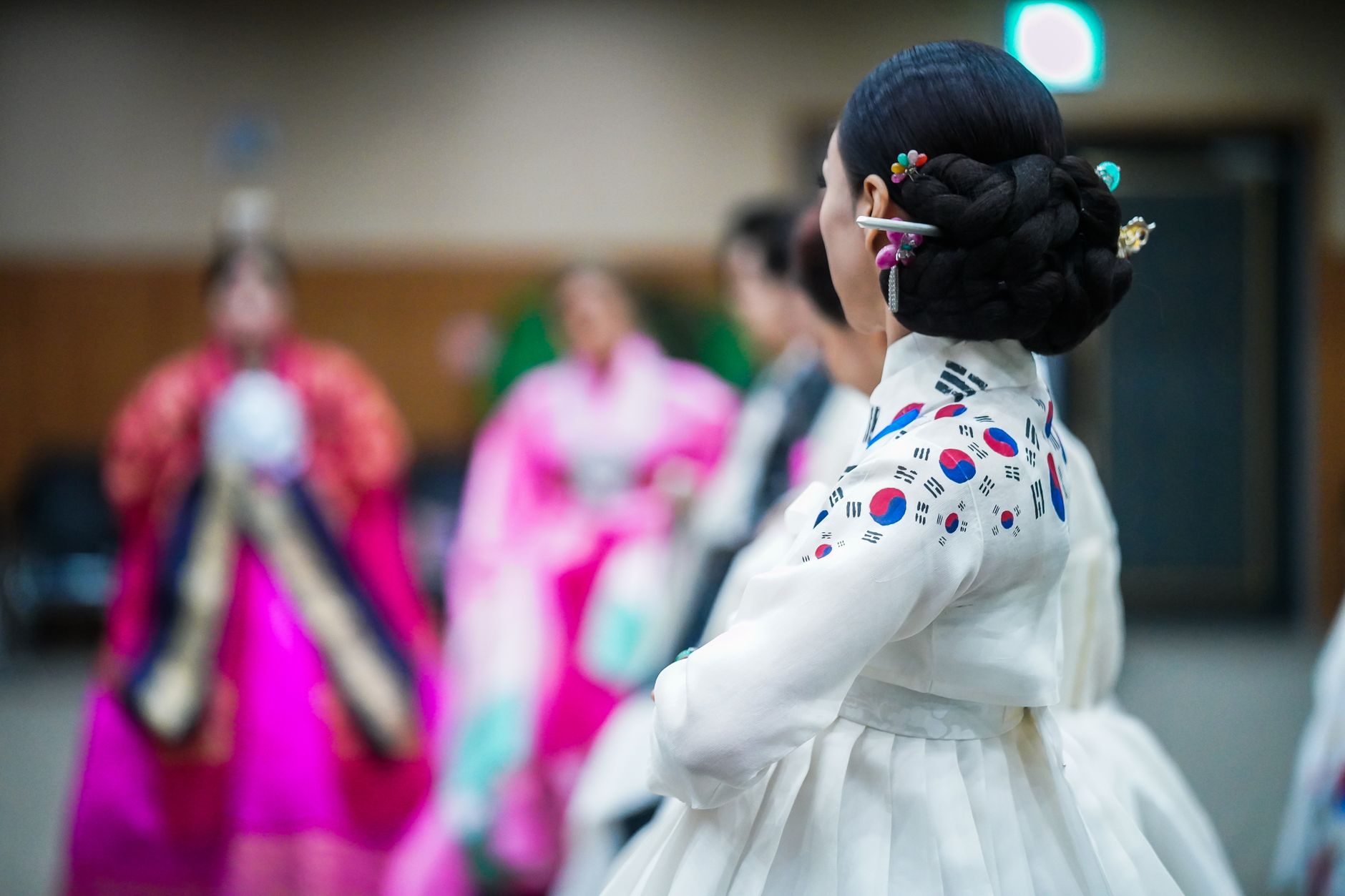
The pyebaek hanbok is more elaborate than everyday hanbok — richer colors, heavier embroidery, often rented specifically for this twenty-minute window and never worn again. The bride typically wears a deep red, and there’s a specific, almost startling detail: her face is marked with small red dots on the cheeks, a holdover from an older belief that red would ward off evil spirits on this vulnerable, transitional day.
In the pyebaek room, the couple bows deeply to the groom’s parents — in many modern versions, the bride’s parents are now included too, which is itself a fairly recent softening of what was originally a groom’s-family-only ritual. They offer dates and chestnuts, and pour rice wine.
The parents, in turn, offer blessings and often toss the jujubes and chestnuts toward the bride, who tries to catch them in the skirt of her hanbok. The specific number she catches is supposed to predict how many children the couple will have — jujubes for sons, chestnuts for daughters, in the older version of the belief. I’ve watched brides scramble genuinely competitively for a good catch, arms out, skirt stretched wide, everyone laughing, and it’s one of the few moments in the entire day that feels unscripted rather than choreographed for a photographer.
It sounds almost quaint written out like this, but standing in the room, it doesn’t feel like a performance for guests — because there mostly aren’t any. Pyebaek is usually just close family: parents, grandparents if they’re alive, sometimes siblings. It’s the private, ritual counterweight to the very public, very fast ceremony happening in the main hall an hour earlier.
Why Both Ceremonies Exist at Once
Korea modernized its wedding customs fast, but didn’t throw out the old ones — it just compressed them and moved them backstage. Until relatively recently in Korean history, a traditional wedding (called “gunlyerye” in its formal historic form) was itself an elaborate multi-day affair, with its own ceremonial bowing between bride and groom in the main hall, not just between the couple and parents afterward. What’s left of that today, for the vast majority of couples, is this two-part structure: a quick, photogenic, Western-style ceremony for the record and for guests, followed by a compressed, deeply symbolic family ritual that keeps the older Confucian-influenced customs of ancestor respect and family integration alive, just in twenty minutes instead of two days.
What took me longest to appreciate is that this isn’t couples “not caring enough” to slow down — if anything, doing both signals they care about honoring both the modern, individualistic idea of a wedding and the older, family-centered one. Skipping pyebaek entirely is possible and some couples do it, especially for very small or destination weddings, but plenty of couples who’d otherwise describe themselves as not very traditional still do a token pyebaek, because skipping it can feel like skipping a step with the parents that’s hard to get back later.
Even after several of these, the whiplash between the two ceremonies still gets me a little: one moment it’s a slick, almost corporate 25-minute program with a professional MC, and twenty minutes later you could be standing outside a door listening to parents laughing as their new daughter-in-law lunges for a chestnut in a hanbok skirt. Both moments are completely genuine. They’re just running on two very different clocks.
Frequently Asked Questions
Do all Korean couples still do pyebaek?
Most do, at least in a shortened form, even couples who describe their overall wedding as modern or Western-style. It’s become less about tradition for tradition’s sake and more a way of formally including parents and grandparents, since they’re often the only guests present for it. Some couples skip it, particularly for very small ceremonies or when getting married abroad, but it’s still the default rather than the exception.
Why do Korean weddings feel so rushed compared to Western ones?
Mostly venue logistics. Popular wedding halls run multiple ceremonies back-to-back on weekends, so the 20-to-30-minute ceremony followed by a buffet is built around turning the room over efficiently. The emotional and ritual depth doesn’t disappear — it’s just relocated to the pyebaek ceremony afterward rather than stretched through the main event.
How much cash should I give if I’m invited to a Korean wedding as a foreigner?
As a general guideline, 50,000 to 100,000 won is the common range depending on how close you are to the couple, given in a plain white envelope with your name written on the back. When in doubt, ask a mutual Korean friend or colleague what’s appropriate for your specific relationship to the couple, since local norms shift by region and social circle.
Leave a Reply