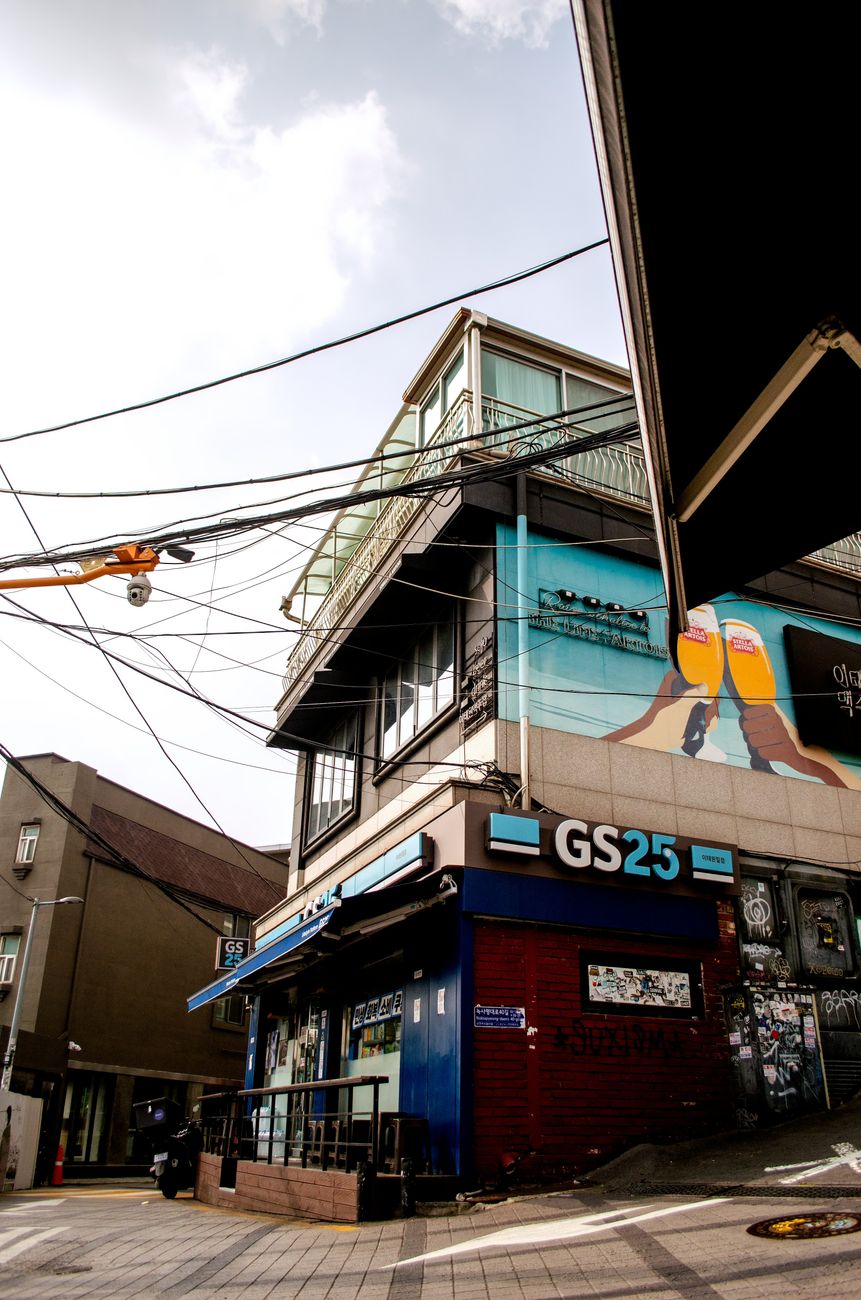
A friend of mine, a fellow foreigner who has lived in Korea about as long as I have, once told me flatly that he doesn’t trust anyone who buys their triangle kimbap at 7-Eleven. Not because it’s bad — he admitted it’s fine — but because, in his words, “if you had options and still picked 7-Eleven, what does that say about your decision-making generally?” I laughed, mostly because I understood exactly what he meant, and partly because I realized I had never once considered that my convenience store loyalty might be a personality trait. It is, apparently. Ask around and you’ll find Koreans and expats alike who will defend GS25 over CU the way people used to defend sports teams. Underneath that ridiculous sports-team loyalty lies a structural reality: these four chains — CU, GS25, 7-Eleven, and Emart24 — are not simply selling snacks. They’re running a permanent, overlapping product war, and the battlefield is a fridge case the size of a phone booth.
So instead of another flat top-ten countdown, which I think under-serves how this actually works, I’m doing a tier list by category. Some categories have a clear champion. A couple are genuinely too close to call, and I’ll say so. The rule I’m using throughout: does the snack survive being eaten standing at the plastic counter by the window, one-handed, possibly while your ramyeon timer counts down on your phone? A lot of excellent Korean food fails that test. Convenience store food has a completely different job description, and the products that win here aren’t always the “best” food in any objective sense — they’re the best convenience store food, which is its own category with its own rules.
Triangle Kimbap: The S-Tier Baseline
Samgak gimbap — the plastic-wrapped rice triangle you unwrap by pulling a tab in a very specific order, which I still occasionally get wrong and end up with seaweed stuck to my hand — is the closest thing convenience stores have to a house speciality, and it earns S-tier because there’s genuinely no bad version of it anywhere. At around 1,200 to 1,600 won depending on the filling, it’s arguably the best value-per-won item in the entire store. My actual ranking within the category: spicy chicken mayo edges out plain tuna mayo for me, mostly because the tuna mayo has gotten a little too popular for its own good and I’ve had versions that felt stretched thin on filling. CU’s version, in my experience, tends to have a slightly better rice-to-seaweed ratio than GS25’s — GS25’s seaweed can turn slightly leathery by the time you get to the last third if the rice has cooled even a little, where CU’s stays closer to crisp longer, though I’ll admit that’s the kind of claim that’s basically impossible to verify scientifically and mostly comes down to which branch near you restocks more often. Either way, if you’re new to this and skeptical that rice wrapped in plastic can be a real meal, I get it — it looked like a snack to me too, the first time. It isn’t. Eat two of these plus a canned coffee and you’ve had dinner for under 4,000 won, and somehow it doesn’t feel like you cut a corner.
The Ramyeon Station: A Tie, and I Hate Ties
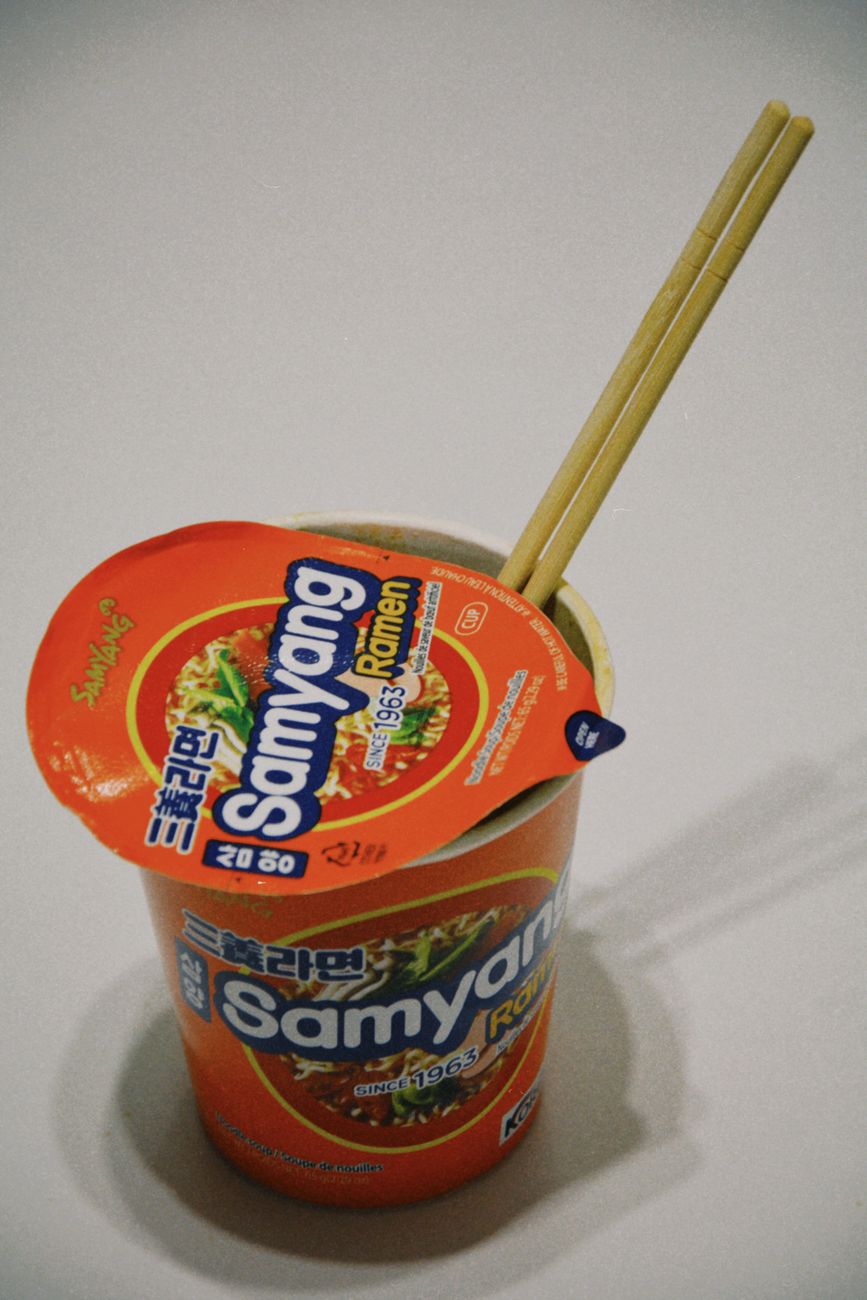
The hot water dispenser is the actual soul of the Korean convenience store, and if you’ve never used one, the ritual is simple: buy your cup ramyeon, peel back the lid partway, fill to the marked line, reseal, wait three minutes, and eat it standing at a narrow counter facing the street, watching people walk by who did not plan their evening around instant noodles. I want to put Buldak Bokkeummyeon cup versions at the top here, because culturally they basically are the modern Korean instant noodle, but I’m being honest: the cup format is drier and clumpier than the packet version stir-fried properly with a lid, and some of the theater — the shaking, the crying, the filming — just doesn’t translate to a convenience store table. So instead I’m giving joint S-tier to classic Jin Ramen (about 1,300 won) and Neoguri, the thick seafood noodle that somehow holds its chew even after sitting in a paper cup for three minutes, which shouldn’t be possible but is. If you want spice without going full Buldak, Buldak Carbonara cup is a legitimate compromise — creamy enough to blunt the heat, and I say that as someone who is not particularly heat-tolerant. I’ve written more on how Koreans actually calibrate spice levels in a separate piece, if the whole “how spicy is too spicy” question interests you, because convenience store ramyeon is honestly a decent entry point into that whole system.
Cold Noodles: The Summer Sleeper Hit
If you’re visiting anytime between May and September, though, forget the hot water station entirely for a minute and go straight to the bottom shelf of the refrigerated case — that’s where this category lives, and it’s the one most first-time visitors miss completely. Jjolmyeon and its chewier cousin jjolbyeongmyeon deserve A-tier, easily. These are cold, springy noodles in a spicy-sweet gochujang sauce, sold pre-portioned in a plastic tray with the sauce packet on the side, usually running 3,500 to 4,000 won. What hooked me the first summer wasn’t the sauce, honestly — it was the terrifyingly elastic, rubber-band resistance of the noodles themselves, more chew than any instant noodle I’d had, the kind of texture that sounds unpleasant described out loud and is somehow completely addictive in person. Both GS25 and CU run competing versions every summer, along with mul-naengmyeon, the cold broth version, and the two chains genuinely seem to treat this as a real seasonal battleground rather than an afterthought — new variants show up practically every June. Still, I’ll say the honest downside: it’s a one-season food. Order one in January and you’ll get a shrug from the cashier, if you can even find it on the shelf.
Corn Dogs: Good, But Overrated by Tourists
While first-timers swarm the hot-food case for this next one, I notice most regulars walk right past it, and I’ve come around to their side. I’m putting hot-case cheese corn dogs at B-tier, and I expect pushback on this one, because they’ve become something of a social media phenomenon — mozzarella-stuffed, coated in fried potato cubes, running 2,000 to 3,000 won depending on the size and the cheese pull. They’re genuinely fun the first time. My issue is durability: a corn dog needs to be eaten within about ninety seconds of being handed to you, or the cheese seizes up and the batter goes from crisp to soggy in a way that no amount of enthusiasm fixes. That’s a much narrower window than triangle kimbap or cup ramyeon give you, and on a system where I’m explicitly rewarding things that survive being eaten standing up at your own pace, a food that punishes hesitation loses points. Still worth trying once — just don’t take photos of it first.
Banana Milk: Technically a Drink, Permanently on This List Anyway
Yes, I know Binggrae Banana Milk is a beverage, not a snack, and yes, I’m including it anyway, because at this point it functions more like a dessert course than something you’d drink with a meal. The barrel-shaped bottle hasn’t meaningfully changed since 1974, which in a market that redesigns snack packaging seemingly every fiscal quarter is its own strange little monument to consistency. It runs about 1,700 won, and the flavor is less “real banana” and more the concentrated, almost candy-like sweetness of banana-flavored taffy — closer to a Runts candy than to actual fruit, and somehow that’s exactly the point rather than a flaw. S-tier for nostalgia and brand loyalty, A-tier if I’m being strict about flavor complexity, because there genuinely isn’t much complexity to it — it’s one note, played well, forever. Don’t pair it with something spicy expecting balance; one of them will lose, and it’s usually the banana milk.
Chips and PB Collabs: Where the Real Money Is
Here’s the category that actually explains why Koreans have brand loyalty to a store that sells gum and canned coffee. When I mention a chain’s “PB” line — GS25’s Youus, CU’s Heyroo, 7-Eleven’s Only@ — that stands for private brand, the store’s own in-house label. In most countries that phrase means cheap and forgettable. In Korea it’s closer to a flagship category, launched with the same fanfare as a limited sneaker drop. The clearest example right now: GS25 partnered with Haitai, the company behind the original Honey Butter Chip phenomenon from a decade ago, to release Hwang Cheese Butter Flavor Fresh Potato Chips — 2,000 won, thin and light like the classic Fresh Potato Chip base, but leaning into a sharper cheese-forward flavor instead of straight honey-sweetness. It’s a legitimate spiritual successor rather than a cash-grab reissue, and I say that as someone who was fairly skeptical going in. On the weirder end, 7-Eleven collaborated with SK hynix — yes, the semiconductor company — on something called HBM Chips, a pun on the memory chip technology “HBM” restyled as “Honey Banana Mat” (a play on the Korean word for flavor). It sounds like a joke SKU that would only exist for a week. It did surprisingly well. It’s a chaotic system, running on half genuine culinary craft and half corporate stunt, but somehow the stunts keep delivering.
Seasonal Ice Cream: The Category Nobody Ranks Fairly
I’m giving this A-tier with an asterisk, because seasonal ice cream in Korean convenience stores isn’t really one category — it’s a rotating cast, and your ranking depends entirely on what month you’re asking in. Melona stays a reliable constant year-round, no matter which chain you’re in, and I trust it the way I’d trust a familiar brand back home. Beyond that baseline, look specifically for the honeycomb-studded soft serve bars — sold under names like Ppopa or Screw Bar depending on the manufacturer that quarter — that show up every summer with a genuine crunch of honeycomb toffee buried in soft serve, worth seeking out even though half the appeal is that you genuinely don’t know if your local branch will have restocked them. That inconsistency should be a flaw. It somehow isn’t — it just makes finding one feel a little bit like a win.
So Which Chain Actually Wins?
If you’re asking me to just pick one chain and be done with it, I won’t, and not to dodge the question. Each of the four plays a different game well. GS25 tends to move first and loudest on collabs and viral moments — the Haitai partnership is a good example. CU, in my experience, has the most consistently solid triangle kimbap and PB snack basics, the stuff you buy without thinking hard about it. 7-Eleven leans into genuinely weird, high-concept collabs that either flop entirely or become the thing everyone’s talking about for a week. Emart24 gets underrated by a lot of foreigners simply because there are fewer locations in most neighborhoods, but its private label lineup punches above its footprint. My actual answer, after several years of this: I don’t pick a chain. I pick whichever one is physically closer at the moment I need it, which is, in the end, the entire premise of a convenience store working correctly.
FAQ
A few practical questions come up often enough, usually from people planning their first trip, that they’re worth answering directly rather than burying inside the tier list above.
Is convenience store food actually a full meal, or just a snack?
It genuinely can be a full meal, and for a lot of people here — students studying late, office workers between overtime, delivery drivers on a short break — it regularly is one. Two triangle kimbap, a cup of Neoguri, and a canned coffee comes to around 4,000 to 4,500 won and covers real calories, not just a sugar spike. It won’t replace a proper Korean home-cooked meal on nutrition, and I wouldn’t build a whole week around it, but as an occasional dinner it holds up better than most countries’ equivalent gas-station food. It also fits neatly into the broader culture of eating solo here, which I’ve written about separately in a piece on honbap culture, if standing alone at a convenience store counter at 11 p.m. sounds like something you’d want context on before trying it yourself.
Do I need to speak Korean to use the hot water station?
No. It’s entirely self-serve: buy your cup ramyeon at the register, peel the lid back to the printed line, walk it to the water dispenser near the seating area, fill it, press the lid back down, and set a timer for about three minutes. Staff generally won’t intervene unless you look genuinely stuck, and most locations have the instructions printed right on the lid in both Korean and English.
Which chain should I go to if I only have time for one convenience store during my trip?
If you’re only stopping once, GS25 or CU are the safest bets simply because they have the widest footprint, so you’re more likely to catch that week’s specific seasonal or collab item rather than a picked-over shelf. If you happen to be near an Emart24 and you’re curious about PB snacks specifically, it’s worth the detour — just don’t go in expecting to find one on every block the way you can with the two bigger chains.
Leave a Reply