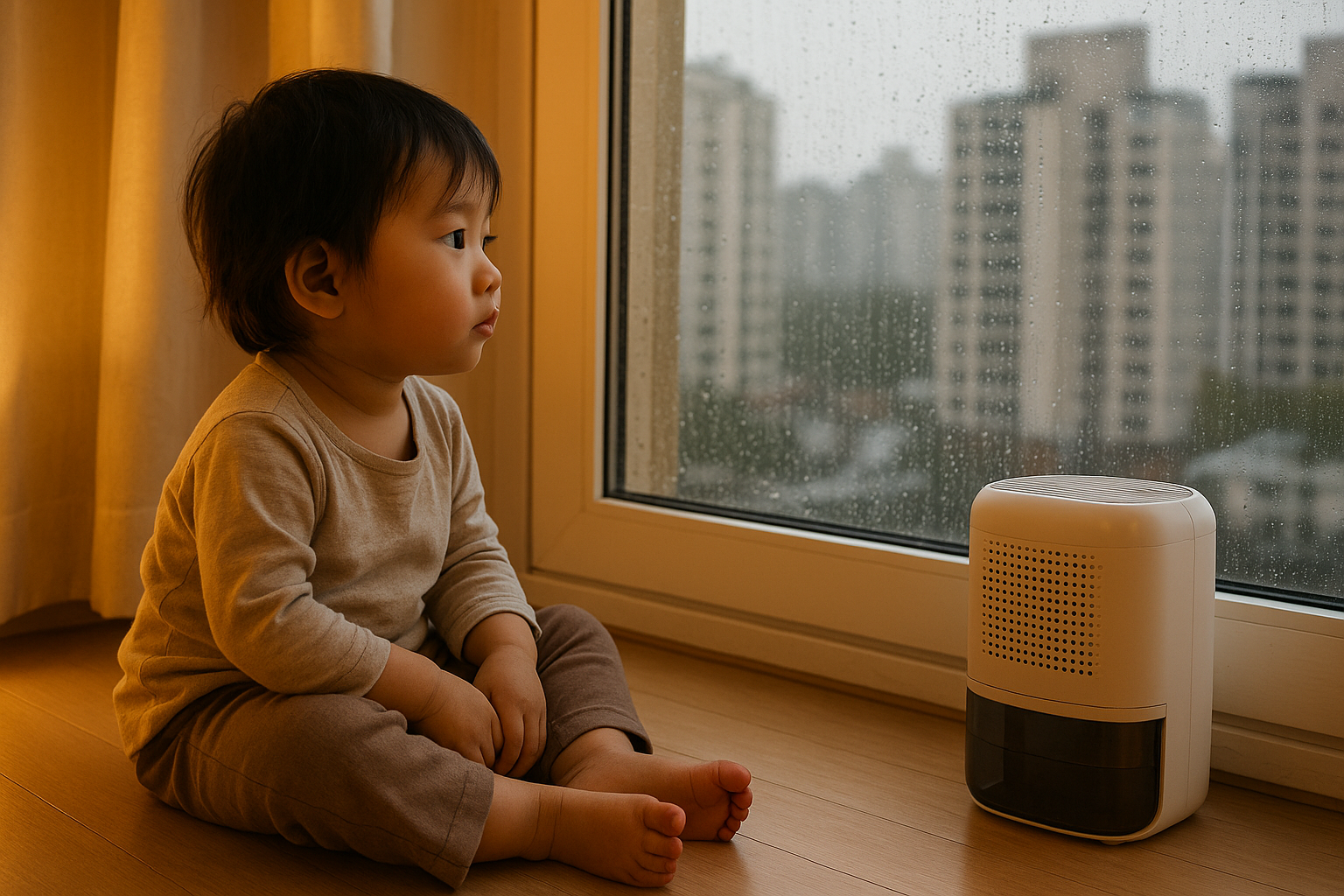
My daughter has started narrating the rain. She sits on the windowsill in her pajamas, points at the water running sideways across the glass, and says “more, more, more” like she’s cheering it on. I used to find that endearing. Around day nine of jangma, I started finding it a little personal.
We’re three weeks into the wet season here in our apartment outside Seoul, and the whole building smells faintly like a gym bag that never quite got aired out. That’s not a complaint exactly — more of a fact I’ve made peace with. Korean summers come in two acts. First the heat builds for a few weeks, then sometime around late June the sky just gives up holding it in, and it rains, hard, for what feels like a month straight. My wife’s family calls it jangma, and every year they warn me about it like it’s a relative visiting from out of town who overstays.
The laundry situation has become a personality trait
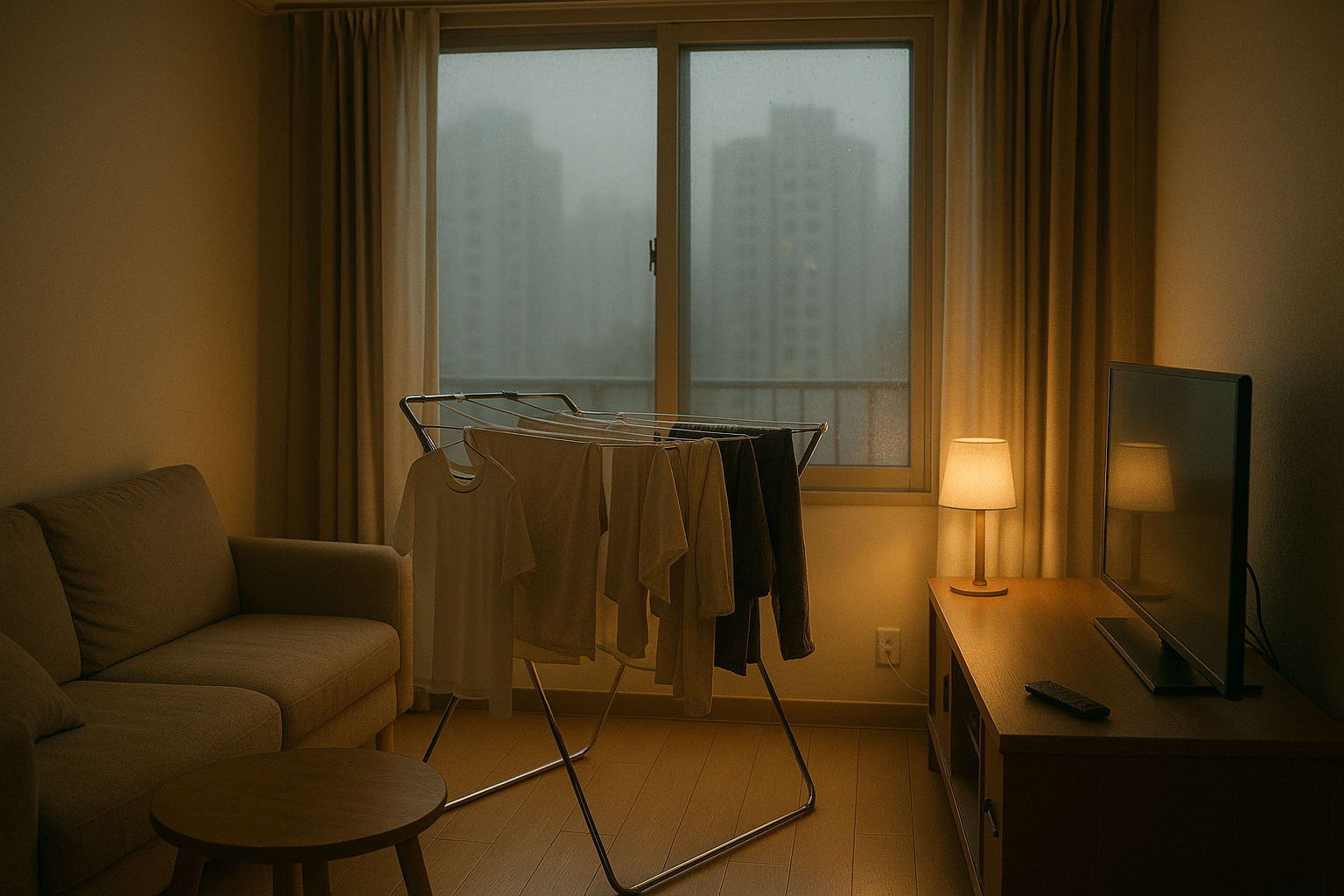
I never thought I’d have opinions about drying racks, but here we are. We own two now — one folding rack that lives permanently unfolded in the corner of the living room, and a second one we bought in a moment of panic during week two, when I realized the first rack alone couldn’t keep up with a toddler who goes through three outfits a day between meals, mud, and whatever mysterious substance ends up on her sleeves by 10 a.m.
The problem isn’t washing the clothes. It’s that nothing dries. You hang a load in the morning, come back that evening, and it’s still damp in that specific way where the fabric feels cool and slightly clammy against your hand, like it’s sweating instead of drying. Leave it another day and you get the smell — that sour, slightly mildewy note that no amount of fabric softener quite covers up. My mother-in-law taught us to run a small fan pointed directly at the rack, which helps, and we finally caved and bought a dehumidifier in our second summer here after I ruined a good work shirt by accidentally re-washing it three times because I kept forgetting which load was “actually clean” versus “clean but cursed.”
The dehumidifier tank fills up almost daily now. I empty it into the bathroom sink most mornings, and there’s something almost satisfying about watching a liter and a half of water pour out of a machine that’s just been sitting quietly in the corner pulling moisture out of the air we’re all breathing. My daughter likes to watch the little indicator light change color when the tank gets full. It’s become part of the morning routine, right after brushing teeth and right before she asks — for the fourth day running — why we can’t go to the playground.
Stuck indoors, and the great umbrella graveyard
That’s the harder part, honestly. Not the laundry — the containment. A two-year-old with unlimited energy and zero outdoor options for days at a time is its own weather system. We’ve done every indoor mall play area within a twenty-minute drive. We’ve built blanket forts. On one particularly grim Tuesday I let her “help” me reorganize the pantry just to burn forty-five minutes, and she ate a spoonful of dry oats directly from the bag while I wasn’t looking, which felt like a fitting metaphor for the whole month.
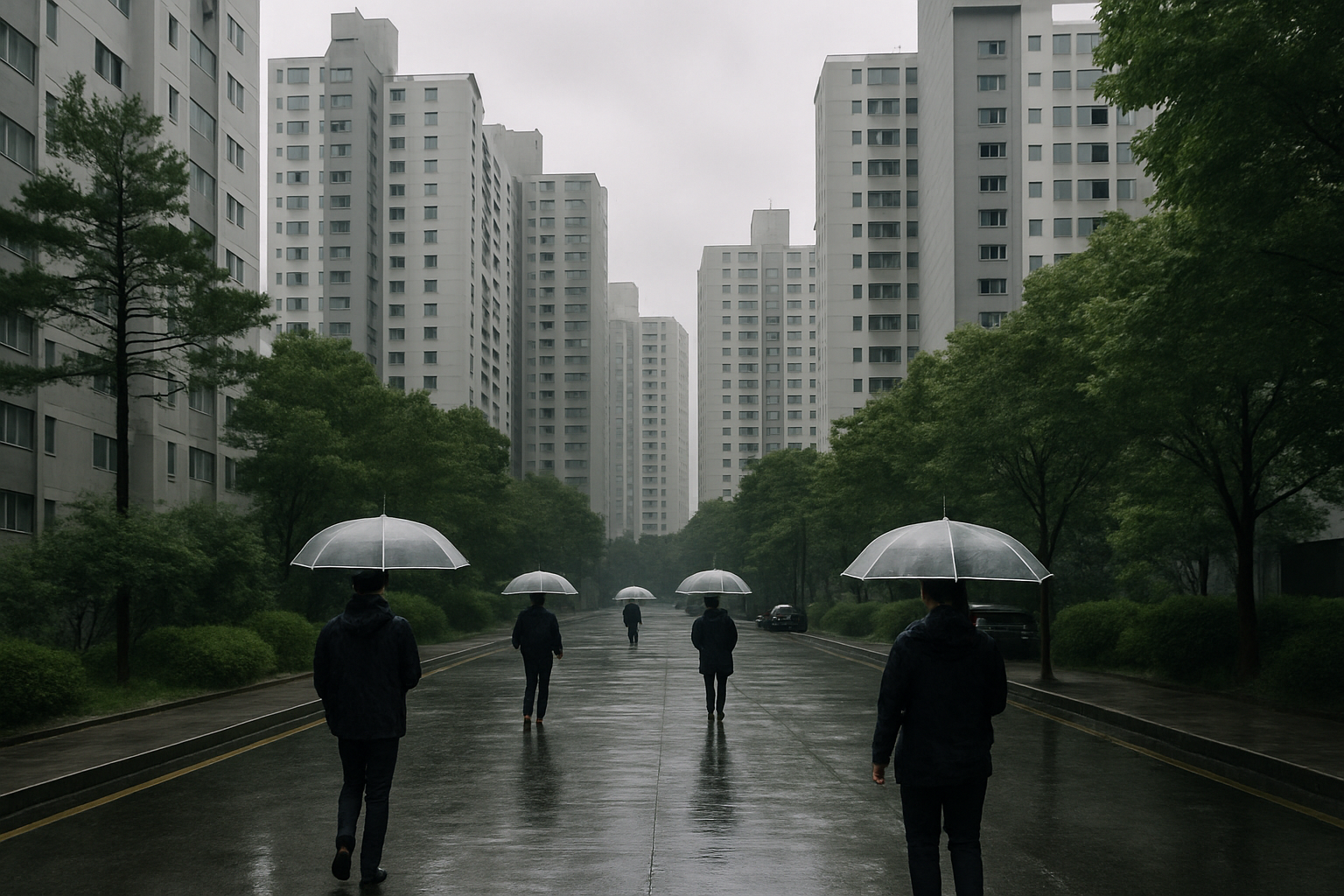
When we do go out — for a doctor’s appointment, for groceries we can’t put off any longer — the convenience store becomes a small ritual. You duck in soaked, and there’s always a bucket of those clear plastic umbrellas by the register, three or four thousand won each, flimsy enough that you half expect it to turn inside out on the walk home but somehow it never quite does. I have at least six of them scattered around our apartment and car now. Nobody buys a nice umbrella during jangma. You buy the sad clear one, use it twice, and add it to the pile.
There’s a sound I’ve started to associate with this whole season — rain hitting the metal casing of the window-unit air conditioner on our building’s exterior wall, a kind of irregular drumming that picks up and slows down depending on the wind. I hear it while I’m making coffee before anyone else is awake, and for about ninety seconds each morning, before the day’s laundry math and playground negotiations start, it’s actually kind of nice. Then my daughter wakes up and starts narrating the rain again, and the ninety seconds are over.
The mold watch
Living in an apartment here means you become, somewhat against your will, an amateur mold inspector every July. We check the closets. We check behind the bookshelf we probably shouldn’t have pushed flush against the exterior wall. There’s a specific dark corner near our daughter’s crib that I check almost obsessively, because I read once that kids’ rooms are worse for this — lower airflow, more soft surfaces, a crib mattress that traps warmth. So far, so good, though I’ll admit I’ve become the kind of person who sniffs a wall unprompted, which is not a sentence I expected to write when I moved to Korea.
FAQ: Surviving jangma with kids
When does jangma actually start and end?
It varies by region and by year, but the general pattern is late June through late July. Jeju and the southern coast usually see it first, sometime around June 19–23, while central Korea (including Seoul) typically starts a few days to a week later and runs into late July. It’s not a fixed calendar date — the Korea Meteorological Administration announces the actual start each year once the rain band stabilizes over the peninsula.
What do Korean families actually do to fight mold and mildew?
Dehumidifiers are the big one — running daily, aiming to keep indoor humidity somewhere in the 40–60% range rather than the 80–90% jangma likes to push you toward. Silica gel packs (제습제) in closets and shoe cabinets are everywhere this time of year — you’ll see them stacked near the entrance of every mart. We also run the bathroom fan longer than usual and try to crack windows for ten minutes on the rare dry-ish hour to keep air moving, even though it feels counterintuitive when it’s humid outside too.
Do schools and daycares close for jangma?
No, not as a rule — Korean schools and daycares operate through the rainy season, though outdoor activities and field trips get cancelled or moved indoors on heavy rain days, and there’s occasionally an early pickup or closure if there’s a serious flood warning in the area. For us it mostly just meant swapping the playground hour for indoor free play, which our daughter tolerated with varying degrees of grace.
Anyway. The forecast this week shows a few days without rain, which around here counts as a small holiday. I already know what I’m doing with it — hanging every damp thing we own outside at once and hoping the sun does its job before the next front rolls in.