The first time a Korean coworker introduced herself, I wrote her name down backwards on a delivery form. She didn’t correct me right away — just watched me hand it to the courier, waited a beat, and said, “It’s fine, it happens to every foreigner once.” That “once” turned into a running joke between us for the next two years, mostly because I kept doing it in new and creative ways.
Family name first, given name second — I knew the rule cold. Applying it under pressure, at a counter, with someone waiting behind me, turned out to be a completely different skill, and it took me embarrassingly long to build it.
If you’ve spent time in Seoul, dated across cultures, or binged enough K-dramas to start picking up vocabulary, you already know the golden rule: Koreans put the family name before the given name. Kim Min-su is a Kim, not a Su. But knowing that fact and actually navigating Korean names in daily life — reading a business card, filling out a hospital form, figuring out what to call your partner’s older cousin — are two very different levels of fluency. This post is my attempt to close that gap, drawing on years of getting it wrong before I got it right.
Family Name First: The Basic Rule
Korean names follow the East Asian order: surname, then given name. A name like 김민수 (Kim Min-su) breaks down as Kim (family name) plus Min-su (given name). That’s the reverse of the Western convention, where “John Smith” puts the given name first. It’s the same underlying logic you’ll find in Chinese and Japanese naming — China, Japan, Vietnam, and Korea all share this family-name-first structure, though the history and reasoning behind each is distinct.
Korean names, when written in English, don’t always signal which part is which, and that’s exactly where newcomers stumble. “Park Ji-sung” could theoretically be misread by someone unfamiliar with the convention as a given name “Park” followed by a surname “Ji-sung.” Context and exposure are the only reliable teachers, which is why I kept making mistakes even after reading the rule a dozen times. Reading about it and internalizing it under real-world pressure are not the same muscle.
Some Koreans who work internationally or study abroad will flip their name into Western order for convenience — writing “Min-su Kim” on a resume aimed at a US company, for instance. That’s a courtesy, not a rule change, and it means you genuinely cannot assume which order you’re looking at unless you already know the person’s family name or you ask. I’ve learned to just ask outright now: “Which part is your family name?” Nobody has ever seemed to mind the question, and it’s saved me from more filing errors than I’d like to admit.
The Short List of Surnames Behind Half the Country
One of the stranger adjustments for an expat is realizing just how concentrated Korean surnames are. There are only around 250 family names in active use across the entire country, and the distribution is wildly lopsided. Kim, Lee, and Park together account for roughly 44.6% of the population — meaning nearly half of the fifty-plus million people in South Korea share one of three surnames. Add Choi and Jung (also romanized Chung), and you cover roughly half of everyone you’ll ever meet.
In a country where “Kim” is about as common as “Smith” and “Johnson” combined in the US, a surname alone tells you almost nothing distinguishing — not family line, not region, not much of anything. What actually carries information is the bon-gwan (본관), or clan seat — a geographic origin point tied to a specific ancestral lineage. A “Gimhae Kim” and a “Gyeongju Kim” are both named Kim, but they trace back to entirely different clans, and older generations still take that distinction seriously. It’s not just trivia, either: South Korea actually banned marriage between people sharing the same surname and same bon-gwan for decades, a law rooted in old Confucian ideas about clan purity that wasn’t fully struck down until a constitutional court ruling in the late 1990s. So when my partner’s grandmother once asked, half-joking, whether my last name had a “bon-gwan” of its own, she wasn’t just being quaint — she was running an old mental checklist that used to have real legal weight behind it.
Generational Syllables: A Naming System Built for Extended Families
This is the part of Korean naming that most outsiders never hear about, and it’s honestly my favorite piece of the whole system. Traditionally, a two-syllable given name isn’t two random syllables chosen for sound or meaning alone. One syllable is often a generational name (돌림자, dollimja) — a syllable shared by everyone in the same generation of an extended family, sometimes across dozens of cousins — while the other syllable is unique to that individual.
So if you meet three cousins named Kim Min-su, Kim Min-jae, and Kim Min-ho, that shared “Min” isn’t a coincidence or a family nickname pattern — it’s a formal marker of generational rank, historically assigned according to rules recorded in the family’s genealogy book (jokbo) and tied to the same clan seat mentioned above. Practically speaking, this meant that within a large extended family, you could often tell at a glance which generation a person belonged to just from their given name, which mattered enormously in a culture built around age- and generation-based hierarchy.
Is this still common? Less common than it used to be. Modern parents increasingly choose names for sound, meaning, or trend value rather than strict adherence to generational naming charts, and plenty of younger Koreans have names that don’t follow the pattern at all. But it hasn’t disappeared — you’ll still meet families, especially in more traditional or rural backgrounds, where the practice is alive and well. It explains a lot about why extended Korean families sometimes seem to “sound” alike, and why a grandparent can occasionally guess a stranger’s rough generation just from hearing their name read aloud.
Paperwork, Passports, and the Romanization Mess
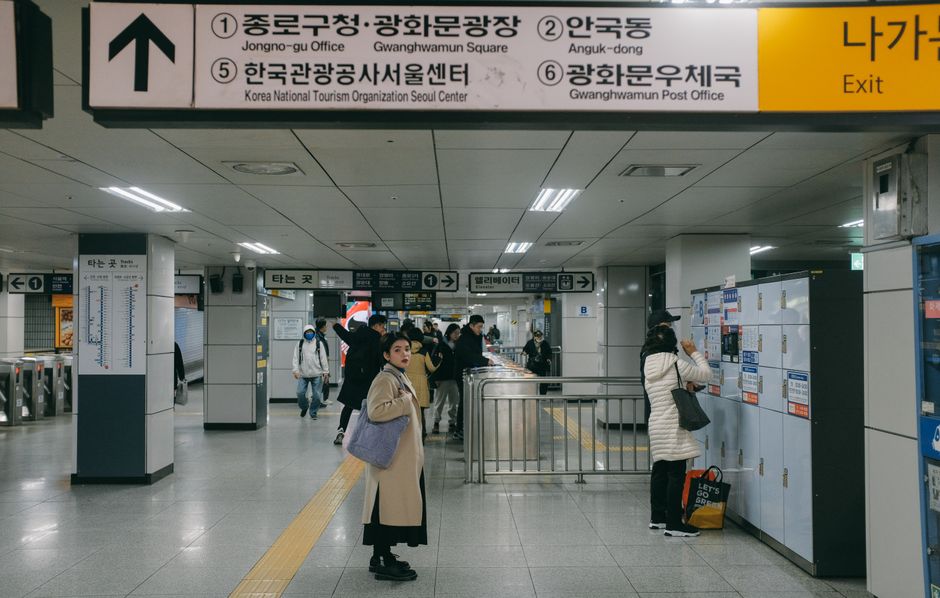
Where the naming order stops being trivia and starts being a genuine bureaucratic headache is on official paperwork. Korean ID cards and resident registration documents list the family name first in Korean script, and the romanized version on the back of a Korean passport typically follows the same order — surname, then given name, often written in all capitals for the surname to reduce ambiguity, as in “KIM Minsu” or “KIM Min-su.”
The spacing and hyphenation of the given name, though, is not standardized at all. You’ll see the same name rendered as “Min-su,” “Minsu,” or “Min Su” depending on which document, which era, or honestly which individual clerk processed the paperwork. This isn’t sloppiness so much as the byproduct of Korea having gone through multiple official romanization systems over the past century. The older McCune-Reischauer system and the newer Revised Romanization of Korean, adopted in 2000, produce genuinely different spellings for the same syllables — a name that would be “Pyŏng” under the older system becomes “Byeong” under the current one. If your visa, your bank documents, and your phone contract all list your Korean partner’s name with three slightly different spellings, that’s not a bank error. That’s Korean romanization history working exactly as inconsistently as it always has.
Surnames carry the same problem. 이 (Lee) is also written “Yi,” “I,” or “Rhee” depending on the individual or the era; 박 (Park) occasionally appears as “Pak”; 정 (Jung) shows up as “Jeong” or “Chung.” None of these spellings is wrong, exactly — they’re the residue of different romanization choices made by different families, sometimes generations apart, and sometimes by a single grandfather who registered a passport back in the 1970s under whatever system a particular office happened to be using that year.
My own run-in with this cost me an entire afternoon at a bank branch near Sinchon, because the name on my landlord’s account was spelled with one hyphen placement, while a separate utility document spelled the same syllables as two solid words with no hyphen at all. The teller squinted at both printouts side by side, shrugged, typed something, and moved on like this happened every week — which, judging by her total lack of surprise, it probably did. That reaction, more than anything, told me how normal this kind of mismatch actually is here. If you’re ever unsure which spelling someone prefers for their own name, just ask; it’s a completely normal question in Korea, and most people appreciate being asked rather than assumed.
Why Foreigners Get Tripped Up So Often
Beyond the order itself, a few other things compound the confusion for newcomers. Korean given names are frequently gender-neutral or only softly gendered, unlike many Western naming conventions where a name almost always signals gender clearly. And because so many Korean surnames are monosyllabic and drawn from that short list of around 250, Western software, forms, and databases built with a rigid “first name / last name” assumption sometimes mangle the order without anyone noticing — especially older systems that were never designed with East Asian names in mind.
What surprised me more, though, was how differently Koreans handle the family name when addressing someone directly versus writing it down. You’ll rarely hear a Korean person call a coworker or acquaintance by their bare family name the way you might casually say “Hey, Smith” in English. That would land as oddly blunt, even rude, in most contexts. Which brings us to the piece of this system that took me the longest to actually internalize: how people are addressed out loud.

Addressing People: Title Beats Name, Almost Every Time
If there’s one habit that separates someone who’s read about Korean culture from someone who’s actually lived inside it, it’s this: in Korean social and professional life, titles usually outrank first names, and often outrank full names entirely. At the office, you don’t call your manager by her given name — you call her by her job title plus the honorific suffix 님 (nim), as in 팀장님 (timjang-nim, “team leader-nim”) or 과장님 (gwajang-nim, “section chief-nim”). Even outside a formal title, adding 씨 (ssi) after a full name or given name, as in “Min-su-ssi,” softens direct address into something closer to “Mr./Ms. Min-su” — appropriate among peers or people you don’t know especially well.
Using someone’s bare given name without any honorific is reserved for close friends, younger family members, or people clearly junior to you in age or status, and using it with the wrong person can land as surprisingly disrespectful, even if you meant nothing by it. I still catch myself defaulting to first names out of habit, and I’ve had to consciously retrain that instinct more than once. Koreans are unfailingly patient about this with foreigners, but the flicker of discomfort on someone’s face when it happens is a pretty clear teacher on its own.
This title-first habit extends surprisingly far into family and social life, too. Many Koreans don’t call their older siblings, close friends, or even long-term romantic partners by their given names at all, relying instead on kinship terms tied to relative age and gender. A younger woman calls an older brother-figure oppa; a younger man calls an older sister-figure noona; a younger man calls an older brother-figure hyung; a younger woman calls an older sister-figure unni. These aren’t just cute nicknames borrowed from dramas — they function as real address terms in daily life, used constantly among friend groups with even a one- or two-year age gap. It’s a system built entirely around relational hierarchy rather than individual identity, which is a genuinely different way of thinking about names than most Westerners grow up with, and it honestly took me longer to get comfortable with than any romanization rule ever did.
Frequently Asked Questions
Do Korean women change their surname when they marry?
No — this is actually one of the more surprising facts for people coming from Western naming traditions. Korean women traditionally keep their own family name after marriage rather than adopting their husband’s. This isn’t a modern feminist adjustment; it reflects an older legal and cultural framework around clan lineage, where a woman’s surname identity stayed tied to her birth family regardless of marital status.
Is it rude to call a Korean person by just their family name, like “Kim”?
In most everyday contexts, yes — it can come across as blunt or oddly formal in the wrong way, closer to how “Hey, you, Smith” might sound in English than a neutral greeting. It’s much more natural to use a title with 님 (nim), a full name with 씨 (ssi), or a kinship term appropriate to your relationship, rather than the bare surname alone.
Why do so many Koreans share the same three or four surnames?
It comes down to a long history where surname adoption was historically restricted and later standardized under a fairly narrow set of clan names, combined with the fact that Kim, Lee, and Park in particular expanded enormously over centuries through both natural population growth and, at points in history, broader access to surname registration. The result is a country where roughly half the population statistically shares one of just five names — which is exactly why the clan-seat (bon-gwan) distinction still matters so much culturally, even when it’s invisible to outsiders.
None of this is a system you need to master before landing in Incheon. Most Koreans are remarkably patient with foreigners fumbling through name order, honorifics, and romanization spellings — I’ve been on the receiving end of that patience more times than I can count. But understanding the logic underneath it, rather than just memorizing “surname first,” makes the whole thing click in a way that sticks. It stopped being a rule I had to consciously recall and became something closer to instinct, which, four years in, is still very much a work in progress.