My kid pointed at a tteokbokki cart last week and asked why the ajumma running it laughed when I said “not too spicy, please.” I found out why about four minutes later, eyes watering over a paper cup of rice cakes that, by Korean standards, were basically kid food. That gap between what I expected and what actually showed up is the whole story of eating spicy in Korea as a foreigner — and it took me longer than I’d like to admit to figure out the system behind it.
Korea Doesn’t Use “Mild, Medium, Hot” the Way You Think
Back home, a spice scale is usually a straight line: mild, medium, hot, maybe an “extra hot” for people who want to suffer. Korean menus and packaging work off a different logic. You’ll see 순한맛 (sun-han-mat, “mild/gentle taste”), 보통맛 (bo-tong-mat, “normal/regular taste”), and 매운맛 (mae-un-mat, “spicy taste”) as the baseline three, with 아주매운맛 (a-ju mae-un-mat, “very spicy taste”) or 핵매운맛 (haek mae-un-mat, “nuclear spicy”) showing up on the aggressive end of instant noodle packaging and fried chicken menus.
The key difference is that “보통맛” — normal — is already spicy by most non-Korean standards. It’s not the zero point. It’s the middle of a scale where the low end is “the burn is present but polite” rather than “no burn at all.” A lot of visitors order what looks like the safe middle option and get blindsided because they were mentally translating it as “medium” on a Western curve that starts near zero.
Where the Heat Actually Comes From
Most Korean spice doesn’t come from raw chili peppers eaten whole — it comes from gochugaru (고추가루, Korean red pepper flakes) and gochujang (고추장, fermented red pepper paste). Gochugaru itself sits in a fairly moderate range, roughly 1,500 to 10,000 Scoville Heat Units depending on the batch and variety, which is comparable to a jalapeño on the high end and closer to a poblano on the low end. What makes Korean food feel more intense than that number suggests is volume and repetition — gochugaru and gochujang show up in the broth, the marinade, and the garnish of the same dish, stacking heat instead of delivering one clean hit.
That’s a structural difference from a lot of Western hot food, which tends to concentrate heat in a single sauce or pepper. Korean heat is often distributed and cumulative, which is part of why it can sneak up on you a few bites in rather than hitting immediately.
Rough Scoville Reference Points
Nobody hands you a Scoville chart at a restaurant, but having rough numbers in your head helps you calibrate. These are approximate ranges, not lab measurements of a specific bowl, since recipes vary by kitchen:
- Kimchi jjigae (김치찌개): generally the gentlest of the well-known “spicy” dishes, often landing in a range comparable to a mild-to-medium salsa — noticeable warmth, rarely punishing.
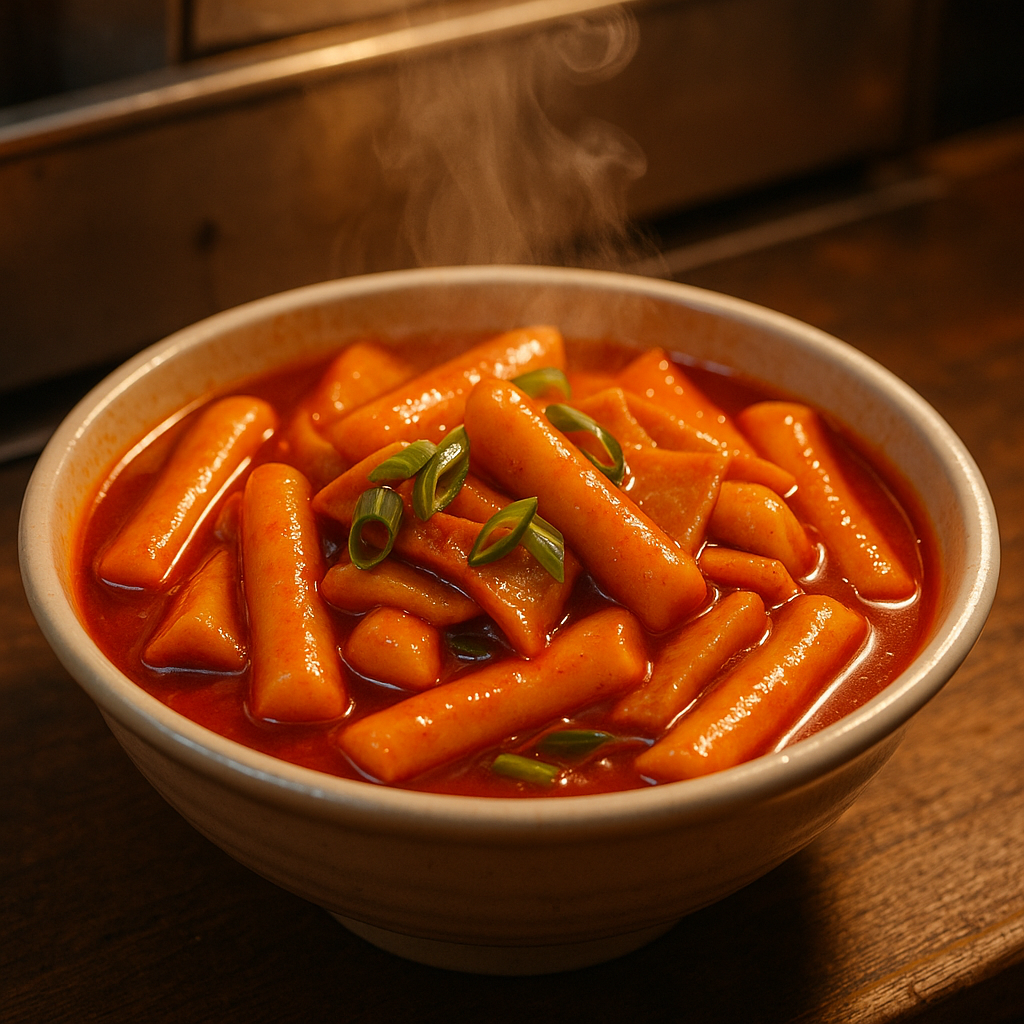
- Tteokbokki (떡볶이): street-cart versions vary a lot by vendor, but a standard bowl is usually in a moderate range, similar to a solid hot sauce — enough to make your lips tingle without derailing the meal.
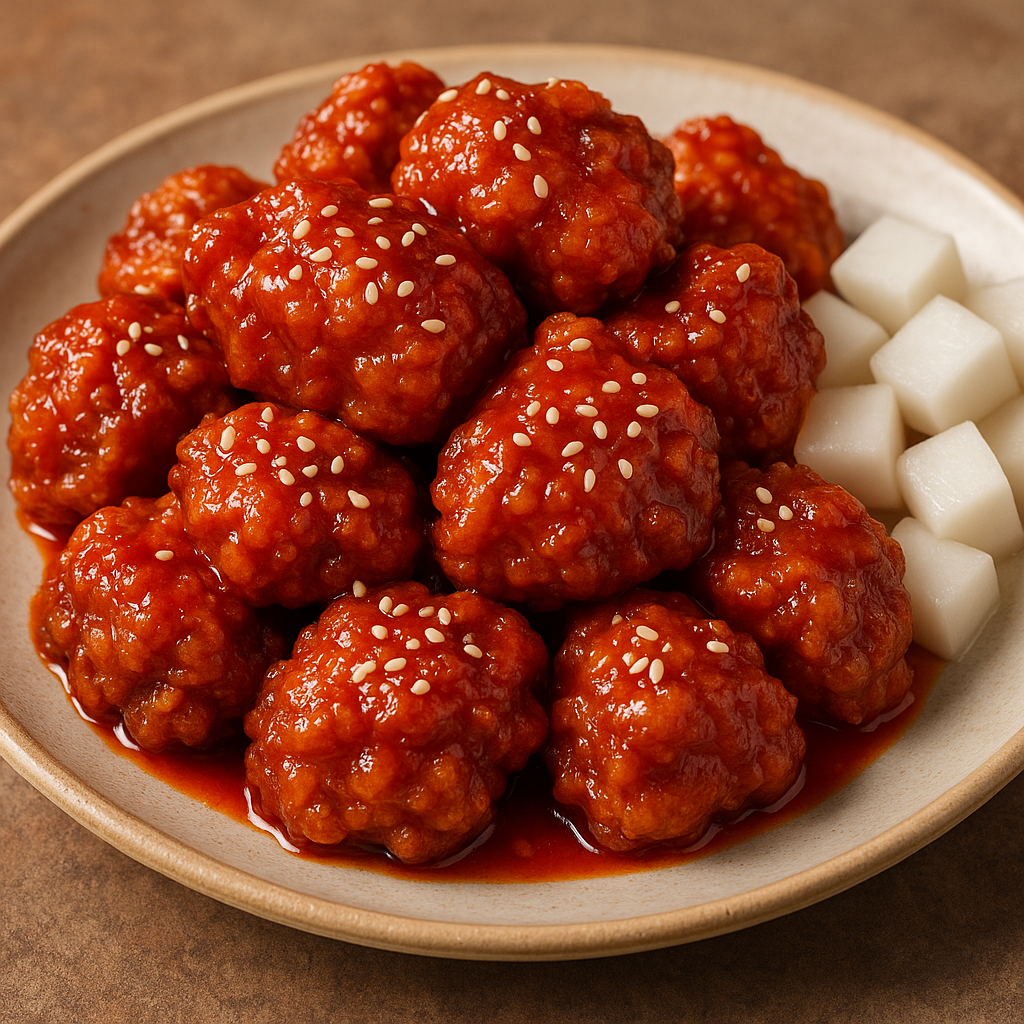
- Yangnyeom chicken (양념치킨): the sweet-spicy glaze softens the perceived heat with sugar and gochujang, so it often reads as less intense than tteokbokki even though the ingredients overlap.
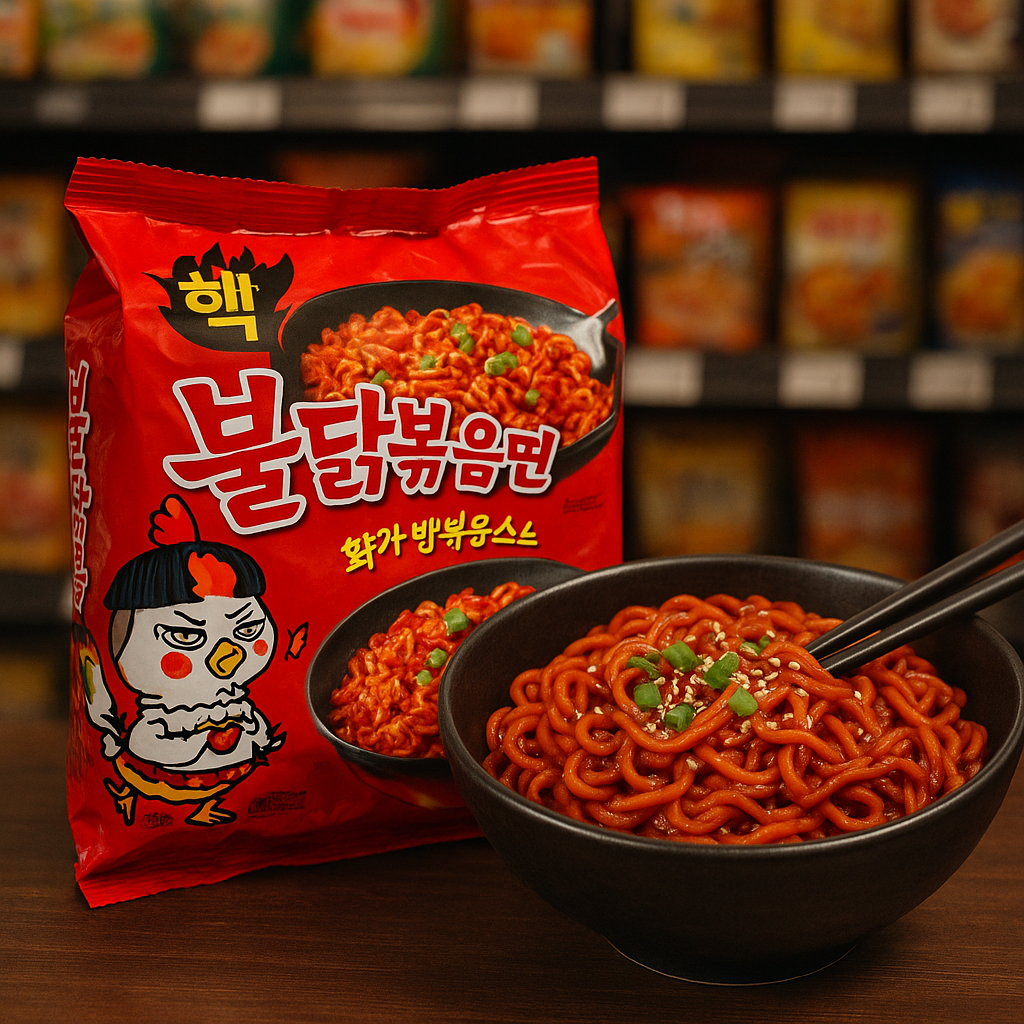
- Original Buldak bokkeummyeon (불닭볶음면): the standard fire noodle, independently measured by outlets that have tested it, comes in around 4,000–4,500 SHU for the sauce packet — genuinely hot, but the brand built an entire tier system on top of this baseline because it was only the starting point.
- Cheese Buldak vs. original: the cheese version isn’t actually less spicy in raw sauce content — the melted cheese coats your palate and mutes the burn, which is a texture trick as much as a heat reduction. It’s a common recommendation for someone easing into the Buldak line.
The Buldak Tier System, Briefly
Samyang’s Buldak (“fire chicken”) noodle line is the closest thing Korea has to a spice video game with difficulty settings. The original launched as a viral-challenge food, and the company kept releasing hotter variants above it — most notably the “2x Spicy” version, which markets itself as roughly double the heat of the original packet. Online spice-tier rankings (fan-made, not official Samyang data) place the standard 2x Spicy somewhere in the 8,000–10,000+ SHU territory, though exact figures aren’t independently published for every release. The practical point for a first-timer: “Buldak” as a brand name does not mean one fixed spice level. Reading which variant is in your hand matters as much as knowing it’s Buldak at all.
Practical Tips for Ordering Without Getting Ambushed
- Ask for “순한맛으로 주세요” (sun-han-mat-eu-ro ju-se-yo — “the mild version, please”) when a restaurant offers a choice. Many tteokbokki and jjigae places will actually adjust it for you if asked directly, especially at sit-down restaurants rather than street carts.
- Treat “보통” as your actual starting point, not as a safe default. If you have low spice tolerance, ask if there’s an option milder than 보통 before ordering it assuming it’s tame.
- Milk, not water, cools your mouth down. Capsaicin is fat-soluble, not water-soluble, so plain water mostly just spreads the burn around. Convenience stores sell small milk cartons specifically because this is common knowledge here.
- Rice is your buffer, not your rescue. A spoonful of plain rice between bites of something like kimchi jjigae dilutes the intensity without watering down the flavor, which is why Korean spicy stews are almost always served with a side of rice rather than eaten alone.
- Read the packaging before you buy instant noodles, not after. The spice-level word, and sometimes a small pepper icon count, is usually printed near the product name. If you can’t read Hangul, a quick photo-translate on your phone before checkout saves you from an unpleasant lunch.
A Note on Tolerance
None of this is about proving anything. Spice tolerance is genuinely variable, tied to how often someone eats capsaicin-heavy food rather than to willpower, and plenty of Koreans I know order 순한맛 without a second thought. The scale exists so people can order what they actually want, not so foreigners can pass a test. Once you know 순한/보통/매운/아주매운 as real categories instead of vague adjectives, ordering gets a lot less like gambling.
FAQ
Is Korean tteokbokki always spicy?
Not always — there are cream-sauce and gungjung (royal court style, soy-based) versions that skip chili entirely, but the default street-cart version almost everyone means by “tteokbokki” is gochujang-based and does carry real heat. If you’re unsure, asking whether a stall has a non-spicy version before ordering is completely normal.
Why does cheese Buldak taste less spicy than the original if it’s the same base sauce?
It’s largely a perception effect. Melted cheese coats the tongue and mouth with fat, and capsaicin dissolves into fat more readily than it clings to your taste buds directly, so the sensation is dulled even though the sauce underneath is comparably hot. It’s a reasonable entry point if you want to try the Buldak line without jumping straight into the higher tiers.
What should I actually order if I want something Korean but genuinely mild?
Kimchi jjigae ordered on the milder side, doenjang jjigae (soybean paste stew, which isn’t chili-based at all), or bibimbap with the gochujang served on the side rather than mixed in are all reasonable low-heat choices that still feel like real Korean food rather than a workaround.