Around 1 a.m. on a Tuesday in Sillim, I watched a guy in a rumpled office shirt — tie still on, ID badge still clipped to his shirt pocket — walk into a PC bang, drop his laptop bag on an empty seat, and log into League of Legends before he’d even taken his coat off. The monitor threw a blue-white glow across his face that made him look about ten years younger than he probably was. He played for two hours, the keyboard clacking away in that specific mechanical-switch rhythm you only really notice at 1 a.m., ordered a bowl of ramyeon halfway through, and left looking more relaxed than anyone I’ve seen leave an actual bar. That’s the moment I stopped thinking of PC bangs as “just internet cafes” and started paying attention to what’s actually going on inside them. I’m Yijidaddy, and after several years living in Korea, I’ve spent enough late nights in these places — sometimes to write, sometimes to game, once memorably to escape a power outage in my building — that I feel qualified to explain why they refuse to die.
What a PC Bang Actually Is
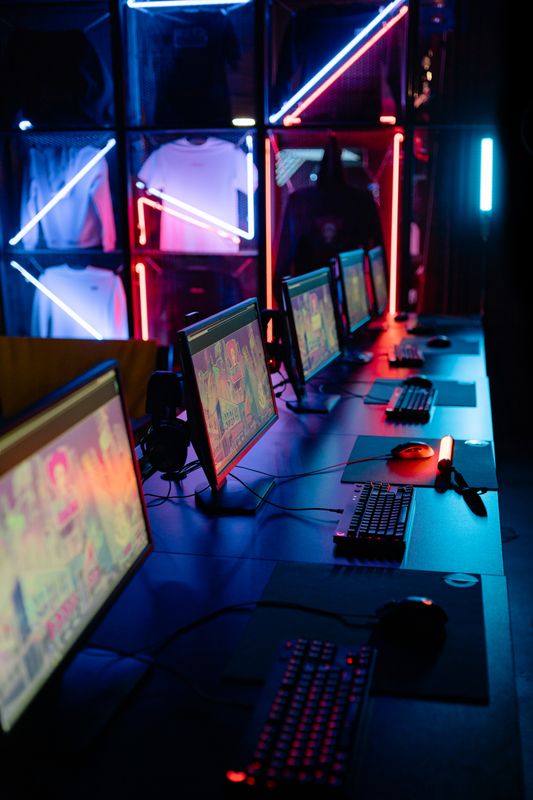
PC방 (PC bang, literally “PC room”) is a pay-by-the-hour gaming café, and the “room” part undersells it — it’s a dense grid of gaming rigs, each with a wide curved monitor, a mechanical keyboard, a decent headset, and a chair that’s usually nicer than anything in my apartment. You sit down, log in with a member card or your phone number, and the clock starts. Rates aren’t fixed nationally, and they swing hard by neighborhood. In student-heavy areas like Sillim or Sinchon, I’ve paid as little as ₩1,000–1,500 an hour on a mid-spec rig. Around Jongno it creeps up to ₩1,500–2,000. Walk into a newer place in Gangnam or Yeoksam and you’re paying ₩2,000–2,500 an hour, but that buys you a machine running a proper RTX-class GPU, a 165–240Hz monitor, and something closer to a DXRacer-style seat than the standard office chair you’ll find in an older Sillim location.
Buy in bulk and the math changes fast — most places sell 5 or 10-hour packages, and the per-hour rate can drop close to half. That’s the number that actually matters, because on paper this should be expensive, and it isn’t. Four hours of gaming, a meal, and a drink can land under ₩15,000 total — less than a single round at a Hongdae bar, and roughly what you’d pay for one movie ticket in Seoul. That price logic is the quiet engine behind why PC bangs are still standing when cheap home broadband and console ownership should, in theory, have wiped them out years ago.
Roots in a Financial Crisis, Not a Marketing Plan
None of this happened by accident, and the origin story explains a lot about why the culture runs so deep. After the 1997–98 Asian financial crisis, the Korean government pushed hard into broadband infrastructure as part of the economic recovery plan, and PC bangs sprang up everywhere as the cheapest way for ordinary people to access it. When StarCraft landed in Korea in 1998, it found a ready-made audience sitting in front of shared machines — Korea reportedly accounted for roughly a third of the game’s total global sales that year, mostly sold through PC bangs. Managers started running small tournaments among their own regulars just to keep machines occupied during slow afternoons, and by 1999 OnGameNet was already broadcasting StarCraft matches on cable television. That’s an almost absurdly fast jump from “guys killing time between shifts” to televised competitive gaming, and it’s the direct ancestor of the sponsor-backed LCK broadcasts filling LoL Park in Jongno today. When Faker plays on that stage, he’s playing in a lineage that traces straight back to PC bang regulars grinding StarCraft ladders for bragging rights and instant noodles.
That history still shapes the industry in a very literal way. League of Legends and other major titles track their real popularity in Korea through PC bang usage rate specifically, not just total player counts, because it’s treated as the most honest signal of what people are choosing to spend their own won on, hour by hour. A game climbing the PC bang chart is a game winning the room, and publishers watch that number closely.

The Menu Is Half the Point
The food ordering setup is one of my favorite pieces of everyday Korean design. Every seat has a small kiosk or a hotkey on the desktop — you order without leaving your chair, without pausing your ranked match, and a staff member brings it to your desk on a tray a few minutes later. The signature order is ramyeon with cheese and an egg cracked in, usually ₩3,500–4,500, and there’s an unspoken understanding that this is the correct way to eat it at 2 a.m. Beyond that, menus run through corn dogs, popcorn chicken, fried mandu, tteokbokki, cheese sticks, instant fried rice, and an iced Americano for roughly ₩1,800–2,500. Almost nothing breaks ₩10,000. If your reference point for internet café food is a stale muffin and flat soda from a rack near the register, recalibrate — this is a real kitchen turning out real food on a five-minute clock.
The reason it’s taken seriously has to do with the business model rather than pride: an hourly rate of ₩1,500 barely covers electricity for a rig running a decent GPU around the clock, so a ₩4,000 bowl of ramyeon and a ₩2,000 iced Americano is where a lot of these places actually turn a profit. Feed people well and they stay longer; that’s the whole equation.
The Honor System Nobody Explains to Foreigners
Walk into a completely packed PC bang and you’ll often see three or four seats sitting empty with a phone, a jacket, or an open drink next to the keyboard. Those seats are taken. Someone stepped out to smoke, use the bathroom, or grab something from a convenience store, and left a personal item behind as a placeholder. Nobody touches it, nobody asks staff to clear it, and nobody sits down assuming it’s free. I asked a PC bang manager in my neighborhood about this once, half expecting a story about people fighting over seats, and he just shrugged and said that’s simply how it’s done — the same tone he might’ve used explaining why people take their shoes off indoors. It’s a small detail, but it says something bigger about how much unspoken trust these spaces run on, and it surprised me more than almost anything else about the culture.
Why They Haven’t Died Out
Friends back home always ask why anyone bothers when most young Koreans have solid internet and often a decent PC at home already. I wondered the same thing before I actually lived here. Part of the answer is space: a lot of people, especially students and younger office workers, live in one-room officetels with no room for a dual-monitor battlestation, let alone a desk sturdy enough for one. Part of it is social — PC bangs are still where groups of friends or coworkers go together after class or after work, in a way solo gaming at home doesn’t replicate. And part of it, to my own surprise, is that a good PC bang can genuinely outperform what a lot of people own personally; upgrading a home rig every year or two is expensive, while a PC bang owner spreads that cost across hundreds of paying customers and refreshes the fleet regularly just to stay competitive with the place two blocks over.
There’s also a habit factor that’s easy to underrate. For a lot of Korean men in particular, the PC bang is tied to specific life stages — university downtime between classes, leave during mandatory military service, the after-work decompression before heading home. It’s woven into the calendar of ordinary life in a way that faster home internet alone was never going to displace.
Visiting as a Foreigner: What to Actually Expect
The process is easier than it looks and slightly more bureaucratic than you’d guess. Most places require ID for registration — your ARC or passport works, and staff do check, since PC bangs are age-restricted late at night for anyone under 18 unless accompanied by a guardian. You’ll get a member card or a login tied to your phone number, prepay a block of time or just start a tab, and that’s it; nobody hovers, and plenty of regulars sit for four or five hours without anyone batting an eye, because the whole business model depends on you staying, not leaving. Not every PC bang looks like the neon-lit, high-spec places in photos online, either — older neighborhood ones can be a little worn, chairs showing a decade of overnight shifts, and that’s fine; it’s part of the texture, not a warning sign.
If you don’t speak Korean, Google Translate’s camera feature handles the kiosk menu fine — I’ve walked into a Gangnam location with almost no Korean and managed by pointing at the screen and holding up fingers for hours. A headset is provided at every seat and generally wiped between users, though plenty of regulars bring their own earbuds for longer sessions. And if you’re worried about going alone, don’t be: PC bangs skew male late at night, but solo visitors of any gender are completely ordinary during the day and early evening, and staff treat a solo customer grinding ranked games in peace as the most normal thing in the world.
Frequently Asked Questions
What happens if I sit in a seat that already has someone’s phone on it? You’ll likely get a polite but firm correction from staff, or the returning customer will just quietly point at their item. It’s an easy, harmless mistake — just check the desk for a jacket, drink, or phone before settling in, especially during busy evening hours.
Is there a minimum time I have to pay for? Most PC bangs let you pay by the minute after an initial small block, often as low as 30 minutes to an hour, so you’re not locked into a long session just to check it out once.
Can I bring my own food or drinks instead of ordering from the kiosk? Technically most places would rather you order from their menu, since food is a real revenue stream for them, but I’ve never seen anyone hassled over a personal bottle of water or a convenience-store snack eaten quietly at the desk.