The Holiday That Shuts Down a Country of Fifty Million People
The first time I understood Chuseok, I wasn’t at a family table or watching a ritual. I was standing in an empty subway car in Seoul on a Thursday afternoon, the kind of emptiness that in any other city would make you check your phone for an emergency alert. There wasn’t one. There was just Chuseok, Korea’s biggest holiday, and everyone who could leave the city already had.
If you look up Chuseok online, you’ll almost always see it translated as “Korean Thanksgiving” — a tidy shorthand that quietly flattens a much heavier, stranger holiday underneath it. It’s not a secular feast with a vague theme of gratitude. At its core, Chuseok is an agricultural reckoning with your own ancestors: a formal, ritualized thank-you to specific dead relatives for the harvest you’re about to eat. Once you get past the surface cheerfulness — the rice cakes, the hanbok, the family photos — it’s also one of the best windows into how Korean families actually work: the obligations, the hierarchy, the quiet tension, and the real warmth that coexists with all of it.
So What Exactly Is Chuseok?
Chuseok falls on the 15th day of the 8th month of the lunar calendar, which is why the date jumps around on the Western calendar every year — in 2026 it lands on September 25th, with the official holiday running from the 24th through the 26th. Because it’s tied to the full moon rather than a fixed solar date, you can’t just memorize “late September” and move on; some years it slides into early October. The name itself breaks down nicely: “chu” means autumn, “seok” means evening, so at its root Chuseok is simply “autumn evening,” a nod to the harvest moon the whole holiday orbits around.
It’s also called Hangawi, an older native Korean word meaning roughly “the great middle of autumn,” and it sits alongside Seollal (Lunar New Year) as one of the two biggest holidays on the calendar. If Seollal is about starting the year right, Chuseok is about closing the harvest out right — giving thanks for the crops, honoring the ancestors who made this year’s abundance possible, and, not incidentally, making sure every branch of the extended family sees each other at least once before winter.
The Ancestors Come First — Literally
This is the part that surprises a lot of newcomers: Chuseok isn’t really a harvest festival for the living first. The centerpiece is charye, a memorial rite performed for deceased ancestors, usually going back two to four generations. Families set a low table — the jesang — according to rules so specific they have their own four-character proverbs. Jwapo-ucheo, for instance, dictates that dried fish goes on the left and fresh fruit on the right; eodu-dongmi places the fish head pointing east. Red fruits go east, white fruits go west. None of this is improvised, and in most families, whoever is in charge of setting the table that year is expected to simply know it, or get quietly corrected by an aunt who does.
The family bows in a specific order — oldest son first, typically, which tells you a lot about how Korean family hierarchy still runs through holidays even in 2026. After the rite at home, many families also do seongmyo: visiting the ancestors’ actual graves to clear weeds and lay out food again, a kind of maintenance visit for the dead. I’ll admit that as an outsider, watching this the first time felt less like a holiday tradition and more like attending a very calm, very organized family funeral rehearsal. It isn’t morbid in practice, though — it’s closer to a formal “thank you,” addressed to people who aren’t around to hear it out loud anymore.
What tourists rarely get to see is this part at all. Charye happens inside homes, not in public squares, so unless you’re invited by a Korean friend or colleague, you’re more likely to encounter a reconstructed version in a folk museum than the real thing. That’s worth knowing if you came to Korea expecting a Mardi-Gras-style street spectacle — Chuseok’s real center of gravity is indoors, around a table, not outdoors in a parade.
The Food: Songpyeon and the Rest of the Table
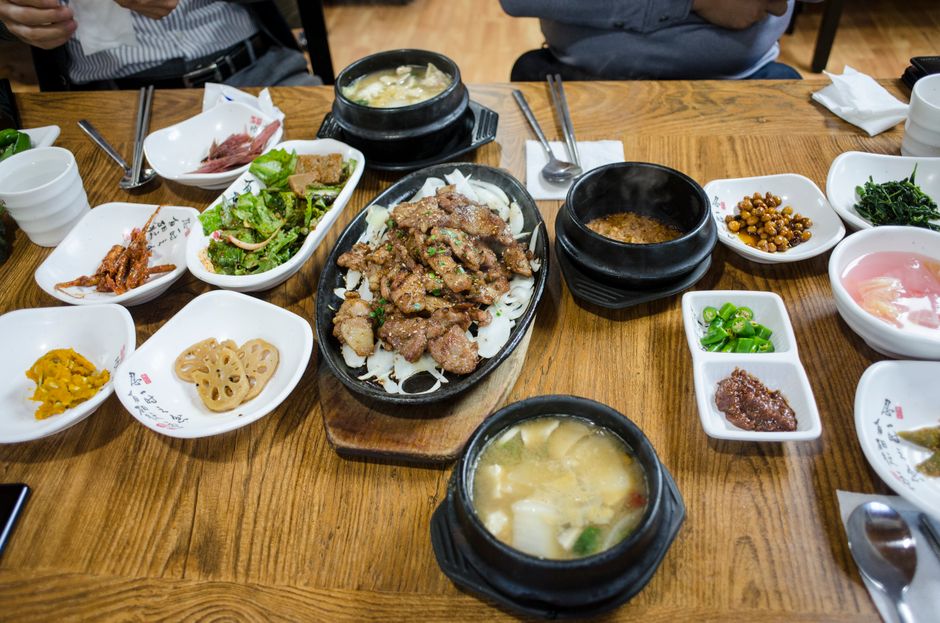
If there’s one food non-Koreans should know by name before Chuseok, it’s songpyeon — small, half-moon-shaped rice cakes stuffed with sesame seeds, chestnuts, sweetened mung bean, or black beans, then steamed over a bed of pine needles, which is where the dish gets its faint, specific pine fragrance. There’s a bit of folklore attached: it’s said that whoever shapes the prettiest songpyeon will have a beautiful daughter or a good spouse, which is exactly the kind of charming pressure you’d expect a culture to invent around a food made by hand, in bulk, by the women of the family, while everyone else watches television in the next room.
That division of labor isn’t just a mild inconvenience, either — it has a clinical name, which I’ll get to in a moment. First, the rest of the table: japchae (stir-fried glass noodles with vegetables and beef), jeon (an umbrella term for various pan-fried fritters — zucchini jeon, fish jeon, meat jeon, you name it), galbijjim (braised short ribs), and sikhye, a sweet rice punch usually saved for dessert. None of this is quick food. A full Chuseok spread for an extended family can take a full day or two of shopping and cooking to produce, which is exactly why the holiday has become shorthand in Korea for both “warm family reunion” and “exhausting unpaid domestic labor,” often in the very same sentence.
Myeongjeol Jeunghu-gun: The Holiday Stress Is a Documented Thing
Here’s something that rarely makes it into the breezier tourist guides: Korea has a semi-official name for the physical and emotional toll Chuseok and Seollal take on people, especially daughters-in-law — myeongjeol jeunghu-gun, literally “holiday syndrome.” Hospitals and news outlets report a real uptick in stress-related complaints, back pain, and family conflict around both holidays, enough that it’s treated as a recognizable seasonal pattern rather than a joke. Divorce filings even tick up in the weeks after Chuseok and Seollal, a statistic Korean media reports on with a kind of grim regularity every year.
I bring this up not to paint Chuseok as miserable — it genuinely isn’t, for most families, most years — but because I think foreigners get an incomplete picture if they only hear about songpyeon and full moons. The tension is baked into the structure of the holiday itself: daughters-in-law traditionally cook for the husband’s side of the family, in-law dynamics get compressed into 72 hours of close quarters, and the question of who visits whose family first, and for how long, is negotiated — or fought over — in households across the country every single year. It’s not unlike the mix of love and low-grade dread a lot of people feel about their own big family holidays anywhere else, just with more ritual structure wrapped around it, and a name for the resulting headache.
The Great Migration: Korea’s Biggest Traffic Jam
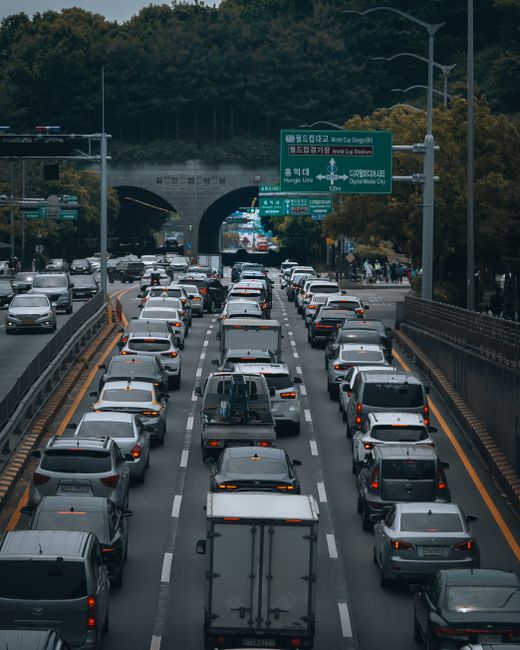
Then there’s the logistics, which deserve their own section because they are genuinely wild if you’ve never seen it. Every Chuseok, Korea’s transport ministry reports tens of millions of trips being made as people leave the cities where they work and head back to their hometowns — a mass movement Koreans call gwiseong gil, the “homecoming road.” A drive that normally takes about three hours from Seoul to Busan can stretch to eight, nine, sometimes closer to twelve hours, as the highways turn into slow-moving parking lots broadcast live on the evening news every year, almost as a ritual of its own, complete with a helicopter shot of the exact same overpass that’s jammed every single year.
If you’re a foreigner living in Korea, this is the part you’ll feel most directly, even if you’re not Korean yourself. Your local market closes. Your favorite little restaurant closes. Half your coworkers vanish for the better part of a week. Large chains, department stores, and tourist-facing palaces generally stay open and even run special programming for visitors, so it’s not like the country becomes unusable — but the texture of daily life changes noticeably, and if you need a specific small business to be open on Chuseok day itself, you should check ahead rather than assume.
Oddly enough, this is also when Seoul becomes one of the most pleasant cities in the country to simply walk around in. With a huge chunk of its usual population sitting in highway traffic somewhere else, the city empties out noticeably — Gyeongbokgung Palace, normally shoulder-to-shoulder with tour groups, gets quiet enough that you can actually read the signage, and a neighborhood like Hongdae, usually loud even on a Tuesday morning, turns strangely calm. Tourists who time a trip for Chuseok week, rather than avoid it, often end up pleasantly surprised, as long as they’ve checked which specific sites and restaurants are closed for the holiday itself.
Hanbok, Moonlight, and Old Folk Traditions
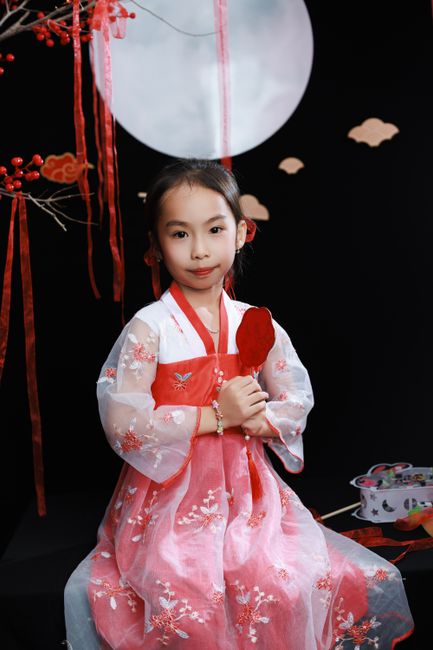
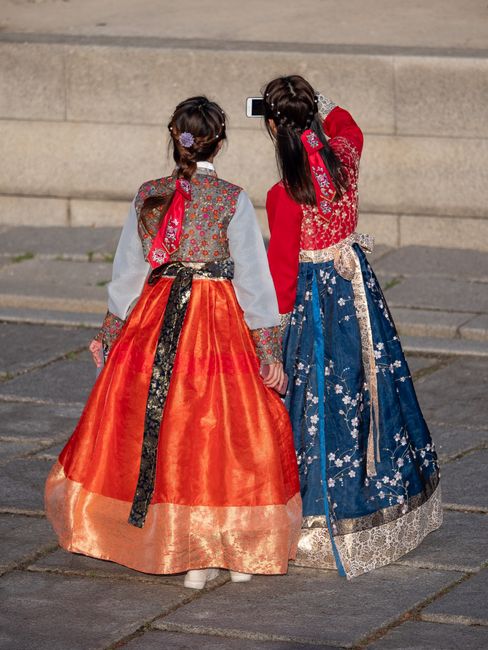
Once the rites are done and the roads have, eventually, delivered everyone home, Chuseok does turn into something lighter. Hanbok comes out, especially for kids and for photos — not the full formal version most people wear maybe twice a year, but still a deliberate, dressed-up touch that marks the day as different from an ordinary Tuesday. Moon-watching is a real, intentional activity: Chuseok falls on a full moon by design, and there’s a tradition of making a wish while looking at it, which is about as universally human a gesture as I can think of, regardless of which country you’re standing in.
In some regions, particularly around the southwestern coast, you’ll still find ganggangsullae — a circle dance performed by women under the full moon, singing as they go, said to date back centuries, possibly used historically as a kind of decoy to make a village look more populated than it was during wartime. Whether or not that origin story is strictly accurate, it’s a genuinely beautiful thing to watch if you happen to catch a performance, and it’s one of the few Chuseok traditions that does play out in public, at folk villages and cultural festivals, rather than strictly behind closed doors.
The Gift-Giving Season: Spam, Fruit, and Pyramids of Boxes
There’s also the gift-giving, which foreigners living and working in Korea will notice almost immediately once September arrives: elaborately boxed sets of Spam, cooking oil, toothpaste, or premium fruit start appearing in every convenience store and department store lobby, stacked into pyramids like a strange, savory Christmas display. Spam specifically has an odd pedigree here — it arrived with the U.S. military after the Korean War, was scarce and expensive for decades afterward, and somewhere along the way flipped from “wartime ration” into a genuine status gift, now sold in sleek gold-and-navy gift boxes that look more like they belong in a jewelry case than a pantry.
These seonmul sets are given to coworkers, employees, landlords, and relatives, and the range runs from a ten-dollar box of canned ham to genuinely eye-watering luxury fruit gift sets that can run into the hundreds of dollars, the kind with a single perfect melon resting on velvet-style padding. If you work for a Korean company, there’s a decent chance you’ll receive one yourself, which is a nice, slightly surreal welcome to the season — and a pretty good conversation starter with coworkers who are usually happy to explain the unspoken rules of who gives what to whom.
Whether you end up dodging empty streets in Seoul, watching a highway traffic report with genuine disbelief, or just unwrapping an unexpected box of Spam from a coworker, Chuseok has a way of showing you Korea at its most unguarded — tired, sentimental, overfed, and briefly, deliberately, slowed all the way down.
FAQ
Is Chuseok the same as Lunar New Year (Seollal)?
No, though they’re often confused by outsiders because both involve travel, ancestral rites, and family gatherings. Seollal falls on the first day of the lunar year, usually in late January or February, and centers on starting the new year properly — new clothes, New Year’s bows (sebae) from children to elders, and rice cake soup (tteokguk). Chuseok falls in autumn, centers on the harvest and the full moon, and leans more heavily on songpyeon than any other single food. Both are major holidays with similar travel chaos, but they’re distinct occasions with different symbolism.
Can tourists actually do anything during Chuseok, or does Korea just shut down?
Tourists can absolutely still visit — in fact, many enjoy it more, since the usual crowds thin out dramatically as locals head to their hometowns. Major palaces, folk villages, and some museums often run special Chuseok programming, including free admission days at royal palaces for visitors in hanbok. Smaller, family-run restaurants and local markets are the ones most likely to close, so it’s worth checking opening hours for anything specific you want to visit or eat, rather than assuming everything will be running as normal.
Do I need to bring a gift if I’m invited to a Korean friend’s home for Chuseok?
It’s a thoughtful gesture, though not a strict requirement for a foreign guest the way it might be for a Korean relative. A modest, nicely packaged gift — fruit, traditional sweets, or a boxed gift set similar to what you’ll see sold everywhere in September — is the safest choice. Showing up empty-handed won’t be seen as a grave insult for an invited guest, especially a foreign one, but bringing something small signals that you understand and respect the spirit of the occasion, which tends to go a long way.
Leave a Reply