Around 9:50 on a weeknight, if you’re anywhere near Daechi-dong in Gangnam, you’ll see something that looks less like a school letting out and more like a stadium emptying after a concert. Streams of kids in puffer jackets and school backpacks pour out of glass office buildings — because that’s what hagwons usually are, floors 3 through 9 of an ordinary commercial building — and the sidewalk fills with waiting parents in double-parked cars, hazard lights blinking in a long orange chain down the block. It’s not a special event. It’s just Tuesday.
“Hagwon” (학원) simply means private academy, and on paper that sounds as mundane as “tutoring center” does anywhere else. But calling Korean hagwons “tutoring” undersells the scale of the thing by a wide margin. This isn’t a once-a-week session to catch up on algebra. For a huge share of Korean students, hagwon is a second, parallel school system that runs every single weekday, often stacked two or three sessions deep, and it shapes the rhythm of childhood here in a way that’s hard to grasp until you’ve watched it happen block by block, night after night.
What an actual school day looks like, hour by hour
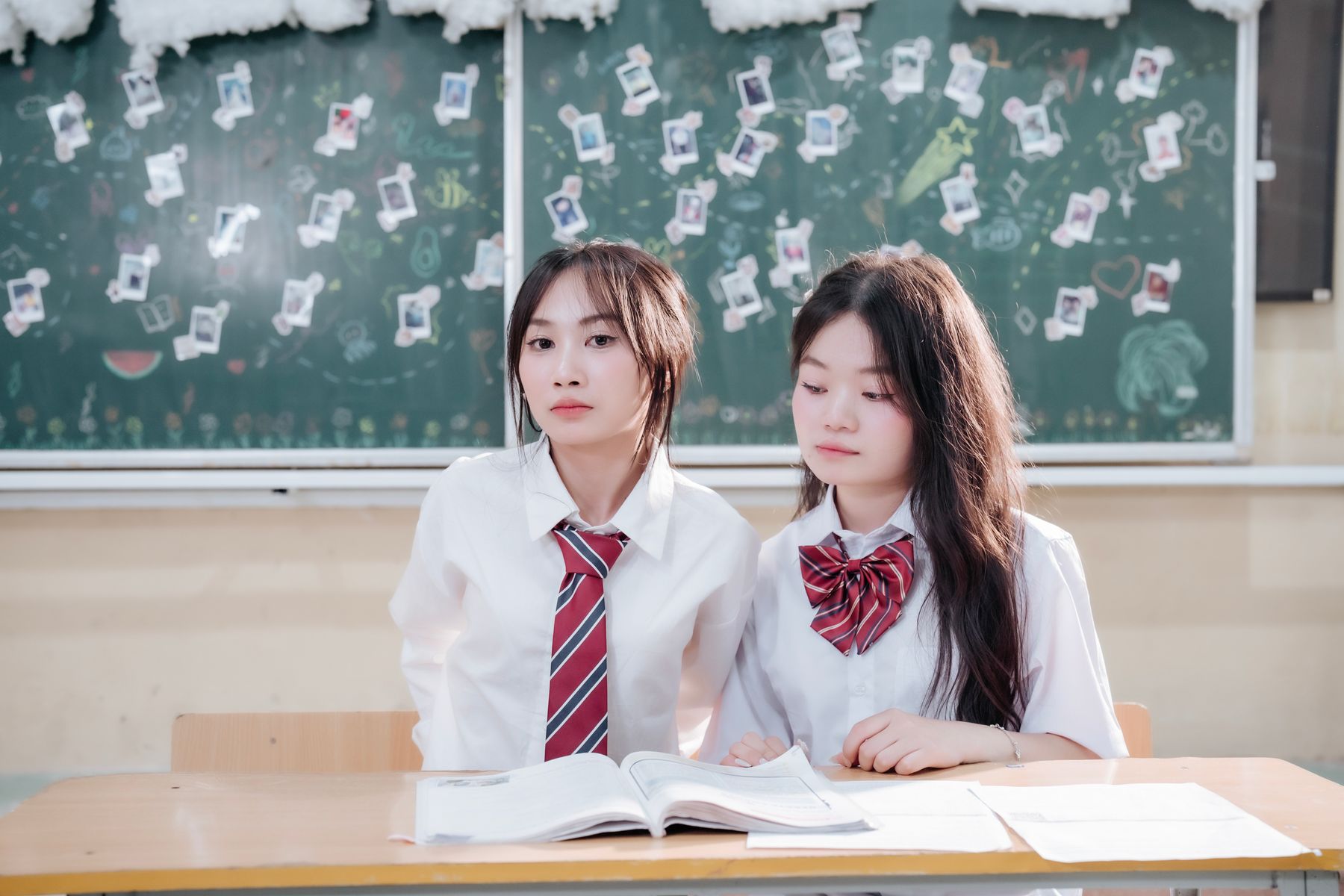
You’d expect regular school to be the demanding part and hagwon to be the add-on. In practice, it often works the other way — regular school is treated almost like the baseline, and hagwon is where the real academic differentiation happens. A fairly typical middle or high schooler’s day might run something like this: school from 8 a.m. to somewhere around 4 or 4:30 p.m., then a math academy from 5 to 7, an English academy from 7:30 to 9:30, and homework from both once they’re finally home — often past 10 p.m., sometimes closer to midnight once exam season hits.
Dinner in that schedule tends to get squeezed into whatever gap exists between academies, which is why gimbap rolls, a cup of instant ramyeon eaten standing at a convenience store counter, or a boxed dosirak meal are such common sights among students in these neighborhoods around 6 or 7 p.m. Step inside one of these buildings and the aesthetic is fairly consistent from one academy to the next: fluorescent-lit rooms divided into narrow desks, whiteboards covered in problem sets, and stacks of thick workbooks that look more like phone books than textbooks. Multiply the daily grind by five weekdays, add a Saturday session for standardized test prep, and you start to see why Korean high schoolers are frequently cited as sleeping somewhere around 5 to 6 hours a night on average, well under what pediatric sleep guidelines recommend for their age group.
What surprised me most isn’t that this happens — plenty of countries have demanding school cultures — it’s how early it starts. This isn’t just a high-school-junior-cramming-for-college phenomenon. Elementary schoolers, some as young as six or seven, already shuttle between an English hagwon and a math hagwon in the same afternoon, sometimes with a piano or taekwondo class wedged in as the “fun” one between two academic ones. Parents refer to this bouncing between academies as a kid’s “schedule,” the same word you’d use for a business executive’s calendar, and by middle school an empty afternoon with nothing booked is often treated less as freedom and more as a gap that needs filling.
The buildings themselves, and the money behind them
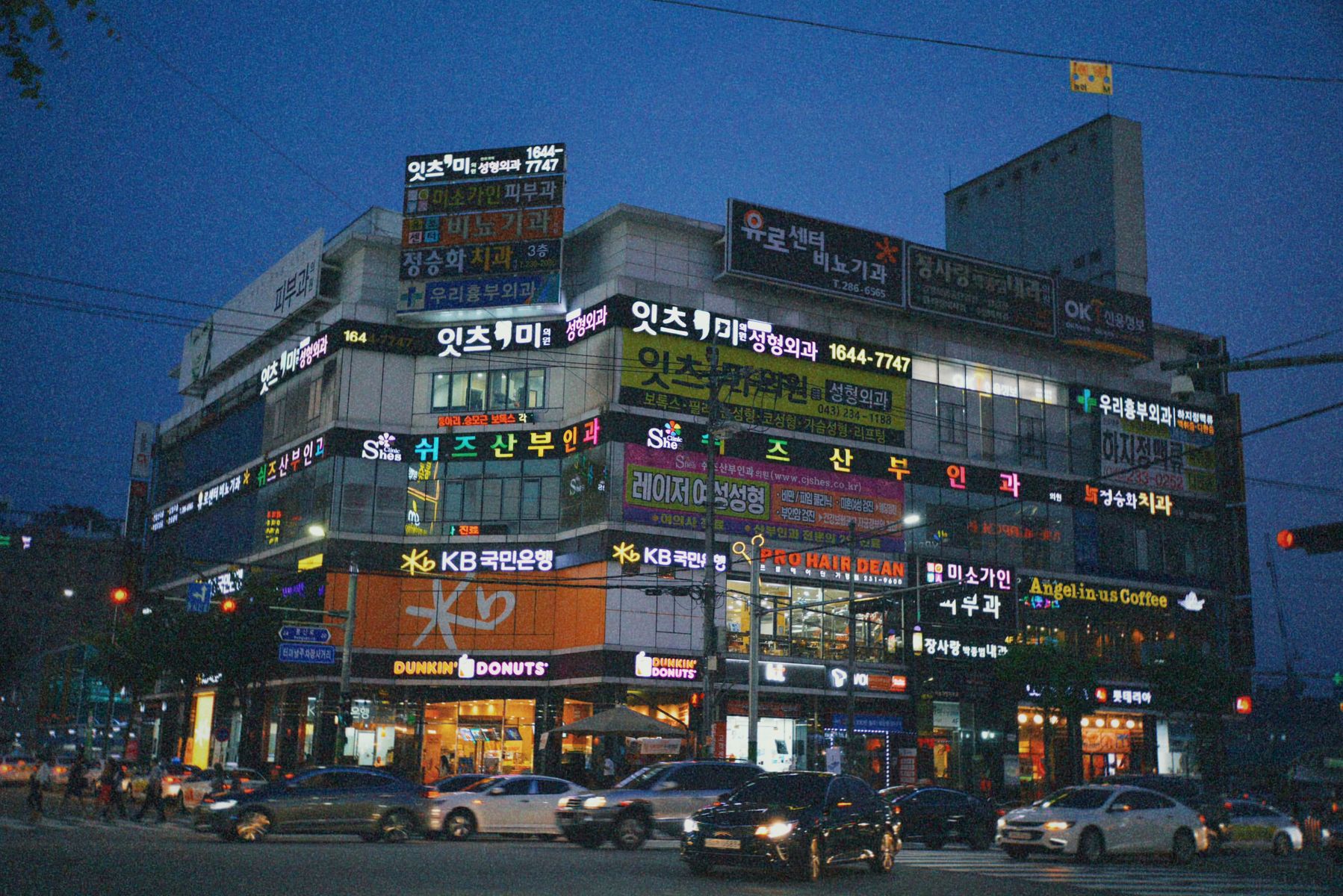
Walk down a hagwon street after dark — Daechi-dong in Gangnam is the most famous example, but every Korean city has its own smaller version — and the first thing you notice is the signage. Buildings that look completely ordinary during the day, just glass-and-concrete offices, turn into vertical stacks of illuminated academy names once the sun goes down: a math academy on the third floor, English on the fifth, a science academy on the seventh, each with its own backlit sign competing for the same sidewalk’s attention. The elevator banks fill up around class-change times with teenagers trading gossip, half-asleep, backpacks heavy enough to visibly round their shoulders.
Korean households collectively spend somewhere north of 27 trillion won a year on private after-school education, according to figures tracked by Statistics Korea — and that figure has climbed almost every year this survey has run, even as the country’s birthrate has fallen to among the lowest in the world. Fewer kids, more spending per kid. That combination alone tells you something about how central this is to Korean family life. A single well-regarded English or math hagwon in a district like Daechi-dong can run several hundred thousand won a month per subject, and it’s completely normal for a family to be paying for two or three subjects simultaneously, per child.
You might assume this spending is concentrated only among wealthy families chasing an edge, and while income obviously affects which hagwons a family can afford, the baseline expectation cuts across income levels in a way that’s genuinely striking. Skipping hagwon entirely, even for families with tighter budgets, is often treated less as a neutral choice and more as an active risk — the fear being that your kid falls behind not just their smartest classmate, but the entire grade’s baseline pace, because so many other students are already ahead of the regular curriculum by the time a topic is taught in class. That fear doesn’t come from nowhere, either — it traces back to a single exam day that looms over the entire system.
Why it got this normalized
It’s tempting to look at this from the outside and assume something has gone specifically, uniquely wrong in Korea. But the roots make a certain kind of sense once you know the history. Korea’s modern hagwon system grew rapidly alongside the country’s postwar transformation from one of the poorest nations on earth into a developed economy within a single generation — and education became the primary, almost the only, socially agreed-upon ladder for that mobility. A single national exam, the Suneung, taken on one day each November, still carries enormous weight in determining which university a student can attend, and university prestige in Korea continues to matter for hiring, marriage prospects, and social standing in ways that are more pronounced than in a lot of Western countries. The scale of what’s built around that one day is honestly hard to overstate — flight schedules get adjusted so planes don’t fly during the English listening portion of the test, stock markets have historically opened later that morning, and it’s not unusual to see a police car giving a panicked, running latecomer a ride straight to their exam hall. When the stakes of one test day feel that concentrated, it’s not exactly surprising that families start preparing years, not months, in advance.
There’s also a structural reason hagwons keep multiplying rather than fading: they’re privately run, for-profit businesses competing directly with each other for enrollment, which means marketing, reputation, and parental anxiety all feed the system’s growth in a self-reinforcing loop. A hagwon that produces visibly strong test results becomes the one every parent on the block wants their kid enrolled in, waiting lists form, and the perceived necessity of academy-based prep gets baked in even further for the next cohort of parents watching from the sidelines.

What it looks like from an expat parent’s chair
This is the kind of thing that rarely makes it into the standard “moving to Korea” checklists about visas and phone plans (I covered more of those practical basics in What I Wish I Knew Before Moving to Korea), but if you’re raising a family here, it ends up shaping your weekly calendar more than almost anything else on that list.
Watching this as an outsider raising kids here puts you in an odd spot, somewhere between admiration and mild alarm, and honestly the two feelings show up in the same five minutes rather than taking turns. There’s something genuinely impressive about the sheer discipline and consistency of it — kids as young as ten managing a schedule that would tire out a lot of working adults, and doing so with a kind of matter-of-fact acceptance, because to them, this is simply what childhood looks like, not an exception worth complaining about. Yet it’s hard not to notice how little unstructured time survives in a given week, and how completely normalized that scarcity has become. Nobody around you treats it as unusual, which somehow makes it feel both less alarming and slightly more so at the same time — like the strangeness has been fully absorbed into the wallpaper of daily life.
To be fair, not every family goes all-in, and there’s more internal debate about this within Korea than outsiders might assume. Some parents have started deliberately pulling back, citing burnout concerns or simply wanting their kids to have evenings free, and there’s ongoing public conversation here about reforming the college admissions system precisely because the pressure has gotten so intense. This piece isn’t trying to render a verdict on whether the system “works” or whether it’s “too much” — those are genuinely contested questions even among Korean parents and educators themselves, and the honest answer is that reasonable people here disagree. What’s not really in dispute is how deeply normalized the hagwon rhythm has become, and how much it structures the visible texture of daily life, right down to the timing of dinner and the traffic jam of parents’ cars outside a nondescript office building at ten at night.
Frequently Asked Questions
Is hagwon only for students who are struggling academically?
Not at all — if anything, it often skews the opposite direction. Many of the students filling hagwon seats are already performing well in regular school and are there specifically to get ahead of the curriculum, not to catch up. A student who’s already the top of their class in math might still attend a math hagwon that teaches a full grade level ahead, because the competitive bar within Korean classrooms is set by the students who’ve had that extra preparation, not by the official curriculum pace.
Do hagwons only cover academic subjects like math and English?
No — the hagwon category is much broader than test-prep subjects. There are hagwons for piano, taekwondo, art, coding, even handwriting practice for young kids. That said, the ones running until 9 or 10 p.m. on weeknights, packed with middle and high schoolers, are overwhelmingly the academic ones tied to school subjects and the university entrance track, since those are the ones parents feel the most pressure to keep up with.
Is this level of hagwon attendance required by law or by the school system?
No, hagwon attendance is entirely optional and privately arranged — there’s no legal requirement or school mandate involved. What makes it function almost like an unofficial requirement is social and competitive pressure rather than policy: because such a large share of a given cohort attends, opting out can feel like falling behind a curve set by everyone else, even though no rule technically obligates any family to participate.
Leave a Reply