My daughter had her shirt off before I’d even found the shoe cubby. That was the first sign that I was the only person in the building who didn’t already know how this worked.
We’d been in Korea for a while by then, long enough that I thought I had a decent handle on the basics. But my wife had been talking about taking the kids to a jjimjilbang for weeks the way you’d talk about a trip to the grocery store — completely unremarkable, something her family had done every couple of months since she was small. I pictured something between a gym locker room and a fancy hotel pool. I was not close.
The Uniform Nobody Explains in Advance
You pay at a counter near the entrance, hand over your shoes, and get a wristband in return. That wristband is your locker key, your ID, and — this part surprised me — your tab. Snacks, drinks, extra towels, the massage chair in the corner: all of it gets scanned to the band and settled when you leave. Nobody asks you to pay cash mid-visit, which means nobody is checking whether you can afford the second bowl of noodles. You just eat it and find out the total later, which is either a relaxing system or a slightly dangerous one depending on your self-control.
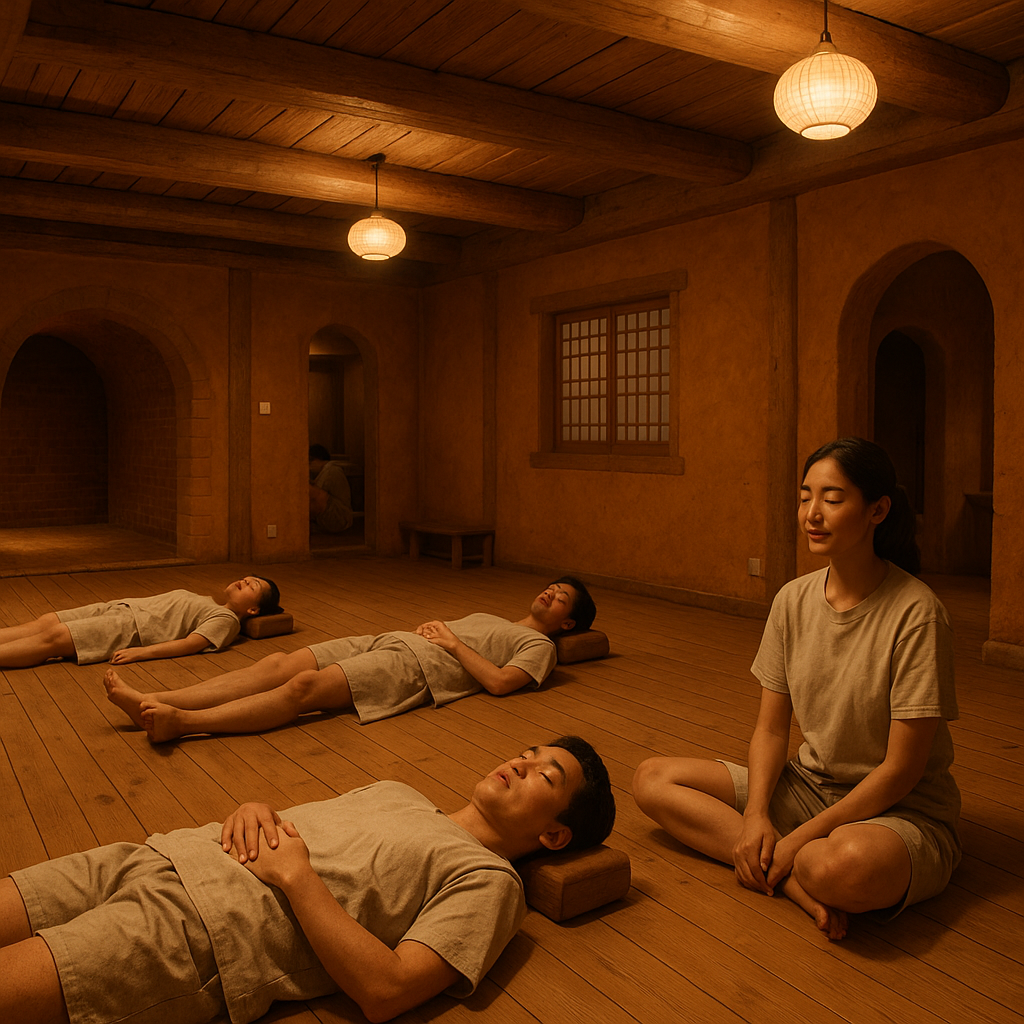
Past the lockers, the building splits in a way that took me a beat to understand. The actual bathing floors — where you scrub down and soak — are separated by gender and require you to be, plainly, naked. No swimsuits, no exceptions, and definitely no phone. But once you’ve washed and changed into the loose cotton shirt and shorts the front desk hands out, you move into a completely different building. That common floor — the heated rooms, the snack counter, the sleeping mats — is mixed. Husbands, wives, grandparents, kids, all wandering around in the same baggy uniform, looking like a very calm summer camp for adults.
What Nobody Tells the New Dad
This is the part the guidebooks skip, because guidebooks are written for tourists going alone, not for a father standing in a hallway holding a four-year-old’s hand and doing math. Below a certain age, kids can go into either bathing section with a parent — a small son can go in with his mother, a small daughter can go in with her father. Nobody hands you a rulebook for this. You just watch what the other parents do and copy it, and you realize fairly quickly that the grandmothers around you have opinions about how a father washes his kid’s hair, and they are not shy about sharing them.
What actually got me wasn’t the nudity, honestly — that stopped being interesting after about ten minutes, the way any novelty does once you realize everyone else is thinking about their own knees, not yours. What got me was how unbothered my kids were by all of it. No self-consciousness, no giggling, no big moment. For them it was just what a bath is. I was the one doing the internal narrating; they were just having a bath with grandma-aged strangers who occasionally handed them a snack.
The Rooms That Are Actually the Point
Once you’re past the bathing floor, the jjimjilbang’s real personality shows up in its heat rooms — a row of small chambers, each lined with a different material and built for a different kind of discomfort. There’s usually a clay room, walls the color of terracotta, mild enough to nap in. A salt room, floor covered in coarse crystals, supposedly good for your skin if you believe that sort of thing. Somewhere there’s an ice room, a cold shock kept just above freezing that everyone treats as a dare. And then there’s the one every jjimjilbang seems to have and every regular has an opinion about — the bulgama, a domed kiln room that runs hot enough that people sit closest to the door and time themselves like they’re playing a game with their own tolerance for pain.

My father-in-law’s routine, which I’ve now inherited whether I wanted to or not, is clay room, then salt room, then a stretch on the heated floor outside doing absolutely nothing, repeat. Nobody’s in a hurry. That’s maybe the biggest adjustment for someone used to gyms and spas built around efficiency — the jjimjilbang has no interest in getting you in and out. Families show up after lunch and leave after dinner. It’s less a spa visit and more a weather system you sit inside of for a few hours.
Snacks, Sleeping, and the Baked Egg Question
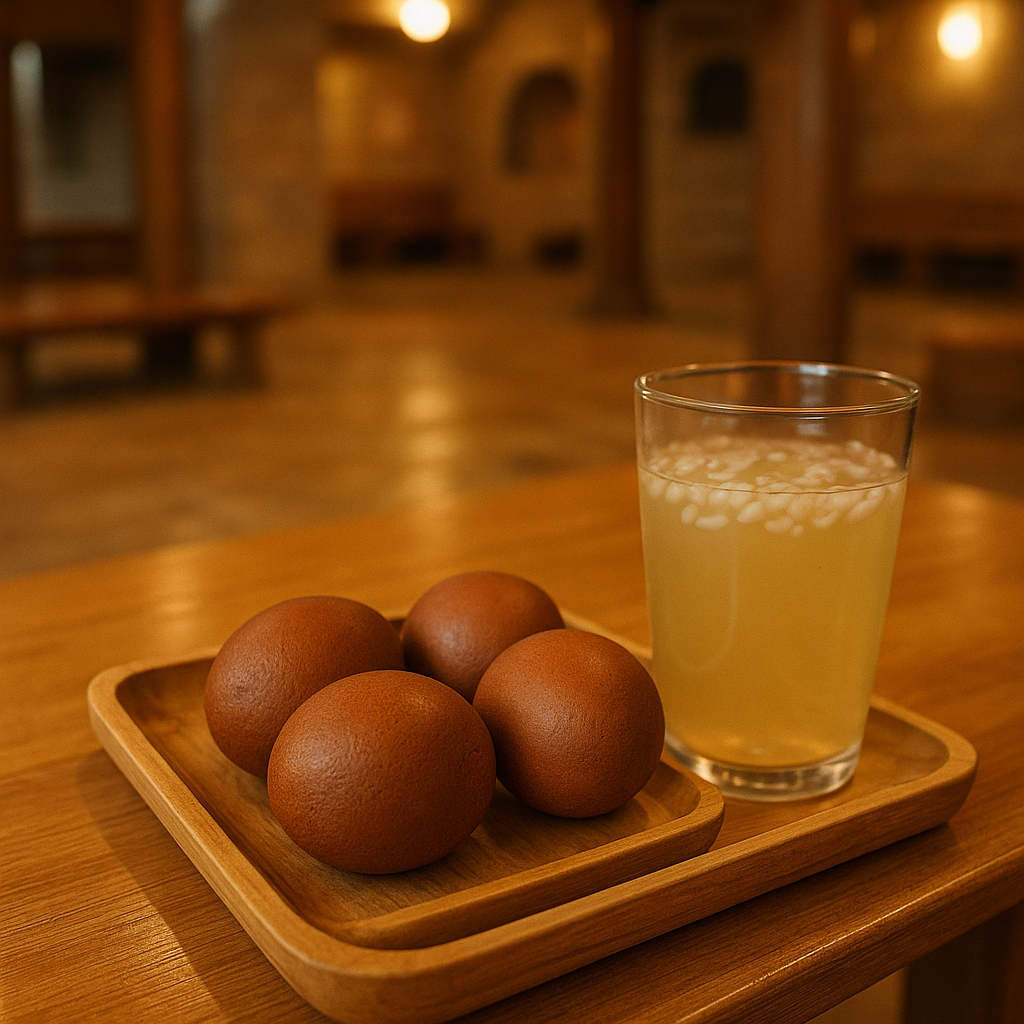
The food counter on the common floor is its own small culture. The signature order is a set of baked eggs — cooked slowly inside one of the heat rooms until the shells go brown and the inside takes on a faint smoky, nutty taste, nothing like a regular boiled egg. You crack them on the edge of the low table, peel with your fingers, and eat them with sikhye, a chilled, faintly sweet rice drink that tastes like it was invented specifically to be drunk in a hot room. My kids ate more baked eggs than actual dinner that first visit and I did not have the energy to stop them.
Scattered around the common floor are mats, wooden pillow blocks, and people fully asleep in the middle of the afternoon, undisturbed by the noise around them. Some jjimjilbang chains lean into this and run as overnight stays — cheaper than a motel, open all night, and apparently a legitimate option for someone who’s missed the last train home. I haven’t tried sleeping there myself, but watching a stranger nap soundly on a wooden pillow while a toddler runs past his head told me everything about how normal this all is to everyone but me.
Why It’s a Family Thing and Not Just a Bath
What stuck with me longest wasn’t any single room, it was the rhythm of the whole afternoon. Three generations moving through the same space at their own pace — grandparents parked on the heated floor, parents ducking in and out of the salt room, kids sprinting between the snack counter and the TV corner in socks that never quite grip right. Nobody was rushing anyone. Nobody was on a phone, mostly because you can’t easily bring one in. It’s one of the few places I’ve been in Korea where an entire family, from six to sixty, is doing the exact same low-key nothing at the exact same time, and everyone seems completely fine with that.
I went in expecting a bathhouse and left thinking about how differently rest gets treated here — as something you do together, out loud, in a room full of strangers, rather than something you retreat to do alone.
Frequently Asked Questions
Do you really have to be fully nude in the bathing area?
Yes, in the gender-separated bathing section — no swimwear is allowed, and washing at one of the shower stations before getting into any bath is expected. The common areas with the heat rooms and food counter are a separate, mixed-gender space where everyone wears the provided uniform.
Can a dad take a young daughter, or a mom take a young son, into the bathing area?
Generally yes, up to a certain young age — you’ll see it happen constantly and nobody blinks. Past that age, kids go into the bathing section that matches their own gender.
What should I actually bring?
Not much. Basic soap is usually provided at the washing stations, but shampoo isn’t always guaranteed, so I bring my own now. A hair tie if you have long hair, and something you don’t mind sweating in for the heat rooms — though most places give you a uniform anyway. Cash or a card for the wristband tab covers the rest.
Leave a Reply