My second night in Mapo-gu, I ordered a fried chicken combo at 11:40 p.m. mostly as a test, half expecting the app to laugh at me and tell me to wait until morning. It showed up at 12:08 a.m., still hot enough to fog up the plastic lid, delivered by a guy on a scooter who bowed slightly before speeding off into the dark. I stood in my doorway holding a box of chicken like it was a small miracle. Back home, the version of “moving abroad” I’d pictured in my head involved dramatic things — language barriers, culture clashes, homesickness. What actually rewired my brain was a twenty-eight-minute chicken delivery at midnight.
Nobody tells you that the big cultural stuff — holidays, honorifics, family hierarchy — is the part you can actually prepare for. It’s the small infrastructure of daily life that quietly takes over: how food gets to your door, how your apartment building keeps track of you, how a bank account gets opened, how a doctor’s visit works, how quiet a subway car really is, how a restaurant decides what “one order” even means. Here’s what caught me off guard, in roughly the order the shock wore off.
The Delivery Obsession Goes Deeper Than You Think
Everyone warns you that delivery in Korea is fast. What nobody mentions is how much Koreans track it. The app doesn’t just say “on the way” — it shows you a little scooter icon crawling across a live map, updates you when the rider is “arriving in 3 minutes,” and sometimes texts you a photo of the food sitting outside your door as proof of delivery. My Korean coworker checks her dawn-delivery groceries — 새벽배송, ordered before midnight, on the doorstep by 7 a.m. — with the same intensity some people check stock prices. You’d think that level of tracking would feel excessive, even paranoid. Turns out it’s the opposite: once you’re used to knowing exactly where your food is at all times, going back to “the pizza will arrive sometime in the next 45 minutes” feels like flying blind.
But before you get to enjoy any of that, there’s a cold reality every foreigner runs into first: almost none of it works without a Korean phone number tied to a local bank account, which itself usually requires an Alien Registration Card. So for your first few weeks — sometimes longer, depending on how quickly your visa paperwork clears — you’re stuck watching your neighbors get 15-minute noodle delivery while you walk to the convenience store like it’s 2003. It’s a strange kind of onboarding tax nobody warns you about in advance, and it leads directly into the part of settling in that actually stressed me out.

Banking Feels Like a Circular Logic Puzzle
This is the one that genuinely stressed me out. To open a Korean bank account as a foreigner, most branches want to see a phone plan in your name. To get a phone plan, most carriers want to see a bank account for the monthly billing. To get either one, you generally need your Alien Registration Card, which itself can take two to six weeks to process depending on your immigration office and how backed up they are that month. I spent close to three weeks in a strange limbo — employed, housed, but financially invisible — paying for everything in cash and mentally rationing my bills like it was a budget stress test.
Once I actually got into a branch (KEB Hana, in my case, on a Tuesday morning with a printed employment letter and my passport), the process itself only took about forty minutes and the teller spoke better English than I expected. But you have to physically go — there’s no fully remote onboarding path for most foreigners, no matter how many banking apps this country has. It’s a genuinely strange contradiction: one of the most digitally advanced banking systems on earth, and the front door is still a paper form and a human being behind a counter.
Apartment Buildings Run Like Small, Quietly Paranoid Nations
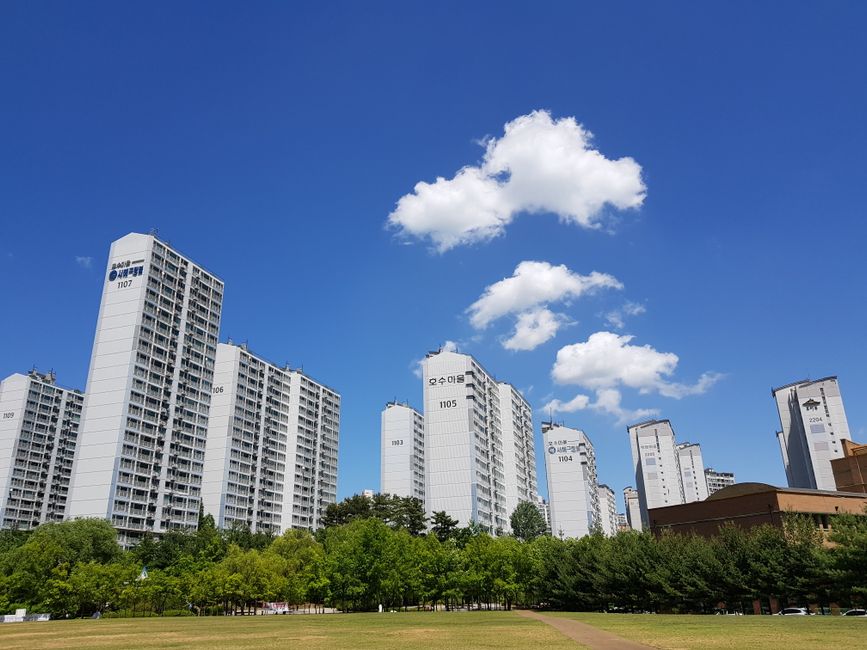
I live in a fifteen-story building with an underground parking garage, and the first week I moved in, a security guard in a small glass booth by the entrance logged my name, my unit number, and the time I came and went — by hand, in a notebook, like it was 1985. Every visitor gets buzzed through a video intercom before the elevator will even respond to their floor button. Packages don’t just get left at your door; most newer buildings have a dedicated parcel room with individual lockers, and older buildings have the guard sign for everything and stack it neatly by the mailboxes, sorted by unit number, no exceptions.
I assumed, going in, that this level of oversight would feel invasive. Surprisingly, it didn’t take long before it felt like the opposite — a kind of built-in reassurance. Nobody’s stealing your Coupang order off the doorstep here, and if a stranger buzzes your unit at 11 p.m., you can see their face on a little screen before deciding whether to answer. The tradeoff is that everyone in the building knows everyone else’s business a little bit — the guard definitely noticed the week I ordered dinner delivery four nights in a row — but even so, I’ll take mildly monitored over unmonitored any day.
Getting Sick Is Almost Suspiciously Easy
Back home, “I have a sore throat” meant either gritting my teeth for a week or booking a doctor’s appointment two weeks out. Here, I walked into a small ear-nose-throat clinic near Hongik University station on a Wednesday afternoon, no appointment, and was seeing a doctor within twenty minutes. The whole visit — consultation, a quick look with a scope, a prescription — cost me about 9,000 won out of pocket once my national health insurance kicked in, and the pharmacy next door filled the prescription in about five minutes for another 4,000 won or so. I’m not exaggerating the timeline; I checked my card receipt afterward because I genuinely couldn’t believe it.
You’d expect a tradeoff somewhere, and maybe there is one in wait times at bigger hospitals, but for basic care, I haven’t found it yet. I do want to flag one thing clearly, though: I’m not a doctor, and none of this is medical advice. Insurance coverage, individual conditions, and what counts as “routine” all vary, and anything beyond a cold or a minor injury deserves an actual conversation with a licensed provider, not a blog post.
Public Transit Etiquette Is Stricter Than It Looks
Seoul’s subway is famously clean and famously quiet, and I’d read that before arriving. What surprised me was how consistently the norms hold even when no one’s obviously enforcing them. On a packed evening train, finding someone without earphones in feels rarer than finding a free seat — the silence has its own texture, less like “nobody’s talking” and more like a shared, unspoken agreement everyone showed up already having signed. Eating on the train is rare enough that doing it draws looks. The pink-marked pregnancy seats near the doors sit empty even on standing-room-only trains; I’ve watched commuters who look genuinely exhausted glance at an open pregnancy seat, hesitate for a second, and then choose to stand rather than risk sitting there “just in case.” I checked our earlier piece on how the transit card system actually works (T-Money Explained) and even that focuses mostly on mechanics, not on this unwritten social contract layered on top of it.
It’s not that Koreans never break these norms — I’ve seen a drunk businessman loudly on speakerphone at midnight, so it does happen. But the baseline compliance is high enough that the exceptions actually stand out, which flips the usual logic. Back home, quiet behavior on public transit is the exception people notice. Here, noise is.
Restaurants Assume You’re Not Eating Alone
The first time I tried to order samgyeopsal (grilled pork belly) for one person, the owner held up two fingers, said “one, two?” with a small apologetic smile, and explained the dish only comes in servings of two — no exceptions, not even for a hungry foreigner willing to pay for the extra portion himself. Same with a lot of jjigae (stews) and barbecue spreads at smaller, older-school places — the assumption baked into the menu and the kitchen workflow is that you’re eating with someone. I ended up either bringing a coworker along or, on nights I genuinely wanted to eat alone, hunting down one of the specific “honbap-friendly” spots that have popped up to serve solo diners, or leaning on kiosks at chain restaurants that don’t care how many people you are (our Kiosk Culture piece covers exactly why those machines intimidated me at first).
You’d think, in a country with such a visible solo-living population, this would’ve changed by now — and to be fair, it has, especially in university neighborhoods and among younger-generation restaurant owners. Even so, plenty of the older, family-run barbecue places still run on the two-person-minimum assumption, and there’s no real workaround except knowing which restaurants to walk into before you’re already seated and hungry.

What I’d Tell Someone About to Land Here
If there’s one thread running through all of this, it’s that “advanced” and “convenient” don’t always point the same direction here — the same country that tracks your fried chicken by GPS will still make you show up in person with a paper form to open a bank account. None of these surprises were dealbreakers; most of them made me like living here more once I understood the logic behind them. My actual advice, if you’re about to land at Incheon yourself: budget three to four weeks of friction before daily life clicks into place, and don’t judge the whole system by week one. If you want the version of this I wish someone had handed me before I packed my bags, our What I Wish I Knew Before Moving to Korea guide covers the practical groundwork this post doesn’t.
Frequently Asked Questions
Q: How long does it actually take to get a bank account and phone plan sorted as a new arrival?
A: In my experience and among most foreign coworkers I’ve compared notes with, plan on two to six weeks from arrival, mostly bottlenecked by how quickly your Alien Registration Card gets processed at your local immigration office. Some cities move faster than Seoul’s busier offices. Bringing an employment or enrollment letter, your passport, and your Korean address registered in advance speeds things up considerably.
Q: Is it true you can’t order delivery food without a Korean phone number?
A: For the major apps — the ones with the fastest delivery times and best selection — yes, practically speaking, you’ll need a Korean number and usually a linked local payment method. Some apps have added limited English or foreign-card support in recent years, but coverage and reliability vary by neighborhood and by app, so don’t count on it working smoothly on day one.
Q: Can I really see a doctor same-day without an appointment?
A: For smaller neighborhood clinics — general practice, ENT, dermatology — walk-ins are genuinely common and wait times are often short on a weekday afternoon. This isn’t universal, and it isn’t medical advice for any specific condition; bigger hospitals and specialists usually require scheduling, and anything beyond routine care deserves its own research and a real conversation with a licensed provider.
Leave a Reply