Standing at the crosswalk near my kid’s hagwon a few months ago, I did something a little embarrassing: I counted cafes. Just turning my head left and right at one intersection, I got to eleven before the light changed. Not eleven coffee-adjacent businesses in the general neighborhood — eleven within maybe two hundred meters, stacked in buildings, tucked into basements, wrapped around corners. A Korean friend walking with me just shrugged. “Yeah, that sounds about right.” That shrug is the whole story, honestly. What looks like an anomaly to a foreigner is just Tuesday to everyone else.
The Math Doesn’t Make Sense (Until It Does)
I’ve read the comparisons that get thrown around — that Seoul alone has more coffee shops than plenty of entire countries. When I first moved here I assumed this was a bubble that would pop the way certain snack-franchise trends did back home. Years later, it hasn’t. There’s real turnover — plenty of shops don’t survive their first eighteen months — but the total keeps climbing anyway, because opening a cafe is one of the default moves for anyone leaving a corporate job with some severance and no clear next step. Enough people make that move that whole commercial streets end up wall-to-wall espresso machines.
Cafes as the Room You Don’t Have at Home
The part that actually explains the density isn’t the coffee, though — it’s the real estate. A lot of people here live in apartments that are compact by design, often shared with parents, roommates, or kids, and genuinely not built for hosting guests. Back home, if a friend wants to catch up, you invite them over. Here, you meet at a cafe. First date? Cafe. Slightly awkward chat with a landlord or your kid’s teacher? Also a cafe. It’s become the default neutral ground for basically every kind of face-to-face meeting that doesn’t happen at home or in an office, which means a city needs an enormous number of “neutral grounds” just to keep up.
Kagongjok: The Cafe as Study Hall
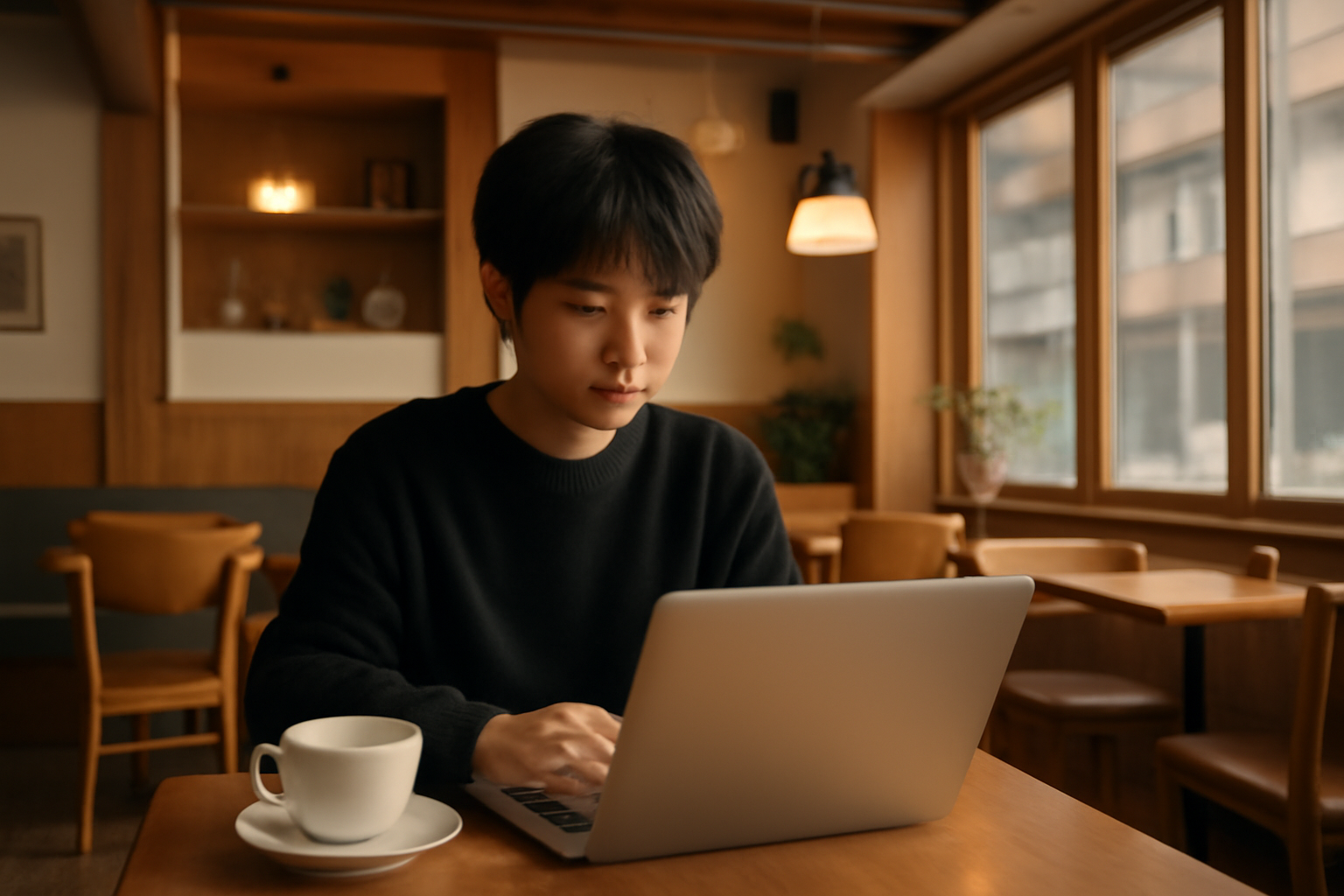
The first time I sat in a cafe here and watched someone unpack an actual desk setup — laptop stand, external keyboard, a stack of textbooks — I thought I was seeing something unusual. I wasn’t. There’s a term for these people: 카공족 (kagongjok), roughly “cafe-study tribe,” combining the words for cafe and studying. Students pull long study sessions over one iced Americano, office workers finish reports between meetings, exam-takers camp out for entire afternoons with headphones on. Some cafes lean into this, adding outlet-heavy seating; others push back, capping laptop hours to get table turnover back. That tension — cafe as living room versus cafe as business — is a real, ongoing debate here, not a settled one.
Nobody’s Rushing You Out
Which gets at something that still catches visitors off guard: there’s no real culture of a minimum or maximum stay. Order one drink and sit for four hours, and in most places nobody says a word. This isn’t universal — small independents running on thin margins have started posting stay-limit signs near the register — but as a broad norm, cafes here are remarkably tolerant of people just existing in them. I think that tolerance is downstream of the same real-estate logic above: if the cafe is functioning as everyone’s extra room, kicking people out defeats the purpose.
Franchise on One Corner, Independent on the Next
Walk down almost any commercial street and the pattern repeats: a big familiar chain anchoring the corner, then two or three tiny independents nearby — one doing hand-drip single-origin, another built around a pastel aesthetic and a signature dessert, another so minimalist it barely has signage. The franchises win on consistency and mobile-order convenience. The independents win by being a destination worth a subway transfer, because of how they photograph or how the espresso tastes. Both models coexist because the market is big enough, and image-driven enough, to support very different reasons for existing.
Built for the Photo, Not Just the Coffee
A lot of newer cafes are clearly designed with a phone camera in mind before they’re designed for efficiency. Floor-to-ceiling windows, one dramatic light fixture, a wall painted a shade that photographs well. I’ve walked into cafes that felt like small art installations with an espresso machine somewhere in back. It sounds gimmicky, but it works — a cafe that gets shared online becomes a destination rather than a pit stop, which is often the whole business model for a shop that can’t compete with a franchise on price or speed.
Eoljuka: Frozen Solid, Iced Coffee Anyway
And then there’s the thing that genuinely surprised me my first winter — watching people order iced Americanos in weather cold enough to make my own coffee cup feel like an insult. There’s a term for this too: 얼죽아 (eoljuka), short for “eoreo jugeodo aiseu amerikano” — roughly, “even if I freeze to death, iced Americano.” It’s said half-jokingly, but it’s a genuine, widely recognized identity here. Explanations vary — some say hot drinks feel too slow to finish before a meeting, others just say cold coffee tastes cleaner — but whatever the reason, cafes stock ice year-round in quantities that would seem absurd anywhere with an actual winter, because the demand never really drops.

Why the Boom Happened When It Did
None of this existed at this scale a generation ago. Coffee culture here really took off after the 2000s, tracking closely with the rise of the smartphone, longer work and study hours, and a generation with more disposable income for small daily luxuries than their parents had. A few-dollar coffee is an affordable treat, and ordering one buys you hours of table space, wifi, and a bathroom. Add social media rewarding photogenic spaces, and you get a perfect incentive structure for opening more cafes, not fewer.
FAQ
Is it rude to stay for hours at a Korean cafe?
Generally no — long stays are an accepted norm, especially for kagongjok studying or working. That said, during busy hours or at small independent shops, it’s worth checking for posted time limits, and ordering a second drink after a couple of hours is a nice unspoken courtesy.
What does 얼죽아 (eoljuka) mean?
It’s short for “eoreo jugeodo aiseu amerikano,” meaning “even if I freeze to death, iced Americano.” It describes the common habit of drinking iced coffee year-round, including in freezing winter weather.
Why are there so many cafes instead of more bars or bookstores?
Cafes fill a social gap that small living spaces created — they’re where people meet, study, date, and work when home isn’t an option. That combination of function keeps demand high enough to support huge numbers of shops, both franchise and independent.
Leave a Reply