The text came in at 6 a.m., which is how I knew before I even opened it that something was wrong. My wife read it once, went very quiet, and pulled a black suit out of the closet that I didn’t know we owned. A few minutes later she explained, in the clipped shorthand of someone whose mind is somewhere else entirely, that her uncle had passed and we needed to go to the hospital. Not a church, not a funeral home in the way I’d pictured one. A hospital. That was the first thing that didn’t match what was in my head.
Funerals Happen at the Hospital, Not a Separate Building
Most Korean hospitals of any real size have a 장례식장 (jangnyeshikjang), a funeral hall, built right into the complex. It struck me as strange at first — grief and treatment sharing the same parking lot — but it makes logistical sense. Many people pass away in hospital care, and keeping mortuary services, memorial rooms, and reception halls in one place spares the family a transfer during the worst days of their lives.
Inside, the building is divided into numbered 빈소 (binso) — individual memorial rooms, each rented by a different grieving family at the same time. You could be paying respects in room 3 while an unrelated funeral happens in room 5 down the hall. It felt oddly public at first, but once you’re inside the room itself, it’s its own quiet world.
Three Days, Start to Finish
Korean funerals almost always run on a fixed three-day structure called 삼일장 (samil-jang). The day someone passes is day one, spent on paperwork, notifying family, and setting up the memorial room. Day two is when most visitors come — this is the day I’ve been to, more than once now. Day three is for the burial or cremation itself, usually early in the morning.
What surprised me was how little room there is for delay. There’s no waiting a week for out-of-town relatives to arrange flights the way I grew up seeing. Everyone mobilizes fast, and the family receives visitors for most of that second day and evening, even while managing their own shock. I remember thinking, quietly, that grieving in public on a schedule like that must be its own kind of hard.
What to Wear, What to Bring
Black is the color of mourning here, and it’s not optional-casual — a dark suit or a simple black dress, subdued, nothing bright or patterned. Traditionally, close family wear hanbok in undyed white or black hemp cloth, a custom that goes back to when white was Korea’s own mourning color long before black became the norm for visitors. You’ll still see sons and daughters of the deceased in those plain ritual garments even at an otherwise modern funeral.
For a guest, the uniform is simpler: dark suit, white shirt, black tie if you own one, black shoes. Women generally wear a modest black dress with minimal jewelry. I learned the hard way that a navy suit reads as “trying” but not quite right — my father-in-law steered me toward an actual black one before my second visit.
You also bring money. Condolence money, 부의금 (buigeum), is handed over in a plain white envelope, never anything decorated or colored, with your name written on the front. You don’t hand it to the family directly — there’s a reception table near the entrance, staffed by a relative or close friend, where you sign a guest register and drop the envelope into a collection box before going further into the room.
The Bow, and the Order of Things
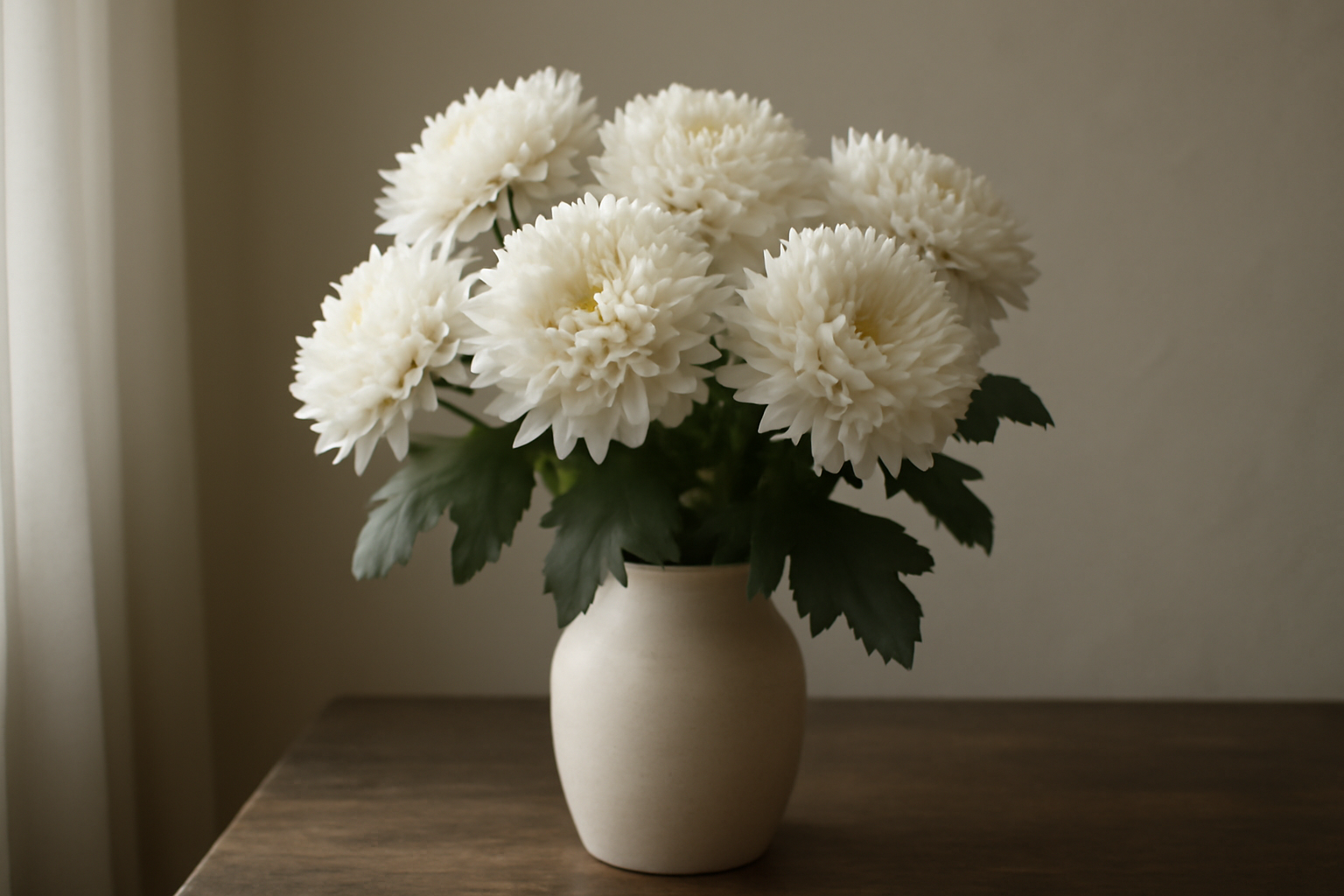
Walking into the memorial room, you’ll see a portrait of the deceased at the front, flanked by white chrysanthemums — the flower used almost exclusively for mourning in Korea, the way lilies might be used elsewhere. You approach, bow twice toward the portrait (a full, formal bow from the waist, not a nod), and then turn to bow once to the family members standing off to the side.
The 상주 (sangju) is the chief mourner, traditionally the eldest son, though this has been shifting — I’ve seen daughters and spouses take the role too as families reorganize around who’s present and able. The sangju stands closest to the portrait, receiving each guest’s bow and a quiet word of condolence. You don’t linger to chat. A short bow, a murmured word of sympathy, and you move to let the next person through.
Cremation Has Quietly Become the Norm
This is one of those slow generational shifts nobody announces but everyone notices. Burial used to be standard, and hillside family grave plots are still visible across the countryside — round mounded graves I pass every time we drive out of the city. But land is limited and plots are costly to maintain across generations, so cremation now accounts for the large majority of funerals in Korea, a near-total reversal from a few decades ago. Many families choose a columbarium, a memorial hall with wall niches for the ashes, instead of a traditional grave. My wife’s family did exactly this, and it was treated as the practical, unremarkable choice.
What I’d Tell Another Foreigner Walking In
Dress dark, bring a white envelope with cash inside, and follow whoever you came with rather than improvising. Nobody expects a foreigner to know the choreography perfectly, and a sincere, quiet effort goes a long way. What stayed with me longest wasn’t any single custom — it was how much structure surrounds Korean grief. Three days, a set sequence of bows, an envelope, a role for everyone. I used to think that sounded rigid. Now I think it’s a kind of mercy: when you don’t know what to do with unbearable news, having something to do with your hands helps.
Frequently Asked Questions
How much condolence money should I give?
For an acquaintance or coworker, 50,000 won is the common baseline in 2026. For closer friends or family, 100,000 won is typical. Traditionally, amounts in odd multiples of 10,000 won (30,000, 50,000, 70,000) were considered auspicious, since odd numbers carry good fortune in this context. Use fresh bills in a plain white envelope — never a decorated one.
What should I wear to a Korean funeral?
Dark, conservative clothing: a black or very dark suit for men, ideally with a black tie, and a modest black dress for women. Avoid bright colors, flashy accessories, and anything casual like jeans or sneakers.
Do I have to bow, and how many times?
If you’re comfortable with it, yes — two bows toward the portrait, followed by one bow to the family. If bowing isn’t part of your own background, a respectful, unhurried nod and a quiet word of condolence is also accepted from foreign guests. What matters most is moving slowly and speaking softly.
Leave a Reply