지난주 화요일 저녁, 서울 마포구의 한 필라테스 학원 탈의실에서 53세 회원 한 분이 이렇게 말했다. “운동하다 말고 갑자기 얼굴이 화끈거려서 창문부터 열었어요.” 옆에 있던 다른 회원 두 명도 고개를 끄덕였다. 그날 그 탈의실에는 비슷한 경험을 가진 사람이 세 명이나 있었다.
이 장면은 특별한 일이 아니다. 40대 후반에서 50대 사이 여성 상당수가 크고 작은 몸의 변화를 겪는다. 대한폐경학회 자료에 따르면 국내 여성의 평균 폐경 연령은 만 49.9세로 알려져 있고, 폐경 전후 수년에 걸쳐 호르몬 수치가 오르내리며 다양한 신체 반응이 나타난다. 이 글에서는 그 시기에 흔히 겪는 증상과, 병원 처방이 아닌 일상에서 실천할 수 있는 생활 관리법을 정리했다.
가장 흔하게 나타나는 증상들
안면홍조는 가장 많이 알려진 증상이다. 얼굴과 목, 가슴 쪽이 갑자기 달아오르고 땀이 나는 현상인데, 짧으면 30초, 길면 몇 분간 지속되기도 한다. 특정 계절과 무관하게 겨울에도 나타날 수 있다.
수면장애도 자주 언급된다. 야간에 식은땀을 흘리며 깨거나, 잠들었다가도 새벽 3~4시쯤 눈이 떠져 다시 잠들기 어렵다는 이야기가 많다. 감정 기복 역시 빼놓을 수 없다. 별일 아닌 일에 눈물이 나거나, 반대로 짜증이 쉽게 올라온다는 사례가 흔하다. 이 밖에도 관절이 뻐근하다거나, 기억력이 예전 같지 않다고 느끼는 경우도 있다.
가벼운 근력 운동은 골밀도 유지와 기분 안정에 도움이 될 수 있다.
운동으로 몸의 변화에 대응하기
운동은 거창할 필요가 없다. 하루 20~30분, 주 3~4회 빠르게 걷는 것만으로도 체력과 기분에 변화를 느끼는 사람이 많다. 근력 운동을 병행하면 더 좋다. 이 시기에는 골밀도 감소 속도가 빨라질 수 있어서, 가벼운 덤벨이나 밴드를 이용한 운동이 뼈와 근육을 함께 챙기는 데 도움이 된다.
스쿼트나 계단 오르기처럼 체중을 싣는 동작은 특별한 장비 없이도 가능하다. 요가나 스트레칭은 관절 뻐근함을 완화하는 데 도움을 준다는 이야기가 많다. 운동은 아침이나 이른 오후에 하는 편이 밤잠에 방해가 되지 않는다.
식습관, 작은 것부터 바꾸기
콩류, 두부, 청국장 같은 대두 식품은 이 시기 식단에서 자주 언급되는 재료다. 등푸른 생선과 녹색 채소, 견과류를 골고루 섭취하면 전반적인 영양 균형을 잡는 데 도움이 된다. 카페인과 알코올, 매운 음식은 안면홍조를 자극할 수 있다는 보고가 있어 스스로의 반응을 살펴가며 조절하는 것이 좋다.
물은 하루 8잔 이상 나눠 마시는 습관을 권장하는 자료가 많다. 야식이나 늦은 시간의 과식은 수면의 질을 떨어뜨릴 수 있으니 저녁 식사는 가볍게 마무리하는 편이 낫다.
대두 식품과 채소, 생선을 고루 갖춘 식단이 자주 권장된다.
스트레스와 감정 기복 다스리기
감정 기복은 의지로 억누르기 어렵다. 대신 하루 5~10분이라도 심호흡이나 명상 시간을 가지면 도움이 된다는 사람들이 많다. 취미 활동, 산책, 반신욕처럼 스스로에게 맞는 이완 방법을 찾는 것이 중요하다. 가족이나 친구에게 지금의 상태를 솔직히 이야기하는 것만으로도 마음이 한결 가벼워졌다는 후기도 적지 않다.
일기를 쓰거나 감정을 기록해보는 것도 방법이다. 어떤 상황에서 감정이 크게 흔들리는지 패턴을 알게 되면, 대응하기가 한결 수월해진다.
짧은 휴식과 이완 습관이 감정 기복 관리에 도움이 될 수 있다.
이런 경우라면 병원을 찾는 것이 좋다
일상 관리만으로 버티기 힘들 만큼 증상이 심하거나, 일상생활과 수면에 지속적으로 지장을 준다면 산부인과나 관련 전문의를 찾아 상담받는 것이 바람직하다. 증상의 정도와 원인은 사람마다 다르기 때문에, 자가 진단이나 인터넷 정보만으로 판단하기보다는 전문의의 진료를 통해 본인에게 맞는 방향을 확인하는 과정이 필요하다.
자주 묻는 질문
Q1. 갱년기 증상은 몇 년이나 지속되나요?
사람마다 차이가 크다. 몇 개월 만에 잦아드는 경우도 있고, 몇 년에 걸쳐 서서히 변화하는 경우도 있다. 정확한 경과는 개인차가 크므로 일반화하기 어렵다.
Q2. 영양제만 먹어도 증상이 나아지나요?
영양제는 전반적인 식습관을 보완하는 역할을 할 수 있지만, 특정 제품이 증상을 없애준다고 단정할 수는 없다. 복용 전에는 전문의나 약사와 상의하는 편이 안전하다.
Q3. 운동을 하면 안면홍조가 더 심해지지 않나요?
운동 중 일시적으로 체온이 오르면서 홍조를 느낄 수는 있지만, 꾸준한 운동은 장기적으로 증상 완화에 도움이 된다는 이야기가 많다. 무리한 고강도 운동보다는 본인 체력에 맞는 강도로 시작하는 것이 좋다.
몸이 보내는 신호를 무시하지 않고 하나씩 기록하고 살펴보는 습관, 그것이 이 시기를 지나는 가장 현실적인 방법일지 모른다. 오늘 저녁 산책 10분부터 시작해보는 것도 나쁘지 않은 선택이다.
이 글은 정보 제공을 목적으로 하며, 개인별 증상에 대한 정확한 진단과 치료는 반드시 전문의와 상담하시기 바랍니다.
My daughter had her shirt off before I’d even found the shoe cubby. That was the first sign that I was the only person in the building who didn’t already know how this worked.
We’d been in Korea for a while by then, long enough that I thought I had a decent handle on the basics. But my wife had been talking about taking the kids to a jjimjilbang for weeks the way you’d talk about a trip to the grocery store — completely unremarkable, something her family had done every couple of months since she was small. I pictured something between a gym locker room and a fancy hotel pool. I was not close.
The Uniform Nobody Explains in Advance
You pay at a counter near the entrance, hand over your shoes, and get a wristband in return. That wristband is your locker key, your ID, and — this part surprised me — your tab. Snacks, drinks, extra towels, the massage chair in the corner: all of it gets scanned to the band and settled when you leave. Nobody asks you to pay cash mid-visit, which means nobody is checking whether you can afford the second bowl of noodles. You just eat it and find out the total later, which is either a relaxing system or a slightly dangerous one depending on your self-control.
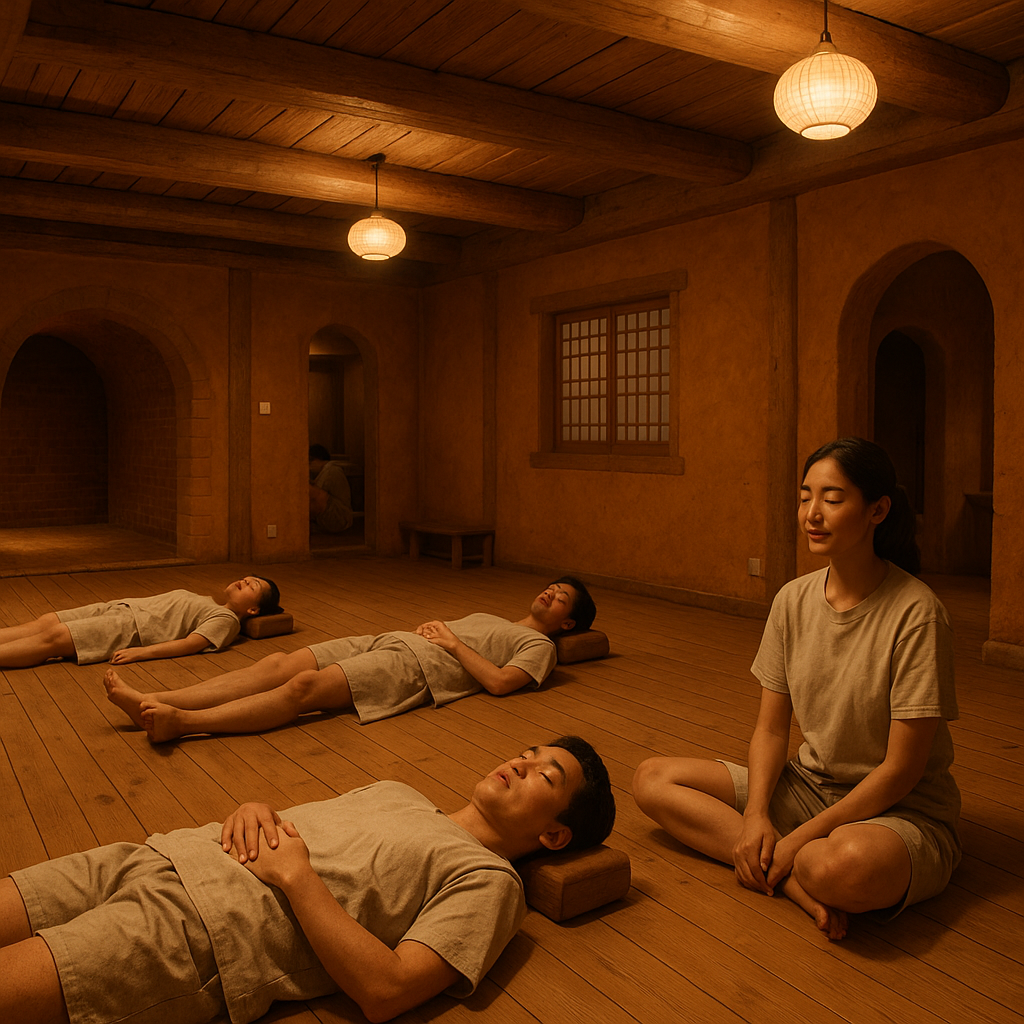
Past the lockers, the building splits in a way that took me a beat to understand. The actual bathing floors — where you scrub down and soak — are separated by gender and require you to be, plainly, naked. No swimsuits, no exceptions, and definitely no phone. But once you’ve washed and changed into the loose cotton shirt and shorts the front desk hands out, you move into a completely different building. That common floor — the heated rooms, the snack counter, the sleeping mats — is mixed. Husbands, wives, grandparents, kids, all wandering around in the same baggy uniform, looking like a very calm summer camp for adults.
What Nobody Tells the New Dad
This is the part the guidebooks skip, because guidebooks are written for tourists going alone, not for a father standing in a hallway holding a four-year-old’s hand and doing math. Below a certain age, kids can go into either bathing section with a parent — a small son can go in with his mother, a small daughter can go in with her father. Nobody hands you a rulebook for this. You just watch what the other parents do and copy it, and you realize fairly quickly that the grandmothers around you have opinions about how a father washes his kid’s hair, and they are not shy about sharing them.
What actually got me wasn’t the nudity, honestly — that stopped being interesting after about ten minutes, the way any novelty does once you realize everyone else is thinking about their own knees, not yours. What got me was how unbothered my kids were by all of it. No self-consciousness, no giggling, no big moment. For them it was just what a bath is. I was the one doing the internal narrating; they were just having a bath with grandma-aged strangers who occasionally handed them a snack.
The Rooms That Are Actually the Point
Once you’re past the bathing floor, the jjimjilbang’s real personality shows up in its heat rooms — a row of small chambers, each lined with a different material and built for a different kind of discomfort. There’s usually a clay room, walls the color of terracotta, mild enough to nap in. A salt room, floor covered in coarse crystals, supposedly good for your skin if you believe that sort of thing. Somewhere there’s an ice room, a cold shock kept just above freezing that everyone treats as a dare. And then there’s the one every jjimjilbang seems to have and every regular has an opinion about — the bulgama, a domed kiln room that runs hot enough that people sit closest to the door and time themselves like they’re playing a game with their own tolerance for pain.
My father-in-law’s routine, which I’ve now inherited whether I wanted to or not, is clay room, then salt room, then a stretch on the heated floor outside doing absolutely nothing, repeat. Nobody’s in a hurry. That’s maybe the biggest adjustment for someone used to gyms and spas built around efficiency — the jjimjilbang has no interest in getting you in and out. Families show up after lunch and leave after dinner. It’s less a spa visit and more a weather system you sit inside of for a few hours.
Snacks, Sleeping, and the Baked Egg Question
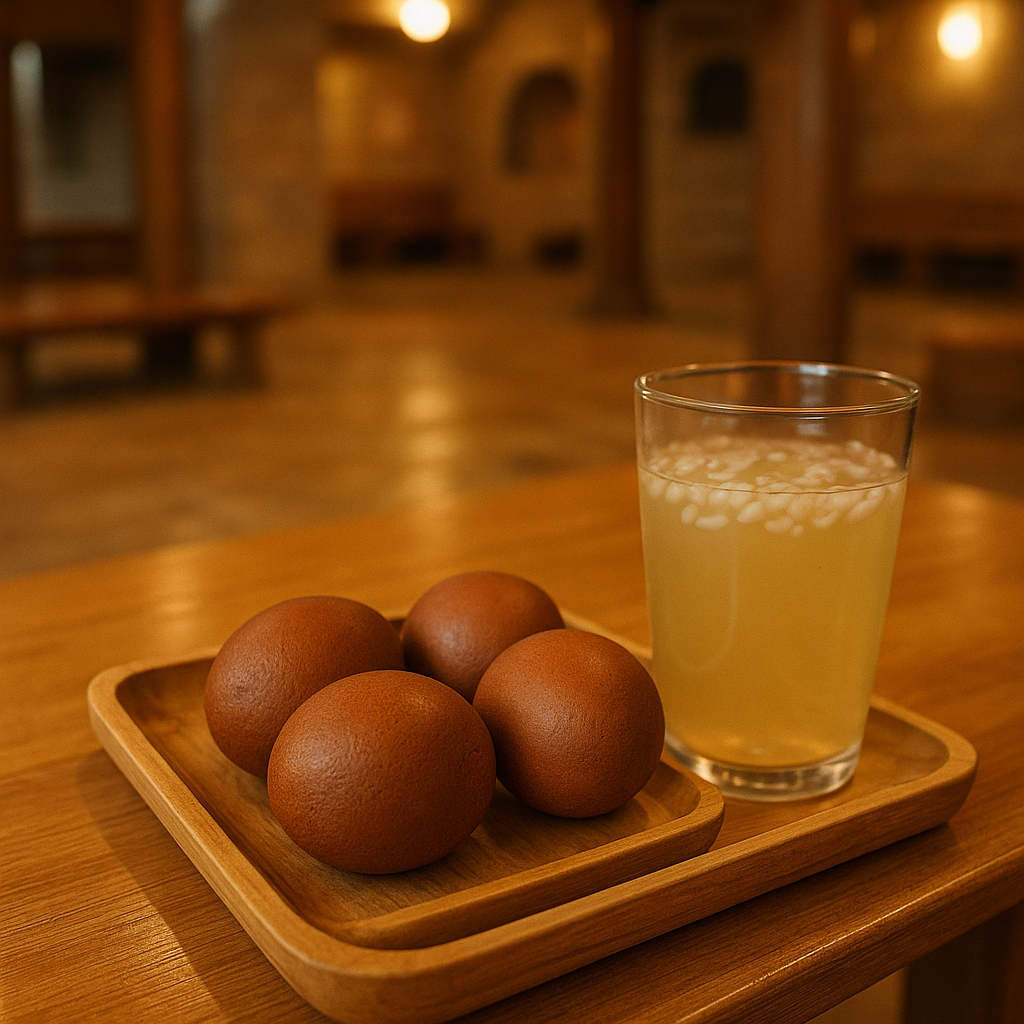
The food counter on the common floor is its own small culture. The signature order is a set of baked eggs — cooked slowly inside one of the heat rooms until the shells go brown and the inside takes on a faint smoky, nutty taste, nothing like a regular boiled egg. You crack them on the edge of the low table, peel with your fingers, and eat them with sikhye, a chilled, faintly sweet rice drink that tastes like it was invented specifically to be drunk in a hot room. My kids ate more baked eggs than actual dinner that first visit and I did not have the energy to stop them.
Scattered around the common floor are mats, wooden pillow blocks, and people fully asleep in the middle of the afternoon, undisturbed by the noise around them. Some jjimjilbang chains lean into this and run as overnight stays — cheaper than a motel, open all night, and apparently a legitimate option for someone who’s missed the last train home. I haven’t tried sleeping there myself, but watching a stranger nap soundly on a wooden pillow while a toddler runs past his head told me everything about how normal this all is to everyone but me.
Why It’s a Family Thing and Not Just a Bath
What stuck with me longest wasn’t any single room, it was the rhythm of the whole afternoon. Three generations moving through the same space at their own pace — grandparents parked on the heated floor, parents ducking in and out of the salt room, kids sprinting between the snack counter and the TV corner in socks that never quite grip right. Nobody was rushing anyone. Nobody was on a phone, mostly because you can’t easily bring one in. It’s one of the few places I’ve been in Korea where an entire family, from six to sixty, is doing the exact same low-key nothing at the exact same time, and everyone seems completely fine with that.
I went in expecting a bathhouse and left thinking about how differently rest gets treated here — as something you do together, out loud, in a room full of strangers, rather than something you retreat to do alone.
Frequently Asked Questions
Do you really have to be fully nude in the bathing area?
Yes, in the gender-separated bathing section — no swimwear is allowed, and washing at one of the shower stations before getting into any bath is expected. The common areas with the heat rooms and food counter are a separate, mixed-gender space where everyone wears the provided uniform.
Can a dad take a young daughter, or a mom take a young son, into the bathing area?
Generally yes, up to a certain young age — you’ll see it happen constantly and nobody blinks. Past that age, kids go into the bathing section that matches their own gender.
What should I actually bring?
Not much. Basic soap is usually provided at the washing stations, but shampoo isn’t always guaranteed, so I bring my own now. A hair tie if you have long hair, and something you don’t mind sweating in for the heat rooms — though most places give you a uniform anyway. Cash or a card for the wristband tab covers the rest.
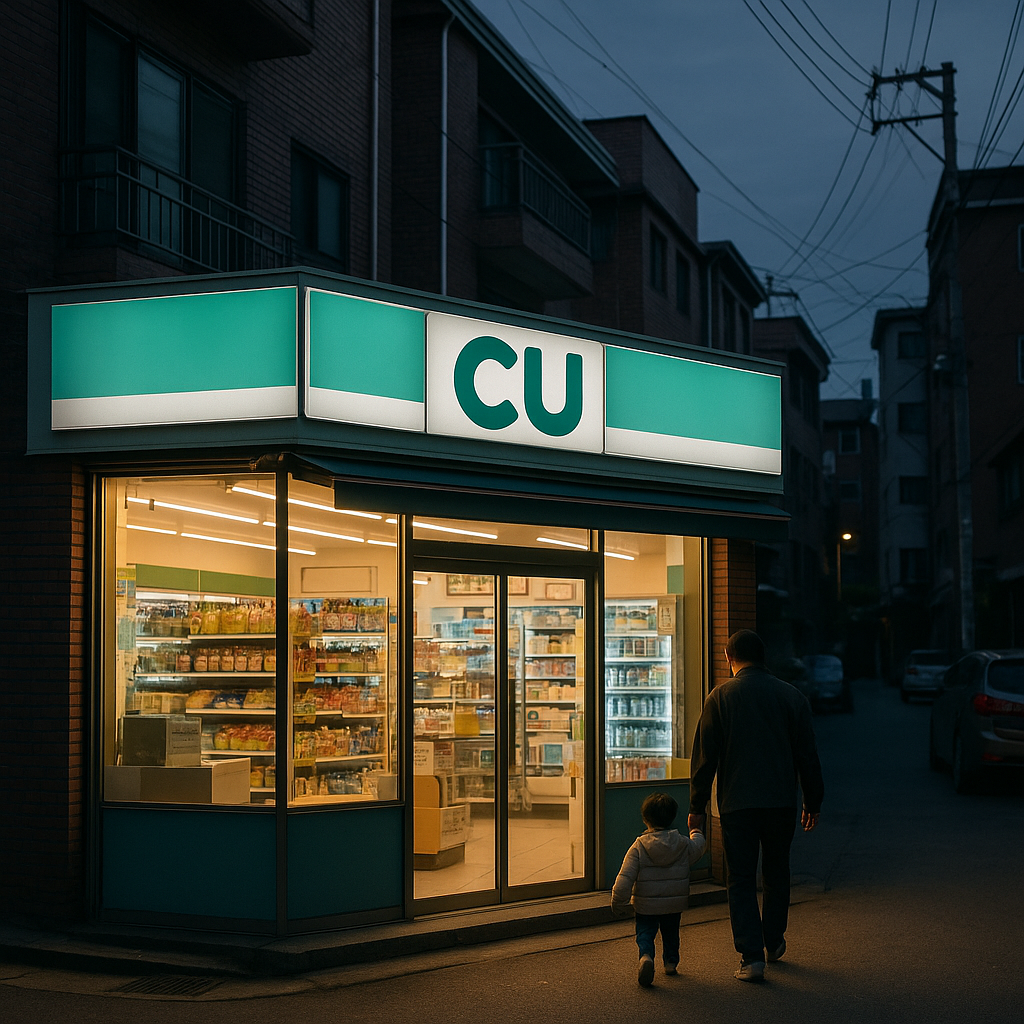
Somewhere between my third year and my fifth year in Korea, I stopped thinking of the convenience store as a backup plan. It became a destination. Not a big one — nobody plans a Saturday around it — but a small, reliable one, the way a corner bench in a park becomes “your” bench even though you never decided that on purpose. My wife noticed it before I did. She pointed out that whenever we couldn’t agree on dinner, or the kids were too tired to sit through a real meal, or I just needed five minutes of quiet, I’d say some version of “let’s just go to the CU.” Not a restaurant. Not delivery. The CU, the one eighty meters from our building, with the automatic door that sighs open a half-second too late.
I want to be upfront about something: I did not come to Korea with strong feelings about convenience stores. Where I grew up, a convenience store was a place you stopped at for gas, gum, and regret. You didn’t linger. You definitely didn’t bring your kids there for something resembling a meal. So the fact that I now have opinions — real, specific, slightly competitive opinions — about which chain does what best is one of those quiet transformations that sneaks up on you when you live somewhere long enough. You stop importing your old categories. You start using the ones the place hands you.
The Density Problem, or, Why I Never Learned to Plan Ahead
The first thing that recalibrates you here is the sheer number of stores. In my neighborhood alone I can name a CU, a GS25, an Emart24, and two different 7-Elevens within a ten-minute walk, and I’m fairly sure I’m undercounting. Back home, this density would be considered a market failure — surely they’re all competing for the same six customers and one of them will fold. Here, they all seem to survive, which tells you something about how differently convenience stores are used. They’re not really competing with each other so much as they’re each competing with the idea of not needing to plan.
And that’s what got me, eventually. I stopped keeping a stocked pantry the way I did back home. Why buy a case of something when there’s a store closer than my own bathroom is to my kitchen? It changed how I shop, how I cook, and honestly how I think about running out of things. Running out stopped being a crisis. It became a five-minute errand, often one I sent my seven-year-old on, solo, because that’s also just normal here in a way it never was where I grew up.
The Rankings Nobody Asked Me For
Somewhere along the way, snack opinions started forming without my consent. I didn’t sit down and decide to become a person who ranks convenience store food. It happened the way most parenting-adjacent opinions happen — through repetition, through being handed the same items by the same small hands often enough that patterns emerge.
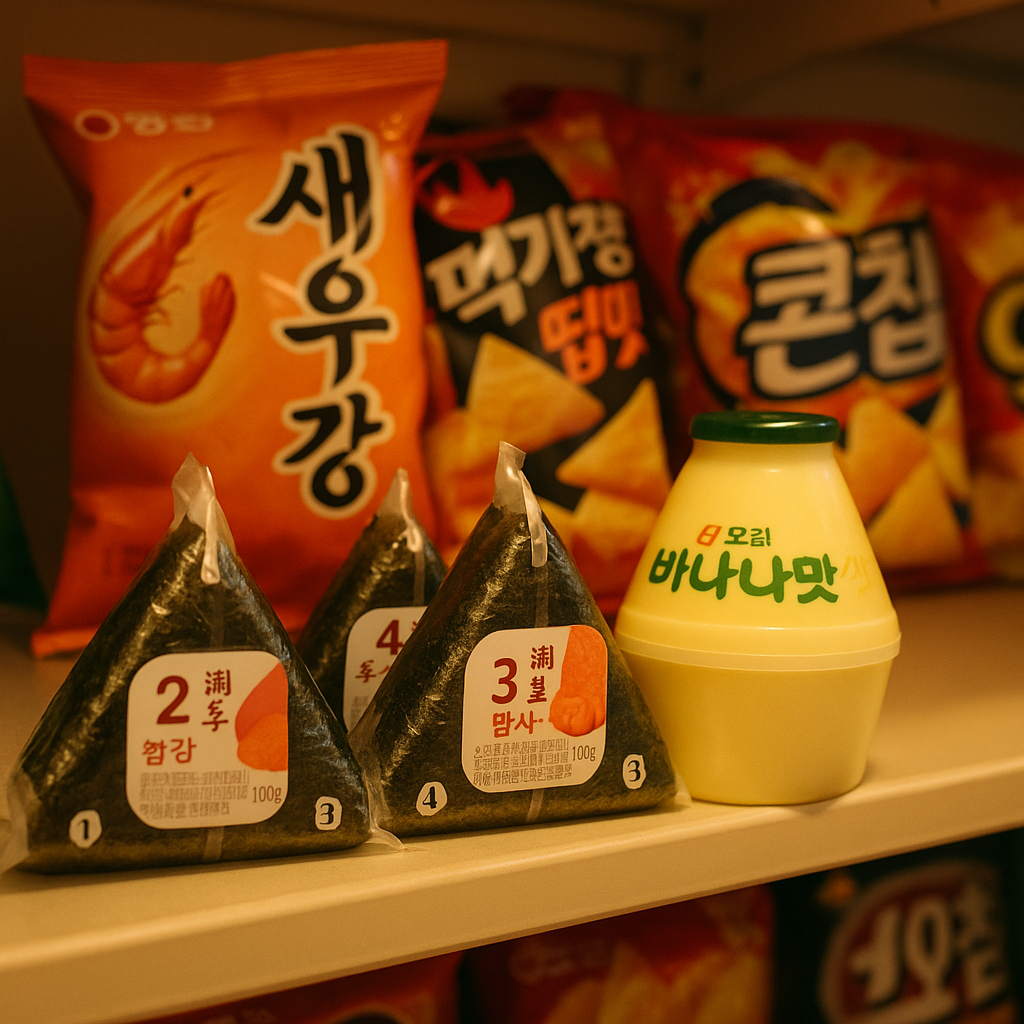
Triangle kimbap — samgak gimbap — is the obvious starting point, because it’s the item that made me understand convenience store food could be actual food and not just a snack. The tuna mayo version is the reliable choice, the one you grab without thinking, and I’ve watched my daughter peel back that plastic wrapper with the two-step fold-and-pull motion faster than she can tie her shoes. There’s a spicy version with gochujang that I like more than she does, and a version with bulgogi that disappears the moment either kid spots it in my hand. I’ve come to believe that ranking triangle kimbap flavors is a genuinely useful piece of small talk with other parents here, in the way that ranking pizza toppings might be back home.
Banana milk is its own category entirely, and I’ll admit I resisted it at first because it looked more like a novelty prop than an actual drink — that squat yellow bottle shows up in dramas and on t-shirts and in gift shop windows, which made me suspicious it was more image than substance. I was wrong. It’s genuinely good, in a nostalgic, slightly too-sweet way that I now understand is the entire point. My younger one asks for it by pointing rather than by name, which is its own kind of endorsement.
Then there’s the hot snack case near the register — the one with the odeng skewers steaming in broth, the corn dogs, the rotating hot dogs on the little warmer. I didn’t grow up with the concept of a convenience store serving something you’d eat standing at a small counter by the window, and there’s something almost civilized about it now, watching my son eat a corn dog dusted in sugar while I sip barley tea from a paper cup, both of us just standing there, no urgency, like we’re at a tiny bar with a very limited menu.
I have soft spots I won’t fully defend: the honey butter chips that started a whole flavor trend years ago and still taste like the flavor trend rather than a chip. The choco pie, which feels less like a snack and more like an institution. And a rotating cast of collaboration items — a cream bread here, a limited ramen flavor there — that show up for a season and vanish, which somehow makes convenience store shopping feel a little like following a TV show with a new episode every week.
What It Actually Became
None of this was supposed to matter. I think that’s the part worth sitting with. A convenience store is, by definition, a place designed to be forgettable — you’re in and out, no memory required. But somewhere in the last few years, ours became a minor character in our family’s daily life. It’s where my kids learned to count change. It’s where we’ve had some of our least dramatic, most honest conversations, standing in the snack aisle with no phones out, just deciding between two kinds of chips. It’s the place I duck into on the way home from work not because I need anything specific, but because walking in and scanning the shelves has become its own small decompression ritual.
I don’t think I’ll ever fully explain this to people back home without sounding like I’m exaggerating. “You have opinions about which chain’s kimbap is better?” Yes. Genuinely. I never knew I’d care, and now I do, and that’s most of what living somewhere long enough actually does to you — it hands you categories you didn’t ask for and, eventually, you find yourself defending them.
FAQ
Which Korean convenience store chain has the best food overall?
It depends what you’re after. In my experience GS25 tends to have the strongest prepared meals and lunch boxes, CU leans into snacks and the hot food case, and 7-Eleven is the one I trust most late at night when almost nothing else is open. None of them is objectively “best” — it’s more about which one happens to be closest when you need it.
Is triangle kimbap actually good, or is it just convenient?
Both, honestly. The rice-to-filling ratio is better than it has any right to be for something wrapped in plastic and sold for a couple thousand won, and the seaweed staying crisp until you open it is a small piece of engineering I still appreciate.
Do convenience stores really function as a place to eat, not just buy things?
Yes — most locations have a small table setup, sometimes just stools by the window, and it’s completely normal to sit there with a cup ramen and a triangle kimbap for a full meal. It surprised me at first, but now it’s one of my favorite parts of the whole ecosystem.
The first time I picked up my daughter’s after-school schedule from her homeroom teacher, I genuinely thought there had been some kind of printing error. Monday: taekwondo, then math. Tuesday: English, then piano. Wednesday: taekwondo again, plus a Korean writing class. I remember standing in the hallway of her elementary school doing the math in my head — school until 2:30, then academies until almost 7 — and thinking, this can’t be normal. It took me a solid year of living here as a parent to understand that it wasn’t the exception. It was, more or less, the baseline.
I’m Yijidaddy, and if you’ve been reading along, you know I came to Korea as an adult, married in, and am now raising kids inside a system I didn’t grow up in myself. There’s a particular kind of vertigo that comes with parenting across a cultural gap — not the big, obvious differences like food or language, but the quieter architecture of daily life. Nothing captures that gap for me more than the hagwon (학원) schedule.
What a Hagwon Actually Is
For anyone unfamiliar, a hagwon is a private academy — not part of the public school system, but running alongside it, sometimes more central to a kid’s day than school itself. There are math hagwons, English hagwons, science hagwons, piano and violin academies, taekwondo studios, art ateliers, handwriting classes, coding classes, and a dozen more specialties I’m still discovering. Some are one-room operations run by a single teacher in a strip mall above a convenience store. Others are multi-floor institutions with vans that circle the neighborhood picking up kids in little fleets, like a school bus system running in parallel to the actual school bus system.
The word “academy” is doing a lot of translation work that doesn’t quite land for a Western ear. When I hear “academy,” I picture something optional — an enrichment activity you sign up for if your kid shows interest, like a Saturday art class back home. What it actually functions as here is closer to a second, privatized layer of education that most families treat as non-negotiable. Not because anyone’s being forced into it, but because the entire social and academic ecosystem around them assumes it.
What the Schedule Actually Looks Like
A fairly typical week for an elementary-age kid in our neighborhood might run something like this: taekwondo two or three afternoons a week (partly for fitness, partly because it teaches discipline and it’s genuinely fun for a lot of kids), an English hagwon two days a week with homework packets that would make a middle schooler groan, a math hagwon that drills computation and problem sets well ahead of the public school curriculum, and maybe a piano or art lesson squeezed in as the “soft” activity of the week. By the time a kid gets home, showers, eats dinner, and finishes hagwon homework, it’s not unusual for bedtime to creep toward 9 or 10 PM. Multiply that across five days, and you start to understand why Korean kids are famous, even among themselves, for being tired.
What struck me wasn’t just the density of it — it was how normal everyone treated it. Other parents weren’t stressed out or apologetic when they described their kid’s week. It was just Tuesday. There wasn’t a sense of “we’re pushing too hard,” because the baseline everyone is measuring against is each other, and everyone else’s kid has a similarly packed week.
The Logic Underneath It
It would be easy — and honestly, a little lazy — to write this off as pure academic pressure or tiger-parenting stereotype. The longer I’ve lived here, the more I’ve come to see it as something more layered than that. Part of it is genuinely about the university entrance exam system, which looms over Korean education from a shockingly early age and creates a kind of gravitational pull that starts pulling kids toward it well before middle school. Part of it is about safety and logistics — with both parents often working full-time, a hagwon isn’t just instruction, it’s supervised, structured time in the hours between school ending and a parent getting home. That’s a very practical calculation, not just an academic one.
And part of it, I think, is a genuine cultural belief that investing heavily in a child’s development — filling their time with skill-building rather than unstructured play — is what a responsible parent does. It’s not that Korean parents don’t value play. It’s that the definition of what a childhood is “for” leans harder toward preparation than mine did growing up, where a summer afternoon with absolutely nothing scheduled was considered a normal, even desirable, way to spend a day.
Where I’ve Landed as a Foreign Dad
I won’t pretend I’ve fully made peace with all of it. There are weeks I look at my kids’ schedule and feel a pang of something between guilt and rebellion — an urge to cancel everything and just take them to the park with no plan. And sometimes I do exactly that, and it’s fine, and the world doesn’t end. But I’ve also watched my kids come home from taekwondo genuinely proud of a new belt, or play something on piano they couldn’t play a month earlier, and I can’t honestly say the hagwon system is producing unhappy kids across the board. It’s producing busy ones, structured ones, and — a lot of the time — kids who take real pride in visible progress.
What I’ve settled into, as a parent standing a little outside the system even while my kids are fully inside it, is something like selective participation. We keep some hagwons, because they clearly bring value and joy. We skip others that feel more like keeping-up-with-the-neighbors than anything my kids actually need. It’s a negotiation I re-run every semester, and I don’t think there’s a single correct answer — just a constant recalibration between two different ideas of what childhood should feel like, one of which I grew up inside and one of which my kids are growing up inside right now.
FAQ
Do all Korean kids attend hagwons?
Not literally all, but attendance is extremely common, especially from elementary age onward. In most neighborhoods, a child with no hagwon at all would be the unusual case rather than the norm.
Are hagwons only about academics?
No — sports like taekwondo and swimming, and arts like piano, art, and dance, are just as much a part of the hagwon landscape as math and English. Many kids attend a mix of academic and non-academic academies.
Is the packed schedule considered a problem in Korea itself?
It’s a genuinely debated topic here, not something everyone quietly accepts. You’ll find plenty of Korean parents and commentators openly discussing whether kids are overscheduled, alongside others who see it as necessary preparation. It’s less a settled cultural consensus than an ongoing conversation, the same as it would be anywhere else.
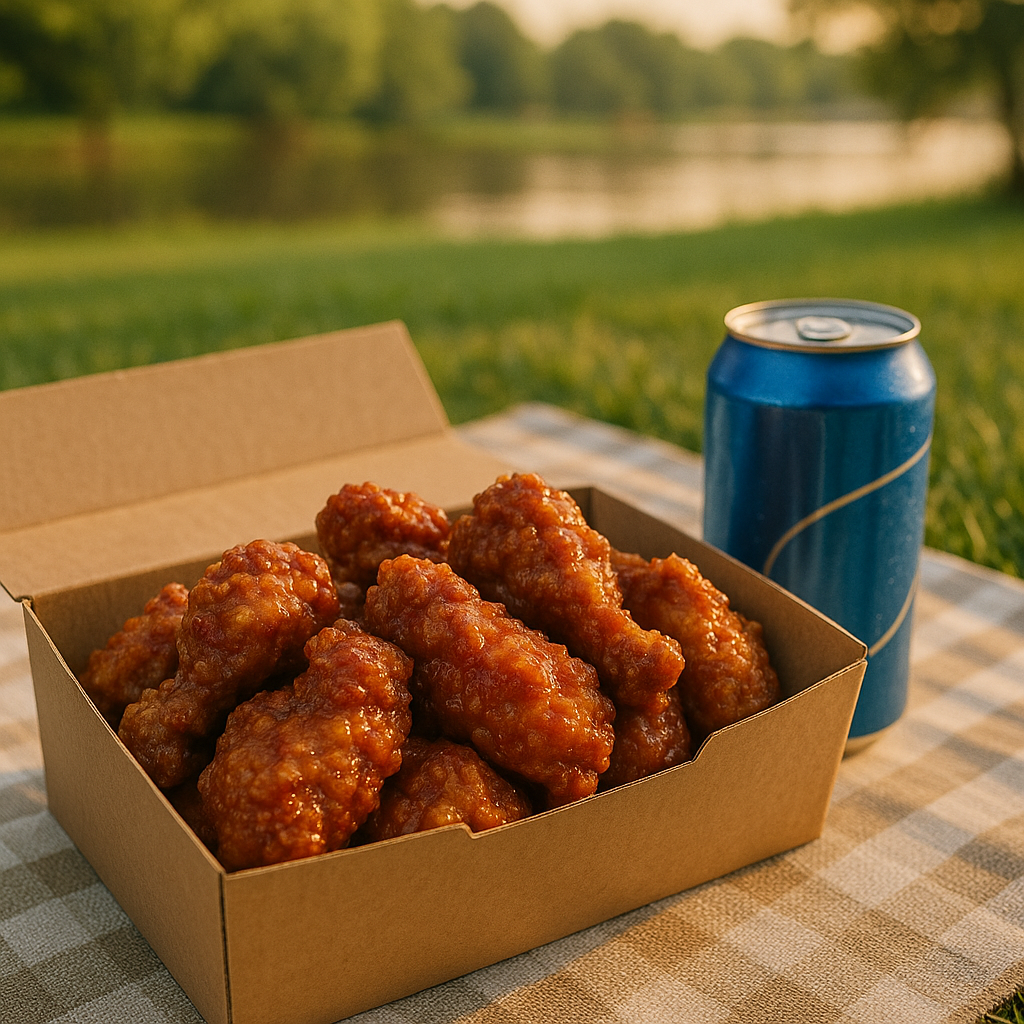
The first time I saw it happen, I honestly thought someone had made a mistake. A man on an electric scooter rolled straight across the grass at Yeouido Hangang Park, stopped in front of a family sitting on a plaid mat, checked his phone, and handed over two paper bags before rolling off again. No restaurant in sight. No car. Just a scooter, a phone, and a guy in a helmet who clearly knew exactly where he was going, even though “where he was going” was a specific patch of lawn with no address.
That was my introduction to what Koreans call 한강 치맥 — Han River chimaek, the practice of ordering fried chicken and beer (chikin plus maekju, mashed together into one very efficient word) and having it delivered directly to your spot by the river. I had lived in Korea for over a year before I actually understood how deep this ritual runs, and now that I do, as Yijidaddy, a dad still cataloguing the small everyday things this country does differently than anywhere I’ve lived before, I genuinely think it might be one of the most quietly brilliant pieces of urban life I’ve encountered here.
A River That Works Like a Backyard
Seoul doesn’t really do backyards. Apartments stack up instead of spreading out, and most of us raising kids here don’t have a patch of grass to call our own. What the city has instead is the Han River, and more specifically, the string of parks that run along both banks of it — Yeouido, Banpo, Ttukseom, Jamwon, and a dozen others, each with its own personality. On a warm evening, these parks become the collective backyard of a city of ten million people, and everyone treats them that way. You see university students sprawled in circles playing cards, couples on early dates trying to look casual, grandparents power-walking past toddlers chasing bubbles, and families like mine just trying to let the kids run themselves tired before bed.
Once you’re there, the question is never really “what should we eat,” it’s “who’s ordering.” And that’s where the delivery apps come in.
How You Actually Order Chicken to a Lawn
This part still amazes me a little, even now. Korea’s food delivery infrastructure — built around apps like Baemin (배달의민족) and Coupang Eats — is so precise that it doesn’t just deliver to buildings, it delivers to zones. Major Han River parks have marked delivery pickup points, often numbered, so instead of typing in a street address that doesn’t exist on a lawn, you select something like “Delivery Zone 3, Yeouido Hangang Park” and drop a pin. Some spots even have small delivery lockers or designated waiting areas near the entrance gates specifically so the scooters don’t have to weave through blankets and toddlers to find you.
Order, and somewhere between twenty and forty minutes later, your phone buzzes. It’s not always the app — sometimes it’s the delivery driver themselves, calling because the pin dropped near a tree that looks a lot like every other tree, and they need you to describe what you’re wearing or wave an arm. You go meet them at the zone, chicken in hand, and walk back to your spot like you just won something.
The first few times I did this, I felt a strange mix of guilt and wonder — guilt because ordering delivery to a park felt like it was supposed to be against some unwritten rule of what a “picnic” is, and wonder because it worked so well I couldn’t stop thinking about the logistics behind it. There’s a reason 20 percent of tourists list Han River food delivery as something they specifically want to try while visiting — it’s not really about the chicken. It’s about watching a system built for convenience apply itself so completely to something as unstructured as sitting on grass.
The Whole Setup Is Its Own Small Ritual
What surprised me most wasn’t the delivery part — it was everything around it. Korean picnicking at the Han River has its own quiet choreography. People show up with more gear than I expected for what is, at the end of the day, sitting outside. Portable folding tables, low enough to sit at cross-legged, appear out of backpacks like magic tricks. Plaid mats get smoothed out on the grass with the kind of care you’d give a picnic blanket at a much fancier event. Some families bring small battery fans; others bring string lights for after dark. Convenience stores near the park entrances do brisk business in ice, canned coffee, and the blue cans of beer that seem to be the unofficial uniform of a Han River evening.
My own version of this ritual is a little clumsier than the local pros. I usually forget at least one essential item — the bottle opener, the extra napkins, the second bag of ice — and end up jogging to the convenience store while my wife holds down our patch of grass with a look that says she’s used to this by now. But even clumsy, it works. There’s something almost meditative about the whole sequence: claim your spot, lay out the mat, order the chicken, wait by the river with your kids running circles around you, then eat while the sky turns orange and the Banpo Bridge fountain, if you’re lucky enough to be near it, starts its light show over the water.
Why It Actually Makes Sense
I used to think of “eating out” and “having a picnic” as two separate categories of activity, one involving a restaurant and one involving effort and a cooler bag. Han River chimaek collapses that distinction entirely, and once you see it working, the logic is hard to argue with. You get the open air, the river breeze, the space for kids to run that no restaurant table could ever offer — plus fresh, hot food you didn’t have to cook or clean up after, arriving with the kind of scooter-driver precision that would be unthinkable in most other cities I’ve lived in.
There’s also something very Seoul about the specific choice of chicken and beer as the anchor of the ritual. Korean fried chicken — twice-fried, often glazed in soy garlic or sweet-spicy sauce — travels well. It stays crisp in the box for the walk back from the delivery zone in a way that, say, a bowl of soup never would. Paired with a cold beer while the sun goes down over a river that cuts right through the middle of a 10-million-person city, it’s hard to design a more satisfying way to end a Tuesday.
A Small Thing That Says a Lot
I don’t think Han River chimaek is really about the food, or even about efficiency for its own sake, though the efficiency is real and it is impressive. I think it’s about how a crowded city finds room for slowness. Everyone at that park is there to do essentially nothing — sit, talk, watch the water, let the evening pass — and the fact that a scooter can bring you a hot meal in the middle of that nothing just means you get to keep doing it a little longer, a little more comfortably, with your kids fed and your hands free.
As a foreign dad still learning the unwritten rules of this city, that’s the kind of detail that sticks with me. Not the app, not the delivery zones, not even the chicken itself — but the sight of an entire riverbank quietly agreeing, evening after evening, that this is simply how you spend a summer night here.
FAQ
Do I need to speak Korean to order chimaek delivery to the Han River?
Not necessarily. Both Baemin and Coupang Eats offer English-language interfaces and accept international cards, and many park entrances have signage or vendor staff who can help point you to the nearest delivery zone if you’re not sure how the pin-drop system works.
Which Han River park is best for a first-time chimaek picnic?
Yeouido Hangang Park is a popular starting point since it’s centrally located, well-marked, and busy enough that you’ll have plenty of company figuring out the routine. Banpo Hangang Park is another favorite, especially in the evening when the Banpo Bridge fountain show adds some extra atmosphere to the meal.
What should I bring if delivery is handling the food?
A mat or blanket, hand wipes or tissues, a trash bag for cleanup, and something to sit on if the ground feels damp. A small portable table is optional but makes eating considerably less awkward, and most parks have convenience stores nearby if you forget ice, cups, or a bottle opener.
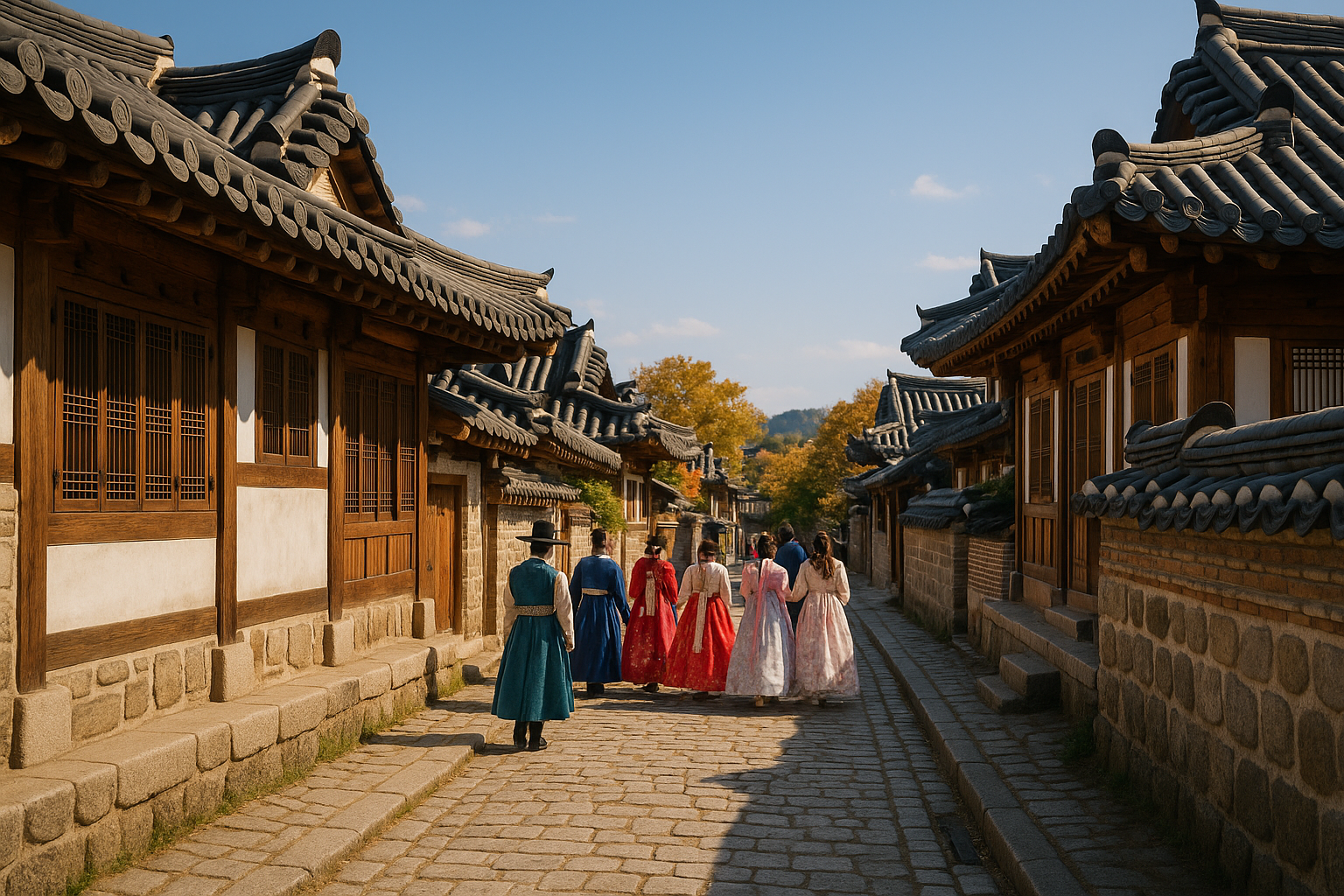
새벽 6시 40분, 전주 객사 골목은 이미 국밥 냄새로 가득했다. 관광객보다 국밥집 사장님과 새벽 배송 트럭이 먼저 그 골목을 채운다. 2026년 7월 25일 토요일, 한옥마을 코스를 다시 걸으며 느낀 건 하나였다. 전주는 ‘한 끼 관광지’가 아니라 ‘하루 종일 먹는 도시’라는 것. 이 글은 그 하루를 그대로 옮긴 실전 코스다.
전주 한옥마을 기와지붕이 이어진 골목 풍경
1. 오전 7시 30분 — 해장의 시작, 콩나물국밥
전주 여행의 첫 끼는 무조건 콩나물국밥이어야 한다. 완산구 동문길 88에 있는 왱이집은 아침 7시부터 문을 연다. 뚝배기째 끓여 나오는 국밥에 밥과 수란을 따로 넣어 먹는 스타일인데, 손님이 벌떼처럼 몰려든다고 해서 ‘왱이집’이라는 이름이 붙었다는 이야기가 전해진다. 1인분은 9천 원 안팎, 모주 한 잔을 곁들이면 만 원을 조금 넘긴다.
줄이 부담스럽다면 완산구 전주객사2길 22의 삼백집도 대안이다. 새벽 6시부터 문을 열고 하루에만 1,500그릇 넘게 팔린다는 말이 있을 정도로 회전이 빠르다. 고추군만두를 곁들이면 해장이 확실히 된다. 두 집 모두 한옥마을에서 도보 10~15분 거리라 아침 산책 겸 걷기 좋다.
2. 오전 9시 — 경기전과 전동성당, 그리고 골목 산책
배가 든든해졌다면 경기전으로 향한다. 태조 이성계의 어진을 모신 곳인데 입장료는 3천 원, 아침 시간대는 사람이 적어 사진 찍기 좋다. 바로 옆 전동성당은 로마네스크 양식의 붉은 벽돌 건물로, 결혼식 촬영 팀과 마주칠 확률이 꽤 높다. 두 곳 다 한옥마을 초입에 붙어 있어 따로 이동할 필요가 없다.
3. 낮 12시 — 전주비빔밥, 3대째 이어온 맛
점심은 가족회관이다. 1979년 문을 연 뒤 지금은 3대째 대를 이어 운영 중이고, 창업주 김년임 명인은 대한민국 식품명인 39호로 지정된 인물이다. 육회비빔밥과 돌솥비빔밥을 함께 시켜 나눠 먹는 손님이 많다. 나물 가짓수가 열 가지가 넘고 간이 세지 않아 재료 하나하나의 맛이 살아 있다. 1인분 가격은 1만 8천 원에서 2만 원대, 콩나물국과 밑반찬 예닐곱 가지가 상다리 휘어지게 함께 나온다. 점심시간 정각에는 대기가 20분을 넘기기도 하니 11시 40분쯤 도착하는 편이 낫다.
돌솥에 담긴 전주비빔밥과 곁들여 나오는 반찬들
4. 오후 2시 — 풍년제과에서 초코파이, 오목대에서 숨 고르기
PNB풍년제과 한옥마을점에서 수제 초코파이를 산다. 1951년부터 이어온 전주 원조 제과점으로, 낱개로 사도 되고 5개들이 세트로 사도 된다. 초코파이를 손에 들고 오목대까지 계단을 오르면 한옥마을 지붕이 파도처럼 겹쳐진 풍경이 눈앞에 펼쳐진다. 오르는 데 10분 남짓, 힘들었던 만큼 뷰는 배신하지 않는다.
5. 저녁 6시 이후 — 남부시장 야시장, 전주만의 밤
금요일과 토요일 저녁에만 열리는 남부시장 한옥마을 야시장은 하절기 기준 오후 6시부터 자정까지 운영된다. 250미터 남짓한 통로에 이동 판매대 40여 개가 늘어서고, 낙지호롱과 소고기불초밥, 철판스테이크 냄새가 골목을 채운다. 가격은 대부분 5천 원에서 1만 원 사이로 관광지치고 비싸지 않다. 풍남문에서 도보 10분 거리라 오목대에서 내려온 뒤 걸어가면 딱 저녁 시간에 맞는다. 겨울철에는 오후 5시부터 10시까지로 운영시간이 짧아지니 미리 확인해야 한다.
해가 진 뒤 불이 켜지는 남부시장 야시장 골목
주차와 이동, 알아두면 편한 것들
한옥마을 안쪽 골목은 차량 진입 자체가 좁고 답답하다. 완산구청 공영주차장이나 오거리광장 주변 공영주차장에 대고 걸어 들어가는 방법을 추천한다. 주말 오전 10시 이후로는 만차가 흔하니 아침 일찍 도착해서 콩나물국밥부터 먹는 이 코스가 주차 면에서도 유리하다. 전주역이나 고속버스터미널에서는 시내버스로 20분 안팎, 택시로는 10분이면 한옥마을 초입에 닿는다.
자주 묻는 질문
Q1. 왱이집과 삼백집 중 어디가 더 나은가요?
왱이집은 뚝배기에 수란을 따로 넣는 방식이라 국물이 더 걸쭉하게 느껴지고, 삼백집은 국물이 맑고 개운한 편이다. 취향 차이지 우열의 문제는 아니다. 둘 다 한옥마을에서 걸어갈 수 있으니 여유가 되면 한 끼씩 나눠 먹어보는 것도 방법이다.
Q2. 야시장은 평일에도 여나요?
아니다. 남부시장 한옥마을 야시장은 금요일과 토요일 저녁에만 운영된다. 평일에 방문한다면 한옥마을 골목 안 카페나 국밥집 위주로 저녁 일정을 짜는 게 낫다.
Q3. 아이를 데리고 가도 코스가 무리 없을까요?
오목대 계단이 살짝 가파른 편이라 유아차보다는 아이 손을 잡고 오르는 편이 낫다. 나머지 구간은 전부 평지라 어린이 동반 가족 여행객도 큰 무리 없이 소화할 수 있는 코스다.
전주는 한 끼로 끝낼 도시가 아니다. 아침 국밥 한 그릇으로 시작해 밤 야시장 냄새로 하루를 닫으면, 그제야 이 동네가 왜 ‘맛의 고장’이라 불리는지 몸으로 이해하게 된다. 다음 방문 때는 왱이집 대신 삼백집으로, 가족회관 대신 골목 안 작은 비빔밥집으로 코스를 바꿔볼 생각이다.
It’s 11:52 p.m. on a Tuesday, and my seven-year-old is standing in the hallway in dinosaur pajamas telling me, with total conviction, that she “just remembered” she’s hungry. Not for anything in our kitchen. Specifically for the tuna mayo triangle kimbap from the CU on the corner, the one with the orange awning that never turns its lights off. My three-year-old, who was supposedly asleep twenty minutes ago, hears the word “pyeonuijeom” — convenience store — through his bedroom door and appears in the hallway like he’d been summoned. So we go. Slippers, no socks, a five-minute walk under streetlights, and nobody in my house thinks this is a strange way to spend a weeknight.
This is maybe the single most Korean thing I do as a parent, and it took me a solid year of living here to stop feeling like I was doing something wrong. Back where I grew up, taking two small kids out after 11 p.m. for snacks would have required a car, a plan, and probably a small internal debate about whether it was safe. Here it barely counts as a decision. It’s just Tuesday.
The Store as Living Room
Korea has something like 54,000 convenience stores, which works out to roughly one for every thousand people, and the big four — CU, GS25, 7-Eleven Korea, and Emart24 — are stacked on top of each other so densely that in my neighborhood I can see two different ones from my apartment window. What makes them different from a gas station mart back home isn’t really the density, though. It’s that nobody treats them as a last resort. They’re a destination.
Outside almost every CU and GS25 you’ll find the same setup: a couple of white or green plastic tables, plastic stools bolted or chained down, sometimes a little awning, sometimes just open sky. Those tables aren’t overflow seating for people who couldn’t find a real restaurant. They’re the whole point. On any given night you’ll see high schoolers splitting a bag of honey butter chips, a couple of guys in suits with a can of Cass and some dried squid, an ajumma eating a triangle kimbap standing up because she’s in a hurry, and — sometimes — me, watching my kids methodically destroy a bag of Homerun Ball chocolate puffs while a cup of ramyeon steams on the table between us.
The Ritual of the Cup Ramyeon
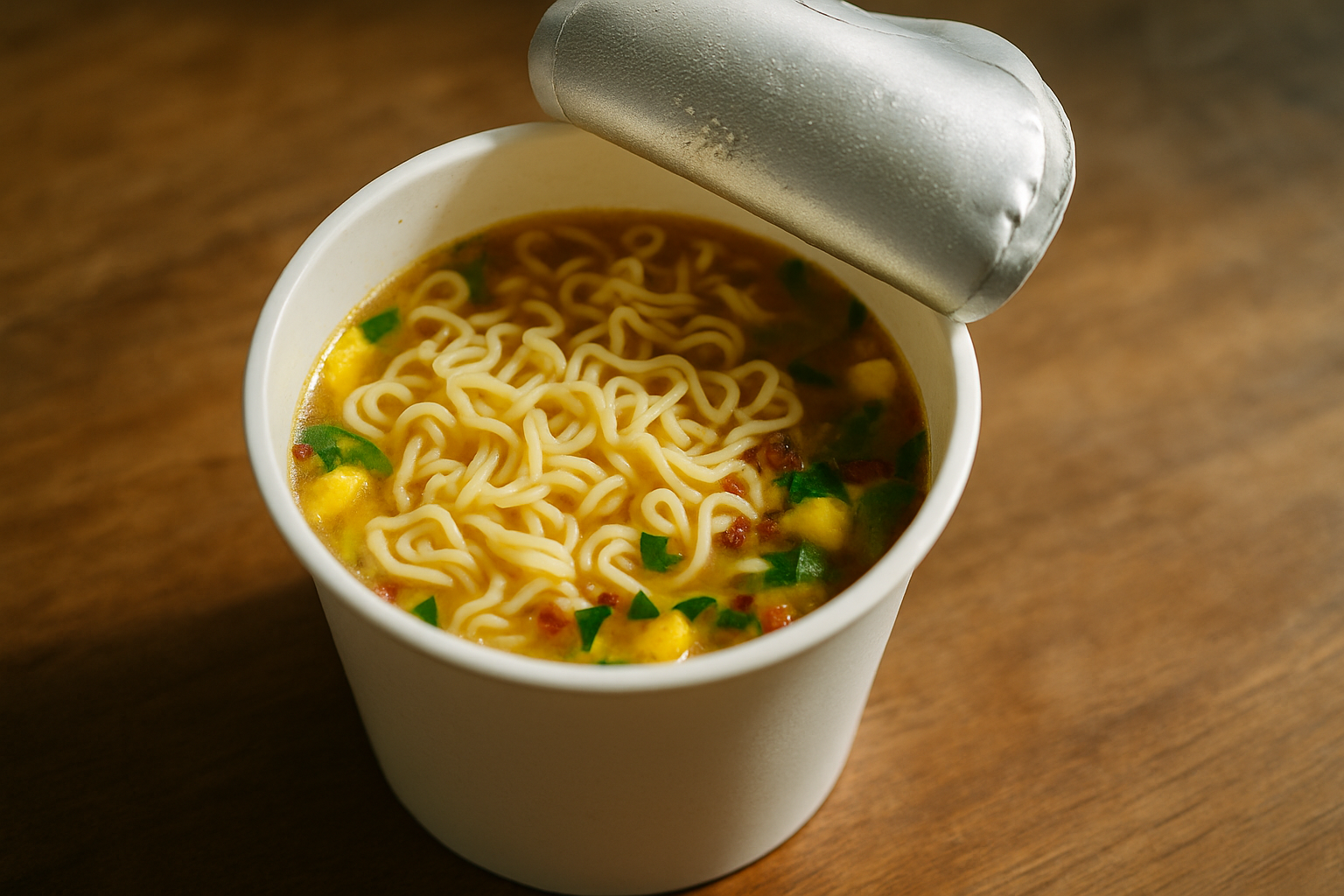
If you’ve never done this, here’s how it works. You grab a cup of instant ramyeon — Shin Ramyun, Jin Ramen, Ottogi’s Jin Jjajang if you’re feeling ambitious — from the shelf, usually somewhere between 1,500 and 3,000 won. You peel back the lid partway. Near the register, or sometimes tucked into a corner by the window seats, there’s a hot water dispenser that runs at a full rolling boil all day and night. You fill the cup to the little line, press the lid back down, and set a timer. No fee, no asking permission, no cashier hovering. It’s an honor-system ritual that every single Korean person over the age of six seems to know by heart, and it took me embarrassingly long to learn the etiquette of not walking away from the machine while it fills.
Three minutes later — my son insists on counting down out loud, badly, starting from whatever number he feels like — you’ve got dinner, or a midnight snack, or breakfast if you’re the kind of person who’s still out at that hour. My daughter has strong opinions about which broth is “too spicy for babies” (her brother) and which one is acceptable, and watching her negotiate this with the seriousness of a UN delegate is honestly one of my favorite parts of the week.
Triangle Kimbap: The Real MVP
If cup ramyeon is the ritual, samgak gimbap — triangle kimbap — is the reason we actually leave the apartment. It’s a triangle of rice wrapped around a filling, sealed in a sheet of dried seaweed, and packaged in this ingenious plastic wrapper with numbered tabs that you pull in order so the seaweed stays crisp instead of going soggy against the rice. Tuna mayo is the classic, the one CU and GS25 both do well, though CU’s tends to lean a little richer and spicier in its lineup. My daughter is a spicy-bulgogi loyalist. My son mostly eats the rice and hands me the rest, which, fine, I’ll take it.
It costs about 1,200 to 1,800 won — genuinely less than a dollar and a half — and it’s become the thing my kids request the way American kids might ask for a bag of goldfish crackers. There’s something almost absurd about how good and how cheap it is, this perfectly engineered little rice triangle sitting under fluorescent lights next to the energy drinks.
What’s Actually Different From Back Home
The food is fun, but honestly, the thing that still gets me is the safety of it. Not just the absence of danger — the total absence of the feeling of danger. Back home, a late-night convenience store run with two young kids would have meant driving, parking under a light, and being at least a little alert walking from the car to the door. Here I don’t think about any of that. We walk. There are grandmothers out with their dogs at midnight. There are teenagers walking home from hagwon — private academy — at 10 or 11 p.m. by themselves, backpacks bouncing, completely unremarkable. CCTV cameras are everywhere, the streets are well lit, and the culture around kids being out and independent is just fundamentally different from what I grew up with.
I’m not naive enough to say nothing bad ever happens here — no place is that. But the baseline sense of “is this normal” has completely recalibrated for me. A dad and two small kids in pajamas at a convenience store at midnight doesn’t get a second look from anyone. It’s not brave. It’s not even notable. It’s just what a Tuesday looks like for a lot of families here, and honestly, that ordinariness is the thing I didn’t expect to move me as much as it has.
The Things I Never Knew I Needed
Beyond the ramyeon and the kimbap, the convenience store has become our late-night pharmacy, our emergency milk run, our “we’re out of eggs” fix, and our reward system all rolled into one. Banana milk in the yellow bottle. Hodu-gwaja walnut cakes when the machine version is stocked. Melona bars in summer. A rotisserie hot dog from the warmer by the register when my son is in a mood and needs bribing. GS25 tends to win points in our house for its collaboration snacks — they’re constantly doing tie-ins with shows and characters my kids somehow already know about — while 7-Eleven Korea has its own rotating lineup that barely resembles the American chain sharing its name. Emart24 is the one nearest my in-laws, so it comes with its own set of family associations now.
What strikes me most, writing this as Yijidaddy and thinking back over almost a decade of these midnight runs, is how much a convenience store can end up meaning to a family without ever being planned as a “thing.” It just became one, the way small rituals do — one late-night craving at a time, one plastic table at a time.
Frequently Asked Questions
Is it really safe to bring kids out at midnight in Korea?
Yes, and this is one of the most consistent things visitors notice. Korea has a low violent crime rate, extensive CCTV coverage in public areas, well-lit streets even in residential neighborhoods, and a strong cultural norm of children and teens moving around independently, including at night. It’s genuinely common to see kids walking home from evening academy classes alone. That said, use the same basic common sense you would anywhere — stick to lit main streets, and use your judgment as a parent about your own child’s age and comfort level.
What should I try at a Korean convenience store?
Start with a triangle kimbap (samgak gimbap) — tuna mayo is the reliable classic — and a cup of Shin Ramyun or Jin Ramen from the free hot water dispenser. Add a banana milk, and if you’re there in summer, a Melona bar. CU is known for its hot snack bar and bold triangle kimbap flavors, GS25 for creative collaboration snacks, and Emart24 and 7-Eleven Korea each have their own private-label lineups worth digging through.
Do you have to pay to use the hot water machine for cup noodles?
No. As long as you’ve bought the cup ramyeon at that store, using the hot water dispenser is free and expected — it’s built into the shopping experience, not an extra service. Just don’t walk away and leave the machine running, and rinse or dispose of your cup at the provided station when you’re done, since the outdoor tables are shared space.
연말정산 환급액이 통장에 148만 5천원 찍히는 걸 본 적 있는가. 우연이 아니다. 연금저축펀드와 IRP를 합쳐 900만원을 채운 사람에게 정확히 계산되어 나오는 숫자다. 반대로 한 푼도 넣지 않은 사람은 그 돈을 그냥 국가에 낸 세금으로 흘려보낸다. 2026년 현재 기준으로 이 제도가 어떻게 굴러가는지, 얼마를 넣으면 얼마가 돌아오는지 숫자로 짚어본다.
연금저축펀드란 무엇인가
연금저축펀드는 은행 예적금이 아니라 증권사 계좌를 통해 펀드나 ETF에 투자하면서 노후자금을 쌓는 절세 계좌다. 매년 납입한 금액 중 일부를 세액공제로 돌려받고, 55세 이후 연금으로 수령할 때는 낮은 세율의 연금소득세만 부담한다. 일반 계좌에서 발생하는 배당소득세 15.4%가 연금저축 계좌 안에서는 인출 전까지 과세가 이연된다는 점이 핵심이다. 자유롭게 편입 상품을 바꿀 수 있고 중도에 납입을 쉬어도 불이익이 없다는 점에서 연금저축보험과는 성격이 다르다.
2026년 세액공제 한도, 정확한 숫자
한도는 두 단계로 나뉜다. 연금저축펀드 단독으로 넣을 수 있는 세액공제 대상 한도는 연 600만원이다. 여기에 개인형퇴직연금, 즉 IRP 계좌를 함께 활용하면 두 계좌를 합산해 연 900만원까지 세액공제 대상으로 인정받는다. IRP 없이 연금저축펀드만으로는 900만원을 다 채워도 600만원까지만 공제 대상이 된다는 점을 헷갈리면 안 된다. 실제로 가장 흔히 쓰이는 조합은 연금저축펀드에 600만원, IRP에 300만원을 나눠 넣는 방식이다.
소득 구간별 공제율 차이
총급여 5,500만원 이하(근로소득자) 또는 종합소득금액 4,500만원 이하: 공제율 16.5%(지방소득세 포함)
총급여 5,500만원 초과 또는 종합소득금액 4,500만원 초과: 공제율 13.2%(지방소득세 포함)
소득이 낮을수록 공제율이 높다는 게 이 제도의 설계 방향이다. 급여가 오르면 오히려 환급률은 3.3%포인트 낮아진다.
실제 계산 예시로 확인하기
연봉 4,800만원 직장인이 연금저축펀드에 600만원, IRP에 300만원을 넣어 900만원을 채웠다고 가정하자. 총급여가 5,500만원 이하이므로 공제율은 16.5%가 적용된다. 900만원 × 16.5% = 148만 5천원. 이 금액이 연말정산에서 환급 또는 결정세액 차감 형태로 돌아온다.
연봉 7,000만원인 사람이 같은 900만원을 넣었다면 공제율은 13.2%로 낮아져 900만원 × 13.2% = 118만 8천원이 된다. 같은 돈을 넣고도 소득 구간에 따라 약 30만원 가까이 차이가 벌어진다는 뜻이다. 다만 아무리 많이 넣어도 그해 실제로 낸 결정세액을 초과해 환급받을 수는 없다. 결정세액이 100만원인 사람이 900만원을 넣어도 148만 5천원 전액이 아니라 100만원 한도 안에서만 공제가 적용된다.
ISA 만기자금 전환, 추가 300만원 공제
ISA 계좌를 만기 해지한 뒤 60일 이내에 연금저축이나 IRP로 옮기면 그해 900만원 한도와 별개로 추가 공제가 열린다. 이체한 금액의 10%, 최대 300만원까지 추가로 세액공제 대상이 된다. 900만원에 이 300만원을 더하면 한 해에 최대 1,200만원까지 세액공제 대상 금액을 인정받는 셈이다. 총급여 5,500만원 이하 기준으로 계산하면 300만원 × 16.5% = 49만 5천원이 추가로 돌아온다. ISA 만기자금은 기존 연금계좌 납입한도와 무관하게 별도로 입금할 수 있다는 점도 알아둘 필요가 있다.
중도인출과 연금 수령 시 세금은 다르다
세액공제를 받은 돈을 5년 이내에 중도 인출하면 기타소득세 16.5%가 부과된다. 낸 세금을 돌려받고도 나중에 더 무거운 세율로 토해내는 구조다. 부득이한 사유(천재지변, 개인회생, 파산, 요양, 사망 등)로 인정되는 경우에는 연금소득세율이 적용되어 부담이 줄어든다.
55세 이후 정상적으로 연금으로 수령하면 연금소득세율은 나이에 따라 달라진다. 55세부터 69세까지는 5.5%, 70세부터 79세까지는 4.4%, 80세 이상은 3.3%가 적용된다. 늦게 받을수록 세율이 낮아지는 구조이므로 수령 시기를 늦추는 것도 하나의 선택지가 된다. 연금 수령액이 연간 1,500만원을 넘으면 다른 소득과 합산해 종합과세되거나 16.5% 분리과세를 선택할 수 있는 갈림길도 생긴다.
납입 시 지켜야 할 조건
가입 후 5년 이상 유지해야 정상적인 연금 수령 요건을 갖춘다
연금 수령은 만 55세 이후부터 가능하다
연간 납입한도는 연금저축과 IRP를 합쳐 1,800만원이지만, 세액공제 대상은 그중 900만원(ISA 전환분 제외)까지다
1,800만원 중 세액공제를 받지 않은 초과 납입분은 나중에 인출해도 세금이 붙지 않는다
연금저축펀드와 IRP, 어떻게 배분하면 좋을까
세액공제 한도만 보면 둘 다 900만원까지 채우는 게 유리하지만 계좌 성격은 조금 다르다. 연금저축펀드는 위험자산 투자 비중에 제한이 거의 없어 운용이 자유롭다. IRP는 안전자산을 최소 30% 이상 담아야 하는 규정이 있어 상대적으로 보수적으로 운용된다. 이런 차이 때문에 연금저축펀드에 600만원을 먼저 채우고 나머지 300만원을 IRP로 채우는 방식이 자산배분과 세제혜택을 동시에 잡는 선택으로 자주 언급된다. 반대로 퇴직금을 IRP로 받아 이미 큰 금액이 쌓여 있는 경우라면 추가 납입은 연금저축펀드 쪽에 집중하는 편이 운용 폭을 넓히는 방법이 되기도 한다.
자주 묻는 질문
Q. 올해 연봉이 올라서 총급여가 5,500만원을 넘게 됐습니다. 작년까지 16.5% 공제율을 받았는데 올해는 어떻게 되나요?
그해 소득 기준으로 공제율이 정해지므로 연봉이 5,500만원을 초과한 그해부터는 13.2%가 적용된다. 예를 들어 연봉이 5,300만원에서 5,900만원으로 오른 직장인이 900만원을 납입했다면, 전년도에는 148만 5천원을 환급받았지만 올해는 118만 8천원으로 줄어든다. 소득이 오른 만큼 세금 부담도 늘어나는 구조라 매년 원천징수영수증을 확인하며 납입 계획을 조정하는 편이 낫다.
Q. 프리랜서인데 근로소득이 아니라 사업소득만 있습니다. 세액공제를 받을 수 있나요?
받을 수 있다. 근로소득자만 대상인 제도가 아니라 종합소득이 있는 사람이라면 프리랜서, 자영업자도 동일하게 적용된다. 다만 기준이 되는 소득이 총급여가 아니라 종합소득금액이라는 점이 다르다. 종합소득금액 4,500만원 이하면 16.5%, 초과하면 13.2%가 적용된다. 종합소득금액은 매출이 아니라 필요경비를 제외한 순소득 기준이므로 매출이 커도 경비율에 따라 공제율 구간이 달라질 수 있다.
Q. 900만원을 다 채웠는데 결정세액이 50만원밖에 안 나왔습니다. 나머지 세액공제는 어떻게 되나요?
안타깝지만 소멸된다. 세액공제는 환급이 아니라 낼 세금에서 빼주는 구조라 결정세액 50만원을 초과하는 공제분은 이월되지 않고 그대로 없어진다. 900만원을 채워 이론상 148만 5천원의 공제 자격이 생겨도 실제 환급은 결정세액 한도인 50만원까지만 이뤄진다. 연봉이 낮거나 다른 공제 항목(부양가족, 의료비, 보험료 등)이 많아 결정세액 자체가 적은 사람이라면 900만원을 무리하게 다 채우기보다 본인의 예상 결정세액을 먼저 계산해보는 편이 실속 있다.
장마가 끝났다고 창문을 활짝 열었는데, 안방 벽지 모서리에 거뭇거뭇한 점들이 번져 있는 걸 발견한 적 있는가. 며칠 신지 않은 운동화를 꺼내려 신발장을 열었더니 퀴퀴한 냄새가 훅 올라오고, 여름 이불을 정리하려 옷장 문을 열었다가 눅눅한 곰팡이 냄새에 인상을 찌푸린 경험도 낯설지 않을 것이다. 장마철에는 눈에 잘 띄지 않던 곰팡이가 비가 그치고 기온이 오르면서 오히려 폭발적으로 번식한다. 습도와 온도가 동시에 높아지는 8월 초가 사실은 곰팡이에게 최적의 계절이기 때문이다. 오늘은 곰팡이가 왜 생기는지부터 벽지, 욕실, 신발장, 옷장 등 부위별로 어떻게 제거하고 다시 생기지 않게 관리할지 하나씩 정리해본다.
장마 끝나고 곰팡이가 폭발하는 이유
곰팡이 포자는 공기 중 어디에나 떠다닌다. 문제는 포자가 아니라 포자가 자리 잡고 번식하는 조건이다. 곰팡이는 습도 70% 이상, 온도 20~30도, 그리고 먼지나 유기물 같은 영양분이 있으면 24~48시간 안에도 눈에 보이는 군집을 만들 수 있다. 장마 기간에는 벽과 바닥이 계속 물기를 머금고 있다가, 비가 그치고 기온이 올라가면 그 물기가 서서히 증발하면서 실내 습도를 오히려 더 끌어올린다. 환기를 제대로 안 시킨 상태로 에어컨만 튼 방, 햇빛이 잘 안 드는 북향 벽, 가구를 벽에 바짝 붙여놓은 자리, 신발이나 옷을 눅눅한 채로 넣어둔 수납장. 이런 곳들이 장마 후 곰팡이가 집중적으로 올라오는 자리다.
부위별 곰팡이 제거법
벽지 곰팡이 제거하기
벽지 표면에만 얇게 낀 곰팡이라면 소독용 에탄올(농도 70~75%)을 분무기에 담아 곰팡이 부위에 골고루 뿌린다. 10~15분 정도 그대로 두었다가 마른 헝겊이나 키친타월로 눌러 닦아내면 얼룩이 상당 부분 지워진다. 물을 많이 묻히면 벽지 안쪽 석고보드까지 스며들어 곰팡이가 더 깊이 자리 잡을 수 있으니 물기를 최소로 쓰는 게 핵심이다. 베이킹소다를 쓸 경우엔 물에 살짝 개어 페이스트 형태로 만든 뒤 곰팡이 자국에 얇게 발라 10분 정도 두고 부드러운 솔로 문질러 닦는다. 다만 얼룩이 벽지 안쪽까지 스며들어 검게 착색되고 문질러도 지워지지 않는다면, 표면만 계속 닦아봤자 곧 다시 올라온다. 이 경우는 도배지를 뜯어내고 곰팡이 제거제로 벽면을 소독한 뒤 방수 프라이머를 바르고 재도배하는 편이 근본적인 해결책이다.
욕실 곰팡이 제거하기
욕실은 타일 줄눈과 실리콘 코킹 부위에 곰팡이가 가장 잘 낀다. 락스 원액을 물에 1:10~1:20 비율로 희석해 곰팡이 부위에 바르고 20~30분 방치한 뒤 솔로 문질러 씻어내면 대부분 제거된다. 락스가 부담스럽다면 베이킹소다 3큰술, 백식초 1큰술, 물 200ml를 섞은 스프레이를 뿌리고 15분 기다린 뒤 칫솔로 문질러 물로 헹궈내는 방법도 효과가 좋다. 베이킹소다의 알칼리 성분이 곰팡이 세포벽을 무너뜨리고, 식초의 산성 성분이 남은 균의 증식을 억제하는 원리다. 실리콘 코킹 안쪽까지 검게 착색된 경우는 표면 세척으로는 한계가 있으니, 오래된 코킹을 칼로 걷어내고 새로 실리콘 시공을 하는 게 낫다. 곰팡이 제거제를 뿌린 뒤에는 반드시 욕실 문을 열고 환풍기를 30분 이상 돌려 냄새와 습기를 함께 빼줘야 한다.
신발장 곰팡이·냄새 잡기
신발장은 밀폐된 좁은 공간에 습기와 발 냄새가 함께 쌓이는 곳이라 곰팡이가 유독 잘 생긴다. 먼저 신발장 안 신발을 전부 꺼내 햇볕이나 그늘에서 말린다. 신발장 내부는 소독용 에탄올을 적신 천으로 선반과 구석구석을 닦아내고, 문을 열어둔 채 30분 이상 환기시킨다. 신발을 다시 넣기 전에는 신문지를 바닥에 깔아두면 습기를 흡수해준다. 실리카겔이나 활성탄 제습제를 신발장 구석에 2~3개 배치하고, 다시백에 베이킹소다를 채워 함께 넣어두면 냄새와 습기를 동시에 잡는 데 도움이 된다. 신발을 신고 들어올 때 흙이나 물기가 묻은 채로 바로 신발장에 넣는 습관도 곰팡이를 부르는 지름길이니, 현관에서 한 번 완전히 말린 뒤 넣는 편이 좋다.
옷장·이불장 관리법
옷장 안 곰팡이는 옷 자체보다 벽면과 선반 뒤쪽, 옷걸이 사이 통풍이 안 되는 틈에서 시작되는 경우가 많다. 옷을 너무 빽빽하게 걸어두면 공기가 순환하지 않아 습기가 그대로 갇힌다. 옷 사이 간격을 손가락 한두 마디 정도는 벌려주고, 옷장 문을 하루 한 번 10~20분씩 열어 공기를 순환시키는 것만으로도 곰팡이 발생률이 눈에 띄게 줄어든다. 이불이나 옷 사이에 신문지를 끼워두면 신문지가 습기를 흡수하는데, 눅눅해지면 바로 새것으로 교체해야 효과가 유지된다. 옷장 안에 곰팡이가 이미 핀 옷은 소독용 에탄올을 뿌려 말린 뒤 세탁하고, 나무 소재 옷장이나 서랍은 베이킹소다 물을 적신 천으로 닦고 완전히 건조시킨 다음 다시 옷을 넣어야 재발을 막을 수 있다.
곰팡이 제거할 때 꼭 지켜야 할 안전 수칙
락스와 다른 세제, 그중에서도 암모니아 성분이 든 유리 세정제나 변기용 세제를 함께 섞으면 유독가스가 발생해 호흡기에 심각한 문제를 일으킬 수 있다. 락스는 절대 단독으로만 사용하고, 사용 중에는 창문을 열어 환기시키며 고무장갑과 마스크를 착용하는 게 안전하다. 곰팡이 포자는 공기 중으로 쉽게 퍼지기 때문에 넓은 면적을 닦을 때는 마른 상태로 털어내지 말고 젖은 천으로 눌러 닦아야 포자가 날리는 걸 줄일 수 있다. 어린아이나 호흡기가 약한 가족이 있는 집이라면 곰팡이 제거 작업 시간 동안만이라도 다른 방에서 지내게 하는 게 좋다.
다시 곰팡이가 생기지 않게 관리하는 법
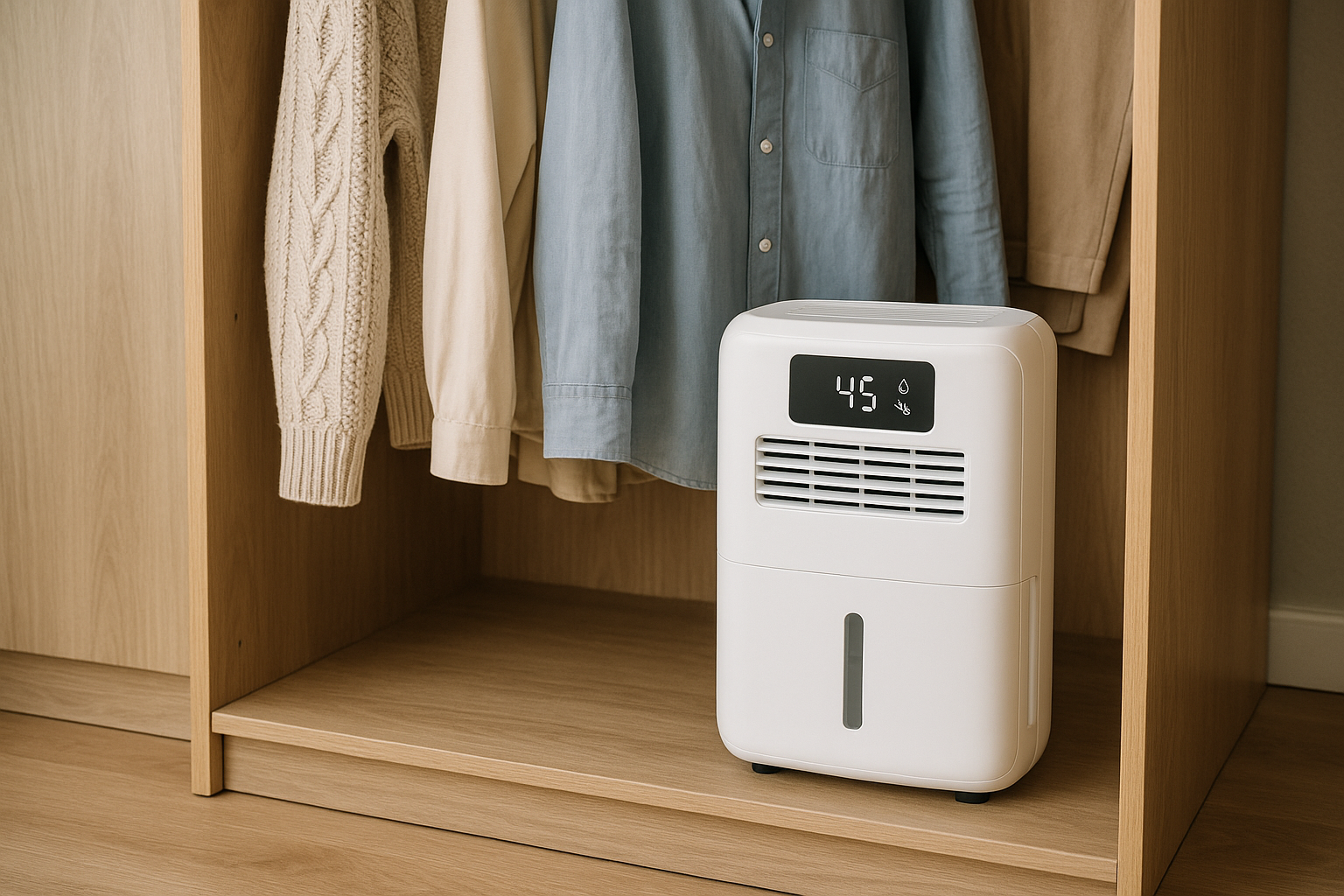
곰팡이를 없애는 것보다 중요한 건 다시 생기지 않게 만드는 환경이다. 실내 습도를 60% 이하로 유지하는 게 기준선이다. 습도계 하나를 거실이나 안방에 걸어두면 지금 우리 집 습도가 몇 퍼센트인지 눈으로 확인할 수 있어 관리가 훨씬 수월해진다. 창문을 마주 보게 두 개 이상 열어 맞바람이 통하게 하는 방식으로 하루 2회, 각 30분 이상 환기하는 습관을 들이자. 비 오는 날에는 문을 닫고 제습기나 에어컨의 제습 기능을 활용하는 편이 오히려 낫다. 에어컨을 오래 켠 뒤에는 반드시 송풍 모드로 1~2시간 돌려 내부를 말려줘야 하는데, 이걸 건너뛰면 에어컨 내부 자체가 곰팡이 배양소가 되어 바람을 틀 때마다 포자를 방 안에 뿌리게 된다. 가구는 벽에서 5cm 이상 띄워 배치해 뒷면 통풍을 확보하고, 붙박이장이나 벽장 안쪽에는 제습제를 상시 비치해두는 게 좋다. 곰팡이가 자주 생기던 자리라면 곰팡이 방지 기능이 있는 도료로 재도장하는 것도 장기적으로 도움이 된다.
자주 묻는 질문
Q1. 곰팡이를 닦았는데 며칠 뒤 같은 자리에 또 생겨요. 왜 그런가요?
표면만 닦고 뿌리는 그대로 둔 경우일 가능성이 크다. 예를 들어 벽지 표면 얼룩은 지웠지만 벽지 안쪽이나 석고보드까지 곰팡이 균사가 파고든 상태라면, 겉모습만 깨끗해 보일 뿐 며칠 안에 다시 얼룩이 올라온다. 이럴 땐 소독보다 원인이 되는 습기 유입 경로부터 찾아야 한다. 창틀 결로가 심한지, 외벽 쪽 방인지, 곰팡이 자리 뒤에 옷장이나 침대 헤드보드가 붙어 있어 통풍이 막혀 있는지 확인해보자.
Q2. 락스와 베이킹소다·식초 중 어느 쪽이 더 효과적인가요?
제거력만 놓고 보면 락스가 살균력이 더 강하고 빠르다. 다만 락스는 색이 있는 벽지나 옷감에 닿으면 탈색되고 냄새가 독해 좁은 욕실에서 쓸 때는 반드시 환기가 필요하다. 베이킹소다와 식초 조합은 상대적으로 순하고 아이 방이나 옷장처럼 자극적인 냄새를 피해야 하는 공간에 적합하지만, 곰팡이가 이미 깊게 착색된 경우엔 효과가 제한적이다. 욕실 타일 틈처럼 물에 자주 노출되고 색상 걱정이 없는 곳은 락스, 벽지나 옷장처럼 예민한 공간은 베이킹소다·식초 쪽을 먼저 시도해보는 식으로 나눠 쓰는 걸 권한다.
Q3. 신발장에 제습제를 넣어도 금방 눅눅해져요. 다른 방법이 있을까요?
제습제만으로는 한계가 있는 상황일 수 있다. 신발장이 현관 외벽에 붙어 있고 그 벽 자체가 결로로 축축하다면, 신발장 안쪽 습기는 계속 벽에서 공급되는 셈이라 제습제를 아무리 넣어도 금방 포화 상태가 된다. 이럴 땐 신발장 뒤판과 벽 사이에 얇은 단열재나 결로 방지 시트를 붙이는 방법을 함께 써야 근본적으로 나아진다. 신발장 문을 하루 한 번씩 열어 환기시키는 습관도 제습제 효과를 오래 유지하는 데 큰 도움이 된다.
칠레 본토에서 3,700킬로미터 떨어진 태평양 한복판, 라노 라라쿠 화산 비탈에는 아직도 땅에서 몸을 다 빼내지 못한 석상 하나가 누워 있다. 높이 21미터, 무게 270톤. 이름은 ‘엘 히간테’. 완성됐다면 이스터섬에서 가장 큰 모아이가 됐을 이 거인은 미완성인 채로 남았다. 섬 전체에 기록된 모아이는 887개. 그중 397개가 바로 이 채석장 안에 몰려 있다. 나머지 절반 가까이는 섬 곳곳으로 옮겨졌고, 실제로 제단(아후) 위에 세워져 완공된 것은 50여 개에 불과하다. 평균 무게 12톤짜리 돌덩어리를 길도 제대로 없던 시절에 사람 힘만으로 수 킬로미터씩 끌고 간 사람들은 대체 누구였을까.
모아이란 무엇인가
모아이는 라파누이 사람들이 13세기부터 16세기 사이, 대략 1250년에서 1500년 사이에 집중적으로 조각한 인물상이다. 화산재가 굳어 만들어진 응회암을 깎아 만들었는데, 대부분 몸통 없이 상반신만 표현되어 있고 눈두덩은 깊고 코는 길쭉하다. 평균 키는 4미터, 무게는 12톤 정도지만 개체 차이가 크다. 조상신이나 부족장의 영혼을 담은 존재로 여겨졌고, 마을을 등지고 바다를 바라보는 게 아니라 반대로 마을 쪽을 바라보게 세워졌다. 조상이 후손을 지켜본다는 뜻으로 해석된다.
태평양 한가운데, 라파누이 문명
이스터섬은 행정구역상 칠레령이다. 남아메리카 대륙과도, 가장 가까운 유인도인 핏케언섬과도 수천 킬로미터씩 떨어진 이 삼각형 모양의 화산섬에 사람이 처음 정착한 시기는 학자마다 견해가 갈린다. 폴리네시아에서 카누를 타고 건너온 이들이 대략 1200년 전후 정착했다는 설이 유력하다. 인구가 최대 수천 명에서 1만 명 가까이까지 늘어났다는 추정도 있는데, 이 작은 섬에서 이 정도 인구가 대형 석상을 수백 개나 만들고 옮겼다는 사실 자체가 이미 놀랍다. 나무가 울창했던 섬이 왜 훗날 벌거숭이가 됐는지를 두고는 삼림 남벌과 인구 붕괴를 연결짓는 이론도 유명하지만, 최근 고고학계에서는 이 서사에 의문을 제기하는 연구도 적지 않다.
오랜 미스터리, 어떻게 옮겼을까
문제는 단순하다. 바퀴도 없고, 섬에는 대형 동물도 없었다. 채석장인 라노 라라쿠에서 완성된 모아이를 조각한 뒤, 섬 곳곳의 해안 제단까지 최대 18킬로미터를 이동시켜야 했다. 12톤짜리 돌덩어리를, 그것도 무너뜨리지 않고. 유럽인이 처음 섬에 도착한 1722년 부활절 당일 네덜란드 탐험가 야코프 로헤베인이 이 섬을 발견해 ‘이스터섬’이라는 이름을 붙였을 때, 이미 상당수 모아이가 쓰러져 있었다는 기록도 있다. 어떻게 세웠고 어떻게 옮겼는지를 물어볼 대상조차 이미 희미해진 상태였다는 뜻이다.
학계의 여러 가설
통나무 굴림설
가장 오래되고 널리 알려진 가설이다. 통나무를 바닥에 깔고 그 위로 석상을 눕혀 굴리거나, 썰매처럼 만든 구조물 밑에 통나무를 받쳐 끌었다는 주장이다. 노르웨이 탐험가 토르 헤위에르달이 1950년대 실험에서 실제로 이 방식으로 소형 모아이를 이동시키는 데 성공하면서 오랫동안 정설처럼 받아들여졌다. 다만 이 방식대로라면 섬에 있던 야자나무 숲을 대량으로 소비했어야 하고, 실제로 옮긴 거리와 필요한 인력 규모를 계산하면 부담스러운 수치가 나온다는 반론이 계속 나왔다.
카누 사다리설
평행한 나무 레일 두 개를 놓고 그 위에 석상을 얹어 끌었다는 가설도 있다. 카누를 옮기던 방식을 응용했다는 논리인데, 마찰을 줄이는 데는 효과적이지만 역시 상당한 목재와 인력이 필요하다는 점에서 통나무 굴림설과 비슷한 한계를 안고 있다.
세워서 걸어갔다는 가설
주민들 사이에 구전되던 이야기는 사뭇 다르다. “모아이가 스스로 걸어서 제자리를 찾아갔다”는 전설이다. 오랫동안 신화 취급을 받았지만, 21세기 들어 이 이야기를 문자 그대로 실험해 본 학자들이 나타났다.
실제 실험으로 증명된 방법
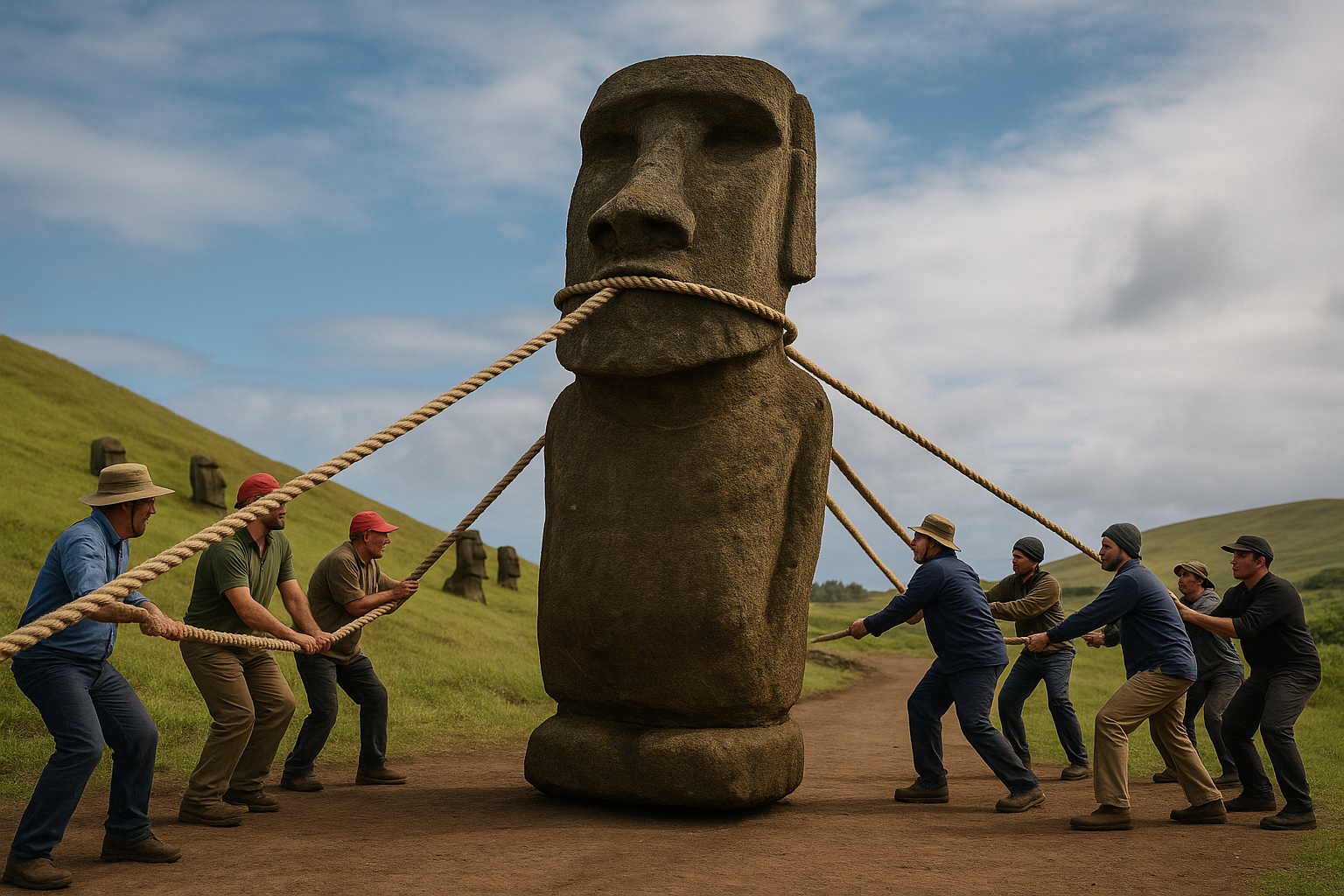
고고학자 칼 리포와 테리 헌트는 섬에 남아 있는 이동 경로의 흔적을 오래 조사했다. 이들이 주목한 건 길의 단면이었다. 썰매를 끌기에 알맞은 평평한 길이 아니라, U자형으로 파인 좁은 길이 발견된 것이다. 평평한 길이라면 썰매나 통나무를 굴리기에 적합하지만, U자형 길은 오히려 무언가를 좌우로 흔들며 앞으로 나아가게 하기에 알맞은 구조였다. 두 사람은 실제 도로에서 발견된 모아이들의 밑면이 D자 모양이고, 앞으로 6도에서 15도가량 기울어져 있다는 점도 확인했다. 세워둔 채로 좌우로 흔들었을 때 넘어지지 않고 안정적으로 움직이도록 설계된 형태라는 해석이 가능했다.
2012년, 두 사람은 실물과 거의 같은 비율로 콘크리트 복제품을 만들었다. 무게 4.35톤짜리 이 모아이 모형에 밧줄 세 가닥을 걸었다. 앞쪽 좌우에서 밧줄을 당겨 좌우로 살짝살짝 흔들고, 뒤쪽에서 균형을 잡는 방식이었다. 18명이 참여한 이 실험에서 석상은 뒤뚱뒤뚱 걷는 것처럼 앞으로 나아갔다. 100미터를 이동하는 데 걸린 시간은 40분. 최근 후속 연구에서는 인원을 15명 수준까지 줄여도 이른바 ‘진자 운동’ 원리로 충분히 걸어갈 수 있다는 결과도 나왔다. 신화 속 표현이 사실은 목격담에 가까웠을 가능성이 여기서 열린 셈이다.
아직 풀리지 않은 의문
모든 모아이가 이 방식으로 옮겨졌다고 단정하긴 이르다. 라노 라라쿠 채석장 안에 반쯤 묻힌 채 남은 397개는 애초에 왜 완성 상태로 옮겨지지 못했는지 뚜렷한 설명이 없다. 험한 지형이나 좁은 길에서는 걷는 방식이 통하지 않았을 수 있다는 지적도 있고, 인구가 줄면서 대형 프로젝트를 유지할 노동력 자체가 사라졌을 것이라는 추정도 있다. 붉은 화산암으로 만든 ‘푸카오’라 불리는 모자 형태 장식을 어떻게 머리 위까지 올려 얹었는지도 완전히 규명되지 않았다. 경사로를 이용했으리라는 가설이 유력하지만, 어느 시점에 어떤 도구로 작업했는지는 여전히 추정의 영역이다.
자주 묻는 질문
모아이는 정말 모두 걸어서 옮겨졌나요?
2012년 실험과 이후 연구는 D자형 밑면과 앞으로 기운 자세를 가진 ‘도로용 모아이’가 좌우로 흔들며 이동하기에 적합했다는 점을 보여줬을 뿐이다. 아후 위에 세워진 완성형 모아이는 이런 형태와 다르기 때문에, 마지막 세우기 단계까지 같은 방식이 쓰였는지는 별개의 문제로 남아 있다.
이스터섬 문명이 삼림을 파괴해 스스로 무너졌다는 이야기는 사실인가요?
재레드 다이아몬드가 저서 ‘문명의 붕괴’에서 널리 알린 서사지만, 리포와 헌트를 포함한 일부 연구자들은 섬의 삼림 감소 원인으로 폴리네시아쥐의 유입, 기후 변화, 유럽인 접촉 이후의 질병과 노예 무역 등 복합 요인을 함께 제시한다. 단일 원인으로 단정하기보다는 여러 가설이 경합하는 주제로 보는 편이 정확하다.
모아이의 눈은 원래 저런 빈 눈구멍이었나요?
완공 당시에는 흰 산호와 붉은 화산암 조각으로 눈동자를 넣었다는 흔적이 남아 있다. 지금 관광객들이 보는 텅 빈 눈두덩은 세월이 지나며 눈 장식이 대부분 소실된 결과이고, 일부 복원된 모아이에서는 흰자와 검은 눈동자가 들어간 원래 모습을 확인할 수 있다.