I was standing outside a soybean paste shop in Bukjeong Village a couple of autumns ago, watching an ajumma haul a plastic basin of red peppers up a hill so steep my calves were already complaining, when it hit me that I hadn’t seen another tourist in twenty minutes. Not one. In a city where every guidebook photo of a hanok roof gets fifty people lined up for the same shot, that felt almost suspicious. Was I lost? I wasn’t. I was just somewhere nobody bothers to check on their itinerary, and that’s exactly the point of this list.
Seoul’s famous spots earned their fame honestly — Bukchon is gorgeous, Myeongdong is chaos in the best way, Gwangjang Market genuinely slaps. But after years of living here and dragging visiting friends around, I’ve noticed the neighborhoods locals actually return to on a regular Tuesday are rarely the ones plastered across every “Seoul in 3 days” listicle. Here are five of them, with the specific streets and stations you’d need to actually find your way there.
Seongsu-dong, But Past the Cafe Strip
Everyone already knows Seongsu. It’s been called the Brooklyn of Seoul so many times the comparison is basically fossilized at this point, and yes, the main strip near Seongsu Station (Line 2, exits 3 and 4) is dense with roastery-cafes and shoe brand flagships. You’d think a neighborhood that famous couldn’t possibly have a quiet side left. It does, though, and it’s a five-minute walk in almost any direction from the main drag.
Head toward the older blocks near Seoul Forest and you hit what locals still half-jokingly call Galbi Alley, a cluster of no-frills grilled beef spots that have been feeding factory workers since before “Seongsu” meant anything to an Instagram algorithm. The tin awnings and plastic stools haven’t been renovated for anyone’s benefit, and that’s precisely why the galbi is still cheap and still good. Wander a block further and the industrial bones of the old shoe-manufacturing district start showing through — rusted shutters next to a design studio next to somebody’s actual leather workshop, still running. There’s a small cultural space combining a bookstore-cafe with a quiet reading room that barely gets mentioned online, tucked into a converted building where the light through the tall windows makes it worth the twenty minutes it takes to find.
Somehow this part of Seongsu still gets treated as an afterthought even by people who’ve been to the main strip three times. Give it the twenty extra minutes.
Mangwon Market Over Gwangjang
If you ask a Seoulite where to get real market food without the tour-bus energy, a lot of them will say Mangwon before they say Gwangjang, and I get why — Gwangjang is wonderful but it knows it’s famous now, and the prices and crowds sometimes reflect that. Mangwon Market, reachable from Mangwon Station (Line 6, Exit 2, about a five-minute walk), still runs like a neighborhood market because that’s mostly what it is.
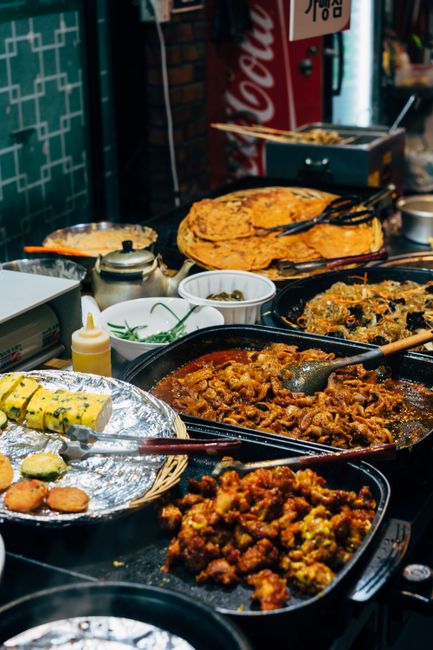
The alley stalls sell the usual market staples — fresh produce, banchan, fish — but it’s the fried food and street snacks that pull people in, from hotteok variations to a startling range of tteokbokki setups, each vendor convinced theirs is the definitive version. Most shops run from around noon to 9pm, so don’t show up at 9am expecting the full spectacle; you’ll just find shuttered stalls and confused pigeons. Just outside the market’s edges is Mangridan-gil, a strip of small cafes and bars that grew up around the market’s foot traffic rather than the other way around, which somehow makes it feel less curated than similar cafe streets elsewhere in the city.
It’s not undiscovered exactly — plenty of Koreans specifically travel across the city for it on weekends — but it’s undiscovered by the tour buses, which for my money is the version of “hidden” that actually matters.
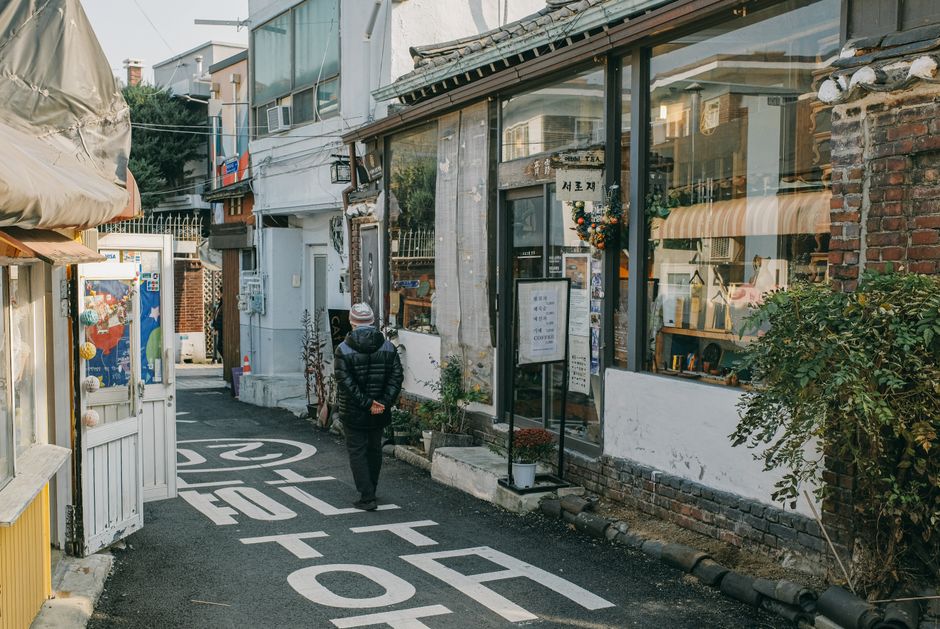
Bukjeong Village, the Last Hillside Village in Seoul
This is the one that surprises people most, maybe because it sits in Seongbuk-dong, a district tourists associate more with museums and old diplomatic residences than with anything resembling a village. Bukjeong Village clings to a hillside behind Naksan, and it’s often described as the last hillside village left within Seoul’s city limits — the kind of low, huddled housing that used to blanket hills all over the city before redevelopment flattened most of it into apartment towers.
Getting there takes a bit more effort than most spots on this list. From Hansung University Station (Line 4), Exit 6, you can catch a village bus or a couple of specific local buses up toward the “Simujang House” stop, named for the home of the poet and independence activist Han Yong-un. From there you’re walking narrow, sloped alleys between houses that lean into each other like old friends, with sections of the original Seoul city wall, Hanyangdoseong, visible along the ridge above. The view back down over the rooftops toward the city center is the kind of thing you’d expect to cost an entrance fee somewhere else in the world.
You do have to be a little careful and respectful here — actual families live in these houses, not stage sets — but the residents are generally used to a trickle of curious visitors and mostly go about their business. It’s not a place to be loud in.
Seorae Village, Seoul’s Quiet French Corner
I still think it’s a little funny that one of Seoul’s most under-the-radar neighborhoods is, of all things, French. Seorae Village sits in Banpo-dong and Bangbae-dong in Seocho-gu, near Express Bus Terminal Station (Lines 3, 7, and 9), and it’s home to a genuine cluster of French and other European expats that’s been growing since the Lycée Français de Séoul relocated to the area back in the early 1980s.
The main street is lined with bakeries, wine bars, and small European-leaning restaurants that feel more like something you’d stumble on in a secondary Parisian neighborhood than in Gangnam’s backyard. There’s a small hillside park named Montmartre Park, built in 2006 in a nod to the French community, with enough elevation to make an evening walk feel like a mini escape from the city grid below. What gets me every time is how few Seoul residents from other parts of the city have actually been here, despite it being maybe fifteen minutes by taxi from the Gangnam clubbing strip everyone already knows.
It’s small — you could walk the whole thing in under an hour — but it rewards a slow coffee more than a checklist visit.
Ikseon-dong’s Quieter North Block
Ikseon-dong itself doesn’t really count as hidden anymore; the main hanok alley near Anguk Station (Line 3, Exit 3) is dense with photogenic cafes and lines out the door on weekends, and honestly it’s become one of the more commercialized pockets in central Seoul. Still, walk one block north of the main strip and the crowd noise drops noticeably. The alleys there run quieter and narrower, favored more by locals heading to a specific izakaya or a small cocktail bar than by anyone hunting a photo spot, and the old timber-and-tile atmosphere feels closer to what made the area interesting in the first place.
Weekday mornings are your best window if you want the alley mostly to yourself — by early afternoon on a Saturday it fills in fast, main strip and side alleys both.
Yeonnam-dong, Just Past Yeontral Park’s Busy End
Gyeongui Line Forest Park runs a genuinely long 6.3 kilometers from Yeonnam-dong all the way to Munbae-dong, but almost everyone piles into the same few hundred meters near Hongik University Station (Line 2, or the AREX line), the section locals nicknamed Yeontral Park as a play on Central Park. That part gets busy, no question — buskers, picnic blankets, lines for the popular bakeries.
Walk further up the green corridor past the Yeonnam intersection, though, and the crowd density drops off fast while the park itself keeps going, small streams and benches included. The surrounding blocks of Yeonnam-dong away from the main entrance are mostly residential streets with a scattering of independent cafes and bars that never made it onto anyone’s top-ten list, which is sort of a relief if you’ve already done the crowded stretch once. You’d assume a park this famous couldn’t possibly have a quiet half, but it genuinely does — most visitors just never walk far enough to find it.
FAQ
When’s the best time to visit these spots?
Weekday mornings or early afternoons work best across the board, especially for Ikseon-dong’s back alleys and Yeonnam-dong’s park, which both fill up fast on weekend afternoons. Mangwon Market is the exception — it barely opens before noon, so aim for early afternoon into evening. Bukjeong Village is nicest in cooler months since the hill climb gets sweaty in Seoul’s summer humidity.
Do I need to speak Korean to get around these neighborhoods?
Not really, though it helps more here than in Myeongdong or Hongdae’s main strips, where English signage is everywhere. Naver Map or Kakao Map will serve you much better than Google Maps for walking directions in Korea, since Google’s map data here is famously incomplete. A translation app for market stall menus in Mangwon doesn’t hurt either.
Can I combine a few of these in one day?
Mangwon Market and Yeonnam-dong pair up nicely since they’re both roughly along Line 6 and Line 2 with a short taxi hop between them, and both lean into an afternoon-into-evening rhythm. Bukjeong Village and Seorae Village, on the other hand, sit on opposite sides of the city and each deserve their own slower half-day rather than being rushed together.
Leave a Reply