Somebody asked me once, half-joking, whether ordering a full rack of galbi for a table of one in Seoul would get me stared at. Fair question. It used to be the kind of thing that made Korean strangers glance twice, maybe pity you a little, maybe assume something had gone wrong in your life. These days, though, that same scene barely registers. Nobody looks up.
Honbap Wasn’t Always This Easy
The word is honbap — 혼밥 — a mashup of “honja” (alone) and “bap” (rice, or meal, depending on how loosely you’re translating). It sounds almost too simple to carry cultural weight, but it does. Korean food culture, for most of its modern history, has been built around the group. Dishes arrive in shared bowls. Barbecue is grilled at the center of the table for everyone to reach. Even the portion sizes assume more than one mouth is eating. Sit down solo at a restaurant built for sharing, and you’re not just eating — you’re quietly announcing that nobody came with you.
That announcement used to carry a sting. Older Koreans have described turning down invitations rather than admit they’d be dining by themselves, and some restaurant owners flat-out refused single customers because a one-top meant less revenue per table and, honestly, a slightly awkward vibe for the room. You’d hear the word “sajangnim” called out, and then that beat of hesitation — where do I put this person who came in alone. It wasn’t hostility exactly. It was just that the whole system wasn’t built for you.
So when people say honbap “used to be rude,” what they usually mean is that it used to be sad-looking, not against any rule. Nobody was going to throw you out. But there was a quiet judgment baked into it — the assumption that a person eating alone must not have anyone, which in a culture that prizes belonging to a group (family, company, school, friend circle) reads almost like a small failure.
Why the Stigma Actually Broke
It wasn’t one sudden social revolution. It was two slower forces landing at roughly the same time, and it’s worth separating them, because flattening the whole shift into “Koreans just got more individualistic” misses half the story. Single-person households have been climbing for years — Statistics Korea’s own household surveys have put the figure above 35 percent nationally in recent counts, and in Seoul specifically it’s already brushing up against 40, a number that would have sounded like a rounding error a generation ago, back when three-generation households under one roof were still the norm in most neighborhoods. That’s not a fringe demographic anymore. That’s a market big enough to build a business model around.
And markets respond to size. Once enough people were eating, drinking, even traveling and watching movies alone, businesses stopped treating solo customers as an inconvenience to tolerate and started treating them as a segment to design for. You can trace the honbap boom pretty specifically to around 2015 through 2017, the years when one-person shabu-shabu chains and “study room” style grill houses — private little booths that looked more like reading carrels than restaurant seating — started popping up around university districts and office neighborhoods. That’s also roughly when honjok — “alone tribe,” people who deliberately choose solo activities rather than settle for them — started showing up on variety shows and in marketing decks. There’s a particular Korean cultural talent for turning a coping mechanism into a lifestyle brand, and that’s basically what happened here.
But it isn’t purely generational rebellion against collectivism, either — a lot of it is plain exhaustion. Company dinners, hoesik, can run long, loud, and obligatory, with rounds of soju you didn’t necessarily want and conversations you’re too junior to steer. After a week of that, a quiet bowl of kimchi jjigae eaten alone, at your own pace, reading your phone without anyone asking why you’re on your phone, isn’t loneliness. For a lot of people it’s the first calm twenty minutes of their day — which is probably why honbap took off hardest among office workers in their twenties and thirties, the exact group most exposed to that hoesik fatigue in the first place.
From Kiosks to Solo Grills to the Convenience Store Counter
Here’s where the shift stopped being just attitude and started showing up as actual physical infrastructure — and it happened in a fairly logical order, starting with how you order.
The self-order kiosk, or “kiosk” (키오스크, borrowed straight from English), quietly removed a huge chunk of the social friction around eating alone. Before kiosks became standard, walking into a restaurant by yourself meant a verbal exchange with staff — how many, table for one, sometimes a look. Small stuff, but it added up if you were already a little self-conscious about dining solo. With a kiosk, you walk in, tap a screen, pay, sit down, and your number gets called. No conversation required. I’ve noticed this pattern in plenty of places outside Korea too — the barrier to doing something alone in public is rarely the activity itself, it’s the tiny moment of having to explain yourself to someone. Kiosks quietly deleted that moment from the honbap equation.
Once ordering stopped requiring a human conversation, the next logical step was redesigning the room itself — and Korean barbecue and hot pot restaurants, the exact category of food that used to require a minimum of two or three people just to place an order, are where that redesign shows up most literally. Rows of narrow booths, each with its own little grill or individual pot, sometimes with a divider on either side so you’re not making eye contact with strangers mid-bite. Some booths even have a small TV or tablet built in.
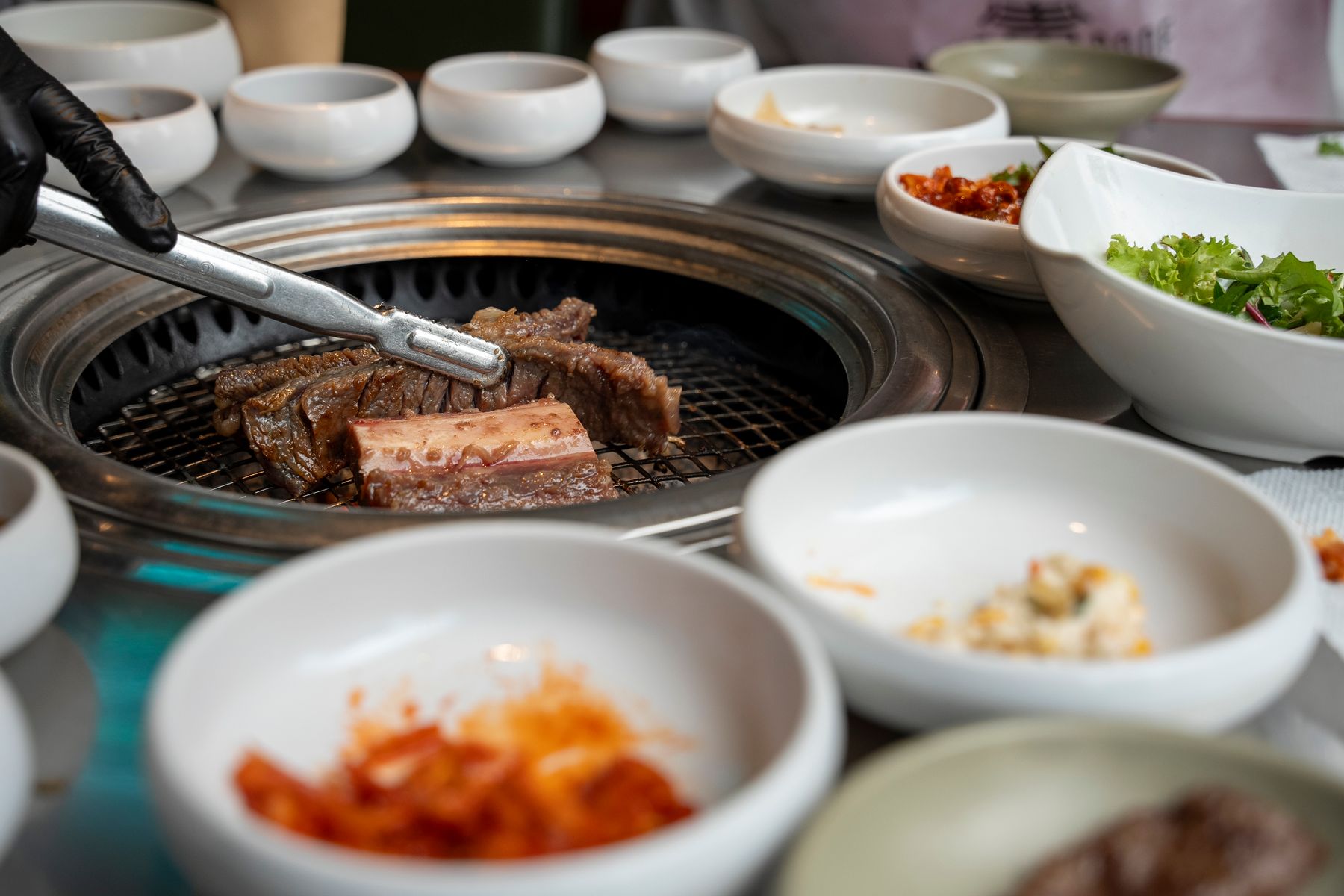
What’s a little funny is how deliberately anti-social these places are, in the best way. The partitions aren’t there because Koreans have become cold or unfriendly — if anything, the opposite. They exist because someone did the math and realized there was a huge, previously ignored customer base that wanted the food without the performance of having company. A single-portion samgyeopsal set with your own tiny grill isn’t a downgrade from the group version. For a lot of regulars, it’s actually preferable — no one’s negotiating who flips the meat, no one’s hogging the good cuts.
And if kiosks handled the ordering and solo-grill booths handled the seating, convenience stores went one step further and removed the restaurant altogether. Walk into a GS25 or CU or 7-Eleven at almost any hour and you’ll find instant noodles, triangle kimbap, and pre-packaged lunch boxes (dosirak) built specifically around eating right there, alone, at the counter seating most stores now have bolted along the front window — usually facing outward toward the street rather than toward other customers, which somehow makes the whole thing less self-conscious rather than more. There’s a hot water dispenser a few feet from the noodle shelf so you can build your own instant meal on the spot, iced-coffee machines that turn the same counter into a five-minute breakfast bar, and, in a few flagship stores, actual ramen-cooking machines that plate a hot bowl for a couple thousand won. None of it requires talking to anyone. It’s hyper-efficient, faintly ritualistic, and — once you’ve done it a few times — strangely calming rather than sad.

I think that’s the part outsiders underestimate the most: honbap culture didn’t just make eating alone socially acceptable, it built entire physical spaces — kiosk counters, grill booths, convenience store windows — where being alone in public simply isn’t remarkable anymore. You’re not the only person doing it; you’re one of several, all quietly doing the same thing, and that shared anonymity ends up feeling less isolating than a lot of forced group meals ever did.
Is There Still Any Awkwardness Left?
Some, sure — I wouldn’t pretend the stigma vanished completely. Certain restaurant categories still lean group-oriented in practice even where they’ll technically serve you: a full traditional hanjeongsik spread, or a table meant for shabu-shabu with one giant communal pot, can feel like overkill for a party of one even when nobody actually stops you. Older generations, generally speaking, are more likely to raise an eyebrow at solo dining than people in their twenties and thirties, who mostly shrug at it. But the trajectory is pretty unmistakable. What used to require an apology now barely requires a second thought, and the businesses that adapted fastest — the honbap-specific grill chains, the kiosk-equipped cafes, the convenience store counter seats — are the ones doing the best business with that exact customer today.
So no, eating alone in Korea today isn’t rude. If anything, it’s become almost fashionable, wrapped up in a broader honjok identity that treats solitude as a preference rather than a consolation prize. The stigma didn’t disappear because Koreans stopped valuing togetherness — hoesik dinners and family meals are still very much alive — it just stopped being the only acceptable way to eat.
FAQ
Will a restaurant actually turn me away if I ask for a table for one?
It’s rare in cities like Seoul or Busan now, especially at honbap-friendly chains, cafes, and anywhere with a kiosk. It’s more likely to come up at group-format places built around communal grilling or hot pot for four or more, where a two-person minimum might still apply on the menu rather than as a personal judgment about you.
Is honbap the same thing as honjok?
Not quite. Honbap specifically means eating alone. Honjok is the broader identity — the “alone tribe” — that covers solo dining along with solo drinking (honsul), solo travel, solo movie-watching, and generally choosing solitary activities on purpose rather than as a fallback.
What’s the easiest first honbap meal to try if I feel self-conscious about it?
A convenience store counter seat or a solo-format Korean BBQ booth is about as low-pressure as it gets — no waitstaff conversation required at either, thanks to kiosks or self-checkout, and you’ll be surrounded by other people doing the exact same thing.
Leave a Reply