Nobody hands you a rulebook before your first hoesik. One second you’re sitting down to dinner, the next a shot glass is being pushed toward you with both hands, and you’re supposed to already know what to do with your body, your face, and your own glass in the next four seconds. I’ve watched more than one foreigner freeze at that exact moment, glass hovering, unsure whether to grab it, bow, turn sideways, or just laugh it off. The laughing-it-off option usually works fine, honestly — Koreans expect newcomers to fumble a little. What they don’t expect is for you to not even try.
Korean drinking culture gets treated online like a single checklist, as if there’s one etiquette test and you either pass or fail. It’s really more like a set of overlapping habits that all point at the same thing: alcohol in Korea is a social contract, not just a beverage. Who pours for whom, how fast you drink, when you’re allowed to say no — all of it is quietly tracking hierarchy and relationship. Once you notice that underneath, the individual gestures stop feeling arbitrary and start making a strange kind of sense.
Hoesik: the drinking that isn’t really optional
Hoesik (회식) literally just means “eating together,” but in practice it means the after-work dinner-and-drinks combo that’s still baked into a lot of Korean workplaces. The frequency has dropped a lot since the pandemic and since younger employees started pushing back — plenty of companies now do monthly hoesik instead of weekly — but the shape of the night hasn’t changed much. Dinner first, at a Korean barbecue place or a stew joint, then everyone piles out to a second round, or 2차, at a bar for beer and somaek. If the night has legs, there’s a third round at a noraebang, and by then it’s well past 11pm and somebody’s boss is three drinks deep into a trot song nobody asked for. Turning down the first round entirely is still awkward in a lot of offices, even if skipping the later rounds is generally fine.
What surprises a lot of newcomers is that hoesik isn’t really about the alcohol. It’s one of the few settings where junior employees get to sit near senior ones outside the rigid office hierarchy, crack a joke, complain a little, get seen as a person instead of a job title. The drinking is the mechanism, not the point. That’s part of why the etiquette around it is so precise — when the alcohol is doing social work, how you handle it says something about you.
Two hands, always, for pouring and receiving
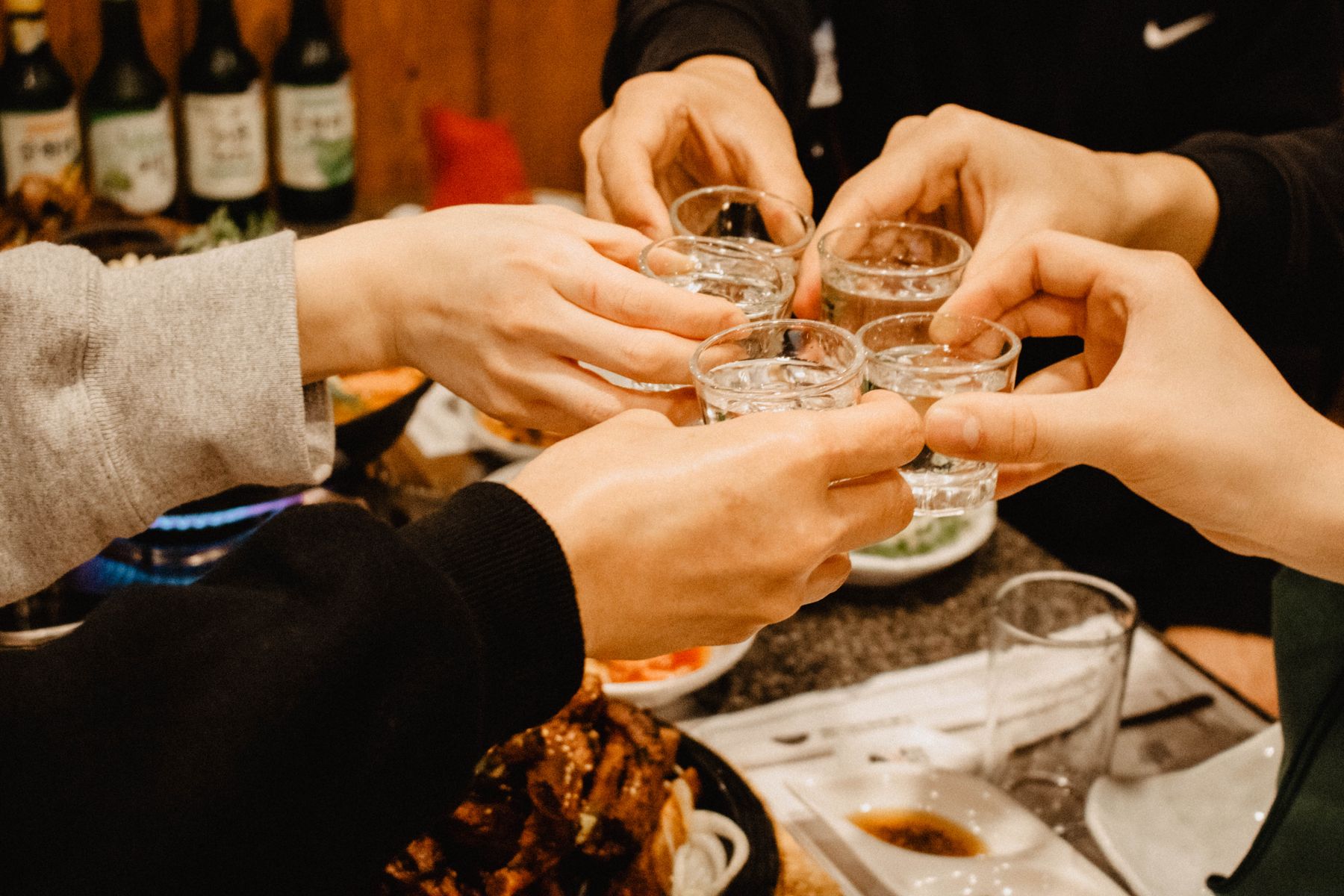
This is the one rule almost everyone has heard of, and it’s still worth spelling out because the details matter more than people think. When you pour for someone senior — or really anyone you want to show respect to — you use two hands: one holding the bottle, the other resting lightly under your forearm or against your chest. When you’re the one receiving, same idea. Both hands on the glass, or one hand on the glass with the other touching your forearm.
You’ll notice it’s not actually about hand count so much as posture. A slight forward lean, eyes not locked challengingly on the other person, glass held a bit lower than theirs if they clearly outrank you. Do all three and the two-hand thing on its own barely matters. Skip all three and holding the glass with two hands won’t save you — it’ll just look like you memorized a rule without understanding it, which, to be fair, is exactly what’s happening the first few times.
Turning away to drink in front of elders
Here’s the part that looks strangest to visitors the first time they see it: someone gets handed a shot, and instead of just drinking it, they angle their whole upper body away from the senior person at the table, sometimes covering the glass with their free hand, before knocking it back. It can look almost theatrical if you don’t know what’s happening.
The logic traces back to Confucian ideas about not displaying an “open mouth” — the act of drinking — directly to someone older or higher in status. Showing your throat and the motion of swallowing was considered a little too intimate, too physically exposed, for that kind of relationship. So the workaround became: turn away, take the shot, turn back. It’s not about hiding that you’re drinking — everyone at the table sees exactly what’s happening — it’s a formal gesture that signals “I know my place here” without anyone having to say it out loud.
You mainly need to do this with people clearly senior to you — a boss, an older relative, someone significantly older even in a casual setting. Among friends who are peers, nobody bothers, and doing it anyway would actually read as odd, like you’re being weirdly formal at a table where formality isn’t the point. Context is everything with this one, which is exactly what trips people up when they try to apply it as a blanket rule.
The glass you’re not supposed to fill yourself
There’s a third rule sitting right next to the first two, and it trips people up constantly: you don’t pour your own soju. If your glass runs dry and nobody’s noticed, the polite move is to wait, or to top off someone else’s glass first and let the gesture come back to you, rather than reaching for the bottle yourself. Part of the reasoning is practical — pouring for others is how the group tracks who’s had how much — and part of it is older superstition around drinking alone being a bit of a bad omen at a shared table. We’ve actually written a full breakdown of exactly why this rule exists and how strictly it’s enforced these days, so if that specific question is what brought you here, that piece goes deeper into it than we will here.
The one-shot tradition — and when you actually don’t have to
“One shot” (원샷) gets shouted across tables in Korea the way “cheers” gets said everywhere else, except it comes with an actual instruction attached: drink the whole glass, now, in one motion. It’s most strictly enforced on the very first toast of the night — that one, you’re generally expected to finish completely, especially if a senior person proposed it.
After that first round, though, the pressure eases more than people assume. Sipping through the rest of the night is completely normal, and a lot of Koreans do exactly that once the obligatory first shot is out of the way. The stereotype of relentless one-shotting all night is mostly a hoesik-horror-story exaggeration — it happens at some tables, especially rowdier ones, but it’s not the baseline expectation everywhere. If someone raises a glass and says “wonshot” later in the evening, it’s often more enthusiasm than rule at that point, and a smaller sip usually gets a pass, particularly for anyone who’s clearly already had enough.
When it’s actually okay to say no
This is where Korean drinking culture is genuinely shifting, and faster than most etiquette guides give it credit for. A decade ago, refusing a drink from a senior colleague could be read as a real breach of respect. These days, especially among younger workers and in bigger companies with more international staff, it’s a lot more acceptable to opt out — you just do it with the right gesture instead of a flat refusal.
Placing a hand lightly over the top of your glass before someone pours is the universal signal, and it’s understood without needing a word attached. Giving a reason on top of that smooths it further — driving, medication, an early flight the next morning, or simply “I’m not really drinking these days” all land fine. Plenty of people who don’t drink at all just quietly keep their glass filled with water, cider, or a non-alcoholic beer instead, and go through every toast of the night without anyone questioning it — from across the table it looks identical to everyone else’s glass. What still lands badly is refusing the very first toast of the night outright, especially from someone senior, without any gesture or explanation at all — that’s the one moment where declining cold, with no softening, can genuinely read as pointed.
Somaek and soju bombs: there’s etiquette here too
Somaek (소맥) — soju mixed into beer — has its own little subculture of showmanship. There’s an actual technique some people take real pride in: dropping a full shot glass of soju into a mug of beer and getting the ratio right, often talked about as roughly three parts soju to seven parts beer, then flipping a spoon or spinning the glass on the table to make the bubbles rise dramatically before it’s downed in one go. At bigger, looser hoesik tables, there’s almost always one person — often an older manager, sometimes just whoever’s had the most practice — who ends up as the unofficial bartender for the whole group, mixing rounds for everyone else while half-joking about their “certification.”
The etiquette part is subtle but real: if someone hands you a somaek they clearly put effort into building — the drop, the flip, the fizz — the polite move is to drink it fairly soon after, while it’s still got some carbonation, and to actually react to it a little. Letting a carefully made bomb shot sit on the table going flat is a small but noticeable social miss, roughly equivalent to letting a coffee someone made you go cold on the counter. It’s not a huge offense. It’s just the kind of small thing that adds up to whether people think you’re paying attention.
Refilling: the empty glass is the actual signal
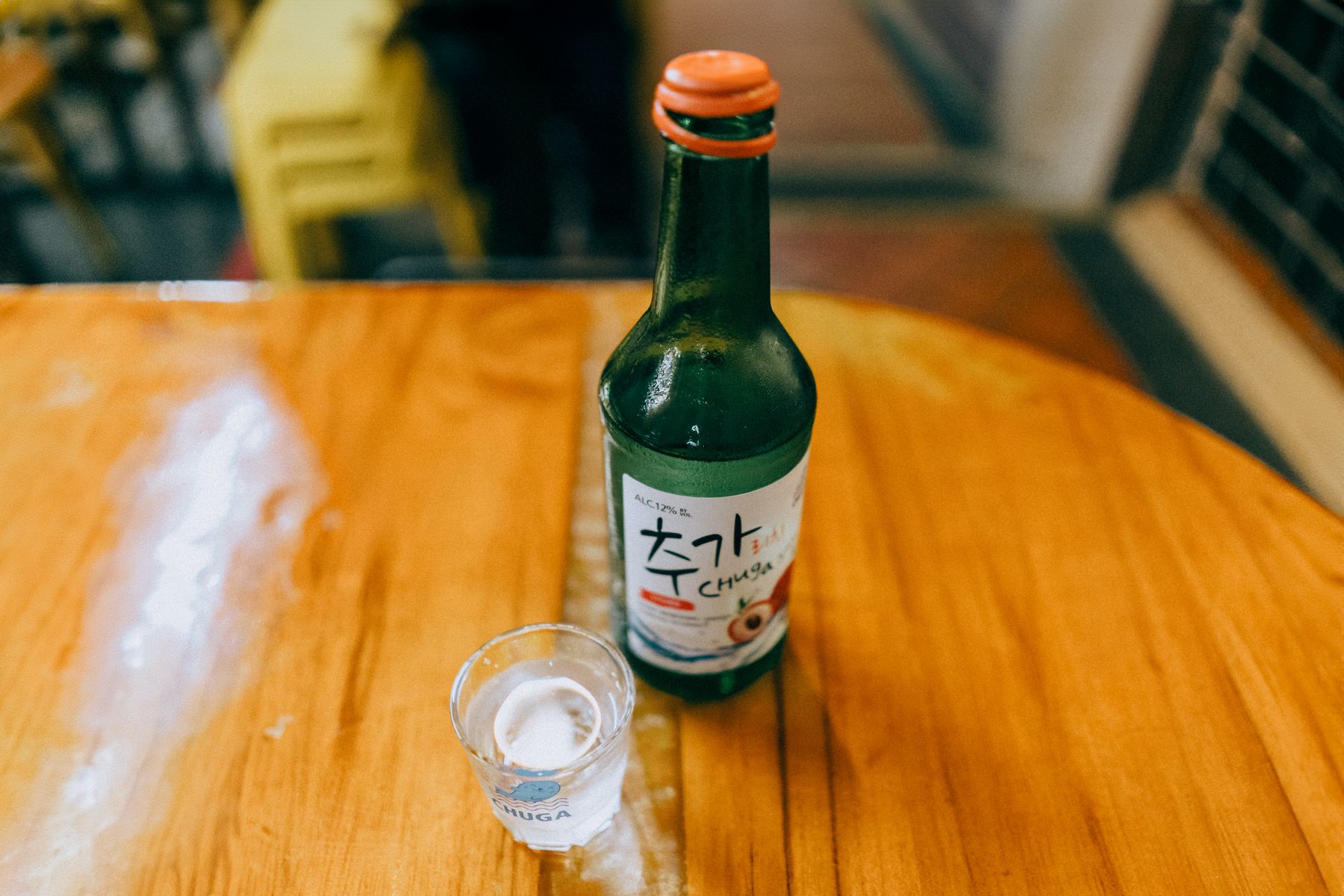
Nobody announces “your turn to pour,” which is exactly why this part trips people up. The unwritten timing rule is that you watch the glasses around you, and the moment someone’s gets empty — or even close to it — you offer to fill it before they have to ask or reach for the bottle themselves. Letting a senior person’s glass sit empty for more than a minute or two while you’re mid-conversation is a small lapse that people do notice, even if nobody says anything about it in the moment.
There’s a flip side too: pouring for someone who clearly hasn’t finished, or topping off a glass that’s still three-quarters full, can come across as pushy rather than attentive — like you’re trying to speed up how much they drink rather than take care of them. The sweet spot is watching, not hovering: notice when a glass is genuinely low, offer the bottle, and let them wave you off if they’re not ready. It’s a small skill, but it’s the kind of thing that quietly signals you’re paying attention to the table, not just to your own glass.
FAQ
Do I really have to finish every “one shot” toast?
Not every single one, no — but the very first toast of the night is the one where finishing it matters most, especially if a boss or an elder proposed it. After that, sipping is generally fine, and most Koreans do exactly that once the obligatory first round is done. If your tolerance is low, it’s completely reasonable to nurse that first glass slowly rather than gulp it, as long as you’re clearly still participating in the toast itself.
What if I genuinely don’t drink at all — will hoesik be miserable?
It doesn’t have to be. Covering your glass before anyone pours, or asking for a non-alcoholic drink to hold during toasts, is widely accepted now, especially in workplaces with any international presence. The social expectation is really about showing up and participating in the meal and conversation — the alcohol itself is negotiable far more than people assume before they’ve actually tried declining it.
Is it rude to make my own somaek instead of waiting for someone else to mix it?
Not at all — mixing your own somaek for yourself is completely different from pouring your own soju shot, since somaek is more of a shared party trick than a formal pour. The etiquette that matters more is what happens after: if someone else goes out of their way to build one for you, drink it while it still has some fizz instead of letting it sit.
None of this is really about memorizing a checklist before you land in Seoul. It’s about noticing that every one of these habits — the two hands, the turned shoulder, the watched glass, even the somaek someone built just for you — is doing the same quiet job: showing someone you see them and where they sit relative to you, without either of you having to say it out loud. Learn to read that underneath, and the specific gestures stop feeling like rules you’re following and start feeling like a language you’re actually speaking.
Leave a Reply