
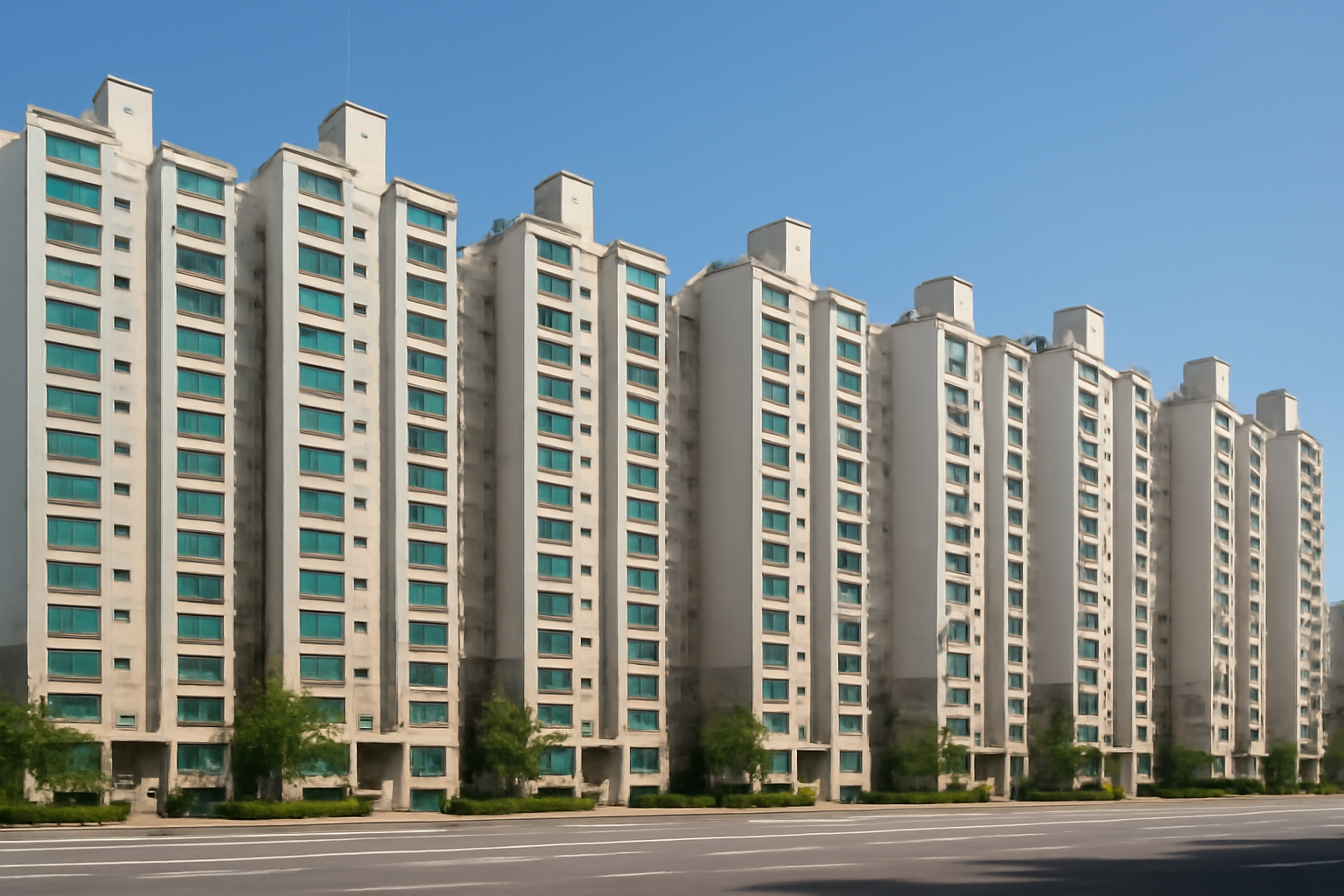
The first time I tried to find my in-laws’ apartment on my own, I walked in a full circle around the same three buildings before I admitted defeat and called my wife. “It’s 102-dong,” she said, like that explained anything. I was standing between a building marked 101 and one marked 103, both identical beige towers with identical balconies, identical playgrounds out front, and not a single visual clue to tell them apart except a number painted near the entrance. I had a bag of fruit melting in the summer heat and zero idea which lobby led to her parents’ floor. That was my real introduction to what Koreans call an apart-danji — and once you notice the pattern, you start seeing it everywhere, in every city, in almost every neighborhood.
The Apart-Danji System
In most English-speaking countries, “apartment complex” might mean a single building or a small cluster of two or three. In Korea, a danji can mean ten, twenty, sometimes forty nearly identical towers built together as one planned unit, each one labeled with a number instead of a name — 101-dong, 102-dong, and so on, dong simply meaning “building.” There’s no 401 to avoid a superstitious number the way some Western buildings skip the 13th floor, but there is often no 4-dong either, because the number four sounds like the word for death in Sino-Korean. Beyond that, the buildings really are meant to look alike. They were designed and approved as a single project, built by one contractor, on one site plan, at the same time, which is a big part of why the elevation, the balcony shape, and even the paint color repeat down the block like a chorus.
The Brand Names on the Gate
What did throw me for a while was realizing those towers usually carry a brand name that has nothing to do with the neighborhood. You’ll see a stone sign at the entrance reading something like “The Xi,” “Prugio,” or “Raemian,” and for months I assumed these were just fancy marketing labels, like a hotel chain. They’re actually the construction companies’ apartment brands — each major builder has its own line, its own logo font, its own vaguely European-sounding name meant to suggest comfort and status rather than mean anything literal in Korean. Once I understood that, I started noticing how Koreans read these names almost like a credit report. The brand hints at which conglomerate built it, roughly what price bracket it sits in, and sometimes even which school district it feeds into. Two brand names stacked together on one sign usually means two companies co-developed the site and split the cost, not that the apartment is somehow double the apartment.
From the Parking Garage to the Elevator Without Ever Seeing the Sky
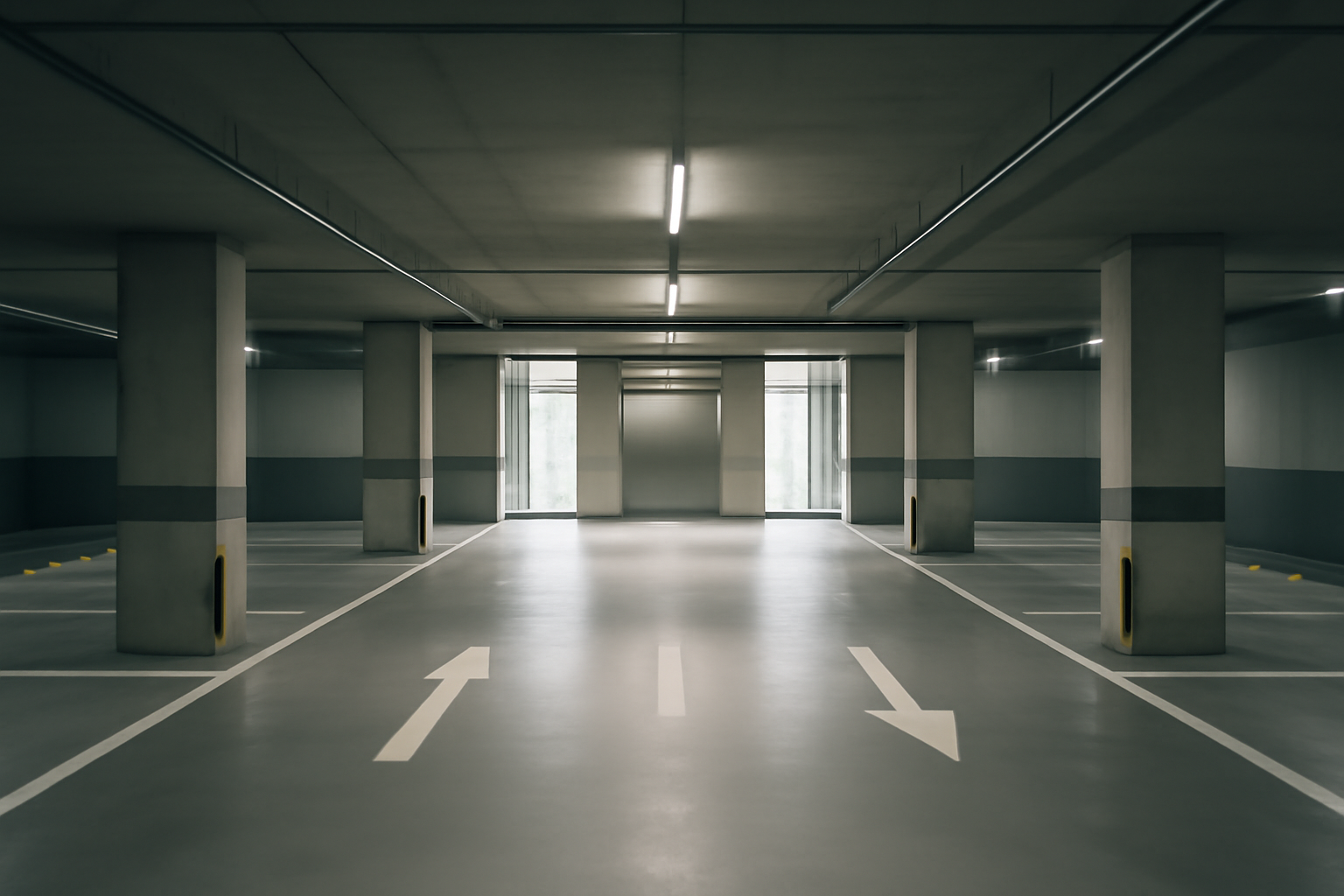
The thing that actually won me over, after the initial confusion, was the underground parking. In a lot of newer danji, you can drive straight into a basement garage that connects to every single building’s elevator lobby, so you park, walk twenty steps, and you’re inside your own tower without ever stepping outside. In winter, when the wind cuts sideways and everyone’s carrying grocery bags and a kid in one arm, that little architectural decision feels like a genuine kindness. I remember hauling a folded stroller and two bags of instant noodles through a heavy downpour once and realizing I hadn’t gotten a drop on me, because the whole trip from car to front door happened underground.
A Small City Behind the Gate
A danji isn’t just towers and a parking lot — it’s closer to a self-contained little town. Most complexes have a central playground, sometimes two or three scattered between buildings, plus outdoor exercise equipment that older residents use every morning like clockwork. Larger complexes have their own fitness room, a reading room or study space for students, a package room where deliveries pile up in labeled cubbies instead of sitting outside your door, and occasionally a small convenience store or dry cleaner tucked near the main gate. The first time I saw a security guard sorting an entire wall of parcels by building and unit number, I understood why package theft basically isn’t a conversation here the way it is back home.
Why They All Have the Same Floor Plan
Ask any Korean friend about apartment floor plans and you’ll probably get an eye roll, because the joke that “every apartment is the same three rooms and a balcony” is pretty close to true. Builders lean on a handful of standard layouts because repeating one floor plan across dozens of units in a tower is simply more efficient to construct, and because a familiar, predictable layout keeps resale value stable. Buyers here aren’t just purchasing where they’ll live; they’re purchasing an asset they expect to sell again in a few years, and a bizarre or overly personal floor plan can actually scare off future buyers. Sameness, in this context, isn’t a design failure — it’s a financial strategy everyone quietly agrees to.
What’s Actually Different Once You’re Inside
Here’s what surprised me: the sameness mostly stops at the front door. Korean apartments get renovated — called “susul” or interior remodeling — far more aggressively and far more often than I expected, especially before a new owner moves in. Walls get reconfigured, kitchens get gutted and rebuilt, flooring gets swapped from the builder’s default to imported hardwood or heated stone tile. Two units with an identical blueprint on paper can feel like completely different homes once you walk in. And then there are officetels — a separate category that looks like an apartment tower from outside but is technically zoned as a mixed residential-commercial studio, usually smaller, often rented rather than owned, and popular with singles and young professionals who want the same convenient neighborhood without the apartment price tag or the family-sized square footage.
The Voice From the Ceiling
And then there’s the management office, the 관리사무소, which somehow always finds a reason to speak to the entire building at once. A recorded announcement crackles through a speaker mounted near the ceiling of every hallway and stairwell — reminding everyone that the water will be shut off Tuesday morning for pipe maintenance, that a lost cat has been found near the playground, that recycling collection has been moved up an hour. The first time it happened I genuinely thought something was wrong, like a fire drill. Now it’s background noise, the sound of a few thousand strangers technically living as one household.
FAQ
Are all Korean apartments really identical inside?
Not anymore, once you’re past the entryway. The exterior shells and the original blueprint are often shared across a whole danji, but interior remodeling is so common that two units on the same floor plan can look nothing alike once furniture, flooring, and renovated kitchens come into play.
What does “apart” mean in Korean slang?
It’s the everyday shortened form of “apartment” (아파트, apateu), used the way English speakers might casually say “apt.” When someone asks where you live and you say “apart,” everyone instantly pictures a high-rise danji rather than a small walk-up.
Why do apartment buildings skip the number four?
Because in Sino-Korean pronunciation, four (사, sa) sounds like the word for death. Some buildings, and especially elevator floor buttons, quietly skip it or relabel it “F” instead of 4, the same instinct that makes some Western buildings skip a 13th floor.
These days I don’t get lost between towers anymore — I can spot my building number from the street before I’m even close. But I still remember standing there with melting fruit, staring at two identical beige walls, wondering how an entire country agreed to build cities this way. The more I’ve lived here, the more it makes sense: efficient, secure, quietly communal, and — once you’re inside your own front door — a lot less identical than it looks from the road.
Leave a Reply