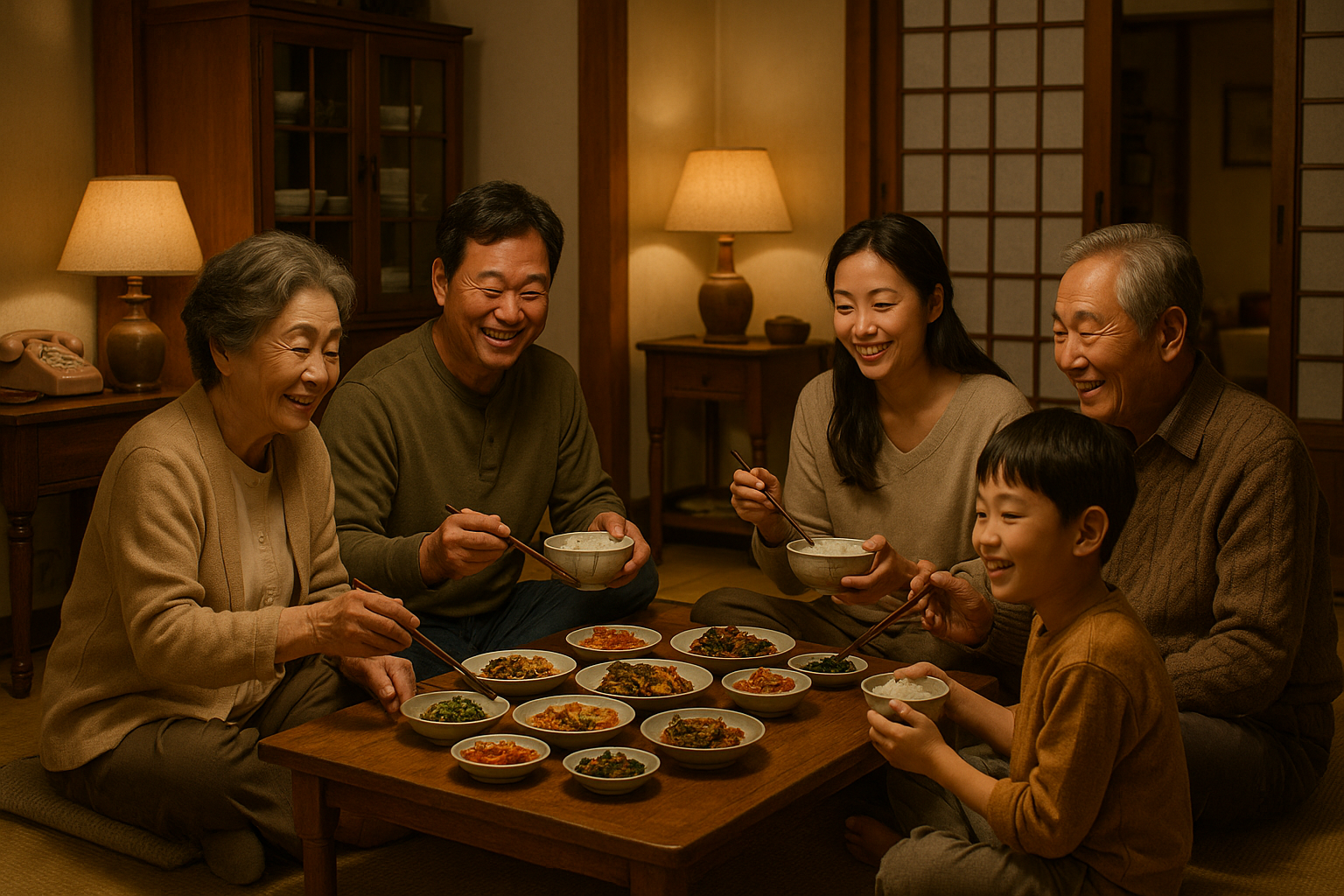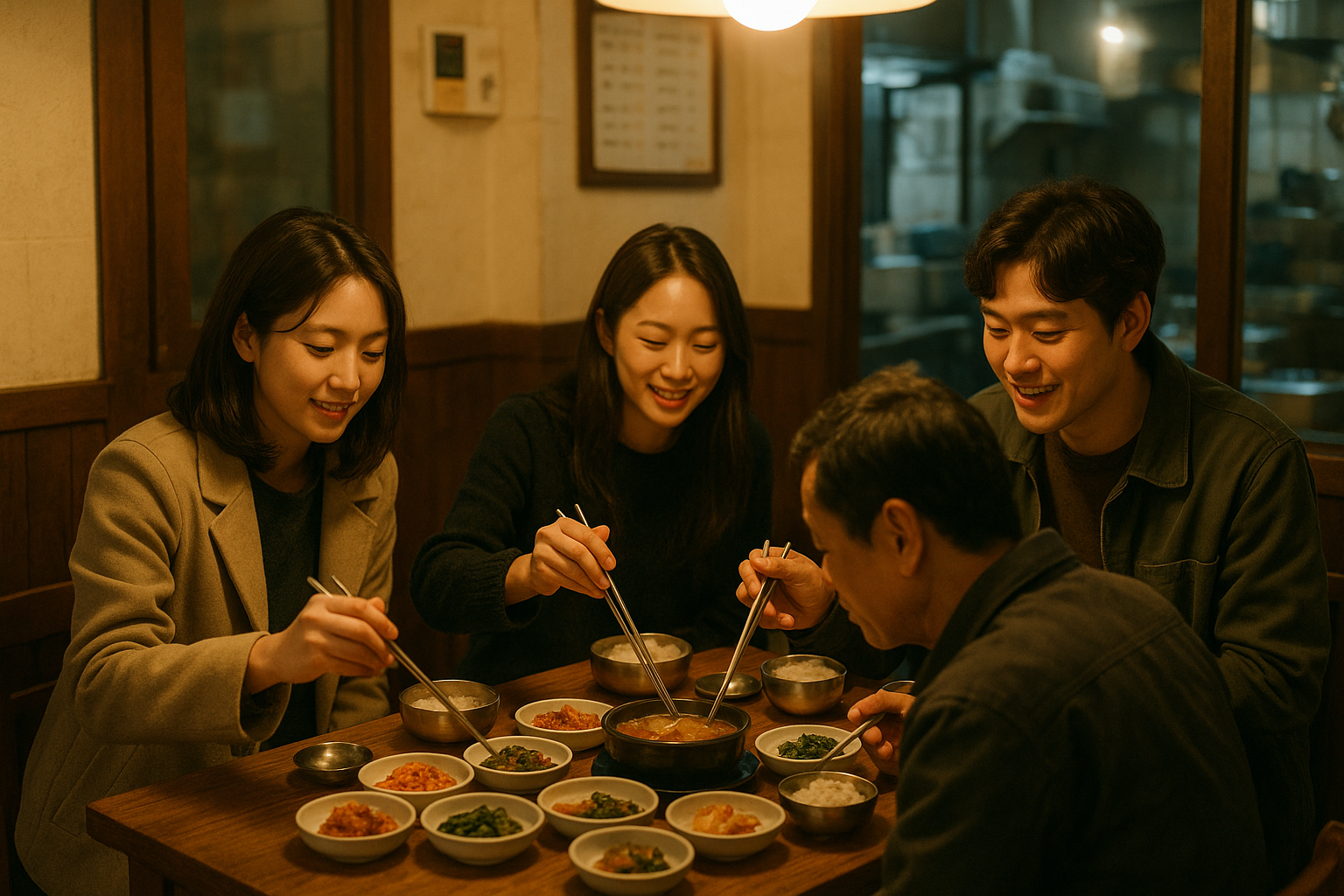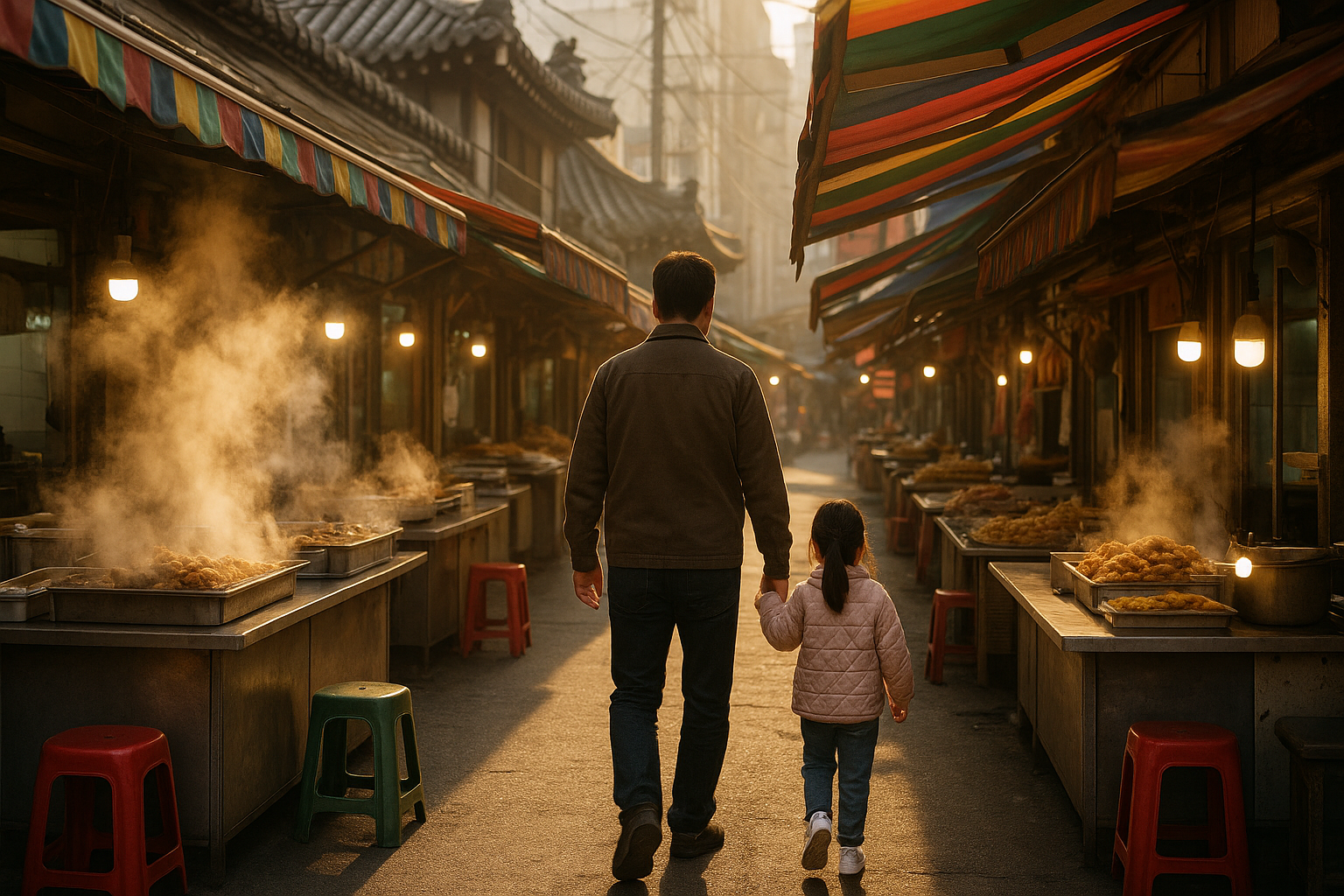
The hotteok ajumma at the second stall past the fish shop has a system, and my daughter and I are not part of it. There’s a line of regulars who just hold up fingers — one, two, three — and get their syrup-filled pancakes wrapped in paper before they’ve even finished paying. Yuna, five years old and holding my hand in a death grip because of the crowd, points at the griddle and says, loud enough for half of Mangwon Market to hear, “Appa, that one is bleeding sugar.” The ajumma laughs so hard she has to set down her spatula. That’s the whole trip, honestly. Everything after that was just details.
We go to Mangwon Market most Saturday mornings, partly because it’s a ten-minute walk from our apartment in Mapo-gu and partly because my wife has decided, correctly, that a five-year-old who only ever sees food arrive through a delivery app’s plastic bag is missing something. It was a hot one this past weekend — late July heat that hadn’t broken yet even at nine in the morning, the kind that makes the awnings smell like warm canvas and the ice buckets under the fish stalls sweat as much as I do.
The Market Doesn’t Whisper
What hits you first isn’t a smell, it’s noise. Mangwon isn’t a tourist market like Gwangjang or Namdaemun — there’s no English menu anywhere, and I’ve never once seen a tour group come through — so the calls aren’t performed for anyone, they’re just how business gets done. “골라 골라, 골라 골라!” — pick one, pick one — from a woman selling socks three for 5,000 won, her voice pitched to cut through the crowd without a microphone. A man near the entrance sells roasted chestnuts and says the price like it’s one long word, “이천원이천원이천원,” until someone stops.
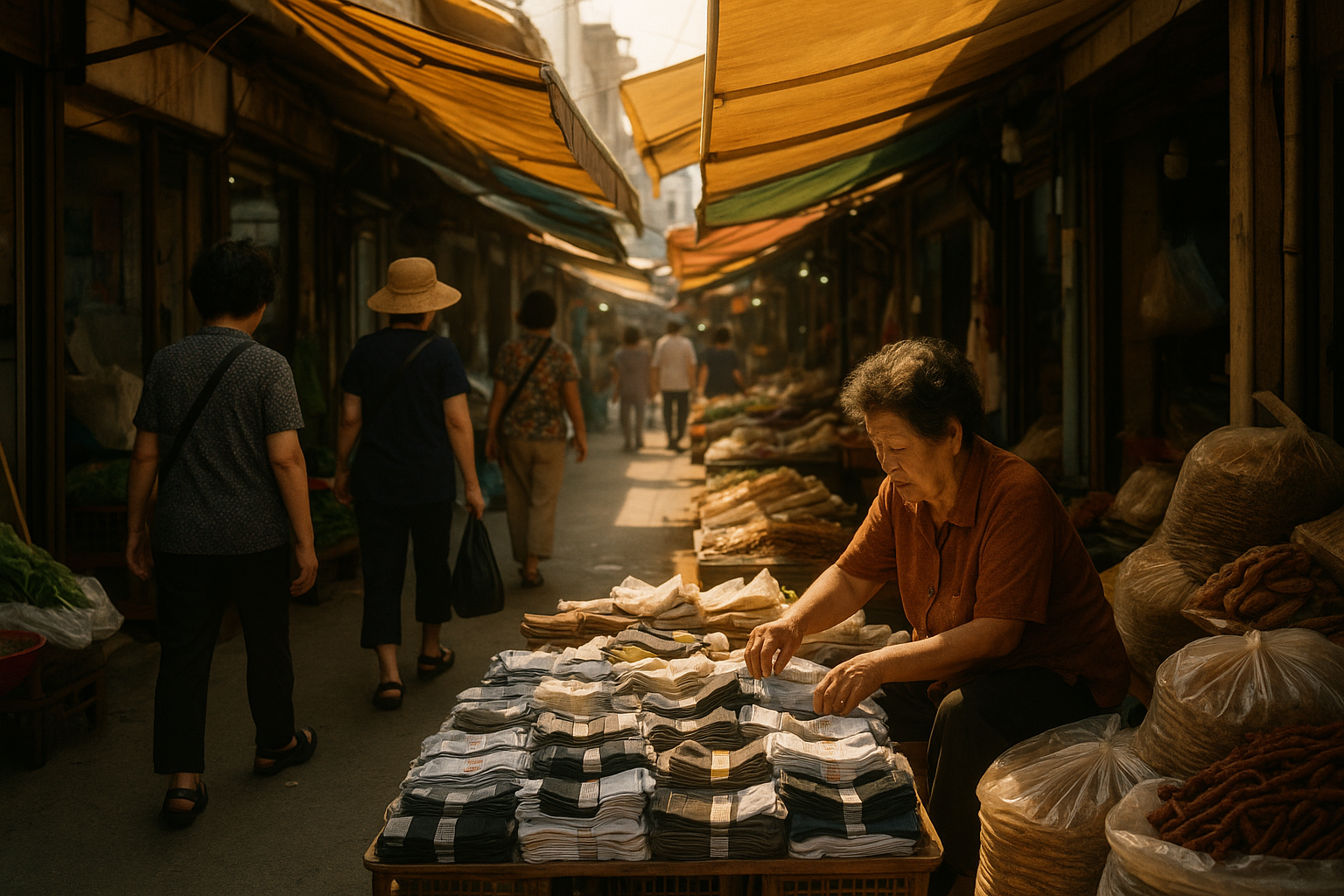
Underneath the calling is the metal-on-metal clang of a woman flattening dough with what looks like a hockey puck welded to a handle, the hiss of oil at the twigim stand, and somewhere, always, a radio playing trot music a decade too old for the vendor working next to it. My daughter has stopped being scared of the noise. Now she just narrates it back to me in a running commentary, which is somehow louder than the market itself.
Ordering Anchovies Badly
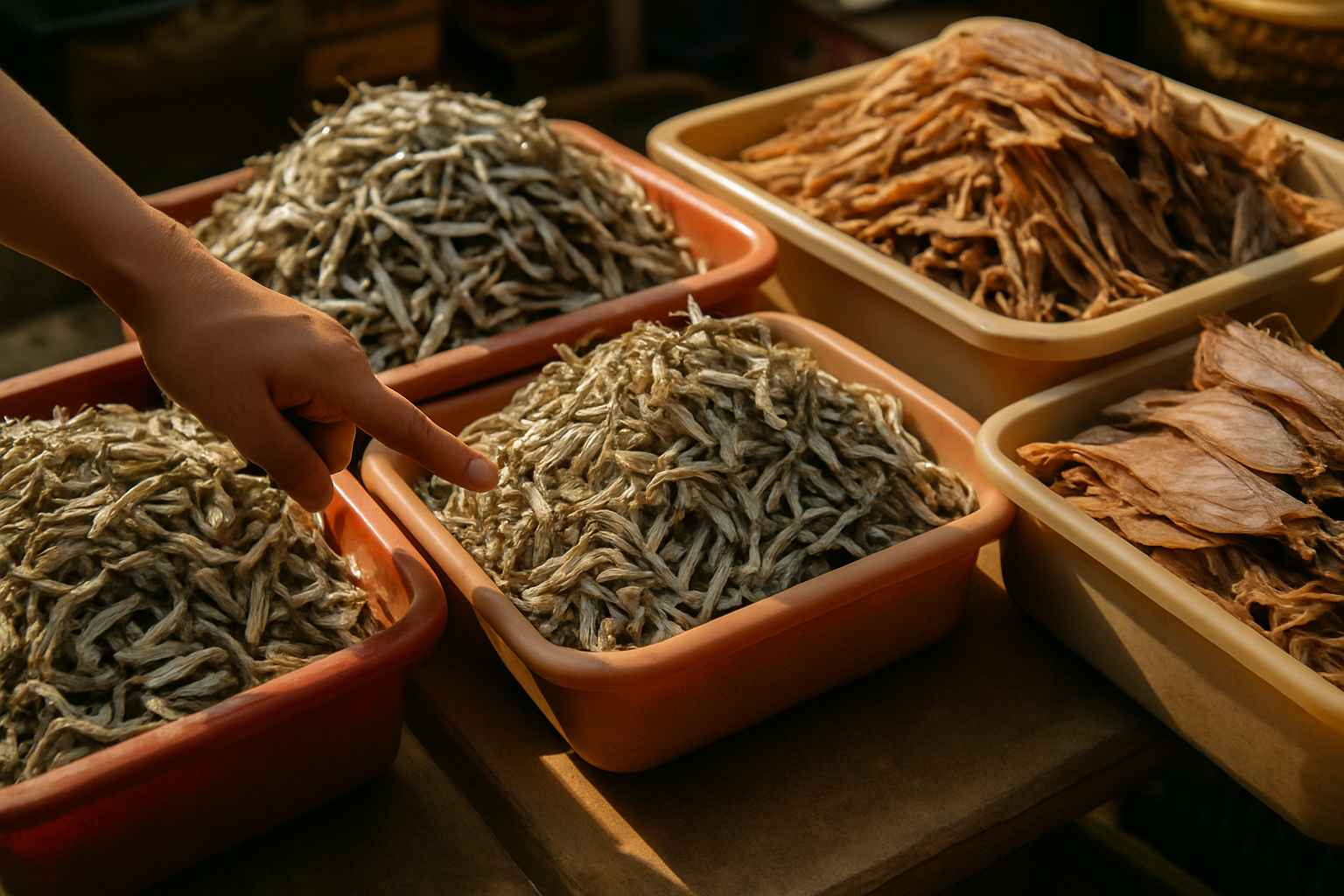
I’ve lived here nine years and my market Korean is still held together with duct tape. There’s a stall near the middle of the alley run by a woman who sells dried myeolchi (멸치, dried anchovies) by the small plastic tub, and I wanted the medium-size ones for anchovy stock, not the tiny ones for banchan. I pointed and said, with total confidence, “이거 큰 거 주세요” — give me the big one — except I pointed at the wrong bin, and she handed me a bag of dried squid instead, laughing, and said something too fast for me to catch that I’m fairly sure translated to “you want fish, this is fish, close enough, sir.” We ended up with both. The anchovies were 4,000 won for a bag; the squid I hadn’t planned on was another 3,000, and I paid it because arguing felt more embarrassing than just eating dried squid for a week.
My daughter thought this was the funniest thing that had happened to her all summer. She still brings it up at dinner — “Appa bought the wrong fish” — like it’s a title I’ve earned permanently.
The Bargain That Wasn’t Really a Bargain
Everyone warns you about haggling in Korean markets, and I want to be honest about how bad I am at it. At a produce stall selling bags of participation-trophy-sized peaches, I tried the classic move — “깎아주세요,” knock a little off — on a 10,000 won bag of six. The ajeossi running the stall looked at me, looked at Yuna, and threw in a seventh peach for free without dropping the price at all, which is not technically a discount but felt like winning. That’s the real shape of bargaining at a neighborhood market like this one: it’s less about the number and more about being seen, being a regular, having a kid with you who says thank you in Korean loud enough that everyone within ten feet turns to smile. Yuna has figured this out faster than I have. She’s started saying “감사합니다!” to absolutely everyone, unprompted, and it works better than any Korean I’ve ever spoken.
Why I Keep Bringing Her Back
None of this is efficient. The supermarket two blocks from our place has air conditioning, self-checkout, and produce that doesn’t require me to gesture apologetically at a stranger. But Yuna knows the tteokbokki lady’s face now, knows to duck under the low edge of the tarp at the banchan stall, knows that the market smells different depending on which direction the wind is blowing the grill smoke. That’s not something an app delivers. If you’re raising a kid here and wondering whether the market fuss is worth it over ordering groceries on your phone — the way I learned to navigate Korean convenience stores as a dad taught me that convenience and connection aren’t the same thing, and the market is where she’s actually getting the second one.
FAQ
Is it normal to bargain at a Korean traditional market?
Yes, but mostly at produce, dried goods, and clothing stalls — not at food stands selling a single cheap item like a 1,500 won hotteok or a bowl of tteokbokki. Asking for a discount on a small snack is considered a little rude. Buying in bulk, like a whole bag of peaches or a kilo of anchovies, is where a small discount or a free extra item is normal and expected.
What should I bring cash for at a market like Mangwon?
Bring small bills and coins. Most stalls now take cards or mobile pay, but the smallest food stands — hotteok, twigim, a paper cup of fish cake broth — still run faster and friendlier on cash, and vendors sometimes round down or throw in an extra piece when you pay in exact change.
Is a neighborhood market like Mangwon worth visiting with young kids, or should I stick to Gwangjang or Namdaemun?
Both have their place. Gwangjang and Namdaemun are bigger, louder, and built for visitors, which makes them fun once. A smaller neighborhood market is better for a regular routine with kids — it’s slower, vendors start recognizing your child, and there’s less crowd pressure per square meter for a five-year-old’s hand to get lost in.