A friend visiting from Chicago handed a taxi driver an extra five thousand won once, on my recommendation, sort of — I’d said something vague like “just be generous, drivers here work hard.” The driver looked at the bill, looked at my friend, and then physically got out of the car to hand it back through the passenger window before driving off. My friend stood on the sidewalk holding a five-thousand-won note like it had personally rejected him. That’s roughly when I learned I should stop giving casual tipping advice to visitors.
The short version: nobody expects it, and some people will actively refuse it
Tipping in South Korea is neither expected nor customary, full stop. There’s no 15-to-20 percent mental math to do at the end of a meal, no awkward moment deciding whether to round up a cab fare, no line on a card receipt to fill in a gratuity. For someone who grew up doing the tipping math automatically, almost without thinking, the first few months here feel oddly weightless. You pay exactly what the menu says. Then you just… leave.
What surprised me more than the absence of tipping itself was how some people react when you try anyway. It’s not universal — plenty of servers will just pocket a small tip without comment if you leave one on the table — but a noticeable number treat an offered tip as something closer to an accusation, as if you’re implying they weren’t already doing their job properly. I’ve seen a barista in Hongdae wave off a thousand-won coin left in a jar with something between confusion and mild offense on her face, the same look you might give someone who tried to pay you back for a favor you didn’t consider a transaction in the first place.
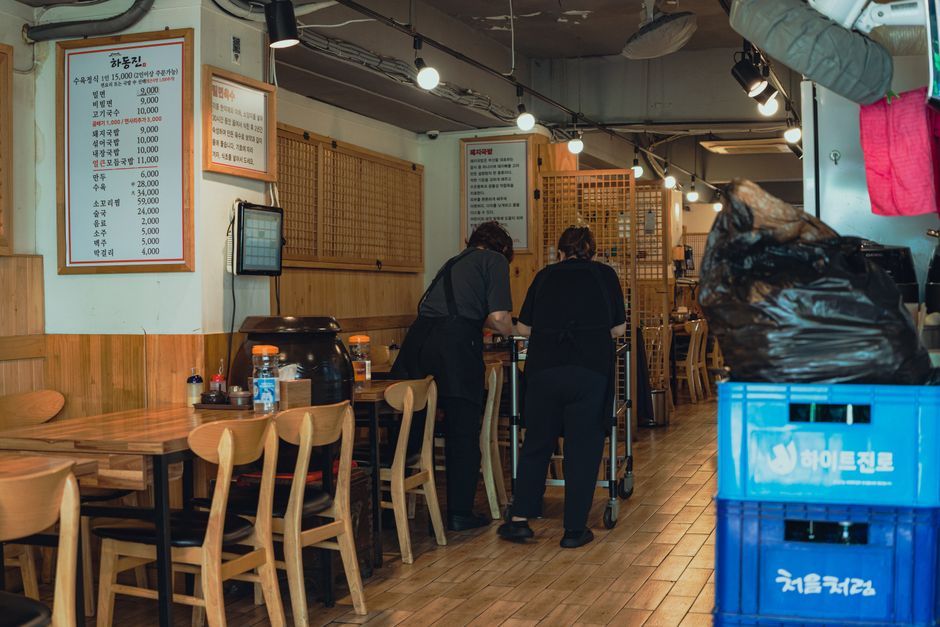
Why, though? It’s not just “different culture,” there’s an actual mechanism
So why did Korea land here in the first place, when plenty of other countries drifted the opposite direction? It’s tempting to chalk it up to vague notions of politeness, but that’s not really the answer. There’s a specific legal and economic scaffolding underneath it that most visitors never hear about, and once you see it, the whole no-tipping thing stops feeling like an arbitrary cultural quirk and starts feeling almost deliberately engineered.
Back in 2013, a revision to the Food Sanitation Act introduced what’s called a “final price display” system, requiring restaurant menus to show prices that already include tax and any service charge, no hidden add-ons at the register. Before that, a handful of upscale restaurants and hotels did quietly print a separate service charge line on the bill, closer to the American model, and it created exactly the kind of confusion the government eventually moved to eliminate. The stated goal of the 2013 revision was to stop tipping from hardening into an expected norm the way it has elsewhere. It worked, more or less. Voluntary tipping isn’t illegal — you can absolutely hand cash directly to a server if you want — but the entire pricing infrastructure was built to make that unnecessary rather than assumed. I still catch myself, more than a decade in, feeling a small flicker of relief every time I glance at a Korean receipt and realize there’s no mental math left to do, no separate line waiting to be calculated on top of the number already printed.
Underneath that legal layer sits an economic one that matters even more. Korean service workers are paid the legal minimum wage, which sits at 9,860 won per hour as of 2026, plus the standard benefits any employee is entitled to. Compare that to the American system, where a server’s base pay can legally dip well below minimum wage on the assumption that tips make up the difference — that gap is the entire reason tipping became load-bearing in the US to begin with. In Korea, nobody’s rent depends on whether a table tips well tonight. Take the tip jar away entirely and a server here still gets the same paycheck at the end of the month.
The pride angle, and why it took me years to actually get it
For a long time I read the no-tipping culture as purely transactional — a wage structure thing, full stop, nothing more philosophical going on. Then I spent enough dinners with my father-in-law, who ran a small restaurant near Incheon for almost two decades before he retired, to realize I’d been missing something. He genuinely bristled at the idea of tipping, not because of the money, but because it implied his service quality was optional, something extra he might or might not bother with depending on the incentive in front of him. To him, showing up and doing the job well wasn’t a favor you paid for afterward. It was just… the job. Attaching a cash reward to basic competence felt, in his words roughly translated, “like being tipped for remembering to breathe.” He used to say the taste of the food and the way he treated the people eating it were the one thing about the business nobody could ever talk him into discounting or upselling, and a tip sitting on the table felt like someone quietly grading something that wasn’t up for grading.
I’ll admit that took me a while to internalize, mostly because I’d spent almost thirty years assuming good service and tipping were the same conversation. They’re not, here. Restaurant staff, cab drivers, hairdressers, hotel bellhops — pride in the work itself does a lot of the heavy lifting that a tip would otherwise be doing elsewhere. Whether that produces objectively better service than a tip-driven system is a genuinely different debate, and honestly a fair one to have. But it does mean the entire emotional transaction around a tip — the reassurance, the little performance of gratitude — simply isn’t part of the script here, and offering it can land as confusing rather than kind.
What about kiosks, delivery apps, and the digital side of it?
Korea went all-in on kiosk ordering and delivery apps faster than almost anywhere I’ve lived, and it’s worth noting that none of that digital infrastructure ever grew a tip prompt the way it did in, say, American coffee shop card readers over the last decade. Order a coffee at a kiosk in Seoul and you’ll get options for size, temperature, maybe a loyalty stamp — never a screen asking you to select 15, 20, or 25 percent before you can finish the transaction. Delivery apps like Baemin do offer an optional “quick delivery” upcharge, but it functions more like a rush fee baked into the base price than a tip handed to the individual rider, and it’s calculated automatically rather than left to the customer’s discretion at checkout. Watching that entire wave of automation roll through the country without ever picking up a tipping prompt says something, honestly — it suggests the absence of tipping here isn’t a fragile custom hanging on by habit, it’s structural enough that even new technology never bothered building the option in.
Where the line actually gets blurry
It’s not quite as absolute as “never, under any circumstances,” though, and this is where a lot of well-meaning advice online oversimplifies things. High-end hotels catering heavily to international guests sometimes have bellhop tipping baked into the culture specifically because so many Western guests expect to tip and feel uncomfortable not doing so — a five-thousand-won note for carrying bags at a five-star Seoul hotel won’t usually get handed back. Some hiking guides or private tour operators, especially ones who market specifically toward foreign tourists, have quietly adjusted to accept tips too, because enough visitors insisted on it that refusing became its own kind of awkward. But the baseline, everyday version of Korea — the neighborhood restaurant, the local cab, the corner hair salon — runs on the assumption that the listed price is the whole transaction, and treating it otherwise usually creates more friction than goodwill.
There’s also a generational wrinkle worth mentioning. Younger service workers in trendier cafes and restaurants, especially the ones who’ve worked abroad or deal with international customers constantly, tend to be less thrown by a tip than an older shopkeeper would be. It’s not a hard rule, more a loose pattern I’ve noticed over the years — younger staff might just say a quick thank you and keep it, where an older business owner is far more likely to insist you take it back, sometimes almost sternly.
What I’d actually tell someone visiting
Skip the tip and skip the guilt with it — the price on the menu really is the whole story here, not a polite fiction. If you had exceptional service and genuinely want to show appreciation, there are other currencies that land better. A sincere “I’ll definitely come back” to the owner on your way out, or clearing your own dishes to the return counter without being asked, tends to register more than cash quietly left on the table. A specific verbal thank-you to a manager, or a good review afterward, does more culturally here than a tip ever would. And if you do try to tip and it gets refused, don’t push it into a whole negotiation — that refusal isn’t rudeness on their end, it’s closer to a compliment about how the system already works from where they’re standing. Take the note back, say thanks, and let it go. That’s basically the lesson my Chicago friend learned the expensive way, standing on a sidewalk holding a bill nobody wanted.
Frequently Asked Questions
Is it ever actually rude to tip in Korea?
Rude is probably too strong a word for most situations — confusing is closer to the truth. In an everyday local restaurant or cab, an offered tip usually just gets refused or produces an awkward beat of confusion rather than genuine offense. Where it can tip into something closer to insulting is if the gesture reads as implying the person needed extra incentive to do a job they were already being paid fairly to do.
Do delivery drivers or food delivery apps expect tips?
Standard delivery in Korea doesn’t run on a tipping model the way it sometimes does elsewhere. Some apps have introduced an optional “quick delivery” fee that functions a bit like a rush charge rather than a gratuity, but it’s baked into the app’s pricing rather than something you hand over separately, and it’s not something drivers expect on every order.
What about tour guides or private drivers hired specifically for foreign tourists?
This is genuinely the gray zone. Guides and drivers who work primarily with international visitors are often more accustomed to tipping and less likely to refuse it, partly because enough of their regular clientele comes from tipping-culture countries. If in doubt, a quick question to the tour company or guide beforehand — “is a tip expected or welcome?” — clears it up fast and avoids any awkwardness either way.
Leave a Reply