강릉역에 내려서 스마트폰 지도를 켜면 다들 비슷한 실수를 한다. 가이드북 순서대로 오죽헌부터 동선을 짜는 것. 나도 처음엔 그랬다. 강릉은 지도로 보면 생각보다 남북으로 길쭉한 도시라서, 오죽헌 쪽과 안목·경포 쪽을 오락가락하다 보면 이동 시간만 절반을 써버리기 십상이다. 그런데 커피거리와 경포호, 초당순두부마을을 하루에 묶어서 돌아본 사람들 얘기를 들어보면 동선은 의외로 단순하다. 안목해변에서 커피 한 잔 마시고, 걸어서 경포호를 반 바퀴 돈 다음, 초당동 골목에서 순두부로 마무리하는 코스다. 세 곳이 전부 걸어서든 버스로든 20분 안쪽 거리에 몰려 있다는 게 이 루트의 진짜 강점이다.
안목해변, 자판기 커피에서 시작된 거리
안목해변 커피거리라고 하면 그냥 카페 많은 바닷가 정도로 생각하기 쉬운데, 유래를 알고 가면 걷는 재미가 다르다. 1980년대 초까지만 해도 안목항은 시내버스가 하루 세 번 들어오는 조용한 어촌이었다. 그러다 해변에 커피 자판기가 하나둘 놓이기 시작했고, 1.2km 남짓한 짧은 구간에 자판기가 50대 가까이 늘어서는 진풍경이 벌어졌다. 가게들끼리 경쟁이 붙으면서 콩가루나 참깨, 헤이즐넛을 탄 자판기 커피까지 등장했다는 이야기가 있을 정도다. 1990년대 들어 커피 명장들이 강릉에 정착하고 로스터리 카페들이 하나둘 문을 열면서 지금의 전문점 거리로 바뀌었다. 그러니까 이 거리는 태생부터 ‘바다를 보며 마시는 커피’였던 셈이다.
해변을 따라 걸으면 오래된 로스터리부터 통유리로 파도를 정면으로 마주 보는 신상 카페까지 섞여 있다. 아메리카노는 대개 5천~6천 원, 시그니처 라떼나 디저트를 곁들이면 7천~8천 원까지 올라간다. 비싸다면 비싼 값이지만, 테라스에 앉아 모래사장에 부서지는 하얀 포말 소리와 갓 내린 원두 향이 섞이는 그 30분은 값을 떠나서 이 코스에서 가장 아깝지 않은 시간이었다. 창가 자리는 주말 오전 11시만 넘어도 대기가 생긴다. 해수욕장 개장 기간이 아니어도 산책하는 사람이 끊이지 않는 걸 보면 여기는 계절을 타는 곳이 아니다.
경포호, 정자 하나에 호수와 바다를 동시에
안목에서 경포호까지는 걸어서 20분 정도, 버스로는 두 정거장이면 닿는다. 택시를 타면 기본요금 수준인 4천~5천 원 선에서 끝난다. 경포대라는 이름을 듣고 대단한 절벽이나 봉우리를 기대하면 살짝 김이 샐 수도 있다. 실제로는 호숫가 언덕에 자리한 누각 한 채다. 그런데도 이 자리가 관동팔경으로 꼽히는 데는 이유가 있다. 누각에 올라 한쪽으로 고개를 돌리면 잔잔한 경포호가, 반대쪽으로는 탁 트인 동해가 함께 잡힌다. 호수와 바다를 한 시야 안에 넣는 정자는 동해안에서도 흔치 않다.
호수 둘레길은 약 4.3km로 한 바퀴 다 돌면 한 시간 넘게 걸리는데, 당일치기 일정이면 굳이 완주할 필요는 없다. 경포대 누각을 내려와 호수를 오른쪽에 끼고 초당동 방향으로 20~30분만 걸어도 갈대와 물억새, 그리고 호수 위로 지나가는 철새 무리를 충분히 볼 수 있다. 이 방향이 다음 목적지인 초당순두부마을과도 이어져서 왔던 길을 되짚어 갈 필요가 없다는 게 은근히 편하다. 벚꽃철도 아니고 단풍철도 아닌 평일 오후에 가봤는데도 산책하는 주민이 꽤 많았다. 관광지라기보다 동네 사람들의 조깅 코스에 여행자가 살짝 끼어드는 느낌이랄까.
초당순두부마을, 두부에 바닷물을 쓰는 이유
경포호에서 초당동 순두부마을까지는 다시 도보로 15분 안팎이다. 순두부라는 메뉴 자체는 전국 어디에나 있는데, 유독 강릉 초당두부가 유명해진 데는 나름의 사연이 있다. 조선 시대 문인 허균과 허난설헌의 아버지인 허엽이 이 마을에 살면서, 집 앞 우물물로 콩을 불리고 인근 바닷물로 간을 맞춰 두부를 만들었다는 이야기가 전해진다. 그의 호가 ‘초당’이었고, 그 호를 따서 마을 두부에 초당두부라는 이름이 붙었다고 한다. 다만 이걸 뒷받침하는 확실한 문헌 기록은 남아 있지 않다는 점은 솔직히 짚고 넘어가야 할 것 같다. 전설처럼 내려오는 이야기이되, 완전히 검증된 역사는 아니라는 뜻이다.
허엽의 전설이 사실이든 아니든, 이 마을이 두부로 진짜 명성을 얻게 된 뿌리는 따로 있다. 일제강점기와 6·25전쟁을 지나며 남자들이 마을을 비운 사이, 여인들이 생계를 이어가려고 만들던 게 두부였다는 이야기다. 그러니까 이 마을에서 두부는 원래 관광 상품이 아니라 생계 수단이었던 셈이고, 지금의 순두부거리는 그 위에 형성된 결과에 가깝다. 간수 대신 동해 바닷물로 응고시키는 방식은 지금도 마을 두부집 상당수가 그대로 이어간다.
백순두부를 시키면 양념장을 살짝만 얹어 그대로 떠먹게 되는데, 입에 넣자마자 사르르 녹아내리는 질감 뒤로 콩 본연의 고소함과 바닷물의 은은한 간이 뒤늦게 따라온다. 자극적인 맛에 익숙한 사람이라면 심심하다고 느낄 수도 있지만, 그 심심함이 오히려 다음 숟가락을 부르는 묘한 맛이다. 골목에 들어서면 순두부집이 스무 곳 넘게 몰려 있어서 어디를 골라야 할지 막막할 수 있는데, 백순두부와 순두부짬뽕 두 가지를 함께 파는 집이 많으니 일행이 있다면 나눠 시키는 걸 추천한다. 가격은 한 그릇에 만 원 안팎이고, 순두부 만들기 체험을 운영하는 곳도 몇 군데 있어서 아이와 함께라면 들러볼 만하다.
동선 정리와 실제 소요 시간
서울역에서 KTX-이음을 타면 강릉역까지 평균 1시간 50분 안팎, 요금은 일반실 기준 2만 7천 원 정도다. 강릉역에서 안목해변까지는 버스로 15분, 택시로는 10분이 채 안 걸리고 택시비는 대략 7천~8천 원 선이다. 안목 커피거리에서 커피 한 잔에 30분, 경포호 산책에 40분, 초당순두부마을에서 식사까지 넉넉히 1시간을 잡으면 오전 11시쯤 강릉에 도착해도 오후 6시 KTX로 충분히 서울에 돌아갈 수 있다. 세 곳 모두 걷는 거리가 짧아서 렌터카 없이도 부담 없이 다닐 수 있다는 것도 이 코스의 장점이다.
앞서 소개했던 강릉 명주동 한옥거리 코스가 골목과 야경 중심이었다면, 이번 코스는 바다와 호수, 음식으로 하루를 채우는 쪽에 가깝다. 잔잔한 골목 감성과 카페 탐방을 원한다면 명주동 쪽이 맞고, 탁 트인 바다와 호수 산책, 로컬 미식까지 한 번에 욕심낸다면 안목·경포·초당 코스가 더 어울린다. 같은 도시라도 어느 동선을 고르느냐에 따라 하루의 온도가 꽤 달라진다.
자주 묻는 질문
Q. 초당순두부마을은 오전에 가도 문을 여나요?
대부분의 식당이 오전 8시~9시 사이에 문을 연다. 아침 겸 점심으로 순두부를 먹으려는 사람이 많아서 오전 10시 전에 가면 대기 없이 앉을 수 있는 편이다. 다만 명절 연휴나 여름 성수기에는 오전에도 줄이 생길 수 있으니 참고하는 게 좋다.
Q. 안목해변 커피거리는 겨울에도 갈 만한가요?
의외로 겨울 방문객도 꾸준하다. 카페 안에서 통유리 너머로 파도를 보는 재미가 있어서 오히려 여름보다 한산하게 즐기기 좋다는 후기가 많다. 다만 해풍이 세게 부는 날은 체감 온도가 뚝 떨어지니 겉옷은 넉넉히 챙기는 게 낫다.
Q. 대중교통만으로 세 곳을 다 돌 수 있나요?
가능하다. 강릉 시내버스가 안목해변, 경포호, 초당동을 모두 지나기 때문에 배차 간격만 확인하면 렌터카 없이도 무리 없이 이동할 수 있다. 다만 배차가 20~30분 간격인 노선도 있어서, 시간이 빠듯하면 구간별로 택시를 섞어 쓰는 편이 마음 편하다.
새벽 3시 33분. 천장을 보고 있는 시간이 길어지면 처음엔 “오늘따라 카페인을 늦게 마셨나” 하고 넘긴다. 뒤척이다 무심코 스마트폰을 들어 시계를 확인했을 때의 그 막막함은 겪어본 사람만 안다. 알람이 울리기까지 아직 세 시간 넘게 남았다는 걸 확인하고 나면, 다시 눈을 감아도 잠은 쉽게 돌아오지 않는다. 그게 하루 이틀이면 그러려니 하겠지만, 한 달, 두 달 반복되면 이야기가 달라진다. 20대 때는 술 한잔 마셔도 눕자마자 곯아떨어졌는데, 마흔을 넘기면서부터는 분명 피곤한데도 잠자리에 누우면 오히려 정신이 또렷해지는 경험을 한다는 사람이 많다. 다음 날 출근길, 커피를 두 잔째 마셔도 머리가 개운해지지 않는 멍한 느낌까지 겹치면 슬슬 걱정이 시작된다. 실제로 국내 수면장애로 병원 진료를 받은 환자는 연간 70만 명을 넘어섰고, 관련 진료비만 2000억 원대에 이른다는 통계도 있다. 이 글에서는 왜 40~50대에 접어들면서 잠이 얕아지는지, 그리고 병원에 가기 전에 스스로 점검해볼 수 있는 생활습관은 무엇인지 정리해본다.
왜 나이가 들수록 잠이 얕아질까
“나이 들면 잠이 없어진다”는 말을 어른들에게 자주 들었을 텐데, 이게 단순히 기분 탓이나 심리적인 문제만은 아니다. 수면은 크게 얕은 잠(1~2단계), 깊은 잠(서파수면), 렘수면으로 나뉘는데, 나이가 들수록 이 중 깊은 잠 단계가 눈에 띄게 줄어든다. 20대에는 깊은 잠이 전체 수면의 20% 안팎을 차지하지만, 50대 무렵에는 이 비율이 10% 안팎까지 떨어지는 경우도 드물지 않다. 절반 넘게 줄어드는 셈인데, 문제는 깊은 잠이 줄어드는 대신 얕은 잠과 짧은 각성이 그 자리를 채운다는 점이다. 본인은 “그래도 8시간은 누워 있었으니 잤다”고 생각하지만, 실제로는 밤새 여러 차례 짧게 깨어나면서 수면의 질 자체가 뚝 떨어져 있는 셈이다.
여기에 멜라토닌 이야기도 함께 봐야 한다. 멜라토닌은 뇌의 송과선에서 분비되는 호르몬으로, 어두워지면 분비량이 늘면서 “이제 잘 시간”이라는 신호를 몸에 보낸다. 그런데 나이가 들수록 이 멜라토닌 분비량 자체가 줄어들고, 분비 리듬도 예전만큼 뚜렷하지 않게 된다. 젊었을 때는 밤 10시쯤이면 몸이 알아서 나른해졌다면, 40대 중반을 넘기면서는 그 신호가 약해지거나 시간대가 흐트러지는 식이다. 그 결과가 바로 “분명 피곤한데 잠은 안 오는” 애매한 상태다.
여성의 경우: 에스트로겐 감소와 수면
여성이라면 이 시기 수면 문제를 갱년기와 떼어놓고 설명하기가 어렵다. 보통 40대 중후반부터 폐경 전후 시기에 걸쳐 난소에서 만들어지는 에스트로겐 분비량이 큰 폭으로 줄어드는데, 이 호르몬은 체온 조절과 자율신경계 균형에도 관여한다. 그래서 에스트로겐이 줄면 한밤중에 갑자기 얼굴과 상체가 화끈거리는 안면홍조나 식은땀(야간 발한)이 나타나기 쉽고, 이게 잠을 깨우는 직접적인 원인이 되기도 한다. 자다가 이불을 걷어찼다 다시 덮었다 하는 밤이 잦아졌다면, 단순히 계절 탓이 아닐 가능성도 염두에 둬야 한다. 게다가 자율신경계가 흔들리면 사소한 일에도 심장이 두근거리거나 이유 없이 불안해지는 경우가 있는데, 이런 증상 자체가 다시 각성 상태를 만들어 잠들기 더 어렵게 만드는 악순환으로 이어진다.
남성도 예외는 아니다
불면증이라고 하면 흔히 여성, 그중에서도 갱년기 여성을 먼저 떠올리기 쉽다. 그런데 남성도 사정이 크게 다르지 않다. 남성호르몬인 테스토스테론은 30대 전후부터 해마다 약 1%씩 서서히 줄어드는데, 이 누적치가 40대 중반쯤 되면 피로감, 집중력 저하, 무기력감과 함께 불면증 형태로 드러나는 경우가 있다. 실제로 국내 조사에서 40대 이상 중년 남성의 57.1%, 50대는 68.4%가 갱년기 현상을 경험한다는 결과도 나온 바 있다. 의외로 이 수치를 처음 접하면 “그렇게 흔한 일이었나” 하고 놀라는 사람이 많다. 본인은 그냥 “요즘 일이 많아서 피곤한가 보다” 정도로 넘기다가, 몇 달째 새벽에 깨는 게 반복되고 나서야 호르몬 변화 가능성을 떠올리는 경우가 흔하다.
이렇게 호르몬 변화만으로도 밤잠이 흔들릴 이유는 충분하다. 그런데 40~50대의 수면을 방해하는 축이 하나 더 있다. 바로 생활 리듬과 스트레스다. 어쩌면 이게 호르몬보다 더 자주, 더 직접적으로 잠을 밀어내고 있을지도 모른다.
몸이 아니라 생활 리듬이 문제일 수도 있다
40~50대는 직장에서는 책임이 무거워지고, 집에서는 자녀 교육이나 부모님 건강 문제가 겹치는 시기이기도 하다. 스트레스와 불안이 수면 부족의 가장 큰 원인(32%)으로 꼽힌다는 조사 결과처럼, 머릿속이 복잡하면 몸이 아무리 피곤해도 뇌는 각성 상태를 유지한다. 여기에 스마트폰 사용(27%)이 더해지면 문제는 더 커진다. 침대에 누워 뉴스나 SNS를 넘기다 보면 화면의 블루라이트가 멜라토닌 분비를 다시 억제하고, 이미 줄어든 멜라토닌마저 더 늦게 나오게 만드는 셈이다.
어쩌면 범인은 매일 오후 마시는 그 커피 한 잔일 수도 있다. 20대 때는 저녁 8시에 커피를 마셔도 다음 날 새벽까지 아무 문제 없이 잤을지 모른다. 그런데 나이가 들면 카페인을 분해하는 간 효소의 활성이 떨어지면서 체내에 머무는 시간이 눈에 띄게 길어진다. 40대 이후에는 오후 2시쯤 마신 커피 한 잔의 카페인 절반가량이 자정 넘어서까지 혈중에 남아 있는 경우도 있다는 게 관련 연구들이 공통적으로 짚는 지점이다. 그런데도 많은 사람이 “예전에 마시던 양과 시간”을 그대로 유지한다. 한 연구에 따르면 카페인의 하루 총량보다 마지막으로 마신 시각이 수면의 질에 더 큰 영향을 미쳤고, 오후 3시 이후 섭취한 카페인은 잠드는 데 걸리는 시간을 늘리고 밤사이 미세 각성 횟수까지 늘렸다고 한다. 점심 이후 마시는 아메리카노 한 잔이 생각보다 밤잠에 오래 영향을 미치고 있을 수 있다는 뜻이다.
오늘 밤부터 점검해볼 수 있는 생활습관 체크리스트
거창한 처방보다 작은 습관 몇 가지를 먼저 손보는 게 순서다. 아래 항목을 하나씩 체크해보면서, 자신에게 해당하는 부분부터 바꿔보는 걸 권한다.
기상 시간을 고정한다 – 늦게 잤어도 다음 날 아침 일어나는 시각은 매일 같게 유지하는 편이 수면 리듬 회복에 더 효과적이다. 주말에 몰아 자는 습관이 오히려 리듬을 더 흐트러뜨린다.
오후 3시 이후 카페인을 줄인다 – 커피뿐 아니라 녹차, 초콜릿, 일부 탄산음료에도 카페인이 들어 있다는 점을 놓치기 쉽다. 디카페인으로 바꾸는 것만으로도 체감이 달라진다.
잠자리 스마트폰 사용을 줄인다 – 최소한 눕기 30분 전에는 화면에서 눈을 뗀다. 알람은 스마트폰 대신 별도 시계를 쓰는 것도 방법이다.
낮잠은 20분 이내로 – 길게 자면 밤잠을 밀어내는 결과로 이어진다. 알람을 맞춰두고 자는 편이 안전하다.
침실 온도를 서늘하게 유지한다 – 20~22도 정도로 맞추고 통풍이 잘 되는 얇은 침구로 바꾸면 야간 발한이 있는 경우 특히 체감이 다르다.
저녁 음주는 오히려 역효과 – 술은 입면을 도와주는 듯 보이지만, 새벽에 잠을 얕게 만들고 중간에 깨우는 쪽으로 작용하는 경우가 많다.
가벼운 유산소 운동을 낮 시간에 – 저녁 늦게 하는 격렬한 운동보다 오후 시간대의 30분 정도 산책이나 가벼운 걷기가 밤잠에 더 도움이 된다.
한 가지만 바꿔서 다음 날 바로 효과가 나타나길 기대하기는 어렵다. 보통 2~3주는 꾸준히 실천해야 몸이 새로운 리듬에 적응한다. 그런데도 조급한 마음에 며칠 해보고 “역시 소용없네” 하며 포기하는 경우를 많이 본다. 수면 습관은 단기간에 고쳐지는 게 아니라는 점을 먼저 받아들이는 게 오히려 지름길일 수 있다.
이럴 땐 병원을 찾아야 한다
생활습관을 서너 주 꾸준히 바꿔봤는데도 잠들기까지 30분 이상 걸리는 날이 주 3회 이상 계속되거나, 낮 동안 일상생활이 힘들 정도로 피로와 졸음이 이어진다면 그때는 스스로 해결하려 하기보다 전문의와 상담하는 편이 낫다. 특히 코를 심하게 골거나 자다가 숨이 막히는 느낌으로 깨는 경우, 다리가 저리거나 움찔거려서 잠을 설치는 경우는 수면무호흡증이나 하지불안증후군처럼 별도의 검사와 치료가 필요한 질환일 수 있다. 여성이라면 산부인과나 갱년기 클리닉에서, 남성이라면 비뇨의학과나 내분비내과에서 호르몬 수치를 확인해보는 것도 방법이다. 정확한 진단과 치료는 반드시 전문의와 상담해야 한다는 점을 다시 한번 강조하고 싶다.
FAQ
Q1. 자기 전에 술을 마시면 잠이 더 잘 오지 않나요?
처음 잠드는 속도만 보면 그렇게 느껴질 수 있다. 알코올이 진정 작용을 하기 때문에 눕자마자 잠드는 경우가 많다. 그런데 문제는 그 뒤다. 술이 분해되는 과정에서 오히려 수면이 얕아지고, 새벽 시간대에 각성이 늘어난다는 보고가 많다. 자다가 새벽 2~3시쯤 유독 자주 깬다면 저녁 음주 습관부터 의심해볼 만하다.
Q2. 낮잠을 아예 안 자는 게 나을까요?
완전히 안 잘 필요까지는 없다. 다만 시간을 정해두는 게 중요하다. 오후 1~3시 사이, 20분 이내로 짧게 자는 정도라면 오히려 오후 업무 효율에도 도움이 되고 밤잠에 큰 지장을 주지 않는다는 게 일반적인 견해다. 문제는 소파에서 1시간 넘게 곯아떨어지는 경우인데, 이러면 정작 밤에는 잠이 오지 않게 된다.
Q3. 수면제를 먹어도 될지 고민되는데, 혼자 판단해도 될까요?
수면제는 약물마다 작용 방식과 부작용, 의존성 위험이 크게 다르다. 특히 40~50대는 다른 약을 함께 복용하는 경우도 많아서 상호작용을 따져봐야 한다. 인터넷에서 본 정보만으로 임의로 복용을 시작하거나 중단하는 건 권하기 어렵다. 정확한 진단과 치료는 반드시 전문의와 상담해야 한다.
잠이 예전 같지 않다고 느껴진다면, 그건 의지력이 약해졌거나 게을러져서가 아니다. 몸의 시스템 자체가 바뀌고 있다는 신호에 가깝다. 오늘 밤에는 스마트폰을 침대에서 조금 멀리 두고, 미지근한 물 한 잔 마신 뒤 방 온도를 낮춰보는 것부터 시작해보면 어떨까. 다만 몇 주가 지나도 나아지지 않는다면 그때는 혼자 버티지 말고, 정확한 진단과 치료를 위해 전문의와 상담하시기 바란다.
The first time someone in Korea reached over and quietly took the bottle out of my hand, I honestly thought I’d done something wrong. I was maybe four months into living here, sitting at a plastic table outside a chicken-and-beer place, and I’d just gone to refill my own glass the way I would anywhere else. My friend didn’t say a word. He just gently pried the bottle from my fingers, filled my glass for me, and set the bottle back down like nothing had happened. I sat there confused for a second, then asked him straight out why he’d done that. He shrugged and said something like, “you don’t pour for yourself here,” as if it were the most obvious thing in the world, then went right back to the conversation we’d been having. It took me another week of quietly asking coworkers between meetings — and one older coworker actually walking me through it over lunch, complete with a demonstration using a water bottle — before I understood what had actually gone on at that table.
This is one of those cultural details that guidebooks mention in a single line stuffed into the back of a sidebar — “don’t pour your own drink” — and then move on, as if that sentence explains anything. It doesn’t. There’s a whole quiet choreography behind who pours for whom, when, and how, and once you start noticing it, you see it everywhere: company dinners, family gatherings, a couple of coworkers grabbing soju after a long shift. Even solo diners aren’t exempt from thinking about it, just in reverse — more on that in a second. I want to walk through what’s actually going on, because the logic underneath it is more interesting than “it’s just tradition.”
Why You’re Not Supposed to Pour Your Own Glass
The basic rule is simple to state: at a shared Korean table, you don’t fill your own glass. Someone else fills it for you, and in turn, you fill someone else’s. It sounds almost too neat, like a system designed by a committee, but it grew out of something pretty old — the Confucian idea that a shared meal is really a web of relationships, not just a bunch of individuals eating in the same room. Pouring for someone is a small physical acknowledgment that you see them, that you’re paying attention to their glass, not just your own plate.
One thing worth clearing up right away: this only applies when you’re actually at a table with other people. If you’re eating alone at a Korean restaurant — which is completely normal here and even has its own name and dedicated culture — none of this applies. You pour your own drink exactly the way you would anywhere else, no ritual required. The whole system exists to manage a social exchange, so once there’s no one else’s glass to think about, it simply switches off.
You’d think having someone else control your glass would slow a meal down, make it feel stiff and managed. And okay, sometimes it does, especially early on when you’re still tracking the rules consciously instead of feeling them. But in practice it becomes second nature shockingly fast. After a year or so, I found myself automatically glancing at other people’s glasses before topping off mine, the same way you’d instinctively check if someone needs the salt passed to them. It stops being a rule you’re following and starts being a habit you don’t think about — which, to be fair, is probably the whole point.
The Two-Handed Pour, and Why It Matters More Than You’d Guess
Here’s where it gets more specific than most explanations bother to go. When you pour for someone older than you, or someone senior to you at work, you don’t just pour — you support the bottle with two hands, or at minimum you rest your left hand lightly against your right forearm while your right hand does the pouring. There’s an actual physical feel to it: soju bottles are small and light, so the two-handed grip isn’t really about needing the extra support. It’s closer to how you’d hand someone a business card with both hands, or bow slightly deeper to someone older — a small, deliberate slowing-down of a mundane action to signal that this particular moment matters. The receiving glass gets the same treatment: held with both hands, or with the left hand touching the base while the right hand grips it, and the body angled slightly away or the head turned a bit to the side when actually drinking.
I remember thinking this looked almost theatrical the first time I watched it happen properly — like a tea ceremony had wandered into a barbecue restaurant. Surprisingly, though, it doesn’t feel performative once you’re the one doing it. There’s a real reason the two-handed version reads as more respectful: a single hand pouring toward someone senior can come across as careless, even a little dismissive, like you couldn’t be bothered to give the moment your full attention. Two hands signal the opposite — this pour is deliberate, it’s for you specifically, I’m not just splashing liquid around while thinking about something else.
With people your own age or close friends, this gets relaxed considerably. One hand is completely fine among peers, and honestly, being overly formal with a friend your own age can come across as stiff or even a little odd, like you’re keeping distance rather than closing it. The two-handed version is reserved for age or rank gaps — a junior employee pouring for a manager, a college freshman pouring for a senior student, anyone pouring for a parent or grandparent. Context does a lot of the work here, and Koreans read it almost instinctively, the way you’d instinctively lower your voice in a library without being told to.
Elders Go First — Always
Order matters just as much as technique. At any table with a clear age hierarchy, the oldest person’s glass gets filled first, before anyone else touches their own. Even at a big table with ten people, someone will usually make a point of walking around to fill the most senior person’s glass before drinks start flowing more casually among everyone else. It’s not treated as excessive or fussy — it’s just the accepted starting move, like saying grace before a meal in some households.
This extends to company dinners in a way that surprised me the most. Rank at the table often mirrors rank at the office almost exactly. The most junior employee is expected to keep an eye on everyone’s glasses, refilling proactively rather than waiting to be asked, and definitely making sure the department head or team lead is never sitting there with an empty glass. I’ve watched a junior staffer keep this going for an entire dinner — topping off the team lead’s beer mid-sentence while the guy is deep into a story about a client meeting, barely breaking eye contact to do it, then going right back to nodding along. It sounds exhausting when I describe it like that, but the employees I’ve talked to don’t experience it as burdensome so much as just what you do — a small, low-stakes way of showing respect that costs you almost nothing.
What Happens When You Get It Wrong
This is a different question from whether you’re allowed to turn down a drink someone offers you — that’s its own can of worms — but the pouring ritual still applies even when you’re only accepting a token sip. Nobody is going to lecture a foreigner for pouring their own drink — Koreans are generally forgiving about this with visitors, and most people will just quietly top off your glass for you before you get the chance, almost preemptively. But among Koreans themselves, or with someone who’s lived here long enough that the rules are assumed to apply, getting it wrong registers. It’s rarely dramatic. Nobody’s going to call you out at the table. It’s more of a flicker — a slightly raised eyebrow, a beat of silence, maybe someone gently correcting you by taking the bottle from your hand the way my friend did to me.
The mistake I see visitors make most often isn’t even the pouring itself — it’s not noticing when someone else’s glass has gone empty. You can be perfectly polite about not pouring your own drink and still miss the equally important other half of the exchange, which is staying alert to everyone else’s glass, especially the senior people at the table. It’s a two-way obligation, not a one-way restriction, and that’s the part that tends to get flattened in quick explanations of the custom.
This is honestly the harder skill to pick up, and it took me longer than the pouring technique itself. Growing up outside Korea, you’re trained to manage your own plate, your own glass, your own pace at a meal — nobody else’s business. Here, you have to run a second, quieter track of attention the whole time: who’s talking, who just finished their glass, whether the oldest person at the table has had a refill in the last few minutes. It’s a bit like learning to drive and suddenly having to check three mirrors instead of just watching the road ahead of you. Clumsy at first, then eventually just part of how you sit at a table.
How to Actually Handle It as a Visitor
You don’t need to memorize a manual before your trip. If you’re at a table with Koreans, just watch for a beat before reaching for the bottle yourself. If someone offers to pour for you, hold your glass up with both hands — or at least one hand supported by the other — rather than leaving it sitting flat on the table. If you’re pouring for someone visibly older, use two hands or the forearm-touch version. With people your own age or clearly close friends, relax and don’t overthink it; nobody expects a tourist to nail formal etiquette with a peer at a casual dinner.
And if you slip up — you will, probably more than once — it’s genuinely not a big deal. Most Koreans know foreigners aren’t raised with this system, and the grace extended to visitors here is real, not just polite fiction. What people notice and appreciate is the effort, not perfect execution. Reach for someone else’s glass before your own, and you’re already doing better than most first-time visitors manage.
It’s Not About Control — It’s About Connection
I used to assume, early on, that this whole system was some subtle way of enforcing hierarchy — reminding juniors of their place, that kind of thing. And sure, there’s a hierarchy embedded in it, no point pretending otherwise. But the longer I’ve lived here, the more I think the hierarchy is almost secondary to the actual function, which is connection. You’re forced, structurally, to pay attention to the people around you rather than just your own glass, your own plate, your own night. Even now, after years of this being completely normal to me, I still notice how different it feels from drinking somewhere everyone just handles their own cup and nobody’s tracking anyone else’s.
There’s also a generosity built into it that’s easy to miss if you’re only thinking about the rules. Pouring for someone means you’re the one making sure they’re taken care of, even in this tiny way, even if it’s just soju in a plastic cup at a table covered in grilled meat. It’s a small ritual, repeated constantly throughout a meal, that keeps reminding everyone at the table that they’re eating together rather than just eating near each other. That’s a genuinely nice thing, once you stop thinking about it as an etiquette test you might fail.
Frequently Asked Questions
What if I don’t drink alcohol — do I still need to follow the pouring rules?
Yes, mostly. The same etiquette applies to non-alcoholic drinks at a shared table, especially juice, soda, or tea served alongside a meal where others are drinking soju or beer. If you’re not drinking, it’s still polite to let someone pour your non-alcoholic drink for you and to pour for others in turn. Koreans generally respect a clear “I don’t drink” and won’t pressure you to hold a shot glass, but the two-handed courtesy around pouring itself tends to carry over regardless of what’s actually in the glass.
Do the same pouring rules apply at a casual work happy hour versus a formal company dinner?
The core rules stay the same, but how strictly people enforce them shifts with the setting. A formal company dinner, especially one with senior executives present, tends to be closer to textbook etiquette — two-handed pours, elders served first, junior staff actively watching glasses. A casual after-work beer with two or three coworkers your own age is much looser; people still avoid pouring their own drink out of habit, but nobody’s tracking the finer points of hand position. Read the room: the more senior people present, and the more formal the venue, the more the details matter.
What do I do if two people try to pour for each other at the same time?
This happens constantly, and it’s honestly one of the more charming moments of a Korean dinner — a small, good-natured tug-of-war over the bottle. Generally, whoever is younger or lower-ranking should yield and let the senior person’s gesture stand, even if the senior person insists on pouring for you first out of warmth. Don’t fight it too hard; a light protest followed by accepting gracefully is the normal pattern, and everyone at the table usually finds it a little funny rather than awkward.
지도 위에서 점 하나 찾기도 힘든 태평양 한복판, 가장 가까운 유인도와도 2천 킬로미터 넘게 떨어진 고립된 화산섬에 키 10미터짜리 돌덩이가 887개나 줄지어 서 있습니다. 이스터섬, 원주민 말로는 라파 누이(Rapa Nui)라 부르는 곳입니다. 크레인도 바퀴도 없던 사람들이 최대 82톤짜리 석상을 채석장에서 해안까지, 많게는 18킬로미터를 옮겼다는 사실 자체가 오랫동안 미스터리였습니다. 그런데 2025년 10월, 이 오래된 질문에 상당히 설득력 있는 답이 나왔습니다.
18명이 4.35톤짜리 돌을 걷게 만들었다
빙엄턴대학교의 인류학자 칼 리포(Carl Lipo)와 애리조나대학교의 테리 헌트(Terry Hunt)가 이끈 연구팀 이야기부터 해야겠습니다. 두 사람은 이미 2010년대부터 “모아이가 스스로 걸었다”는 가설을 주장해왔는데, 처음엔 학계에서 반신반의하는 분위기였습니다. 밧줄로 석상을 좌우로 흔들어 걷게 한다는 게, 말로는 그럴듯해도 실제로 통할지 의문이었으니까요. 그런데 2025년 학술지 Journal of Archaeological Science에 실린 논문에서 이들은 물리 시뮬레이션과 3D 모델링, 그리고 실물 실험까지 동원해 이 가설을 다시 검증했습니다.
핵심은 ‘흔들어서 걷게 하기’였습니다. 실험은 꽤 직접적이었습니다. 무게 4.35톤짜리 콘크리트 모아이 복제품을 만들어 밧줄 세 가닥을 묶고, 사람들이 양옆에서 번갈아 당겼습니다. 처음 움직이는 데는 15명에서 60명 정도가 필요했지만, 일단 움직이기 시작하면 5명에서 25명만으로도 계속 나아갈 수 있었다고 합니다. 실제로 18명이 100미터를 40분 만에 이동시키는 데 성공했다는데, 지그재그로 뒤뚱거리며 걷는 모습이 마치 냉장고를 옮길 때 좌우로 흔들며 미는 동작과 비슷했다고 묘사됩니다. 그냥 밧줄로 끌었다고 하기엔 이상하지 않나 싶었는데, 막상 원리를 들어보면 꽤 그럴듯합니다. 집에서 큰 장롱이나 세탁기를 옮길 때 한쪽 모서리를 축 삼아 씰룩씰룩 돌려가며 이동시켜 본 경험이 있다면, 모아이가 걸었다는 말이 한결 실감 나게 다가올 겁니다.
왜 하필 배가 볼록하고 앞으로 기울었을까
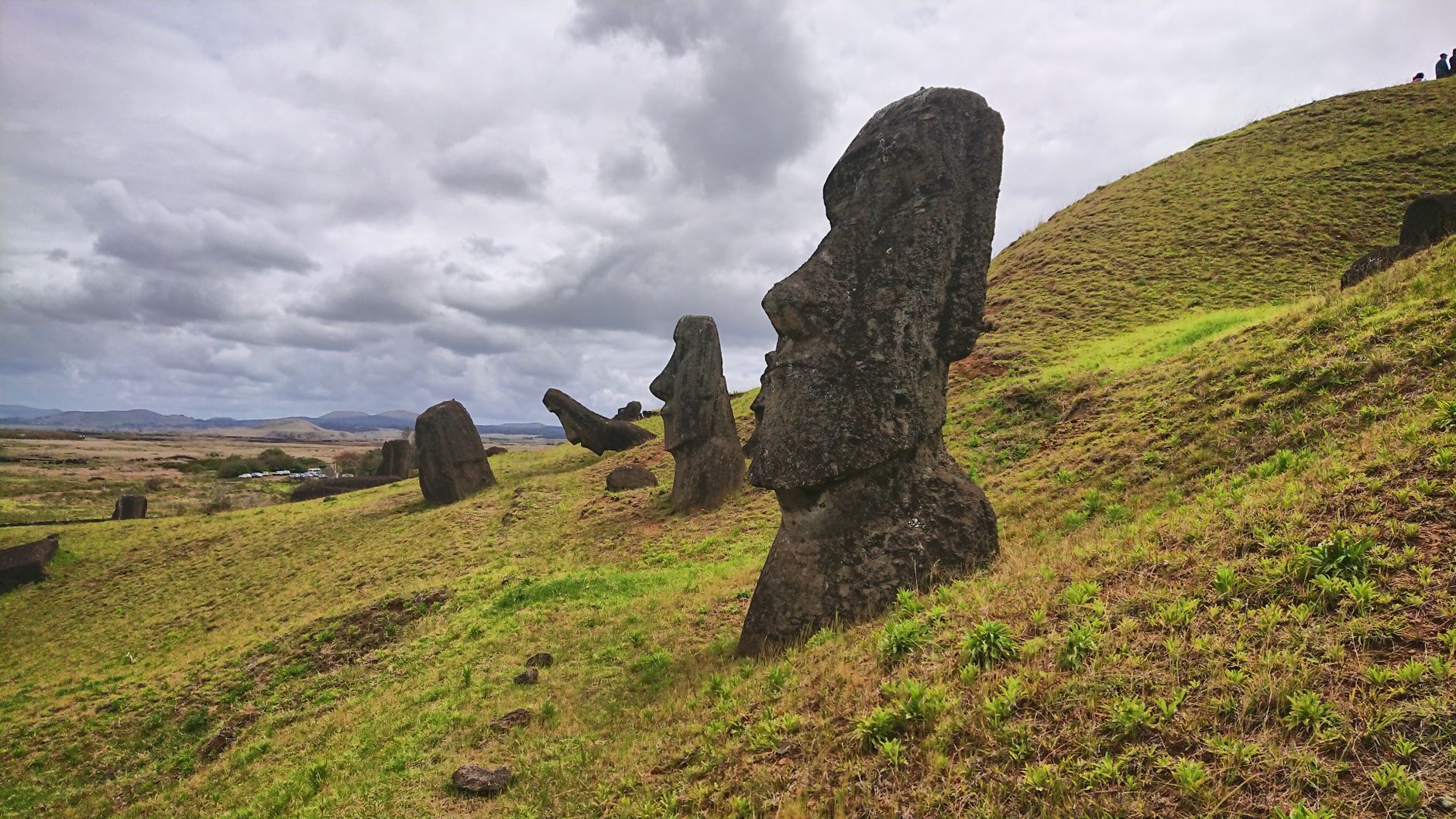
여기서 흥미로운 부분이 나옵니다. 연구팀이 섬 전역의 모아이 962개를 전수 조사하고, 그중 길가에 쓰러져 있던 62개를 따로 분석했더니 공통된 특징이 드러났습니다. 밑바닥이 D자 형태로 볼록하고, 몸체가 앞으로 6도에서 15도가량 기울어져 있었던 겁니다. 혼자 세워두면 앞으로 고꾸라질 정도의 기울기라고 하니, 언뜻 설계 결함처럼 보이지 않나요. 그런데 의외로 이게 핵심이었습니다. 무게 중심이 앞쪽으로 쏠려 있어야 좌우로 흔들 때 한쪽 모서리를 축으로 삼아 회전하듯 앞으로 나아갈 수 있었다는 겁니다. 완성된 모아이일수록, 그러니까 실제로 운반될 예정이었던 석상일수록 이런 형태가 두드러졌다는 점도 이 가설에 무게를 실어줍니다.
운반로도 이 가설과 딱 맞아떨어집니다. 섬 곳곳에 남아 있는 옛길은 폭이 약 4.5미터로 일정하고, 가운데가 오목한 U자형 단면을 가지고 있습니다. 석상을 눕혀서 굴리거나 썰매로 끌었다면 이런 형태의 길이 나올 이유가 없다는 게 연구팀 설명입니다. 오히려 좌우로 흔들리며 걷는 석상의 움직임을 지탱하기 위해 길 가장자리를 다졌다고 보는 편이 더 자연스럽다는 거죠.
그렇다고 논쟁이 완전히 끝난 건 아니다
벌써 이걸로 미스터리가 다 풀렸다고 하기엔 이릅니다. 과거에는 통나무를 바닥에 깔고 그 위로 석상을 눕혀서 굴렸다는 ‘통나무 굴림설’이 정설처럼 여겨졌습니다. 실제로 1998년 체코의 공학자 파벨 파벨(Pavel Pavel)과 노르웨이 탐험가 토르 헤위에르달(Thor Heyerdahl) 팀이 통나무와 밧줄을 이용해 석상 복제품을 눕혀서 끌어보는 실험을 진행한 적도 있습니다. 이 방식도 어느 정도는 통했습니다. 문제는 이스터섬에 그렇게 많은 통나무를 댈 만한 숲이 있었는지, 그리고 있었다 해도 그게 다 모아이 운반에 쓰였는지는 여전히 불분명하다는 점입니다. 리포와 헌트의 ‘걷는 모아이’설은 나무를 거의 쓰지 않고도 설명이 된다는 점에서 매력적이지만, 이 역시 모든 석상, 모든 구간에 똑같이 적용됐다고 단정하기는 어렵습니다. 경사가 급하거나 지형이 험한 구간에서는 또 다른 방법이 쓰였을 가능성도 충분히 남아 있습니다.
나무가 사라진 이유, 생각보다 복잡하다
나무를 베어서 망한 게 아니었다. 이스터섬 하면 따라붙는 또 하나의 서사가 있습니다. 원주민들이 모아이를 만들고 옮기느라 숲을 다 베어버려서 스스로 문명을 무너뜨렸다는, 이른바 ‘에코사이드(ecocide)’ 이야기입니다. 재레드 다이아몬드의 저서 ‘문명의 붕괴’를 통해 널리 퍼진 이 설명은 오랫동안 정설처럼 받아들여졌습니다. 그런데 최근 고고학과 기후학 연구들은 조금 다른 그림을 보여줍니다. 16세기 중반 이후 섬에 수백 년간 이어진 가뭄이 있었고, 폴리네시아쥐가 야자나무 씨앗을 먹어치우면서 숲의 자연 재생이 애초에 어려웠다는 겁니다. 그러니까 섬 주민들이 무분별하게 벌목만 한 게 아니라, 여러 요인이 겹쳐서 숲이 서서히 줄어들었다는 쪽에 가깝습니다. 1722년 네덜란드 탐험가 야코프 로헤베인(Jacob Roggeveen)이 부활절 일요일에 이 섬을 처음 ‘발견’했을 당시 인구는 약 3천 명에서 5천 명 정도로 추정되는데, 이 숫자 자체도 완전한 붕괴라기보다는 환경 변화에 적응한 결과로 보는 시각이 늘고 있습니다.
채석장에 미완성 석상이 수백 개나 남아 있는 이유
라노 라라쿠(Rano Raraku) 채석장에 가보면 이상한 광경을 만나게 됩니다. 완성되지 못한 채 산비탈에 반쯤 파묻힌 모아이가 수백 개나 그대로 남아 있는 겁니다. 그중에는 ‘엘 기간테(El Gigante)’라 불리는, 완성됐다면 높이 21미터에 무게 145톤에 달했을 것으로 추정되는 초대형 석상도 있습니다. 왜 작업이 중단됐을까 싶은데, 최근 빙엄턴대와 애리조나대 공동 연구팀이 드론으로 채석장 이미지 1만 1천 장 이상을 촬영해 3차원 모델을 만든 결과가 흥미롭습니다. 채석장 안에서도 조각 기법이 다른 작업 구역이 약 30곳이나 확인됐다는 건데, 이는 하나의 중앙 권력이 통제한 작업이 아니라 여러 씨족 집단이 각자 구역을 나눠 독립적으로 작업했을 가능성을 시사합니다. 그렇다면 미완성 석상들은 재앙 때문이 아니라, 그저 어느 집단이 작업을 마무리하지 못했거나 우선순위가 바뀌었기 때문일 수도 있습니다. 의외로 시시한 이유일 수도 있다는 거죠.
구조와 분업 이야기에서 잠깐 시선을 돌려, 석상의 ‘얼굴’ 자체로 가보겠습니다. 모아이의 눈에도 사연이 있습니다. 원래 완성된 석상에는 흰 산호로 만든 공막과 붉은 응회암이나 흑요석으로 만든 눈동자가 박혀 있었습니다. 지금 우리가 보는 텅 빈 눈의 모아이는 원래 모습이 아니라, 세월이 지나며 눈이 빠져버린 상태인 셈입니다. 눈을 끼운 상태에서만 석상이 ‘마나(mana)’라는 초자연적 힘을 갖게 된다고 믿었다는 기록도 있는데, 이걸 알고 나면 사진 속 텅 빈 눈이 조금 다르게 보이기도 합니다.
붉은 모자, 그리고 아직 못 읽은 문자
일부 모아이 머리 위에 얹힌 붉은 원통형 모자, ‘푸카오(pukao)’도 여전히 궁금증을 남깁니다. 이 모자는 몸체와 다른 채석장, 그러니까 푸나 파우(Puna Pau)라는 붉은 화산암 채석장에서 따로 만들어졌는데, 무게가 최대 12톤에 달하는 이 돌덩이를 어떻게 석상 머리 꼭대기까지 올렸는지는 걷는 모아이 가설로도 완전히 설명되지 않습니다. 승용차 예닐곱 대를 합친 무게의 돌을, 나무도 부족했던 섬에서 10미터 가까운 높이까지 밀어 올렸다는 이야기인데 상상만 해도 아찔합니다. 경사로를 이용해 굴려 올렸다는 설, 밧줄과 지렛대로 끌어 올렸다는 설이 있지만 어느 쪽도 확실한 물증은 없습니다.
여기에 더해 롱고롱고(rongorongo)라는 문자도 있습니다. 나무판에 새겨진 이 상형문자는 태평양 지역에서 거의 유일하게 독자적으로 발전한 문자 체계로 추정되는데, 지금까지 전 세계에 남은 판은 20여 개뿐이고 완전히 해독된 적이 없습니다. 19세기 후반 선교사들이 섬에 들어왔을 때 이미 이 문자를 읽을 수 있는 사람이 거의 없었다고 하니, 뜻을 잃어버린 채 형태만 남은 셈입니다.
결국 남는 질문
‘걷는 모아이’ 가설은 지금까지 나온 설명 중 가장 정교하고 실험적으로 검증된 편입니다. 그런데도 모든 미스터리가 풀린 건 아닙니다. 887개나 되는 석상 전부가 똑같은 방식으로 옮겨졌는지, 지형이 가파른 구간에서는 어떤 보조 수단이 쓰였는지, 12톤짜리 푸카오는 정확히 어떻게 올렸는지는 여전히 가설 단계에 머물러 있습니다. 롱고롱고 문자를 해독할 실마리도, 채석장 30개 구역이 정확히 어떤 사회 구조를 반영하는지도 마찬가지입니다. 그렇다고 답답해할 일만은 아닙니다. 이스터섬의 거인들은 여전히 우리에게 묻고 있습니다. 미스터리가 하나씩 풀릴 때마다, 다음 질문은 또 얼마나 놀라운 모습으로 나타날까요.
자주 묻는 질문
Q. 모아이 석상은 총 몇 개나 남아 있나요?
섬 전역에 공식적으로 확인된 모아이는 887개입니다. 이 중 상당수는 채석장인 라노 라라쿠 주변에 미완성 상태로 남아 있고, 실제로 해안가 제단(아후, ahu)에 세워져 완성된 형태로 옮겨진 것은 이보다 적습니다. 2025년 연구에서는 이 중 962개(중복 집계 포함 추정치)를 전수 조사해 위치와 형태 데이터를 분석했습니다.
Q. 이스터섬에 실제로 가면 모아이를 직접 만질 수 있나요?
대부분의 모아이는 칠레 정부가 관리하는 라파 누이 국립공원 구역 안에 있고, 훼손 방지를 위해 접근과 접촉이 엄격히 제한됩니다. 2008년에는 한 관광객이 석상 귀 조각을 훼손해 벌금과 함께 섬 출입이 금지된 사례도 있었습니다. 가까이서 보는 것은 가능하지만 만지는 행위는 대부분 구역에서 금지되어 있다고 보면 됩니다.
Q. ‘걷는 모아이’ 실험은 재현 가능한가요, 아니면 한 번뿐인 이벤트였나요?
2025년 논문 이전에도 리포와 헌트는 2011년 미국 방송사와 함께 비슷한 실험을 소규모로 진행한 적이 있습니다. 이번 실험은 더 정교한 3D 모델링과 물리 시뮬레이션, 그리고 실제 지형에 가까운 조건에서 재현했다는 점이 다릅니다. 다만 실험은 어디까지나 현대 조건에서의 재현일 뿐, 수백 년 전 실제 운반 과정을 그대로 증명하는 건 아니라는 점은 연구팀도 인정하는 한계입니다.
You hesitate. Not because you’re hiding your age, and not because you forgot your birthday — you hesitate because the honest answer depends on who’s asking, why, and which year it currently is. I’ve watched people stall on this exact question, run the arithmetic out loud, and then just pick a number and hope it lands close enough. That small pause is the whole story of Korean age, compressed into a couple of seconds of visible math.
The system nobody designed on purpose
The old counting system, called se-nai (세는 나이) in Korean, didn’t start you at zero. A baby born on any day of the year was already considered one year old the moment it arrived. That wasn’t sloppy math — it came from an older East Asian convention of counting the time spent in the womb as part of a life already in progress. You weren’t nothing before birth, so you didn’t start counting from nothing.
Then the part that really confuses outsiders: everybody aged up together on January 1st, no matter when their actual birthday fell. A baby born on December 30th turned “two” on January 1st, two days later — not two years old in any biological sense, just two by the count. Which raises an odd question nobody quite has a clean answer for: what do you do with a baby’s first birthday party, the traditional dol celebration with the doljabi tray of objects the baby picks to “predict” their future, when the baby is technically already registered as two by the time the actual first-birthday date rolls around? In practice, families just celebrated dol on the real anniversary of birth regardless of what the official count said — the ritual tracked biology, the number tracked the calendar, and everyone quietly lived with the mismatch.
Age as something you do together, not alone
If you’re used to a Western framework, this feels almost backwards — shouldn’t your age be the most individual fact about you, tied to the exact date you personally arrived? Traditionally in Korea, not really. Age worked more like a shared seasonal marker, something the whole country experienced together, similar to how everyone’s rice-cake soup on Seollal, the Lunar New Year, marks a collective turning of the year rather than a private milestone. You didn’t age alone. You aged with everyone else, on the same calendar day, whether you liked it or not.
That collective framing shows up in language too. Korean social structure leans heavily on relative age — who’s the hyung, who’s the noona, who owes who the honorific speech level — and se-nai made that sorting simple. Everyone born in the same calendar year was, functionally, the same age. No birthday math required, no exceptions to track. It’s efficient for a culture where age quietly determines a surprising amount of daily social choreography, and it’s exactly why the system survived for centuries even as much of the world moved to counting from zero.
What actually changed in June 2023
By the early 2020s, having three overlapping age systems running at once had turned into a genuine administrative headache — pension eligibility, medical consent forms, insurance payouts, and rental contracts kept tripping over which “age” applied where, and ordinary people were the ones stuck untangling it. So on June 28, 2023, South Korea’s revised Civil Act and General Act on Public Administration took effect, making international age — man-nai (만 나이), the counting-from-zero, add-a-year-on-your-birthday method most of the world already uses — the default for virtually all legal and administrative purposes. The bills had passed the National Assembly back in December 2022, with President Yoon Seok-yeol’s administration pushing the change specifically to end the day-to-day confusion.
The practical effect was strange but simple to calculate: overnight, most Koreans became one or two years younger on paper. Take someone born December 31, 1980. Under se-nai, they were already 43 as of June 27, 2023. The next morning, under international age, they were 42 — not because anything happened to them, but because the method of counting reset around them while they slept. Nobody’s actual birth date moved. Only the arithmetic did. There was a small wave of jokes at the time about “getting younger for free,” and most people I’ve heard discuss it treated it exactly that way — a pleasant, mildly funny piece of national trivia rather than a serious bureaucratic overhaul.
The exceptions nobody warns you about
Here’s the catch, and it’s one that trips up even Koreans: the 2023 law didn’t kill every alternate age system. You’d expect one law, one age, done and settled. Not quite. A third counting method, yeon-nai (연 나이) — “year age,” calculated simply as the current year minus your birth year, with no birthday adjustment at all — still governs a specific set of situations by design. Military conscription eligibility runs on yeon-nai. So does the Youth Protection Act, which sets the legal drinking and smoking age.
In practice, that means the legal drinking age in Korea isn’t tied to your actual birthday. It’s tied to the calendar year you were born in. If you turn 19 by yeon-nai count in a given year, you can legally buy alcohol and cigarettes starting January 1st of that year — even if your real birthday, under international age, hasn’t happened yet. So a teenager born in November could legally be served soju in a restaurant in, say, March, months before their international-age 19th birthday would actually arrive. Convenience store ID checks in Korea are built around exactly this quirk — clerks check birth year on the ID, not the exact birthdate, and that’s not an oversight. It’s the law working precisely as intended.
Why “what year were you born” still beats “how old are you”
You’d think that after a national law standardizing age, people would just start answering “how old are you” with a clean international-age number. Surprisingly, that’s not really what happened in everyday conversation. Koreans still very commonly ask “myeot nyeon-saeng-i-seyo” (몇 년생이세요) — literally, what year were you born — instead of asking for an age directly. It sounds like a small phrasing quirk, but it’s actually the more useful question, because a birth-year answer sidesteps the ambiguity of which counting system the other person has in their head. Two people born in the same calendar year are functionally the “same age” for social purposes, no matter which system either of them is mentally using — which keeps the honorific and seniority calculations running the way they always have.
This is where the law and the culture quietly diverged. Legally, Korea moved to international age. Socially, the birth-year framework that used to define se-nai never really left, because it still answers the question people actually care about: are you my senior, my junior, or my peer. Think of it like an invisible org chart at every dinner table — no job titles, no name tags, but everyone in the room instinctively knows who pours first and who gets addressed with honorifics, based entirely on the year stamped on their birth certificate. A 2023 law can rewrite a government form. It can’t really touch decades of built-in reflex about who reaches for the soju bottle first, turns slightly away from the table to drink, and holds the bottle with two hands when pouring for someone senior. Even people who’ve fully absorbed “I’m technically two years younger now” will still defer to someone born the year before them, because that social math never ran on the legal definition to begin with.
Navigating it as a foreigner
For anyone living in Korea without having grown up inside this system, the practical challenge isn’t the math — that part clicks after about five minutes with a pen and paper. It’s knowing which number belongs in which room. Filling out a hospital form or a bank application, you use international age, full stop; June 2023 settled that question completely. But in a casual conversation with coworkers about age, giving a number that’s technically correct by international counting can land a little oddly if everyone else at the table is still running the old birth-year comparison in their head.
The simplest fix, and the one that actually works in practice: skip stating an age entirely and answer with your birth year instead. If someone asks your age, just say “1994-nyeon-saeng-ieyo” (1994년생이에요) — “I was born in 1994” — instead of doing the age math yourself. It sidesteps almost every version of the confusion in one move, and it signals that you understand what’s actually being asked, which tends to land better, in my experience watching this play out, than a technically precise age ever does.
Frequently asked questions
Does the 2023 law mean Korean age is gone completely?
Not entirely. International age (man-nai) is now the default for essentially all legal, administrative, and medical purposes as of June 28, 2023. But a separate counting method, yeon-nai — current year minus birth year — still governs specific areas by law, most notably the drinking and smoking age under the Youth Protection Act and military conscription eligibility. The traditional se-nai system, where you’re born at one and everyone ages up together on New Year’s Day, no longer has any legal standing, but it still shows up informally in casual conversation and social age-ranking.
If I’m 20 by international age, am I automatically old enough to drink?
Not necessarily, and this is one of the most common points of confusion. Drinking and smoking age in Korea run on yeon-nai, calculated purely by birth year, not exact birthdate. Depending on your birth month, you could become legally able to drink under yeon-nai before your international-age birthday actually arrives, or vice versa — the two systems can genuinely give different answers to “am I old enough” depending on the month and how close you are to New Year’s.
Why do Koreans ask what year you were born instead of your age?
Because birth year avoids the ambiguity of which age-counting system the other person is using in their head, and it’s also the number that actually determines social seniority in Korean culture — who uses honorific speech to whom, who’s addressed as hyung or noona, and so on. It’s less about the law and more about a social habit that predates the 2023 reform by decades and doesn’t appear to be going anywhere.
The first time I watched a grandmother at a cramped neighborhood kalguksu joint point at a foreign tourist’s feet like she’d spotted a fire, I understood something about Korea that no guidebook had managed to explain. It wasn’t anger. It wasn’t even really annoyance. It was closer to the reflex you’d have if someone tracked mud across a floor you’d just mopped — automatic, a little panicked, and completely unbothered by whether the offender meant any harm. He’d missed the hyeon-gwan, the sunken entry step every Korean building has, and walked straight past it in his sneakers. That reaction, multiplied across millions of households and restaurants, is the exact blueprint for why Koreans don’t wear shoes indoors. It’s not a rule written down anywhere. Nobody teaches it in a classroom. It’s just absorbed, the way you absorb which side of the escalator to stand on.
Why the floor is actually furniture
Most explanations of this custom jump straight to hygiene, and hygiene is real, but it’s actually the second reason, not the first. The first reason is architectural, and it goes back further than most people assume. Korean homes have been heated from below for roughly two thousand years, through a system now called ondol — literally “warm stone,” though the older, more native word is gudeul. Archaeologists have traced heated-floor structures on the Korean peninsula back to the Bronze Age, with clear examples from around 1000 BCE in what’s now North Korea. The system that eventually heated an entire room, rather than just a corner, spread widely during the Goryeo dynasty in the 13th century and became standard across the peninsula by the early Joseon period.
The mechanism itself was simple and, frankly, clever for its time. A wood or straw fire burning in a kitchen hearth called an agungi sent smoke and heat through a network of stone channels, or gorae, running underneath the floor slabs before venting out a chimney on the far side of the house. The floor itself became the radiator. Picture the warmth of a heated car seat on a cold morning, except it’s under your entire body, all night, radiating up through a stone slab instead of foam and wiring. There was no separate heating system to install or maintain — the same fire that cooked dinner also warmed the room you’d eventually sleep in.
Here’s the part that surprises people: this wasn’t a supplementary comfort, like a rug or a space heater. It restructured how Koreans used their bodies inside a house. If your floor is the warmest surface in the room, you don’t put a bed up on legs above it — you sleep on the floor, on a folded mattress called a yo, moved and stored during the day so the room can serve other purposes. You don’t sit in chairs around a raised table — you sit cross-legged around a low one. Furniture in traditional Korean homes stayed low and light precisely because the real infrastructure, the heating itself, was underfoot. So when you ask why Koreans take their shoes off, the honest answer starts with: because the floor isn’t just something you walk on here. It’s something you sit on, eat on, and lie down on, often within the same hour.
You might wonder whether any of this still matters in 2026, when most Koreans live in high-rise apartments with hot-water pipes running under the concrete instead of smoke channels under stone. It does, actually — that’s the part that still trips up expats who’ve lived in Seoul for three years and never quite thought about why their apartment feels different from a place back home. Modern apartment heating, still called ondol out of habit, works on the same basic principle: heat the floor, not the air. Walk into almost any Korean apartment in winter and the first thing you’ll notice is warm feet before warm air. The old logic never left. It just got quieter and more efficient.
The spatial logic of inside versus outside
Once you understand the floor-centered lifestyle, the hygiene reasoning stops sounding like an overreaction and starts sounding almost inevitable. If you’re going to sit where you walk, and sleep where you sit, then whatever your shoes picked up on the sidewalk — and city sidewalks pick up a lot — is going to end up against your skin, your food, your child’s face. This isn’t really about germophobia in the Western, hand-sanitizer sense. It’s closer to a spatial rule: outside is outside, and it stays there. Korean apartments and traditional hanok houses both formalize this with that recessed entryway, the hyeon-gwan, usually sunk a step below the main floor level. You stand in that lower zone with your shoes still on, take them off there, and only then step up onto the raised, heated floor in socks or bare feet. The step itself is doing conceptual work — it’s a small, physical line between “outside world” and “inside world,” and crossing it with shoes on breaks the logic of the whole house.
And this is where the etiquette gets genuinely specific, not just “take your shoes off.” The polished move — the one that signals someone grew up doing this rather than learning it as an adult — is to step out of your shoes facing into the house, then turn around and nudge the shoes so they point back toward the door, heels lined up neatly. It sounds almost absurdly minor. But think about what it solves: the next person leaving that house, maybe in a hurry, can step straight into their shoes and walk out without twisting around or fumbling. It’s a tiny act of consideration aimed at a future version of yourself, or at whoever leaves after you. I’ve watched Korean guests do this on total autopilot, mid-conversation, without even glancing down at their feet. It’s muscle memory, not manners performed for an audience.
Where the rule follows you, and where it doesn’t
This is the part that trips up a lot of visitors, because they brace for the shoes-off rule at someone’s house and then get blindsided by it showing up at a restaurant. Plenty of traditional Korean restaurants still use ondol-style floor seating — low tables, cushions instead of chairs, sometimes a sunken well under the table so your legs can hang down comfortably. Walk into one of those and shoes come off at the entrance exactly the way they would at a home, sometimes into open cubbies, sometimes into small lockers if the place is nicer. Temple stay programs and hanok guesthouses extend the logic even further, since you’ll often be on wooden floors and thin floor cushions for hours at a stretch, and jjimjilbang saunas go past even that.
Now picture walking a single block in downtown Seoul. Step into a glass-fronted office tower or a chain coffee shop with hard tile and chairs, and nobody expects you to touch your laces — that space reads as an extension of the street. Duck down a side alley into a tiny hanok-style restaurant with low tables and floor cushions, and shoes come off at the door exactly the way they would at someone’s grandmother’s house. Same street, same ten minutes, two completely different rules, and Koreans switch between them without a second thought. The rule isn’t really “shoes off indoors” as a blanket law — it’s “shoes off wherever the floor itself is functional furniture.” Once that distinction clicks, the whole system stops feeling arbitrary.
What it’s like adjusting to it from the outside
Foreigners tend to have a complicated, not entirely negative relationship with this custom, and it’s worth being honest about both sides of it. There’s a real adjustment period — lacing and unlacing boots several times a day turns into a small daily workout in a cramped entryway, especially in a Seoul winter when you’re layered up and running late. There’s also the mild social anxiety of not knowing, the first few times, whether a given restaurant or office expects shoes off or not, and the slight dread of standing at someone’s door doing mental math about whether your socks have holes in them.
That sock anxiety is not exaggerated, by the way — it’s one of the more universally reported small stresses among people newly living in Korea, precisely because bare feet or socks become visible here in a way they never are in shoe-wearing cultures. It’s common enough that plenty of long-term expats keep a spare, unworn pair of socks tucked in a bag just in case they end up at a traditional restaurant or someone’s home unannounced, and the subway underpass sock stalls that seem to exist in every Seoul station start to make a lot more sense once you’ve had that particular panic once or twice.
But most people who stick around long enough end up genuinely converted, and not just out of politeness. There’s something to be said for a home where the floor is reliably clean enough to sit on without thinking twice, where a toddler can crawl across it without picking up whatever was on the street that day. Once you’ve lived in an ondol-heated room in January, with warmth radiating up through your feet while the air outside sits at minus ten, forced-air heating in shoes-on countries can start to feel almost primitive by comparison — the kind of thing you don’t fully appreciate until the first time you’re back home, barefoot on a cold hardwood floor, missing the warm stone under your feet.
FAQ
Do Koreans really point their shoes toward the door, or is that just internet trivia?
It’s real, though not everyone does it with the same precision. It’s considered thoughtful, above-average etiquette rather than a strict rule — nobody scolds a guest for skipping it, but hosts notice.
Is it rude to ask a Korean host whether you should take your shoes off?
No — it shows you’re paying attention. In practice you rarely need to ask: a sunken hyeon-gwan, a shoe rack, or slippers by the entrance is usually a clear enough signal on its own.
What if my socks have holes or I’m not wearing any?
Nobody will say anything to your face, but it’s noticed, especially somewhere formal like a temple stay. Keeping a spare pair in your bag before visiting a home or a traditional restaurant isn’t overkill.
Look at a Korean business card and the sequence almost never wavers: family name first, given name second, no comma between them. It shows up the same way on delivery slips, hospital wristbands, and the subtitles under a newsreader’s face. Foreigners tend to notice the order only when it costs them something — a hotel reservation that doesn’t match a boarding pass, a courier who calls out the wrong half of a name at an apartment lobby and gets blank stares back. Two syllables, one small flip, and suddenly a name that was never actually wrong on paper looks wrong to whoever’s checking it. Living inside this system long enough makes the logic feel obvious, which is exactly the problem — it’s worth pulling apart for anyone encountering it for the first time.
Family First, Self Second
In a name like Kim Ha-yun, Kim is the family name and Ha-yun is the given name — two syllables functioning as one unit. Swap the order into English style and you’d get “Ha-yun Kim,” which is exactly what shows up on a lot of international paperwork, and exactly what trips people up later. The logic behind putting the surname first isn’t arbitrary formality; it reflects an older assumption that a person is introduced as a member of a lineage before being introduced as an individual. You are a Kim, or a Lee, or a Park, and only after that are you Ha-yun or Min-jun or Seo-yeon. English does roughly the opposite, prioritizing the individual and tacking the family on at the end, which is part of why the two systems clash so awkwardly whenever they meet on the same form.
What surprises a lot of newcomers is exactly how few surnames the whole system runs on. According to South Korea’s most recent census figures, Kim alone accounts for roughly 21 percent of the population, Lee sits around 15 percent, and Park adds another 8 percent — meaning close to 45 percent of the country shares one of just three surnames. Add Choi, Jung, Kang, Cho, Yoon, Jang, and Lim, and you’ve covered the overwhelming majority of people you’ll meet. That concentration is exactly why the given name carries so much of the identifying weight in daily life; in an office with a dozen Kims on the payroll, the surname alone tells you almost nothing useful, and everyone defaults to the given name or a title to sort out who’s who.
The Two-Syllable Puzzle: Given Names and Dollim-ja
Most Korean given names run two syllables, and that’s rarely accidental. In many families, one syllable is a shared “generation name,” or dollim-ja (돌림자), that ties siblings and cousins of the same generation together, while the other syllable is unique to the individual. If the generation character is Min, you might find siblings named Min-jun, Min-seo, and Min-ho all under the same roof — the shared syllable marking them as belonging to the same rung of the family tree, the other syllable marking them as themselves. Some clans still keep a formal jokbo, a family register book that assigns a specific generation character to every cohort decades in advance, so a grandparent flipping through it can place a distant relative’s exact generation and rough age just by reading one syllable of their name.
Younger parents have loosened their grip on the tradition — plenty of names born after the 2000s skip dollim-ja entirely in favor of something that just sounds good or carries a nice meaning on its own. Still, the instinct behind it hasn’t fully disappeared, and it’s common enough to meet three cousins from the same generation whose names all share a syllable, even if none of them could recite the family’s formal generation-poem off the top of their head. It’s less a rulebook now and more a residual habit, one that occasionally resurfaces at family gatherings when someone points out that all the boys born in a certain decade got the same middle syllable.
The Form Problem: Which Box Gets Which Name
A lot of international forms — visa applications, hotel check-ins, airline bookings — are built around the Western assumption of “first name” and “last name,” and those labels map onto Korean names in a way that isn’t intuitive at all. For someone named Park Ji-min, “Park” goes in the box labeled “Last Name” and “Ji-min” goes in “First Name,” even though in the name’s native order, Park comes first and Ji-min comes second. The word “first” is doing double duty — sometimes it means “first name as in given name,” sometimes it means “the name written first on the page” — and those two meanings point in opposite directions for a Korean name. Type Ji-min into a booking site’s “First Name” field while the airline’s backend expects the name written first on a Korean ID, and the mismatch can print a boarding pass reading something like “Ji Park,” splitting a two-syllable given name in half and leaving it stranded next to the wrong surname. It’s the kind of error that looks trivial until an immigration officer is squinting between a printed ticket and a passport that technically say the same thing in the wrong order.
Weirdly enough, the mismatch causes almost as much trouble domestically as it does abroad, because Korean two-syllable given names sometimes get chopped into pieces by systems that assume a single given name and a single family name and nothing else. Someone named Lee Seo-yeon can end up with a database entry reading “Seo” as the middle name and “Yeon” as the last name, splitting a given name that was never meant to be split. It’s a small technical glitch, but it’s exactly the sort of clerical snag that turns a routine document request into a multi-week back-and-forth once a legal filing needs to match a passport character for character.
The Romanization Maze: Lee, Yi, Park, Bak, and Everything Between
Take the surname 이, the second most common family name in the country after Kim. Depending on who’s spelling it and when, you’ll see it written as Lee, Yi, I, Rhee, or even Ree. The government’s official Revised Romanization system technically renders it as “I,” but that one-letter spelling looked so strange next to English words that the National Institute of the Korean Language recommended “Yi” instead back in 2001. Almost nobody actually uses either. The overwhelming majority of people with this surname still spell it “Lee” on their passports, partly out of habit and partly because Korean passport regulations make it genuinely difficult to change a name’s spelling once it’s registered. Meanwhile, South Korea’s first president spelled his own name “Syngman Rhee,” and North Korea spells the same surname “Ri” almost uniformly — three governments, three different answers for one syllable.
Park runs into a similar split, just with less variety. The surname is spelled “Park” on the overwhelming majority of documents, largely because that spelling was already entrenched before the current romanization rules existed, but the more phonetically accurate Revised Romanization spelling is actually “Bak.” You’ll occasionally spot “Pak” too, especially in older academic transliteration or North Korean contexts. None of these spellings is exactly wrong — they’re frozen snapshots of whichever romanization rulebook happened to be in effect the day someone’s grandparent stood at a passport window and had a clerk type out a name. Korea has switched its official system more than once, most notably dropping the older McCune-Reischauer standard for the current Revised Romanization in 2000, and anyone whose passport predates that switch, or whose family simply kept an inherited spelling, ends up carrying a version that doesn’t match today’s “official” rules at all. Nobody’s rushing to fix it, either — once a name is printed on a passport, changing the spelling is its own bureaucratic ordeal.
The practical upshot is that romanized Korean names should be treated less like a fixed spelling and more like a personal choice with historical baggage attached. Two people can share the exact same Korean characters in their surname and legitimately spell it two different ways in English, and neither one is more correct than the other. It’s worth asking rather than assuming, especially in professional contexts where getting someone’s name wrong on a document can trigger a flagged file at immigration or a mismatched booking that takes an afternoon to untangle.
Why Koreans Almost Never Just Say Your First Name
Even once the naming order and spelling are sorted out, there’s a third layer that catches a lot of visitors off guard: Koreans still rarely use a bare given name to address each other directly. Calling a coworker or a stranger by their given name alone, with no title attached, can come across as oddly blunt or even disrespectful, depending on the age and rank gap between the two people. Instead, Korean substitutes relationship terms and job titles for the name itself — a colleague becomes “Team Leader” or “Manager,” an older sibling’s friend becomes “oppa” or “unni,” a senior at school or work becomes “sunbae.” The name itself often just sits quietly in HR records and on business cards, rarely spoken aloud the way an English-speaking office would use it constantly.
Turns out this isn’t really about secrecy or formality for its own sake — it traces back to a broader emphasis on marking relative age and social position in nearly every interaction, a habit with deep Confucian roots. Two coworkers who are genuinely close friends outside the office might still default to “Team Leader Kim” and “Manager Park” the moment they’re back at their desks, because the title communicates the relationship, not just the identity. It can feel impersonal to someone used to first-name-basis offices, but inside the system it actually reads as more precise: everyone in the room instantly knows who outranks whom, which matters more in daily interaction than most outsiders expect.
FAQ
Do all Koreans have two-syllable given names?
No, though it’s the most common pattern. Most given names run two syllables, often with one functioning as a dollim-ja shared across siblings or cousins, but single-syllable given names exist too, and they’ve become somewhat more common as parents move away from traditional generation-naming conventions.
Which name should I use when addressing a Korean colleague?
Default to their job title or an honorific rather than their bare given name, at least until they explicitly invite something more casual. “Manager Kim” or “Team Leader Park” is a safe, respectful starting point in almost any Korean workplace, and switching to first-name terms uninvited can come across as presumptuous even among people close in age.
Why do some Koreans spell their surname differently from their relatives?
Usually because of when a passport was issued or which romanization convention a family adopted early on. Since Korea has shifted its official romanization rules more than once, and passport name changes are tightly restricted, siblings or cousins can end up with slightly different spellings of what is, in the original Korean, the exact same surname.
Every September, my group chats go quiet for three days straight, and if you’ve never lived through a Chuseok in Korea, that silence is the first clue that something big is happening. Coworkers vanish. Delivery apps post “closed for the holiday” banners a week in advance. Even the convenience store on my corner, which I genuinely believed operated 24/7/365 out of some cosmic obligation, shuts its shutters. This year that silence lands on Friday, September 25, 2026. If you just landed a flight into Incheon that happens to overlap with it, or you’re new here and bracing for the quiet, you deserve a real explanation of what’s going on — not the two-line “it’s like Thanksgiving” version tour guides hand out.
So what actually is Chuseok?
Chuseok (추석) translates roughly to “autumn eve,” and it lands on the 15th day of the 8th lunar month every year — which is why the date on the solar calendar jumps around. It’s built on three overlapping ideas that don’t always get untangled for outsiders: a harvest festival thanking the year’s crop, a set of ancestral rites called charye performed for deceased family members, and a mass family reunion that empties out Seoul for the better part of a week. Most explainers stop at “it’s Korean Thanksgiving,” and sure, there’s a harvest-gratitude layer that overlaps. But the ancestral-rite part has no real American equivalent — it’s closer, structurally, to visiting a family shrine than to carving a turkey.
The confusing bit for a lot of newcomers is that Chuseok isn’t really one holiday, it’s three stacked on top of each other, and which one a given family emphasizes depends heavily on how traditional they are. Some households still do the full charye ceremony every year without fail. Others have quietly let it lapse, or condensed it into a shorter version, or skip it and just eat together. If you ask five Korean coworkers what Chuseok “is,” you might get five slightly different answers, and that’s not because anyone’s wrong.
The exact 2026 dates (and the holiday quirk worth knowing)
Chuseok Day itself falls on Friday, September 25, 2026. The official public holiday runs three days, from Thursday, September 24 through Saturday, September 26. Here’s the detail that trips people up: because the third day lands on a Saturday rather than overlapping a Sunday, Korea’s automatic “substitute holiday” rule doesn’t kick in, so Monday, September 28 stays a normal working day — unless the government makes a separate, one-off decision to designate it as a temporary holiday, which does happen some years but isn’t guaranteed. If you’re planning travel around a long weekend, don’t assume you’re getting four or five days off by default; check whether that extra Monday got approved before you book anything.
Banks, government offices, most hospitals except emergency rooms, and the vast majority of small businesses close for the full three-day stretch. Larger supermarkets and department stores usually close on Chuseok Day itself (the 25th) but stay open the days around it, often with shortened hours. Restaurants are a mixed bag — plenty of the small, family-run places you rely on simply vanish for the week because the owners are, unsurprisingly, also traveling to see their own families.
Minjok daedidong: the traffic event nobody warns you about
There’s a phrase Koreans use for the Chuseok travel surge — 민족대이동, minjok daedidong, which literally means “the great migration of the people.” It sounds dramatic until you see the highway camera footage, and then it sounds accurate. Korea’s expressway authority is projecting daily highway traffic averaging around 6.05 million vehicles during the 2026 holiday period, up roughly 11.8% from last year’s Chuseok. Tolls are waived across the entire expressway network from September 24 through 27, which is a nice gesture, but it also means everyone hits the road at once because there’s zero financial incentive to stagger a trip.
The numbers are staggering on paper, but the real education is in the rhythm of it. The worst congestion isn’t on Chuseok Day itself — it’s the day before, when everyone’s racing to their hometown for the morning rites, and the day after, when everyone’s racing back to Seoul before Monday’s a normal workday again. A Seoul-to-Busan drive that normally takes about four hours can stretch past ten during that window — roughly the distance from Boston to Washington, D.C., except half of it crawls at walking pace. KTX train tickets for the peak departure windows typically sell out within minutes of the reservation window opening, roughly two weeks ahead, so if train travel is part of your plan, that’s not a “buy it the week before” situation.
Songpyeon: the rice cake that’s basically the whole holiday in miniature
Songpyeon (송편) is the rice cake most closely associated with Chuseok, and it’s worth understanding because it shows up everywhere during the holiday — gift boxes, bakery windows, office snack trays. They’re small, half-moon-shaped cakes made from rice flour, filled with things like sweetened sesame, chestnut paste, or red bean, and traditionally steamed over a bed of pine needles, which is actually where the name comes from — “song” means pine. The pine needles keep the cakes from sticking together and leave behind a faint, slightly resinous smell that people who grew up with it describe as inseparable from the memory of the holiday itself.
The shape isn’t random, either — a detail easily missed if you inhale one on the go without asking. A half-moon represents something still growing toward fullness — the idea being that a family’s fortune, like the moon, is on its way up rather than already at its peak. There’s an old bit of folk wisdom that whoever shapes a particularly well-formed songpyeon will have good luck, or a good marriage, or a beautiful daughter, depending on which grandmother you ask. Families traditionally make them together the night before Chuseok, which functions as much as a bonding ritual as it does meal prep.
The charye table and what actually happens at a family gathering
Charye (차례) is the ancestral memorial rite performed on Chuseok morning, and it’s more structured than most outsiders expect. A low table gets set with an exact arrangement of food — rows of fruit, rice, soup, songpyeon, jeon (savory pancakes), and rice wine — following placement rules that have been passed down for generations and still get debated at the table — rice cakes go to the east side of the second row, noodles to the west, red fruit generally to the east and white fruit to the west, and heaven help you if you set out the wrong side by mistake in front of a strict grandfather. The eldest son’s household traditionally hosts, and family members take turns bowing in a specific order, oldest to youngest. Afterward, many families visit ancestral graves to tidy the site, a practice called seongmyo, sometimes preceded days earlier by beolcho, a separate trip specifically to cut back overgrown grass at the gravesite before the holiday.
What tends to surprise foreigners isn’t the ceremony itself, it’s how much unpaid labor sits behind it. The cooking, the table-setting, the cleanup — historically, and still very often today, that work falls disproportionately on the women who married into the family, not blood relatives. This has become an actual point of social friction in Korea in recent years, enough that “Chuseok stress” and “post-holiday divorce filings” are phrases that show up in the news cycle with some regularity. It’s not something every family talks about openly, but it’s the friction hiding underneath the holiday table.
Gift sets: the commercial layer that eats every mart in the country
Walk into basically any large supermarket in the weeks before Chuseok and you’ll find an entire section, sometimes an entire floor, dedicated to gift sets. This is a massive seasonal retail ritual, not a side note — Chuseok and Lunar New Year are the two biggest gift-giving occasions on the Korean calendar, and the sets are stacked like a pyramid by price point. At the accessible end, there’s the Spam gift set, which sounds like a joke to a lot of foreigners until they realize it’s a genuinely coveted, boxed-and-ribboned item that people give to landlords, coworkers, and distant relatives without a hint of irony — a standard nine-tin box runs around 30,000 won and is consistently one of the best-selling items in the entire gift-set category. Move up the ladder and you hit dried seafood assortments, premium fruit boxes, and Korean beef sets — E-Mart held its Chuseok short-rib set at 99,800 won this year specifically to counter inflation complaints — up through red ginseng and hotel-curated boxes running anywhere from roughly 100,000 to 300,000 won or more.
What’s easy to misread as excess is actually a fairly precise social system. The gift you give signals the relationship — a Spam set to your building’s security guard, fruit to a boss, ginseng to your own parents — and getting the tier wrong reads as either cheap or oddly showy. If you work at a Korean company, don’t be shocked if a gift set from HR or a manager shows up on your desk the week before the holiday; it’s not personal generosity so much as it’s the norm working exactly as designed.
What Chuseok feels like when you’re on your own
Here’s the part nobody puts in the tourist guides: for a foreigner living in Korea without extended family here, Chuseok is oddly quiet in a way that can catch you off guard. The city empties out. Streets that are normally choked with traffic go strangely calm. Restaurants you rely on are dark. It’s not lonely exactly — more like being handed three unscheduled days in a place that’s usually running at full volume, and not quite knowing what to do with the silence. Some foreigners use it as a genuinely great travel window, since domestic tourist spots outside the traffic corridors thin out while everyone’s headed to hometowns instead of sightseeing. Others end up cooking their own version of a holiday meal, or getting invited by a Korean friend’s family, which — if it happens — is worth taking seriously as an honor, not just a nice gesture, given how much of Chuseok is genuinely about family space.
Still, there’s something clarifying about experiencing a country’s biggest family holiday from just outside it. You notice things a busy regular week hides — how central the idea of ancestral continuity still is here even in a hyper-modern, hyper-digital society, how a rice cake can carry that much cultural weight, how a traffic jam can be a form of devotion. It doesn’t need to be your holiday for it to be worth paying attention to.
FAQ
Is Chuseok the same date every year? No — it follows the lunar calendar, so the solar date shifts annually. In 2026 it falls on Friday, September 25, with the official holiday running September 24–26. In past and future years it’s landed anywhere from early September to early October.
Will stores and restaurants be open during Chuseok 2026? Expect most banks, government offices, and small family-run restaurants to close for the full three-day period. Large supermarkets and department stores typically close on Chuseok Day itself (September 25) but reopen with adjusted hours on the surrounding days. Convenience stores generally stay open, though some smaller franchise locations close if the owner is traveling.
Should I avoid traveling in Korea during Chuseok? Not necessarily — domestic flights and highways to major hometown regions get genuinely congested, with expressway authorities projecting around 6.05 million vehicles a day on the roads. But destinations off that migration path, especially in Seoul itself once locals have left, can actually be pleasantly uncrowded. Just book KTX tickets early, since peak-window seats sell out fast, and don’t expect small local restaurants to be your backup plan.
I have eaten dinner standing at a plastic-topped counter under fluorescent light more times than I want to admit, and I regret almost none of it. Ask any expat who has lived here longer than a year what they miss most when they go home, and somewhere in the top three you will hear “the convenience store.” Not the food court, not a restaurant with a name — the convenience store, at eleven at night, with the hot water dispenser hissing and someone’s ramyeon timer counting down on their phone.
Korea did not invent the convenience store, but it perfected a very specific version of it: one where a triangle of rice and seaweed can be a legitimate meal, where a bag of chips can spark a national shortage, and where GS25, CU, 7-Eleven and Emart24 compete so hard on snack exclusives that Koreans genuinely have brand loyalty to a chain that sells gum and instant coffee. A cup of Jin Ramen runs somewhere around 1,300 won, a decent samgak gimbap another 1,500, and a canned coffee to wash it down maybe 1,500 more — dinner for under 5,000 won, eaten standing up, and I have done exactly that more nights than I’d care to count. So I ranked them. Not scientifically — there is no lab for this — but with the accumulated authority of someone who has run that same math a lot.
The rules I made up for myself
Before the list, some ground rules, because “best” is a dangerous word to throw at midnight processed food. I only counted things you can actually buy at GS25, CU, 7-Eleven, or Emart24 right now, not seasonal ghosts that vanished three years ago. I weighted taste, but also weighted the thing that separates a good convenience store snack from a good snack generally — does it survive being eaten standing up, possibly one-handed, possibly at 1 a.m.? A lot of genuinely excellent Korean food fails that test. Convenience store food has a different job. One more thing worth knowing going in: when I mention a chain’s “PB” line — GS25’s Youus, CU’s Heyroo, 7-Eleven’s Only@ — that stands for private brand, the store’s own in-house label. In most countries that phrase means cheap and forgettable. In Korea it’s closer to a flagship category, because these four chains compete less like grocery stores and more like restaurants running rotating specials against each other.
10. Samyang Buldak cup versions — respect, but not love
I’ll get the obvious one out of the way early, and some of you will already disagree with putting it this low. Buldak Bokkeummyeon, the fire noodle that built a YouTube subgenre out of people crying while eating, is available in cup form in every chain now, including the Buldak Carbonara and 2x Spicy versions. It’s fine. It’s more than fine, honestly — the carbonara cup version is genuinely well-balanced, creamy enough to cut the heat. But cup Buldak is drier and clumpier than the packet version cooked properly with a lid, and a lot of the appeal of Buldak was always the ritual of shaking the sauce packet and photographing the aftermath. In cup form, eaten alone with a plastic fork at a convenience store table, some of that theater is gone. Great snack. Not a top-tier convenience store snack specifically.
9. Binggrae Banana Milk
You could argue this doesn’t belong on a “snacks” list at all, since it’s technically a drink, but I’m including it because at this point Banana Milk functions more like a dessert course than a beverage. The barrel-shaped bottle has been basically unchanged since 1974, which in a country that redesigns its packaging every fiscal quarter is its own kind of statement. It’s sweet in a way that reads as slightly artificial and completely unbothered by that fact. My actual complaint is that it’s a touch too rich to pair with anything else — drink it with a spicy cup ramen and one of them loses. Best on its own, ideally cold enough that condensation is dripping down the bottle onto your hand while you stand outside the store.
8. GS25 Youus 1,000-won snack bars
This entry might look strange to anyone expecting a chip bag or a chocolate bar. GS25 has been pushing a line of extremely cheap Youus-brand items — nut and jerky bars in flavors like Butter Peanut, Salted Peanut, and Anchovy & Butter Peanut, priced at 1,500 won, alongside a run of “Real Price” snacks at a flat 1,000 won. These aren’t chasing the same audience as a name-brand bag of chips, and they don’t need to. Bar snack sales across GS25’s PB lineup reportedly grew over 11% year over year, which tells you this is a deliberate growth strategy, not a discount afterthought. The anchovy-butter-peanut bar in particular works because it balances the salt-lick intensity of dried anchovy against a sweet, creamy peanut coating — it sounds like it shouldn’t work on paper and then does, especially with a canned coffee.
7. CU Heyroo desserts (Baek Jong-won collabs included)
CU has quietly become the dessert chain, and I think this is underrated by people who default to GS25 out of habit because it has more locations. Under the Heyroo private brand, CU has leaned hard into soft, cakey convenience-store desserts, and its collaborations with celebrity chef Baek Jong-won have produced some legitimately good stuff rather than the usual cynical brand tie-in. The rotating cream buns and small cheesecakes taste like what they are — mass-produced, refrigerator-cold, a little dense from sitting in plastic — and that’s fine, because nobody is walking into a convenience store expecting a patisserie. But for something you grab on the way out the door at 9 p.m. because you suddenly need something sweet, CU’s dessert case is doing more interesting work right now than either of its two biggest rivals.
6. Nongshim Jjapageddi cup and Jin Ramen cup
Here’s a claim I’ll admit is a little unfashionable: the “gourmet instant” trend that’s taken over Korean cup noodles in the last couple of years has quietly made the boring, familiar stuff better than it used to be, and that matters more than another fire-noodle variant. Cup Jjapageddi — the instant version of jjajangmyeon, that black bean noodle dish everyone in Korea eats on birthdays and moving days for reasons nobody can fully explain — used to taste noticeably thinner than the packet version cooked at home. The current cup formula closes that gap a lot. Jin Ramen’s cup version leans mild and beefy rather than fiery, which after enough spicy cup noodles starts to feel less like a compromise and more like a relief. Neither one photographs well. Both disappear fast.
5. Honey Butter Chip and its many descendants
You cannot write this list without acknowledging the single most consequential Korean snack launch of the last fifteen years. When Haitai-Calbee released Honey Butter Chip in August 2014, nobody predicted what happened next — by that November, demand had so badly outstripped supply that stores were keeping waiting lists, capping purchases at one bag per customer, and bags were reportedly reselling online for nearly fifty times their original retail price of around 1,500 won. It sounds absurd typed out like that, and it was — the company reported roughly 10.3 billion won in sales within three months of launch, on a potato chip. What matters for this list is what came after: an entire genre of honey-butter-flavored snacks that still lives on today, from honey butter Kkokkalcorn to honey-butter-adjacent chip flavors that show up seasonally at every chain. The original chip itself, still on shelves, is genuinely good — sweet-savory in a way that doesn’t feel like a gimmick, crunchy enough to survive a bag getting crushed in a backpack. Not the single best snack on shelves today, but arguably the most important one, and still worth buying.
4. Samgak gimbap (triangle kimbap) — the workhorse
Some readers expected this at number one, and I understand the instinct. Samgak gimbap, the triangular rice ball wrapped in a separate layer of crisp seaweed you assemble yourself by pulling two plastic tabs, is the unofficial mascot of Korean convenience store food. It’s cheap — usually somewhere between 1,200 and 1,800 won depending on the filling — endlessly variable, and it photographs like nothing else on this list because the packaging is basically a small ritual. Spicy tuna mayo, bulgogi, kimchi, plain gim (seaweed and rice with nothing else, which sounds boring and is somehow perfect at 2 a.m.). Here’s my honest gripe, though: quality varies wildly by chain and even by location, and a dry, underseasoned samgak gimbap is a genuinely sad experience. When it’s good, it’s one of the best cheap meals in the country. When it’s mediocre, which happens more than fans of it want to admit, it’s just cold rice in plastic. That inconsistency is the only thing keeping it out of my top three.
3. GS25’s Omori ramen line
This is going to be my most controversial pick, because it’s the newest and least internationally known item here, but it deserves the placement. GS25’s Omori series is a premium instant ramen line exclusive to the chain, built around richer broths — real retort-pouch soup bases and meat rather than the flavor-powder-only formula most cup noodles still use. It’s part of a broader shift in Korean instant noodles away from “how spicy can we make this” and toward “how close can this get to actual restaurant ramyeon,” and Omori is the clearest example of a convenience store chain treating its own exclusive product line as a genuine culinary project instead of a licensing deal. It costs more than a standard cup noodle, and I think that’s the right trade. You’re paying for a broth that tastes like it simmered rather than dissolved.
2. Seasonal oversized items — Big Honey Hotteok and Extra Large Chicken Gangjeong
I debated putting a “category” this high, but the trend itself deserves recognition, not just one product. Korean convenience stores have leaned into deliberately oversized versions of already-popular items — GS25’s BIG Honey Hotteok and Extra Large Chicken Gangjeong, both roughly 1.5 times the size of the standard versions, are the clearest recent examples, and they work precisely because they lean into excess instead of apologizing for it. Hotteok, the syrup-filled fried pancake usually sold from street carts in colder months, translates surprisingly well to the heated convenience-store case, and the size increase isn’t just marketing — a standard street hotteok is basically two or three bites before the filling is gone, while the BIG version actually lets you finish it slowly, layer by layer, without rationing. More surface area also means a better ratio of crisp shell to molten honey-brown-sugar filling. The chicken gangjeong, coated in that sticky-sweet-spicy glaze, holds up even after sitting under the heat lamp for a while, which is more than I can say for most fried convenience store chicken.
1. Jin Ramen and Shin Ramyun cup, cooked properly, eaten at the store
I know. Putting the most obvious, least exotic option at number one feels like a cop-out, and I almost talked myself out of it. But the actual convenience store ramyeon experience — the hot water dispenser, the little folding stool, the two-minute wait staring at your phone — is the single most Korean thing on this entire list, and no other snack captures the full cultural weight of “pyeonuijeom” (편의점) culture the way a properly prepared cup of Shin Ramyun or Jin Ramen does. It’s not about which brand’s broth is objectively best, though Shin Ramyun’s beefy-spicy base still holds up against every newer competitor. It’s that this single act — buying a cup, adding hot water yourself, waiting at a shared counter next to a stranger doing the exact same thing — is the closest thing Korea has to a communal ritual built entirely around a convenience store. Add a triangle kimbap and a can of coffee and you have, genuinely, one of the best four-dollar meals available anywhere in the world. I’m not being sentimental for effect here. I think it’s just true.
Honorable mentions
A few things that didn’t crack the top ten but deserve a mention because leaving them out felt dishonest. Emart24’s collaboration snacks tend to fly under the radar compared to GS25 and CU’s marketing machines, but the chain’s own PB ice cream bars are underrated, especially in summer. 7-Eleven’s Only@ and 7-Select lines lean more toward imported and global snacks than the other three chains, which makes 7-Eleven the best option specifically when you’re craving something non-Korean at 11 p.m. and don’t want to think too hard about it. And I have to mention the self-serve coffee machines — CU’s Heyroo machines pull a surprisingly competent 1,000 to 1,500 won Americano, which sounds like a small thing until you’ve relied on one to survive a late night. Zoom out and the pattern across all four chains is the same one I mentioned at the start: convenience store growth in Korea has slowed as the market matures, so every chain is leaning harder into exclusive PB items — Youus, Heyroo, Only@ — as the thing that actually builds loyalty, because a generic snack aisle can’t. Whatever the business reason behind it, the result for a customer standing in the aisle is more interesting shopping than you’d expect from a place that also sells phone chargers.
FAQ
Which convenience store chain in Korea has the best snacks overall?
There isn’t a clean single answer, and honestly anyone who gives you one confidently is oversimplifying. GS25 tends to win on ramen exclusives (the Omori line) and PB bar snacks, CU wins on desserts and its Heyroo brand plus Baek Jong-won collaborations, 7-Eleven wins if you want imported or global items, and Emart24 is worth a stop for its underrated PB ice cream. If I had to pick one for a first-time visitor with limited time, I’d say GS25 or CU, mostly because they have the highest store density in most neighborhoods.
Is samgak gimbap safe to eat if it’s been sitting on the shelf?
Convenience stores rotate stock aggressively and mark expiration dates directly on the packaging, usually a same-day or next-day window depending on when it was made, so checking the date printed on the wrapper before buying is worth the five seconds it takes. Chains also generally pull unsold gimbap at set intervals rather than letting it sit for days, which is part of why quality can vary — you’re sometimes getting something made hours ago and sometimes something closer to its expiration window.
Can I find Honey Butter Chip and Buldak products outside Korea?
Both have gone fairly global at this point — Samyang’s Buldak line in particular is now sold in a lot of international supermarkets and Asian grocery chains, partly because of its social media popularity. Honey Butter Chip is less consistently exported and tends to show up more reliably in Korean or Asian grocery stores abroad rather than mainstream supermarkets, so if you want the original, a Korean convenience store is still the most reliable place to find it.
Somewhere around 11 p.m. most weeknights, the ceiling above my living room starts to talk. Not loudly — a chair dragged two feet, a child’s heel-drop, the specific thud of a laundry basket set down a little too hard — but consistently enough that I’ve started narrating the footsteps in my head like a sports commentator. This is not a complaint post. It’s closer to a confession: I am Yijidaddy, I have lived in Korean apartments for most of my adult life, and I have never once knocked on that neighbor’s door. Almost nobody does.
Koreans call it cheung-gan so-eum — literally, “between-floor noise” — and it is one of those phrases that needs zero translation once you’ve lived here, the way “rush hour” needs none in English. Ask a random group of ten Korean apartment residents whether they’ve had a noise problem with a neighbor, and I’d bet at least seven raise a hand. A 2013 government survey by the Anti-Corruption and Civil Rights Commission found that 79 percent of people in multi-household housing reported being distressed by neighbor noise, and 9 percent said the resulting conflict itself had caused them real stress. More than a decade later, anecdotally, it hasn’t gotten better. If anything, more people are simply naming it now, out loud, to an agency.
That agency is the Korea Environment Corporation’s Neighbor Noise Center, a hotline and counseling service that exists purely to mediate this exact kind of dispute. Last year it fielded roughly 33,027 consultations. In 2012, that number was 8,796 — close to a 275 percent jump in about a decade. I’ve scrolled through summaries of these numbers late at night, half-annoyed at my own ceiling, and the thing that strikes me isn’t that Koreans got noisier. It’s that a private irritation quietly turned into a publicly nameable problem with a government office attached to it. Before you can really understand why tens of thousands of people are calling that hotline every year, though, you have to look down — literally — at what they’re all standing on.
Why Korean Apartments Are Built the Way They Are
Here’s the part most outsiders miss: this isn’t really about rude neighbors. It’s structural, in the most literal sense of that word. The overwhelming majority of Korean apartment complexes use what’s called wall-bearing construction — the floor slabs rest directly on load-bearing walls rather than on a beam-and-column skeleton, the “Rahmen” style more common in older Japanese or Western buildings. That design is cheaper and faster to build, which matters enormously in a country where, according to Statistics Korea, apartments made up 53.1 percent of all housing units as of 2023. But a wall-bearing slab transmits impact noise — footsteps, dropped objects, dragged furniture — almost like a drumhead stretched between two rooms. A sharp heel-strike travels as a sharp crack; a dragged chair travels as a low, rolling thud you feel more than hear. There’s no beam structure in between to interrupt any of it.
For years, the legal minimum floor slab thickness for these buildings sat around 210 millimeters, and even that was frequently treated as a design target rather than a hard floor, if you’ll forgive the pun. Builders discovered that a slab tested for sound insulation in a lab, before installation, could pass easily — and then perform far worse once it was actually poured, cured, and topped with a thinner cushioning layer than advertised on paper. That gap between the spec sheet and the lived reality is, in my opinion, the single most underreported cause of the entire noise-wars phenomenon.
Regulators eventually caught on. Apartment builders are now required to test actual completed units for impact-sound performance after construction, not just submit a pre-approved sample floor design, and units that fail can be named publicly or face fines. Even so, that rule only applies going forward — it does nothing for the millions of units built under the old system, which is most of the country’s existing apartment stock. My own building predates the reform by a wide margin, which is a polite way of saying I already know how this paragraph ends for me personally.
The Etiquette Nobody Explains to You
If you move into a Korean apartment complex without a Korean friend to brief you, nobody hands you a manual, but there is one, unwritten and absolutely real. Slippers indoors are not a suggestion; they’re closer to a load-bearing social contract. Walk into almost any Korean home and you’ll find a small pile of noise-reduction slippers by the door — thick foam or gel soles specifically marketed as “cheung-gan so-eum slippers,” sold in every home goods aisle and on every shopping app, right next to the interlocking foam play mats parents put down under a toddler’s favorite running route. I own three pairs. I did not choose to become a person who owns three pairs of noise-dampening slippers; the apartment made that decision for me.
What surprised me more, honestly, was the note culture. Somewhere along the way, Korean apartment life developed an entire genre of anonymous, laminated notices taped to elevator walls or slid under doors. The tone ranges from gently pleading — something in the spirit of “please be a little more careful with noise after 10 p.m., we have a newborn” — to openly seething, occasionally illustrated with a cartoon of an angry face for emphasis. Management offices post these as general warnings to the whole building rather than naming a specific unit, which sounds diplomatic in theory but in practice means everyone quietly suspects everyone else. I’ve watched grown adults debate, with genuine intensity, whether a note was “about them.” It almost never is. It’s about all of us, all at once, which somehow makes it worse.
All of that — the slippers, the mats, the laminated notes — can feel almost cute in isolation, a quirky bit of shared apartment-block etiquette. But it’s worth remembering that this soft cushioning, literal and social, exists as a buffer against something that can turn genuinely serious.
When It Escalates — And It Does
The official advice, and I think it’s correct, is: never confront the neighbor directly. Go through the management office, or through a formal mediation channel like the Neighbor Noise Center, and keep a written log — date, time, duration, type of sound. That sounds almost bureaucratically cold for what is, at its core, an emotional problem between two households sharing a wall or a slab. But the research backs up the caution. One study tracking criminal cases connected to inter-floor noise disputes between 2013 and 2023 found 734 such cases nationally, and of those, roughly 70.5 percent involved violent offenses, with about 9.9 percent classified as serious felonies. Separately, police data shows more than half of noise-related reports involve some element of confrontation turning physical. Disturbingly, nearly all of those violent cases started with someone knocking on a door in person to “just talk it out.”
As it happens, the calm, bureaucratic, slightly absurd note-on-the-elevator system exists precisely because the alternative is so much worse. I used to find the anonymous-notice approach almost comically indirect — why not just talk to each other like adults? — but the more I read the case data, the more I understood it as a genuine safety valve. Removing the face-to-face element removes the moment where things go wrong. The Korea National Police Agency logged as many as 137,912 inter-floor noise reports between 2021 and 2024, an average of roughly 160 calls a day, nationwide. That’s not a niche problem. That’s a structural feature of how tens of millions of people live stacked on top of each other, in a housing form the entire country chose, for good economic reasons, decades ago.
Living With It, Not Solving It
What I’ve settled into, after years of this, is something closer to defensive courtesy: the slippers, the rubber-backed rug under the dining table, timing the washing machine’s spin cycle to daytime hours, and a working assumption that the people above me are, at worst, ordinary and tired rather than malicious. Even so, on the nights the thumping goes past midnight, the old irritation flares right back up, no matter how many statistics I’ve read about how common and structural the whole thing is. Knowing why something happens doesn’t always make it easier to sleep through.
What I keep coming back to is that this conflict says something bigger about density itself. Korea built vertical, fast, and affordable, and it got a country where the overwhelming majority of people live within a few feet — vertically — of a stranger’s daily habits. Mediation centers, slippers, laminated notices, tighter construction codes: none of these are fixes so much as they are the accumulated coping mechanisms of a society that built itself into this problem and is now, slowly and somewhat awkwardly, building its way back out.
FAQ
My upstairs neighbor’s kids run around every evening around 7 p.m. — is that normal, or should I file a complaint? Honestly, early evening is about as forgivable as it gets — that’s prime kid-chaos hour in most households, mine included at various points. I’d log it for a week or two just to see if it’s a pattern rather than a bad night, and if it keeps happening, route a polite note through the management office before you do anything else. Skip the direct knock; it almost never goes the way you picture it in your head.
I want to complain but I’m scared of retaliation from my neighbor. What’s the safest first move? Let the management office or the Neighbor Noise Center be the messenger, not you. That’s not cowardice, it’s just how this works best in practice — a neutral third party can raise the issue without your name attached to it, and given how many of these disputes turn ugly once it becomes face-to-face, keeping some distance is the genuinely smart move, not the timid one.
Do noise-reduction slippers and mats actually help, or is it mostly placebo? They help more than I expected them to, for what it’s worth — impact sound especially. But they’re a patch, not a cure. No amount of foam padding on your feet fixes a 1990s-era slab that was never built with proper cushioning underneath. Think of slippers as the seatbelt, not the airbag.