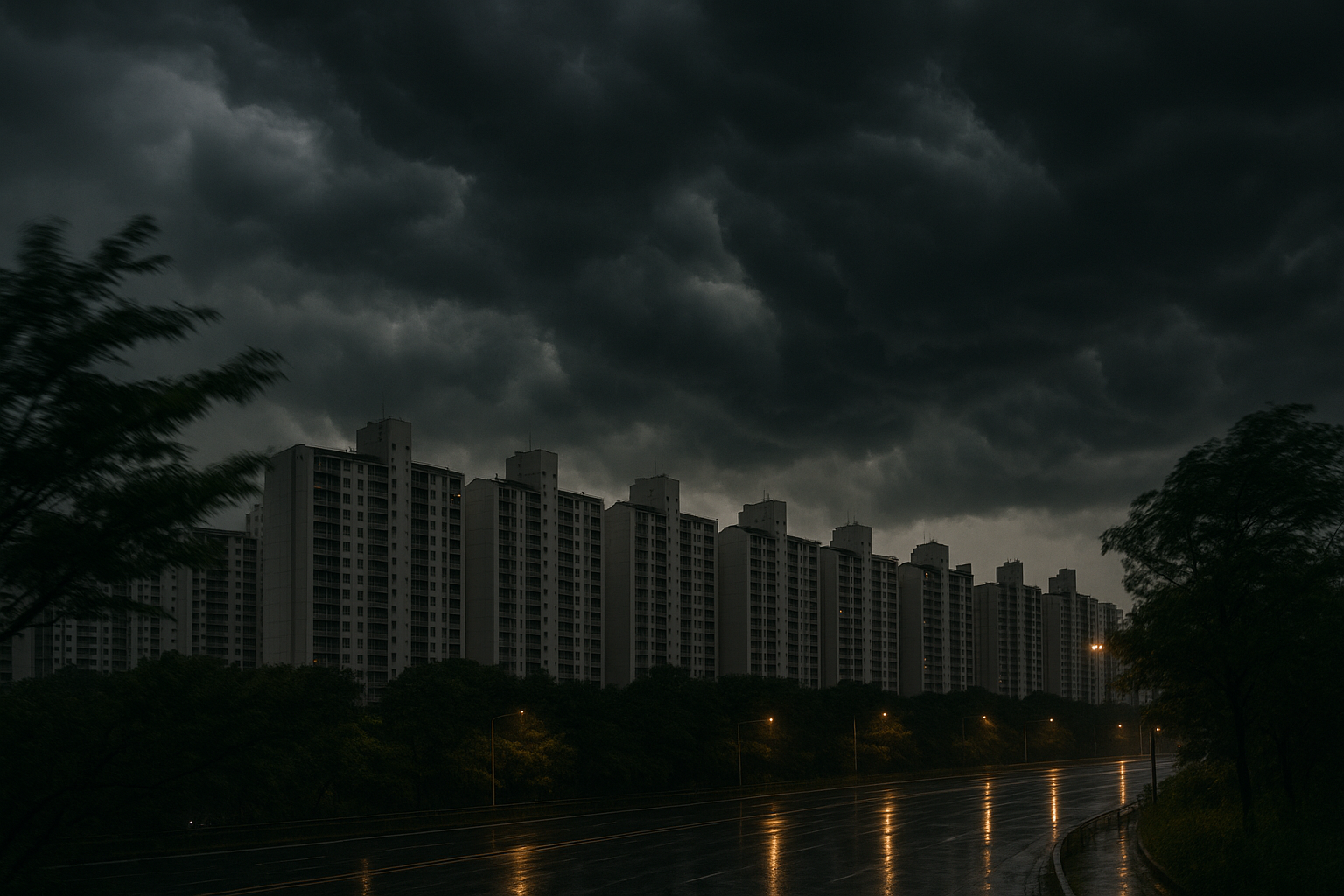
The first sound was a siren, not a ringtone. I was standing at the stove flipping gyeranmari for my daughter’s lunchbox at 6:40 in the morning when my phone erupted with that flat, blaring emergency tone — the one that overrides silent mode, overrides Do Not Disturb, overrides whatever gentle notification settings you thought you’d configured. My wife didn’t even look up from the rice cooker. “태풍,” she said. Typhoon. She’d already known, of course, because the neighborhood broadcast had gone out the night before and half our apartment complex’s balconies were suddenly empty of the flowerpots and drying racks that normally clutter them. I was the only one in the building who hadn’t gotten the memo, and the memo, as it turns out, is a very specific piece of Korean summer culture that nobody hands you when you move here. You just learn it, one blaring alert at a time.
The Alert That Doesn’t Ask Permission
The message itself is called a 재난문자 (jaenan-munja, “disaster text”) or, in its friendlier official branding, 안전안내문자 (anjeon-annae-munja, “safety guidance text”). It’s a cell-broadcast system, not a regular SMS, which is why it can blast through phone settings that would normally silence everything else. Local governments — the district or city office, not the weather agency directly — send these out once the Korea Meteorological Administration issues a typhoon watch or warning for that area. During peak season you might get three or four in a single day: one when the advisory is upgraded, one telling you to avoid riverside paths and underground spaces, one when a specific bridge or road closes, one when it’s finally downgraded and life can resume.
Since February 2024, these alerts have started including a few English keywords alongside the Korean — things like “Heavy Rain Warning” tagged onto the message — which helps if you’re still building your vocabulary. But the bulk of the text is still Korean, dense with administrative phrasing, and the first few times I got one I just squinted at it and waited to see what everyone else was doing. That’s honestly not a bad strategy. Watch the ajummas at the market. If they’re closing up early, you should probably head home too.
What the Apartment Complex Does Without Being Asked
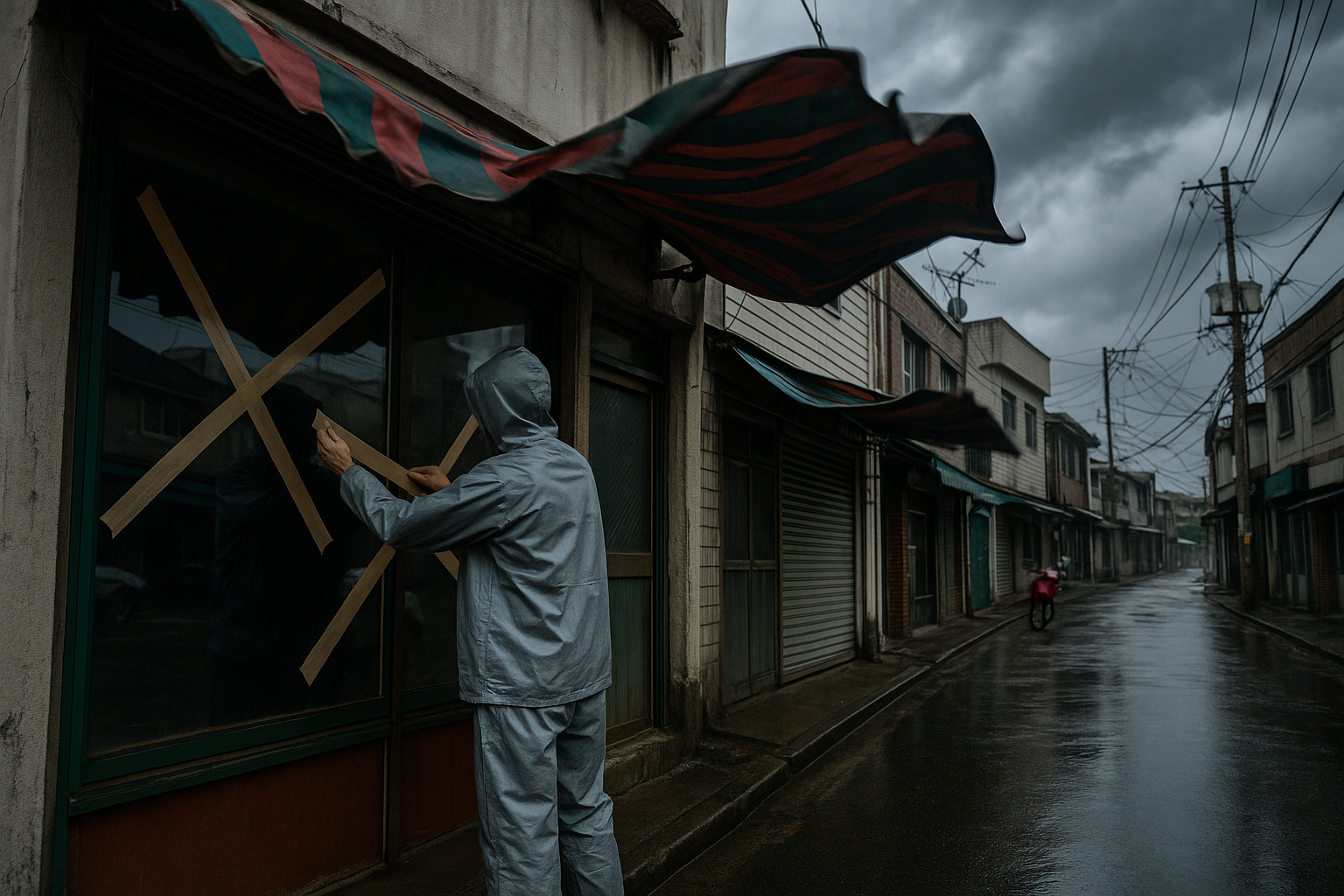
Korean apartment complexes run on an internal PA system that most residents only really notice during typhoon season. A voice — usually the building manager or someone from the 관리사무소 (management office) — comes over the speakers in the stairwells and parking garages announcing that a typhoon is approaching and residents should move cars out of low-lying or underground parking, secure anything sitting on a balcony, and stay away from windows during peak winds. It’s not optional-sounding advice; it’s closer to a standing instruction, and most people follow it without complaint because everyone remembers the year a flowerpot went through somebody’s windshield three floors down.
Low-lying neighborhoods and areas near rivers get sandbags stacked at entrances and underground parking ramps days in advance. Construction sites take down cranes or lock them into a “weathervaning” position so the wind can’t catch them broadside. None of this is dramatic in the moment — it’s closer to a citywide checklist quietly being worked through — but if you’ve lived through even one real approach, like Typhoon Hinnamnor in September 2022, you notice how fast an entire city can shift into preparation mode. Jeju’s ferries stopped running, flights were grounded, and schools across the southern coast closed or switched to remote learning almost overnight.
School Closes, But Not the Way You’d Expect
This is the part that catches a lot of foreign parents off guard. Korean schools have a mechanism called 재량휴업일 (discretionary closure day), which lets individual schools cancel classes or shift to remote learning when conditions in their specific district warrant it — a typhoon bearing down is a textbook case. It’s not a nationwide snow-day announcement; it’s decided school by school, sometimes hagwon by hagwon too, based on the local forecast and how exposed the area is. So my daughter’s elementary school might close while a school two subway stops away stays open, because the wind and rain forecasts for those two neighborhoods genuinely differ. The decision usually comes the evening before or very early that morning, which means typhoon season turns you into someone who checks the school’s parent app compulsively at 6 a.m.
The Convenience Store Knows Before You Do
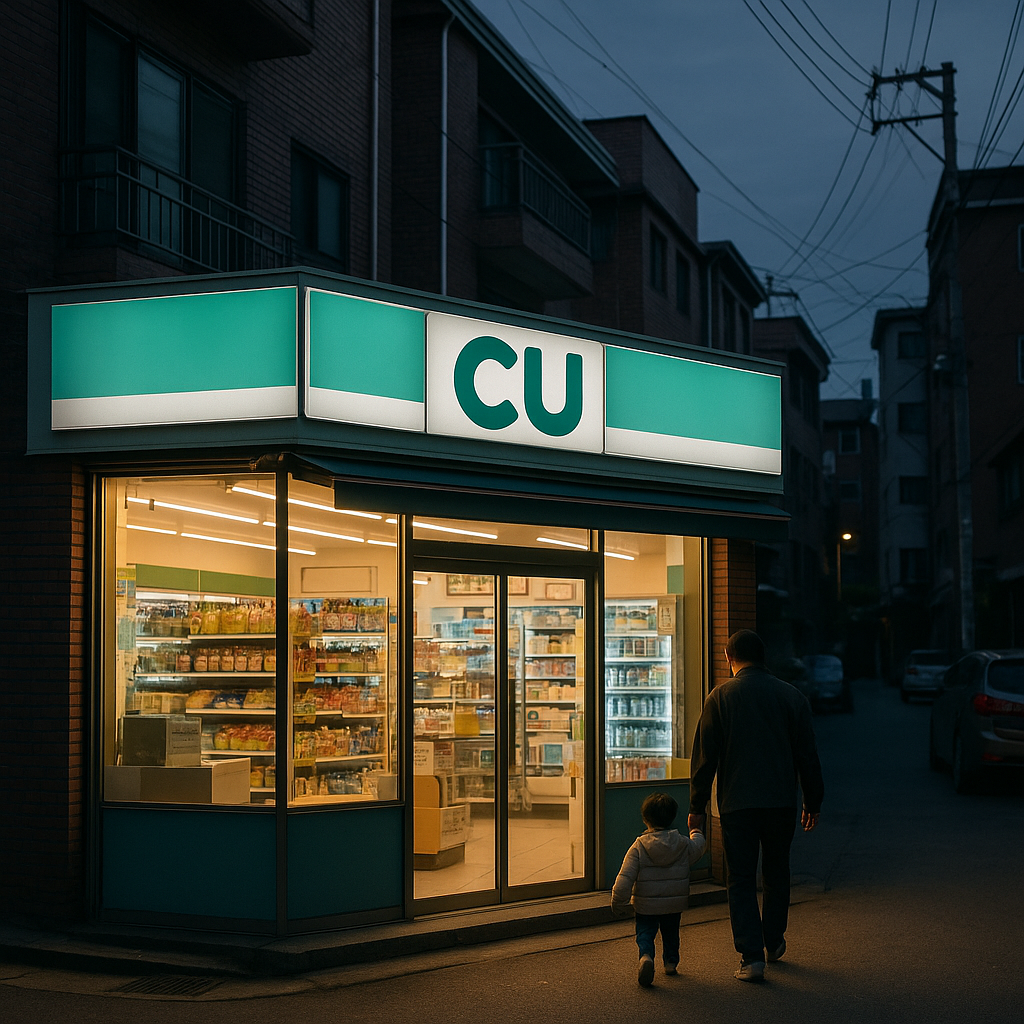
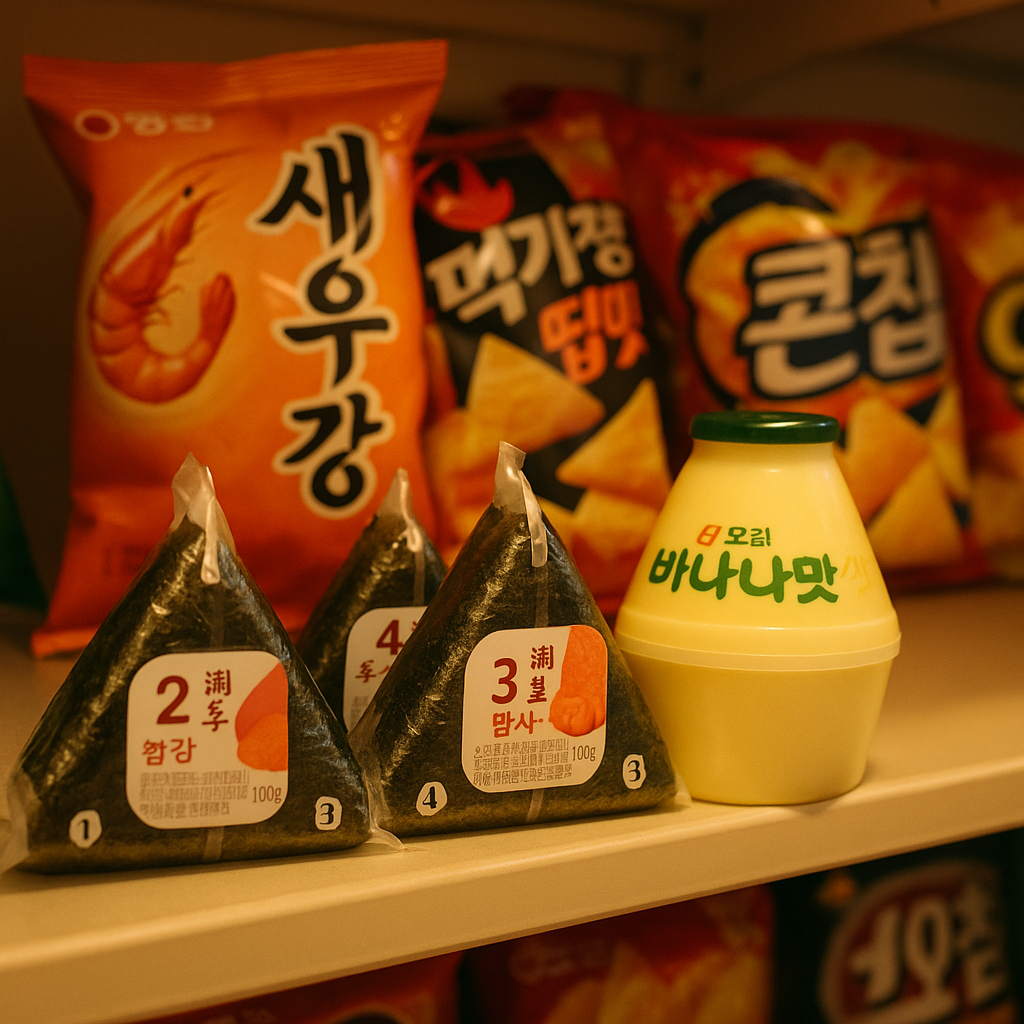
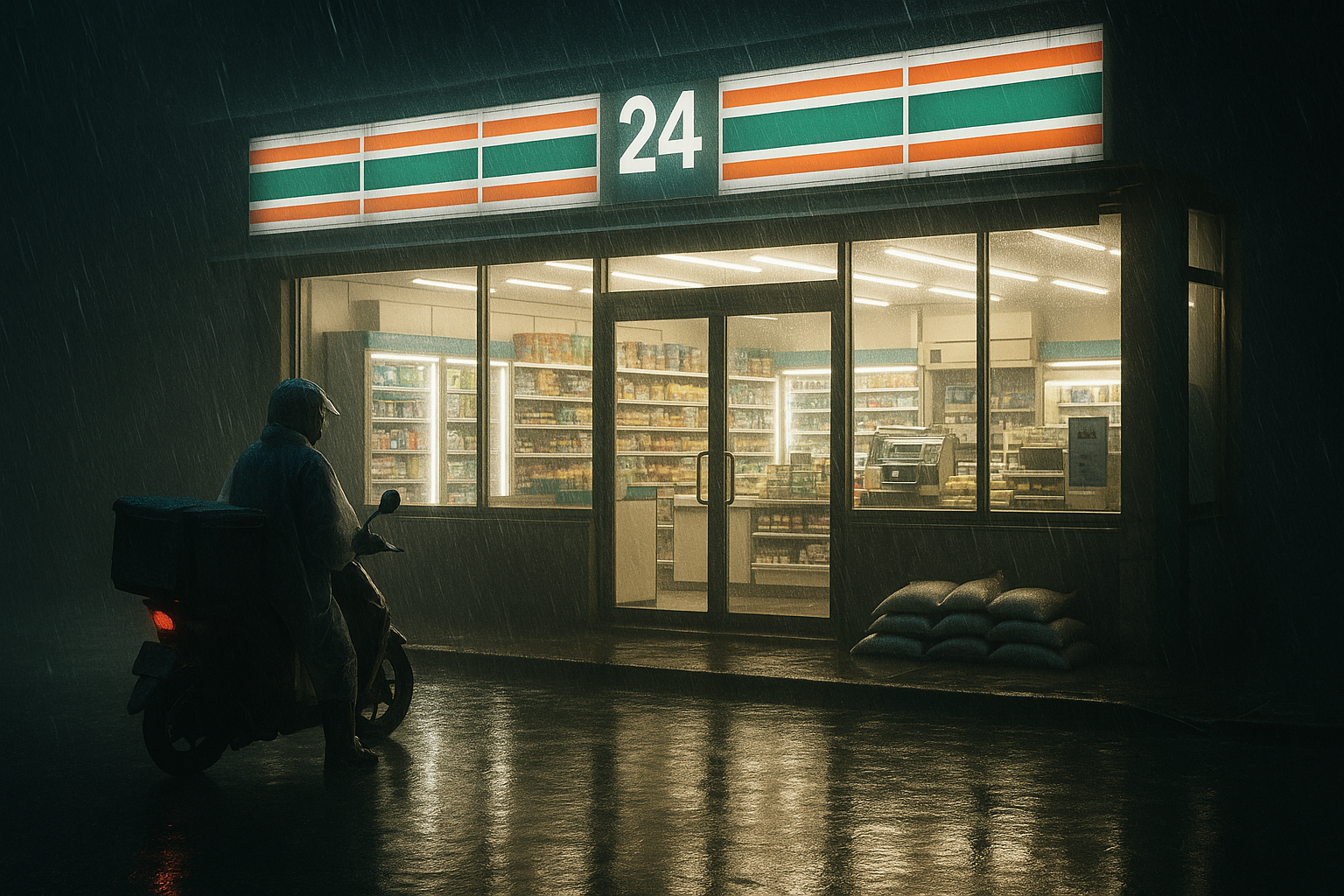
You can read a typhoon’s approach in the shelves of your neighborhood GS25 or CU almost as reliably as you can read it in the sky. A day or two out, the instant noodle shelf thins, bottled water disappears, and the little rack of flashlights and batteries near the register — usually ignored — gets picked over. Delivery riders, who are normally weaving through every kind of weather without hesitation, start thinning out too; food delivery apps will actually pause dispatch in the worst wind conditions for rider safety, something that would have been unthinkable to me before I saw it happen. The store itself stays open, because in Korea a 24-hour convenience store closing is treated almost like a minor emergency in its own right, but the energy around it changes — more people moving with purpose, fewer people lingering over the ramen cooker by the window.
Names Like Kirogi and Doksuri
One of my favorite oddities of typhoon season is the naming system. Unlike the Atlantic hurricane list, which recycles Western first names, Pacific typhoons draw from a shared pool of 140 names contributed by fourteen countries around the region — Korea, Japan, China, the Philippines, Vietnam, and others each supply ten. Korea’s contributions tend to be plain, almost storybook Korean nouns: Kirogi (wild goose), Nari (lily), Mirinae (galaxy), Gaemi (ant). It’s a strange thing to watch the news describe a monster storm system using a word that means “ant,” but that’s the charm of it — the naming list was built for clear communication across languages, not drama, and a name only gets permanently retired from rotation if the storm attached to it caused catastrophic damage.
What We Actually Keep Ready at Home
After a few Augusts here, our typhoon prep has become fairly boring and routine, which I think is the goal. We keep a headlamp and a few candles in a kitchen drawer, fill a couple of bottles with tap water the night before a bad one is forecast, and make sure the balcony drain isn’t clogged with leaves — a clogged drain during a real downpour is how water backs up into the apartment, and it happens more often than you’d think in older buildings. We bring in anything that could catch wind, charge devices in advance in case of a brief outage, and otherwise just wait it out watching the trees outside bend sideways. Korea’s four-tier typhoon classification — normal, strong, very strong, and super strong, based on wind speed — gives you a rough sense of how seriously to take a given system, and honestly most of what reaches central Seoul lands in the “very windy, very wet, mildly inconvenient” category rather than genuine disaster. The coast and the south get the worst of it far more often than we do.
Frequently Asked Questions
- Do typhoons actually hit Seoul, or is it mostly a southern coast thing? Seoul usually gets the tail end — heavy rain, strong gusts, the occasional flooded underpass — while the most severe wind damage tends to land on the southern coast and Jeju Island first. That said, “usually” isn’t “always,” so it’s still worth paying attention to every alert rather than assuming the capital is exempt.
- What should I actually keep at home if I’m new to Korea and typhoon season is coming? A headlamp or flashlight, a few days of bottled water, a portable battery pack, and anything on a balcony or windowsill brought indoors. Most apartments won’t lose power, but it’s a cheap, low-effort habit that costs you almost nothing to keep up.
- My kid’s school sent a message about 재량휴업일 — does that mean class is cancelled? It usually means either a full closure or a shift to remote learning for that day, decided by the individual school based on local forecasts. Check the school’s parent messaging app for the specific instructions, since the exact format varies by school.
None of this is especially cinematic, and I think that’s the point worth passing on. Korean typhoon season isn’t a disaster movie — it’s a well-rehearsed, mildly annoying seasonal routine that a whole country quietly runs through every August and September, from the alert on your phone down to the sandbags by the parking garage. You get used to it. You even start reading the convenience store shelves like a weather report.